Have one like this? Check yours freeOr have an appraiser value it
Lot description
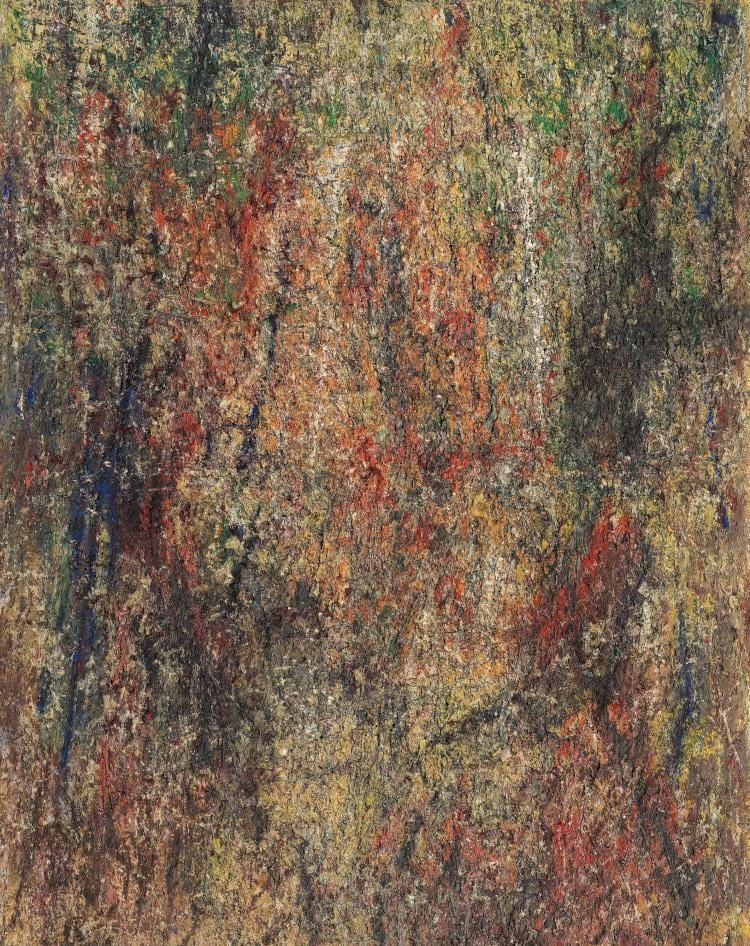
FRANÇOIS FIEDLER (Kosice 1921 - 2001 Saint-Germain-Laval) Untitled. 1959. Oil on canvas. Signed and dated on the reverse: Fiedler 24 décembre 1959. 160 x 130 cm. Provenance: Private collection Switzerland. “Miró encouraged me and introduced me to the world of calligraphy and gesture painting. He encouraged me to set my unconscious free. There are neither principles nor rules. You cannot deceive art; I feel deep respect for it: you cannot deceive that which emerges from the unconscious”. François Fiedler Born in Hungary, the young François Fiedler began painting at the age of 5 and by the age of 10 he was already copying the greatest masterpieces. His works were shown in public exhibitions and competitions and were acquired by Hungarian state institutions such as the Municipal Gallery and the Museum of Fine Arts in Budapest. After completing a classical training at the Hungarian Academy of Arts in Budapest, in 1945 he moved to Paris, where he got by with small commissions, making copies of paintings for museums. Very soon François Fiedler discovered abstract painting and was tireless in his study of its multifarious forms and techniques. In those first months after the war, group and solo shows were organised, including the Salon des Réalités Nouvelles and the Salon de Mai. In 1946 Joan Miró discovered a canvas by Fiedler in a small gallery and was impressed by his accomplished style as well as his innovative spirit of freedom and curiosity and decided to introduce him to the art dealer Aimé Maeght. This was the beginning of a successful 25-year collaboration. Maeght ensured that he was represented in a large number of exhibitions and was presented amongst the most important artists of the 20th century. Alongside painting, Fiedler also experimented with etching techniques and from 1954 to 1977 no fewer than four issues of the magazine “Derrière le Miroir” were dedicated entirely to him. The present painting is reminiscent of the work of the American Abstract Expressionist Jackson Pollock, whose unique technique had inspired Fiedler. Like Pollock, Fiedler allowed himself to be guided by spontaneity, for the work to be initiated, for it to develop and take shape until a complete unity emerged. François Fiedler’s works have something sculptural about them, they harbour a powerful depth, through the dense overlaying of strokes and layers of paint. The layer of paint is tightly packed with only a few gaps as far as the primer. The viewer stands before what seems like a solid whirlwind, produced by the power of painterly skill. The artist often had his large format canvases dry outside in the open air, knowing that the wind and dust could leave their traces. The thick layers of paint applied in quick succession, crucially favoured the formation of early surface cracks. There is a deliberate rawness as a consequence (Lots 3406 and 3413). Fiedler distinguishes his canvases by having lasso-shaped lines float over almost monochrome backgrounds. Some of the lines are closed, while others extend over the edge of the canvas. With these clearly defined lines, Fiedler produces a harmonious yet lively spontaneity. François Fiedler’s works are present in important museums and galleries, including the Fondation Maeght in Paris and the Guggenheim Museum in New York. --------------- FRANÇOIS FIEDLER (Kosice 1921 - 2001 Saint-Germain-Laval) Ohne Titel. 1959. Öl auf Leinwand. Verso signiert und datiert: Fiedler 24 décembre 1959. 160 x 130 cm. Provenienz: Privatsammlung Schweiz. „Miró encouraged me and introduced me to the world of calligraphy and gesture painting. He encouraged me to set my unconscious free. There are neither principles nor rules. You cannot deceive art; I feel deep respect for it: you cannot deceive that which emerges from the unconscious”. François Fiedler In Ungarn geboren, beginnt der junge François Fiedler im Alter von 5 Jahren zu malen, und mit 10 Jahren kopiert er bereits die grössten Meisterwerke. Seine Bilder werden im Rahmen von Ausstellungen und Wettbewerben öffentlich gezeigt und von ungarischen Staatsinstitutionen wie der Municipal Gallery oder dem Museum of Fine Arts in Budapest erworben. Nachdem er eine klassische Ausbildung an der ungarischen Akademie der Künste in Budapest abschliesst, zieht er 1945 nach Paris, wo er sich zunächst mit kleinen Aufträgen zurechtfindet, indem er für Museen Kopien von Gemälden erstellt. Recht schnell entdeckt François Fiedler für sich die abstrakte Malerei, deren vielseitige Formen und Techniken er erkundet. In diesen ersten Nachkriegsmonaten werden Gruppen- und Einzelausstellungen organisiert, unter anderem im Salon des Réalités Nouvelles oder im Salon de Mai. Joan Miró entdeckt 1946 eine Leinwand von Fiedler in einer kleinen Galerie und ist von seinem meisterhaften Duktus sowie von seinem innovativen Freigeist und seiner Neugierde beeindruckt. Er beschliesst, ihn mit dem Kunsthändler Aimé Maeght bekannt zu machen. Dies ist der Anfang einer 25-jährigen erfolgreichen Zusammenarbeit. Maeght sorgt dafür, dass er in einer grossen Anzahl von Ausstellungen vertreten ist und immer unter den wichtigsten Künstlern des 20. Jahrhundert präsentiert wird. Neben der Malerei experimentiert Fiedler auch mit Techniken der Radierung, von 1954 bis 1977 sind ihm nicht weniger als vier Nummern der Zeitschrift „Derrière le Miroir“ vollständig gewidmet. Das vorliegende Gemälde lässt an den US-amerikanischen Abstrakten Expressionisten Jackson Pollock denken, dessen einzigartige Technik Fiedler inspiriert hat. Ähnlich wie bei Pollock, lässt sich Fiedler durch Spontaneität leiten. Um ein Werk zu schaffen, entwickelt und formt es, bis eine vollständige Einheit entsteht. François Fiedlers Werke haben etwas Skulpturales, sie verbergen eine kraftvolle Tiefe durch diese dichten, übereinander aufgetragenen Farbstriche oder -schichten. Die Malschicht ist mit nur wenigen Aussparungen bis auf die Grundierung geschlossen. Der Betrachter steht wie vor einem stabilen Wirbelwind, welcher durch die Kraft des malerischen Könnens erzeugt wird. Der Künstler lässt seine grossdimensionalen Leinwände oftmals draussen in der Natur trocknen, wohl wissend, dass Wind- und Staubspuren hinterlassen werden können. Durch die dicken Farbschichten, die in schneller Abfolge übereinander gelegt worden sind, wird die Entstehung von Frühschwundrissen entscheidend begünstigt. Eine absichtliche Rauheit entsteht (Lose 3406 und 3413). Fiedler charakterisiert seine Leinwände, indem er Lasso-förmige Linien über den fast monochromen Hintergründen schweben lässt. Manche Seilenden schliessen sich, andere gehen über die Leinwandkante hinaus. Fiedler erzeugt durch diese klar definierten Linien eine harmonische, dennoch bewegte Spontaneität. François Fiedlers Werke sind in wichtigen musealen Institutionen und Galerien vertreten, unter anderem in der Fondation Maeght in Paris oder im Guggenheim Museum in New York.