Have one like this? Check yours freeOr have an appraiser value it
Lot description
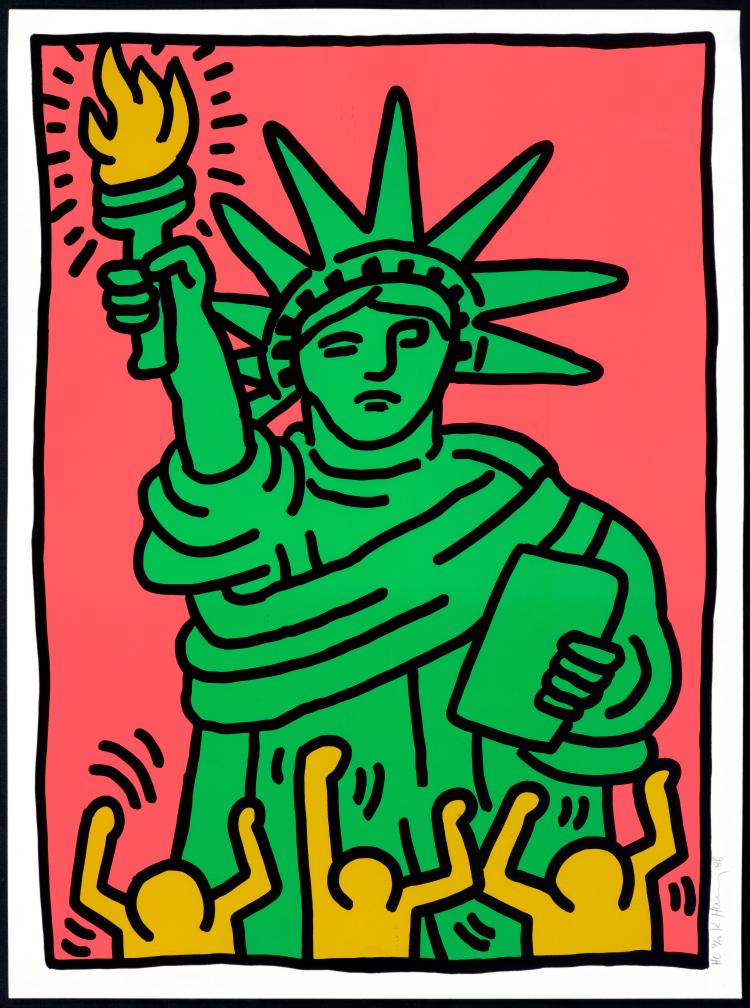
KEITH HARING (Reading 1958 - 1990 New York) Statue of Liberty. 1986. Colour screenprint. H.C. 4/10, hors commerce outside the edition of 100. Signed and dated in pencil in the right margin: K. Haring '86. Image 91.1 x 66 cm on wove paper 96.3 x 71.6 cm. Printed by Rupert Jasen Smith (with the blindstamp). Provenance: - Martin Lawrence Limited Editions, USA. - Purchased from the above by the present owner in 1996, since then private collection Southern Germany. Catalogue raisonné: Littmann, p. 63. Keith Haring was born in Reading, Pennsylvania in 1958 and learned to draw at an early age. Through his father, an engineer and amateur caricaturist, he soon discovered a fondness for cartoons. He quickly cut short his studies at the Ivy School of Professional Art in Pittsburgh, as he did not want to pursue a career as a commercial graphic artist. By then certain that he wanted to devote himself entirely to his art, he moved to New York in 1978 and enrolled at the School for Visual Arts. In New York Haring encountered a flourishing art scene, and through his studies he became familiar with the works of Andy Warhol, Jean Dubuffet, Stuart David, Kenny Scharf, Jackson Pollock, Paul Klee, Mark Tobey and others. Although in his studies he experimented with performance art, video and other media, drawing remained his primary medium. In the early 1980s he used the blackboards in the subway in order to draw ceaselessly. These “Subway drawings” helped him to process his thoughts and ideas. In 1981 Haring exhibited on his own for the first time at the Wesbeth Painters Space and in 1982 there was a solo show at the Tony Shafrazi Gallery in New York. At the same time, he took part in Documenta 7 in Kassel, the Sao Paulo Biennale and the Whitney Biennale. The highest recognition value goes to the pictograms, with which Haring’s oeuvre is associated, and which he filled with his typical style. With the use only of the line, he developed and imagined everything from the individual details of the figures to the large narrative cycles. His figures, rendered in a lively and striking range of colours, appear if anything humorous, cute and smart and are reduced to a pithy essential gesture. His artistic messages were above all the testimony of a generation that symbolised for many the America of the 1980s. For with the simplest pictorial motifs Keith Haring reacted and confronted his epoch directly and reflected it: in the motif of the figure surrounded with rays (Lot 3679 or Lot 3682), the dog with rays, the UFOs, cultural symbols of the USA, as well the many drawings in which he centred on the theme of his own sexuality and repeatedly seized on art as a life-giving power. Having been diagnosed with AIDS in 1988, in the following year he set up the Keith Haring Foundation, which gave financing and art material to AIDS Organisations as well as initiating programs for children. He also devoted himself to broadening his audience with exhibitions, publications and licensing of his paintings. He used many of his late works for AIDS awareness. His paintings campaigned against AIDS for UNICEF, against Apartheid in South Africa, against illiteracy and drug abuse. Time and again children were at the centre of his endeavours. The conscious and targeted marketing of his art with merchandise which was sold in his Pop Shops first in New York and Tokyo, furthered the worldwide popularity and diffusion of his style. The oeuvre which Keith Haring left behind with his death at the age of just 31 is as extensive as it is diverse. It includes paintings, drawings, sculptures, murals and stage sets, painted objects and countless temporary works as well as T-shirt motifs and posters. --------------- KEITH HARING (Reading 1958 - 1990 New York) Statue of Liberty. 1986. Farbserigrafie. H.C. 4/10, hors commerce ausserhalb einer Auflage von 100. Am rechten Seitenrand mit Bleistift signiert und datiert: K. Haring '86. Darstellung 91,1 x 66 cm auf Vélin 96,3 x 71,6 cm. Gedruckt bei Rupert Jasen Smith (mit dem Blindstempel). Provenienz: - Martin Lawrence Limited Editions, USA. - Bei obiger Galerie vom heutigen Besitzer 1996 erworben, seitdem Privatsammlung Süddeutschland. Werkverzeichnis: Littmann, S. 63. Keith Haring wird 1958 in Reading/Pennsylvania geboren und lernt bereits früh zu zeichnen. Durch seinen Vater, einen Ingenieur und Amateur-Karikaturist, findet er Gefallen an Cartoons. Sein Studium an der Ivy School of Professional Art in Pittsburgh bricht er schnell ab, da er keiner Karriere als kommerzieller Grafiker nachgehen möchte. Nun sicher, dass er sich ganz seiner Kunst verpflichten will, zieht er 1978 nach New York und schreibt sich an der School for Visual Arts ein. In New York trifft Haring auf eine blühende Kunstszene, und über seine Studien macht er sich mit den Werken von Andy Warhol, Jean Dubuffet, Stuart David, Kenny Scharf, Jackson Pollock, Paul Klee, Mark Tobey und anderen vertraut. Auch wenn er im Studium mit Performance Kunst, Video und anderen Medien experimentiert, so bleibt die Zeichnung sein primäres Medium. In den frühen 1980er Jahren nutzt er die schwarzen Tafeln in der U-Bahn, um unablässig zu zeichnen. Diese „Subway drawings“ helfen ihm, Gedanken und Ideen zu verarbeiten. 1981 stellt Haring erstmals allein im Wesbeth Painters Space aus, 1982 folgt eine Einzelausstellung bei Tony Shafrazi in New York. Gleichzeitig nimmt er an der documenta 7 in Kassel, der Sao Paulo Biennale und der Whitney Biennale teil. Der höchste Wiedererkennungswert, mit dem man Harings Oeuvre verbindet, ist das Genre des Piktogramms, welches er mit seinem typischen Strich besetzt. Durch die ausschliessliche Verwendung der Linie entwickelt und imaginiert er jede einzelne der Bildfiguren hin bis zu grossen Erzählzyklen. Seine Gestalten, in einer lebendigen und fast plakativen Farbigkeit, wirken humorvoll, aufgeweckt und pfiffig, indem sie auf eine knappe Gestik reduziert werden. Seine künstlerische Botschaft ist vor allem auch Zeugniss einer Generation geworden, die für viele das Amerika der 1980er Jahre symbolisiert. Denn mit seinen einfachen Bildmotiven reagiert und setzt sich Keith Haring mit seiner Epoche direkt auseinander und spiegelt diese wider: in der Figur des verstrahlten Menschen (Lot 3679 oder Lot 3682), des verstrahlten Hundes, der fliegenden Ufos, Kultursymbole der USA, sowie die vielen Zeichnungen, in denen er thematisch um seine eigene Sexualität kreist und immer wieder Kunst als lebensspendende Kraft begreift. Nachdem er 1988 mit AIDS diagnostiziert wird, gründet er im darauf folgenden Jahr die Keith Haring Foundation, die Finanzierung und Bildmaterial an AIDS Organisationen gibt sowie Programme für Kinder initiert. Auch widmet sie sich der Erweiterung des Publikums für seine Werke durch Ausstellungen, Publikationen und der Lizenzierung seiner Bilder. Viele seiner späten Arbeiten nutzt er, um auf AIDS aufmerksam zu machen. Für UNICEF malt er gegen AIDS, die Apartheid in Südafrika, Analphabetentum und Drogenmissbrauch. Immer wieder stehen Kinder im Zentrum seiner Bemühungen. Die bewusste und gezielte Vermarktung seiner Kunst über Merchandisingprodukte, die in seinen Pop-Shops zunächst in New York und Tokio verkauft wurden, förderten zudem die weltweite Beliebtheit und Verbreitung seines Stils. Das Oeuvre, das Keith Haring mit seinem Tod im Alter von nur 31 Jahren hinterlässt, ist so umfangreich wie vielfältig. Es umfasst Gemälde, Zeichnungen, Skulpturen, aber auch Wand und Bühnenbilder, bemalte Objekte sowie unzählige temporäre Arbeiten, T-Shirt-Motive und Plakate.