Have one like this?
Upload a photo for a free check of what yours may be worth.
Lot description
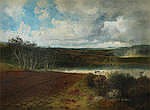
John Wright Oakes (British, 1820-1887) The Fallow Field 'The building rook 'ill caw from the windy tall elm tree, And the tufted plover pipe along the fallow lea.' signed and dated 'JWOakes/75' (lower left) oil on canvas 123 x 167.5cm (48 7/16 x 65 15/16in). Footnotes Provenance Private collection, The Netherlands. Exhibited London, Royal Academy, 1875, no. 481. John Wright Oakes was born in Cheshire and studied in Liverpool, exhibiting at the Liverpool Academy from 1839. He began to paint from nature and when he moved to London in 1859, he was associated with the Pre-Raphaelite movement. Later his large landscapes of Wales and northern England, were more closely aligned with the works of George Vicat Cole and Benjamin Williams Leader. Oakes achieved considerable success, as well as exhibiting in Glasgow, Liverpool and Manchester, he also exhibited 90 paintings at the Royal Academy, 28 at the British Institute and 11 at the Royal Society of British Artists. He was made an Associate of the Royal Academy in 1876, a year after the present lot was exhibited. A review of the Royal Academy show from 1875 read as follows, 'After speaking of a work, clever, but dull and sad as a subject, it was said, "Let us get into the open, and breathe a less tainted atmosphere. Here we are, happily, in The Fallow Field of J. W. Oakes, one of the best landscapes he ever painted, and one of the best, too, in the present exhibition. The fallow field runs down to a piece of water in the middle distance, which is dominated in the distance by low, pleasant hills"... The freshness of the spring-time was never better expressed on canvas...Mr. Oakes is all brightness and crispness."υ1 The Fallow Field is both haunting and poetic. The ploughed field leads the viewer's gaze into the scene and is flanked by detailed foliage to the right and tall elm trees on the left. Oakes' association with the Pre-Raphaelite society and his interest in working outdoors, is evident in this large oil, celebrating the glory of nature. υ1 James Dafforne, British Painters, John Wright Oakes, A.R.A, 'The Art Journal', vol V, 1879, p. 324.