Have one like this?
Upload a photo for a free check of what yours may be worth.
Lot description
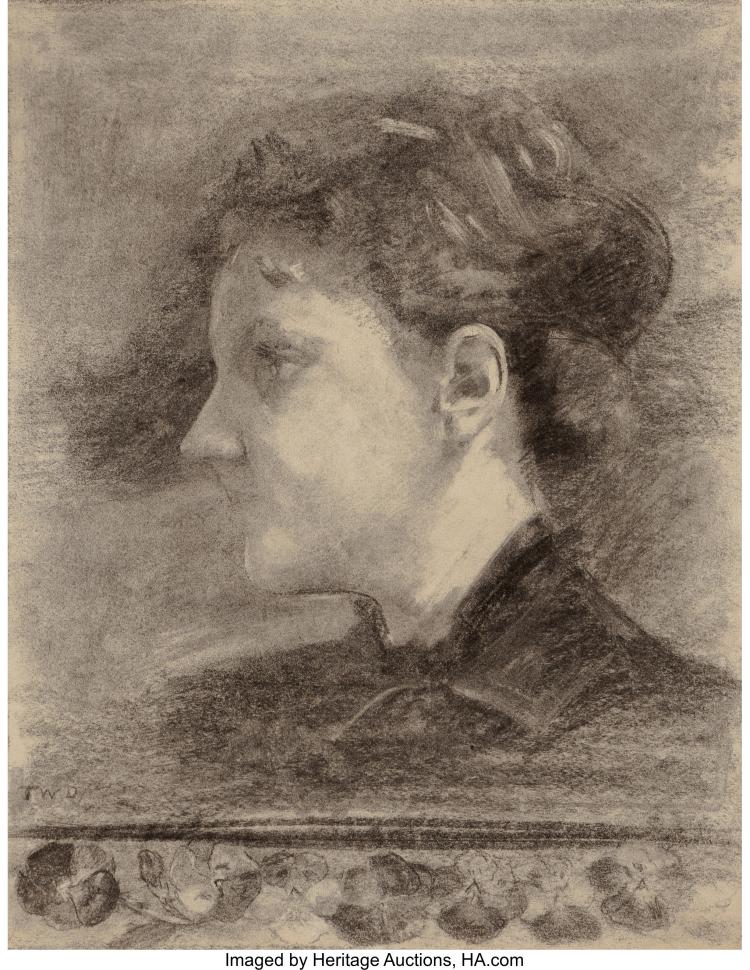
Thomas Wilmer Dewing (American, 1851-1938) Pansy Cotton (Mariette Benedict Cotton) Charcoal and pencil on paper 17-3/4 x 14 inches (45.1 x 35.6 cm) (sheet) Initialed lower left: TWD PROVENANCE: Mariette Benedict (Mrs. Leslie Cotton), by mid-1880s; Hugh Cotton, son of the above, Schenectady, New York, by descent; Hugh Cotton, Jr., son of the above, Olympia, Washington, by descent; Estate of the above; David Schaff, Ltd., Mendenhall, Pennsylvania; Jill New House, New York; Hollis Taggart Galleries, New York; [With]Adelson Galleries, Inc., New York; Private collection, Massachusetts. EXHIBITED: Adelson Galleries, New York, "Light Impressions: American Works on Paper, 1875-1925," May 9-June 30, 2006, no. 34. LITERATURE: Adelson Galleries, Light Impressions: American Works on Paper, 1875-1925, exhibition catalogue, New York, 2006, p. 43. no. 34, illustrated. Dewing Scholar Dr. Susan A. Hobbes writes: During the mid-1870s Thomas Wilmer Dewing became known for his meticulous black-and-white charcoal portraits. His virtuosity in the medium followed a tradition established in Boston by Charles A. Barry and Samuel Worcester Rowse. These drawings were noted for a fine, realistic modeling that portrayed with care the features of the sitters. This portrait of Mariette Benedict Cotton, however, shows the impact on Dewing of a later influence--that of the English Aesthetic movement. The painters of this movement utilized shallow, foreground, stage-like settings for profile poses against intricate, patterned surfaces. "Dewing, similarly, employed a shallow, friezelike composition in this expressive and contemplative portrait. He silhouetted the young Mariette against a drapery, the folds of which provide a shimmering surface against which he etched her carefully defined form. A strip of pansies along the lower margin of the drawing reasserts the two-dimensional character of the drawing, further emphasizing the decorative quality of the work. The flowers also cleverly refer to Mariette herself, who was known to friends as "Pansy." Dewing obviously knew her by this nickname. In 1883 Mariette traveled from Schenectady, N.Y. to New York City where she became his student at the Art Students League; she was just sixteen years old. The next winter she worked in Paris under Carolus-Duran. Later she spent a winter in Dennis Bunker's studio in Boston, and subsequently, two more winters in New York where she studied under Abbott Handerson Thayer and William Merritt Chase. "In a well-known article, Chase vividly recounted his first meeting with Mariette Benedict Cotton. The young woman had come to his Tenth Street studio to present herself as a prospective pupil but, as Chase remembered, " I saw her only as a splendid model." She agreed to sit for him, and Chase painted all day and into the evening without stopping. ** The result was his famed Lady in Black (Metropolitan Museum of Art). The artist was so inspired by this new model, whom he considered a "treasure find," that he went on to paint her as Lady in Pink (Museum of the Rhode Island School of Design, 1888-89). Mariette Benedict Cotton's distinctive profile, shadowed eyes and dainty mouth are readily apparent in the Chase portrait. Dewing also emphasized these features in his portrait of the young woman. "When he portrayed her, however, Dewing introduced a quality of elusiveness. Shadows play fleetingly across Mariette's face, merging her profile into the drapery behind her. The result is a suggestive, intimate view of the young woman. This effect is derived in part from a calculated use of emphasis and subordination, for with a subtle play of dark and light, Dewing obscured certain features (such as lips, forehead, and chin) and highlighted others (the round cheek and ear). Lady in Yellow, Harmony in Rose and Gray and Lady in Blue, all pastels from the mid-1890s in the 1996 Dewing retrospective, similarly demonstrate the artist's penchant for casting portions of the face, such as the mouth, into shadow. "According to an 1892 article by the critic Mariana G. Van Rennselaer, Mariette Benedict married her fellow artist Leslie Cotton in about 1889.† She continued to paint after which she took a studio in Munich. She had first exhibited at the Paris Salon in 1889, winning honorable mention for a portrait; subsequently when she exhibited at the Royal Academy in London critics praised her portrait of a well-known Boston Brahmin. Van Rennselaer fully expected Mariette Benedict Cotton to become a favorite portrait painter with a 'fine clientele,' due to the 'vitality' of her work. This vitality may have derived in part from her own liveliness, for according to Chase, Mariette Benedict Cotton possessed a 'vivid personality.' "Dewing's paintings and pastels most often portray women whose intelligence gave them presence and stature. In this drawing, one that is intimate and personal in its close-up view of the sitter, Dewing seems to have paid tribute to Mariette Cotton's talent as well as to her delicate profile." This work will be included in Dr. Susan A. Hobbs' forthcoming Thomas Wilmer Dewing Catalogue Raisonné. HID04901242017