Lot description
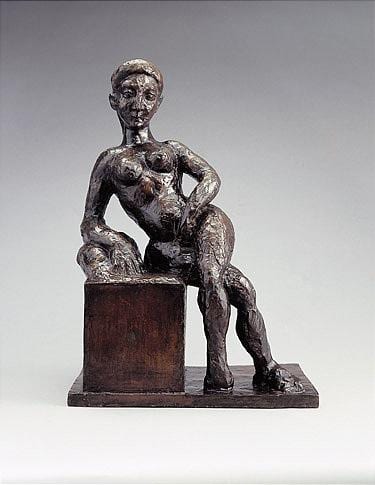
HENRI MATISSE 1869-1954 FIGURE DECORATIVE Signed H.M., stamped with the foundry mark C. Valsuani cire perdue, and numbered 8 Bronze, rich brown patina with gold highlights Height 28 7/8 in. 73.3 cm. Conceived in Paris in August 1908 and cast in 1952. Provenance Pierre Matisse Gallery, New York Acquired from the above by the present owner on November 15, 1966 Literature Alfred H. Barr, Jr., Matisse, His Art and His Public, New York, 1951, illustration of another cast p. 327 An Exhibition of the Sculpture of Matisse and Three Paintings with Studies (exhibition catalogue), Tate Gallery, London, 1953, no. 25, listed p. 12 Matisse, Sculptures, Paintings, Drawings (exhibition catalogue), Museum of Fine Arts, Houston; Museum, of Fine Arts, Boston, 1955, no. 24, listed Henri Matisse, Das Plastische Werk (exhibition catalogue), Kunsthaus, Zurich, 1959, no. 33, illustration of another cast p. 14 Kunst von 1900 bis Heute (exhibition catalogue), Museum des 20. Jahrhunderts, Vienna, 1962, no. 41, Modern Sculpture from the Joseph H. Hirshhorn Collection (exhibition catalogue), The Solomon R. Guggenheim Museum, New York, 1962-63, no. 291, illustrations of another cast pp. 78-79 Moderne skulptur, dansk og udenlandsk (exhibition catalogue), Ny Carlsberg Glyptotek, Copenhagen, 1964, no. 701a, catalogued p. 132 Herbert Read, The Concise History of Modern Sculpture, New York, 1964, fig. 27, illustration of another cast p. 35 Herbert Read, "The Sculpture of Matisse," Henri Matisse (exhibition catalogue), UCLA Art Galleries; The Art Institute of Chicago; Museum of Fine Arts, Boston, 1966, no. 110, illustration of another cast p. 129 Henry H. Arnason, History of Modern Art, Painting, Sculpture, Architecture, New York, 1968, illustration of another cast pl. 178 Jean Laude, La Peinture franAaise, Paris, 1968, illustration of another cast fig. 40 Hanne Finsen, Matisse, en retrospektive udstilling (exhibition catalogue), Statens Museum for Kunst, Copenhagen, 1970, no. 67, illustration of another cast Pierre Schneider, Henri Matisse, Exposition du Centenaire (exhibition catalogue), Galeries Nationales du Grand Palais, Paris, 1970, no. 234, illustration of another cast p. 278 Mario Luzi and Massimo Carr 1/2, L'Opera di Matisse dalla rivolta fauve all'intimismo 1904-1928, Milan, 1971, fig. S4, illustration of another cast p. 108 Alicia Legg, The Sculpture of Matisse (exhibition catalogue), The Museum of Modern Art, New York, 1972, no. 34, illustration of another cast p. 22 Albert E. Elsen, The Sculpture of Henri Matisse, New York, 1972, no. 109-110, illustration of another cast p. 88 Henri Matisse, dessins et sculpture (exhibition catalogue), MusEe National d'Art Moderne, Paris, 1975, no. 197, illustration of another cast p. 212 Ellen Charlotte Oppler, Fauvism Reexamined, New York and London, 1976, illustration of another cast fig. 65 John Elderfield, Matisse in the Collection of The Museum of Modern Art (exhibition catalogue), The Museum of Modern Art, New York, 1978, no. 41, illustration of another cast p. 189 Pierre Schneider, Tout l'oeuvre peint de Matisse, 1904-1928, Paris, 1982, no. 54, illustration of another cast p. 111 Jack Flam, "Matisse and the Fauves," Primitivism in 20th Century Art, New York, 1984, illustration of another cast p. 226 Isabelle Monod-Fontaine, The Sculpture of Henri Matisse (exhibition catalogue), Edinburgh City Art Centre; Hayward Gallery, London; City Art Gallery, Leeds, 1984, no. 33, illustration of another cast p. 92 Michael P. Mezzatesta, Henri Matisse, Sculptor/Painter (exhibition catalogue), Kimbell Art Museum, Fort Worth, 1984, no. 16, catalogued p. 71, illustrations of another cast pp. 24 and 71 Pierre Schneider, Matisse, New York, 1984, illustration of another cast p. 549 Jack Flam, Matisse the Man and his Art 1869-1918, Ithaca and London, 1986, no. 236, illustration of another cast p. 238 James Huneker, "On the Photo-Secession Gallery Exhibition," Matisse, a Retrospective, New York, 1988, illustration of another cast p. 71 Gilles NEret, Matisse, Paris, 1991, fig. 75, illustration of another cast p. 50 Suzanne Kudielka, "Henri Matisse," Transform BildObjektSkulptur im 20. Jahrhunderts (exhibition catalogue), Kunstmuseum and Kunsthalle, Basel, 1992, no. 9, illustration of another cast p. 30 Pierre Schneider, Matisse, Paris, 1992, illustration of another cast p. 549 John Elderfield, Henri Matisse A Retrospective (exhibition catalogue), The Museum of Modern Art, New York, 1992-1993, no. 106, illustration of another cast p. 188 Yves-Alain Bois, Henri Matisse, 1904-1917(exhibition catalogue), MusEe National d'Art Moderne, Centre Georges Pompidou, Paris, 1993, no. 58, illustration of another cast p. 239 Guy Patrice and Michel Dauberville, Matisse: Henri Matisse Chez Bernheim-Jeune, Catalogue des Oeuvres REpertoriEes No. 261 au No. 798, Paris, 1995, no. 798, illustration of another cast p. 1417 Claude Duthuit and Wanda de GuEbriant, Henri Matisse, Catalogue raisonnE de l'oeuvre sculptE, Paris, 1997, no. 41, illustrations of another cast pp. 110, 111, 113 (for an exhaustive bibliography for this work, please see pp. 320, 342, 356-57) Yve-Alain Bois, Matisse and Picasso, a Gentle Rivalry (exhibition catalogue), Kimbell Art Museum, Forth Worth, 1999, no. 35, illustration of another cast p. 52 Jack Flam, Henri Matisse: Sculpture (exhibition catalogue), C&M Arts, New York, 1998, no. 11, illustration of another cast In 1908 Matisse moved his residence, studio and school into the Hotel Biron (the former Convent du SacrE Coeur and now the MusEe Rodin). In his new studio he painted the large Baigneuses 1/2 la tortue (see fig. 1) which has been seen as a possible reply to Picasso's Les Demoiselles d'Avignon, as well as two other imaginary figure compositions, Game of Bowls and Nymph and Satyr. Simultaneously he was beginning to develop his sculptural ideas on a much grander scale, working on the first of the Dos series (see fig. 2), completed late in the following year, and the present work, Figure dEcorative, which was completed in August. Later that year, Matisse would paint Sculpture et vase persan (nature morte, bronze 1/2 l'oeillet, see fig. 3), incorporating one of his sculptures as a compositional motif. From modest beginnings in 1894, when he modeled a small medallion, Profil de femme, until 1950 when he executed his last sculpture, Nu debout (Katia), Matisse turned to sculpture at crucial moments in his career, when problems he had encountered in his painting could only be resolved by investigations in three dimensions. Throughout his life, Matisse published brief statements and gave interviews which give fascinating insights into his creative process, but he had relatively little to say about sculpture. In 1908, however, he revealed his thinking in the celebrated Notes of a Painter and in the notes taken by Sarah Stein during the early days of the AcadEmie Matisse. This was a period when every young sculptor had to measure himself against the example of Rodin, and Matisse was no exception. Referring to Rodin in the Notes of a Painter, he said: "For me all is in the conception. I must therefore have a clear vision of the whole from the beginning. I could mention a great sculptor who gives us some admirable pieces: but for him, a composition is merely a grouping of fragments, which results in a confusion of expression." He further clarified his ideas, formulated while he was working on his own sculpture, in his advice to his students: "The joints, like wrists, ankles, knees, and elbows must show that they can support the limbs - especially when the limbs are supporting the body. And in cases of poses resting upon a special limb, arm or leg, the joint is better when exaggerated than when underexpressed. Above all, one must be careful not to cut the limb at the joints, but to have the joints as an inherent part of the limb. The neck must be heavy enough to support the head...Put in no holes that hurt the ensemble, as between thumb and fingers lying at the side. Express by masses in relation to one another, and large sweeps of line in interrelation. One must determine the characteristic form of the different parts of the body and the direction of the contours which will give this form. In a man standing erect all the parts must go in a direction to aid that sensation. The legs must work up into the torso, which clasps down over them. It must have a spinal column. One can divide one's work by opposing lines (axes) which give the direction of the parts and thus build up the body in a manner that at once suggests its general character and movement" (quoted in Alfred H. Barr, Jr., "Matisse speaks to his students,"Matisse: His Art and his Public, New York, 1951, p. 551). In Figure dEcorative, Matisse achieved a remarkable synthesis of formal rigor and sensuousness. It seems probable that he used the painting La coiffure, 1907 (Staatsgalerie, Stuttgart - see fig. 4) as a starting point, although in moving from two into three dimensions the pose was radically transformed. In the painting, the model sits in a relaxed pose while an attendant arranges her hair; in the bronze she sits upright on a cube, a direct reference to the studio. The architectonic clarity of the cube acts as a measure against which the axes of the limbs are measured and located in space. Matisse's new concern for formal order was reinforced by his response to the physical presence of the model. As noted by Albert E. Elsen: "The voluptuous instincts of Matisse manifest themselves strongly in the great Decorative Figure of 1908. There is no coy evasion of the viewer by averting the model's gaze: like Manet's Olympia, the woman confidently displays her body for inspection. The swollen fullness of her buttocks takes on an arrogance. Her sensuousness comes from the serpentine pose and promising proportions" (Albert E. Elsen, The Sculpture of Henri Matisse, New York, 1972, p. 87). Although rooted in tradition Figure dEcorative may also be seen as a response to the latest developments on the Parisian art scene. In his discussion of this sculpture, Michael P. Mezzatesta suggested that "the extraordinary combination of the pose's formal structure with its unabashed physical appeal reflects Matisse's answer to the early phases of Cubism" (Michael P. Mezzatesta, Henri Matisse Sculptor/Painter (exhibition catalogue), Kimbell Art Museum, Fort Worth, 1984, pp. 72-73). During 1908, while many of the Fauve painters came under the influence of Picasso's Les Demoiselles d'Avignon, Matisse was formulating his own response. "Decorative Figure may have been conceived, therefore, in response to the new aesthetic. Matisse formulated his own figural alternative, sublimating the external geometry of Picasso's figures while maintaining a voluptuous allure and rigorous formal order... The face of Decorative Figure - the almond shaped eyes, outturned ears, simplified features, and archaic smile - is reminiscent of the placid expression of Etruscan heads. The exaggerated anatomy may reveal the influence of African art, but, if so, it is an influence strained through the many levels of Matisse's western cultural heritage and stripped of the malefic overtones it possessed in Picasso's art. Perhaps quieter than Nu couchE I (Aurore) (see fig. 5), Decorative Figure is no less insistently sensual. Matisse has created an archaic goddess. Frontal and hieratic, yet informally posed; voluptuous and curvaceous, yet rigidly organized; revealing the abundance of her form, yet concealing it as well. Decorative Figure was Matisse's most skillful synthesis to date of the modern and primitive - an image evoking the sensual fullness of Matisse's ideal world" (ibid., p. 73). NO. 0 Private Collection, cast in 1957 NO. 1/10 The Art Gallery of Ontario, Toronto, cast circa 1908 NO. 2/10 Private Collection, cast in 1930 NO. 2/10 Private Collection, cast in 1950 NO. 3/10 Private Collection, cast in 1950 NO. 4/10 Hirshhorn Museum & Sculpture Garden, Smithsonian Institution, cast in 1950 NO. 5/10 The City Art Museum of St. Louis, cast in 1954 NO. 6/10 Private Collection, cast in 1954 NO. 7/10 This cast was never made to compensate for the existence of two casts 2/10 NO. 9/10 Ny Carlsberg Glyptotek, Copenhagen, cast in 1952 NO. 10/10 Private Collection, cast in 1952