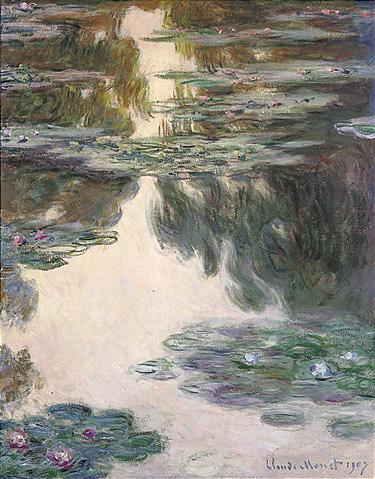
Lot description
CLAUDE MONET 1840-1926 NYMPHEAS Signed and dated 1907 Oil on canvas 36 1/4 by 28 3/4 in. 92.1 by 73 cm. Provenance The Property of the Artist (sold: Hotel Drouot, Paris, February 20-21, 1918, lot 102, donated by the to benefit the Janson-de Sailly-Hospital) Durand-Ruel and Bernheim-Jeune, Paris (acquired at the above sale) The Detroit Institute of Arts (acquired from the above through Albert Kahn and Myron Barlow in 1920) E. and A. Silberman, New York (by 1935) Albert Kahn, Detroit Ernestine Kahn, Detroit (by descent from the above) Dr. and Mrs. Barnett Malbin (acquired from the above circa 1947 and sold: Sotheby's, New York, The Lydia Winston Malbin Collection, May 17, 1990, lot 18) Private Collection, Japan (acquired at the above sale) Acquired from the above Exhibited Paris, Galeries Durand-Ruel, Les NymphEas: SEries de Paysages d'eau, 1909, no. 37 San Diego, Fine Arts Gallery, Inaugural Exhibition, 1926, no. 40 The Detroit Institute of Arts, Selections from The Lydia and Harry Lewis Winston Collection (Dr. and Mrs. Barnett Malbin), 1972-73 Sydney, Art Gallery of New South Wales; Melbourne, National Gallery of Victoria; New York, The Museum of Modern Art, Modern Masters - Manet to Matisse, 1975, no. 81 New York, Acquavella Galleries, Claude Monet, for the Benefit of the New York Hospital, 1976, no. 65 Tokyo, Bridgestone Museum of Art; Nagoya, City Art Museum; Hiroshima Museum of Art, Monet: A Retrospective, 1994, no. 73, illustrated p. 207 Chiba, Kawamura Memorial Museum of Art; Kurashiki, Municipal Museum; Hokkaido, Museum of Modern Art; Takaoka Museum of Art, Les NymphEas de Louis Cane: Regard sur Claude Monet, 1995, no. 27 Boston, Museum of Fine Arts; London, Royal Academy of Arts, Monet in the 20th Century, 1998-99, no. 40 (exhibited only in Boston) Literature The More Important Paintings and Sculptures of the Detroit Institute of Arts of the City of Detroit, Detroit, 1927, illustrated p. 144 Walter Heil and Clyde H. Burroughs, Catalogue of Paintings in the Permanent Collection of The Detroit Institute of Arts of the City of Detroit, Detroit, 1930, no. 146 Lionello Venturi, Les Archives de l'Impressionnisme, vol. I, Paris, 1939, discussed pp. 421-22, 448 Oscar Reutersward, Monet, En konstnarhistorik, Stockholm, 1948, listed p. 288 Denis Rouart and Jean-Dominique Rey, Monet, NymphEas, ou les miroirs du temps, Paris, 1972, illustrated p. 161 Daniel Wildenstein, Claude Monet, Biographie et catalogue raisonnE, vol. IV, Paris and Lausanne, 1985, no. 1705, illustrated p. 221; p. 376, discussed in letters nos. 1885, 1887, 1888; p. 398, discussed in letters nos. 2254 and 2267; p. 431, discussed in letter no. 284 J. Patrice Marandel, "A Valentiner Legacy: The Broad Stream of European Painting," Apollo, London, December 1986, discussed pp. 469 and 492 Daniel Wildenstein, Claude Monet, Biographie et catalogue raisonnE, vol. V, Lausanne and Paris, 1991, no. 1705, catalogued p. 53 Daniel Wildenstein, Monet, Catalogue RaisonnE, vol. IV, Cologne, 1996, no. 1705, illustrated p. 782 Pierre Georgel, Monet, Le cycle des NymphEas (exhibition catalogue), MusEe National de l'Orangerie, Paris, 1999, illustrated p. 39 On June 22, 1890, Claude Monet wrote to his friend Gustave Geffroy, the art critic who later become his biographer: "I have again taken up things that are impossible to do: water with grasses waving on the bottom... it's wonderful to see, but it's maddening to want to paint it. But then I'm always working on such things" (Gustave Geffroy, Claude Monet: sa vie, son temps, son oeuvre, Paris, 1922, p. 188). Seven years later, he continued to ponder such imagery when the critic Maurice Guillemot visited him in his studio in Giverny. Monet spoke to the critic about a project for a group of paintings devoted to depictions of "an expanse of water dotted with aquatic flora...a transparent vision of alternating greens and mauves, the calm and silence of the still water reflecting the blossoming panorama; the tones are imprecise, beautifully nuanced with the delicacy of a dream.. . This decorative vision is peace and quiet" (Maurice Guillemot, "Claude Monet," La Revue IllustrEe, Paris, March 15, 1898, n.p.). Between 1903 and 1908, Monet worked on an extended series of paintings devoted to views of the surface of the water lily pond that he had created on his property in Giverny. The development of the group is characterized by increasing abstraction and spatial ambiguity; as the series progressed, Monet shifted from greater naturalism to greater decorativeness and abstraction. The first views of the pond included glimpses of the banks and the sky, but before long the paintings depicted only the transparent surface of the pond, water lilies, and reflections of trees, sky, and clouds, as in the present work. As Grace Seiberling has noted, "In the treatment of reflecting surfaces, the interlocking of positive and negative shapes in curving arabesques and in the observation of nuances of hue and value, they are important forerunners for the late series" (Grace Seiberling, Monet's Series, Ph.D. dissertation, Yale University, New Haven, 1976, p. 327). Of the many views of the surface of the pond executed between 1903 and 1908, forty-eight (including the present work) were selected for a landmark exhibition at the Galerie Durand-Ruel in 1909. As a whole, they signal the subject matter and pictorial interests that were the focus of the rest of Monet's career, culminating in the pair of large, decorative suites of Water Lily paintings that were permanently installed in two oval galleries in the Orangerie not long after he died in 1926. The present work was included in the 1909 Durand-Ruel exhibition (as no. 37). As such, it was clearly selected by the artist for its quality, compositional strength, and beauty. Commenting presciently on the exhibition in 1909, Geffroy wrote: "... when one sees the water landscapes reunited, one has the impression of an admirable decorative ensemble, [and] one dreams of retaining it as it is, on the walls, in peaceful rooms where strollers would come seeking diversion from social life, appeasement from fatigue, and love of eternal nature" (Gustave Geffroy, "Les Paysages d'eau, ou les nymphEas" 1909, reprinted in L'Art et les Artistes, Paris, November 1920, pp. 80-81). The present example is one of thirteen works with a similar composition and format that Monet painted in 1907 (see figs. 1-3); he continued to do variations on the theme the following year. In addition to recording a moment in time, the differing palette of each picture seems to connote a mood or interior state of feeling. As such, these works, like the best of Monet's series paintings, reach beyond objective interpretations of the subject matter to the realm of feelings and subjective response. In the words of George Heard Hamilton, "A work of art may be defined in many ways, but at least one such definition may state that it is the projection in visible and tangible conditions of a state of sensibility undergone by a particular person at particular moment in time" (George Heard Hamilton, Monet's Paintings of Rouen Cathedral, London, 1960, p. 5). The early provenance of this painting is especially important, because it appears that Monet regarded it with particular favor. He chose to keep this painting in his own collection until 1918 when he donated it to a charity sale in aid of the war wounded being treated at the Janson-de-Sailly Hospital. It was bought by the dealers Durand-Ruel and Bernheim-Jeune, and in 1920 Durand-Ruel sold it to the Detroit of Institute of Arts. Subsequently it was bought by the esteemed collector Lydia Winston Malbin, who sold it at Sotheby's (New York) in 1990.