Have one like this?
Upload a photo for a free check of what yours may be worth.
Lot description
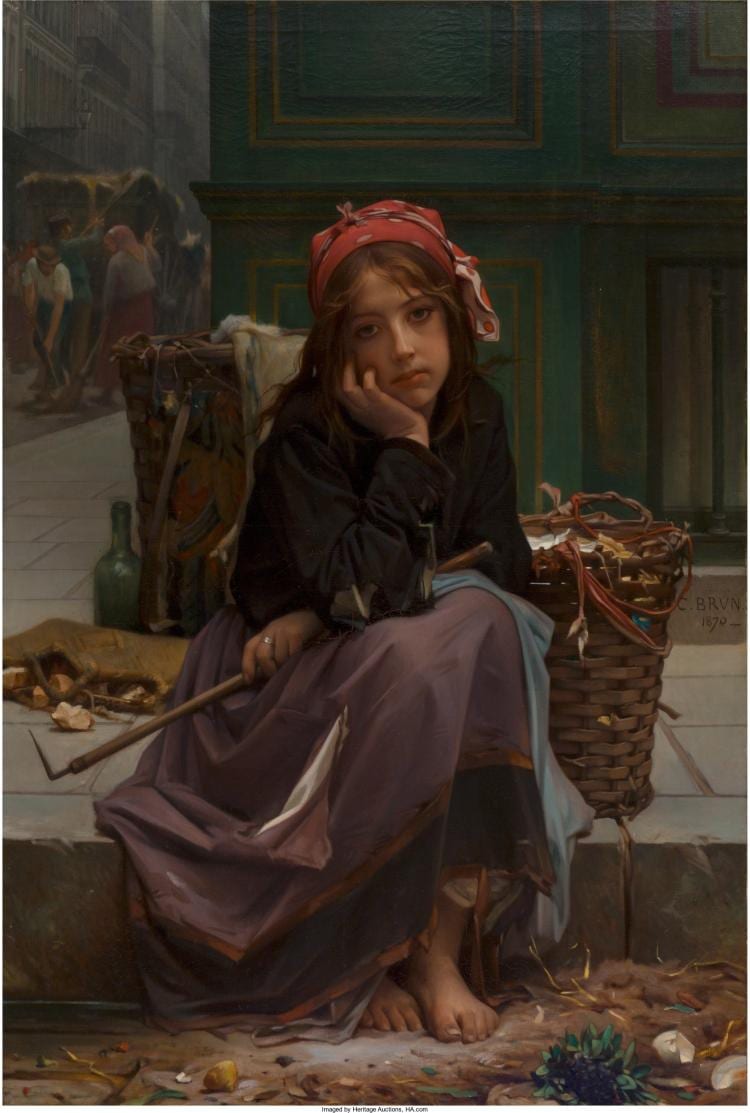
Guillaume-Charles Brun (French, 1825-1908) The young rag seller, 1870 Oil on canvas 47-1/2 x 31-3/4 inches (120.7 x 80.6 cm) Signed and dated center right on the building: C. Brun / 1870 PROPERTY FROM A DISTINGUISHED DALLAS COLLECTION PROVENANCE: Christie's, Amsterdam, October 26, 1999, lot 100; [With] Roughton Galleries, Inc., Dallas, Texas; Acquired by the present owner from the above, November 15, 1999. Painter Guillaume-Charles Brun moved to Paris from his native Montpellier as a young man to pursue artistic training, and made the city his home for the rest of his life. Following studies with François-Édouard Picot (also represented in the present auction) and Alexandre Cabanel, Brun was admitted to the Ecole des Beaux-Arts in 1847, and debuted at the French Salon in 1851 with a genre scene featuring a young girl at morning prayer. Indeed, his first Salon effort treated a romanticized subject akin to the work of his teacher Piot, although over the next two decades, Brun's genre subjects shifted instead to a portrayal of a harsher reality of Parisian life-the city's youngest and poorest denizens forced to eke out a living on the streets. He painted buskers, flower sellers, and rag pickers. The young rag seller of 1870 is an outstanding example of genre painting from Brun's early maturity. A young girl barely into her early teens rests for a moment from her wanderings to scavenge scraps of fabric from urban garbage bins, which she can sell to paper mills. Broken eggshells near her bare feet, and crusts of bread and a green bottle close by perhaps signal that she has stopped to eat. With the tools of her trade surrounding her-her crochet (hooked rag-staff) to extract bits of cloth from piles of rubbish, and baskets that she used as containers for her rags-the young girl stares directly at the viewer without smiling. Despite the rag picker's hardships, however, Brun ensures that she remain pretty, a requirement of French academic figure painting, but her expression is entirely devoid of flirtatiousness one discerns in analogous works by some of Brun's contemporaries. Hers is a look of candid resignation. It is a masterful task to create such a beautiful, alluring image from a subject with such a high degree of pathos. Brun's skill in achieving this is dependent upon an arsenal of academic skills to be sure. However, the painting's success seems to stem from something more than skill, and point to an authentic understanding and empathy the painter had with the subject. It is notable that Brun's palette is a delicately calibrated harmony of secondary hues such as lavenders, greens and orange reds. These are not the happy primary triad of yellow, blue and red but rather the more meditative secondary colors that contribute to the serious mood of the painting. Will the young girl ever rise out of her situation? During the 19th century, rags were viewed as a valuable commodity, widely collected for recycling into paper. It is estimated that there were 15,000 rag pickers in Paris alone, and at least 100,000 in France in the middle of the 19th century. Most were children and teens. A Victorian-era artist like Brun would have been aware that writers of his day often used the metaphor of recycling rags into clean paper as a way of discussing how society might transform the lives of its street children into those of social usefulness, education enabling them to take the imprint of new, more hopeful life stories. This analogy can be traced back to John Locke's concept of the tabula rasa, whereby children at birth resemble 'white paper.' From the 1860s on, Brun devoted himself primarily to painting orientalizing subjects, sometimes using compositions he developed for his Parisian genre subjects. HID04901242017