Lot description
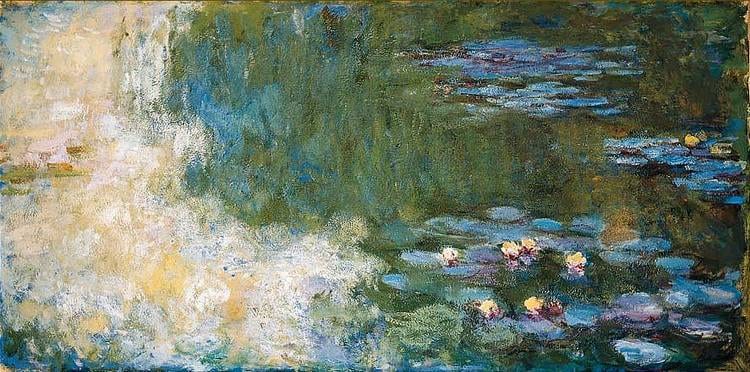
CLAUDE MONET Property of a Lady le bassin aux nympheas stamped with the signature oil on canvas 100 by 200 cm., 39 3/8 by 78 3/4 in. Painted circa 1917-1920. Provenance Michel Monet, Giverny Katia Granoff, Paris Maharanee of Baroda (sale: Palais Galliera, Paris, 30th November 1961, lot 10) Acquired at the above sale by the present owner Exhibited London, The National Gallery, London's Monets, 1997, no. 24, illustrated in colour in the catalogue Literature Denis Rouart and Robert Maillard, Monet, Paris, 1972, p. 175, illustrated (with the date circa 1919-1922) Daniel Wildenstein, Claude Monet, Biographie et Catalogue raisonne, Peintures 1899-1926, Lausanne & Paris, 1985, vol. IV, p. 293, no. 1900, illustrated Daniel Wildenstein, Monet Catalogue raisonne, Paris, 1998, vol. IV, p. 904, no. 1900, illustrated (with the O'Hana Gallery incorrectly listed as provenance) Monet's famous lily pond in his garden at Giverny provided the subject matter for most of his major later works, paintings whose significance in the development of modern art is now fully recognised. The present example, which dates from circa 1917-1920, is one of the most monumental of the Nympheas series. Its scale and power are testament to Monet's enduring vision and creativity in his mature years. In 1890, at the age of fifty-six, Monet had become financially successful enough as an artist to afford his own house and garden at Giverny. With enormous vigour and determination, he swiftly set about transforming the gardens and creating a large pond in one section, in which waterlilies gradually matured. Once Monet's aim to create a stable immediate environment had been achieved, the subjects of his painting began to focus in increasingly on these surroundings, and the last three decades of his long career are remarkable, above all else, for his Nympheas. John House writes: 'The water garden in a sense bypassed Monet's long searches of earlier years for suitable subjects to paint. Designed and constantly supervised by the artist himself, and tended by several gardeners, it offered him a motif that was at the same time natural and at his own command - nature re-designed by a temperament. Once again Monet stressed that his real subject when he painted was the light and weather' (J. House, Monet: Nature into Art, Newhaven, 1986, p. 31). In the present work, Monet's primary interest is clearly the effects of light on the surface of the pond and on the waterlilies themselves; the play of shadows and modulations of light that the weather creates. Although the effect is one of great immediacy, as if the artist has painted the canvas with rapid and vigorous brushstrokes to capture the scene before the weather turns or the light fades, its surface in fact displays all of the hallmarks of Monet's obsessive and enduring search for perfection: exactly the tone, precisely the density of pigments to capture the evanescent mood. Kathleen Adler and John Leighton write of the present work: 'In this work, painted in about 1917-19, the richly textured, granular surface bears witness to the artist's repeated reworkings as he sought to fix the most transitory of effects. Yet the deft movements of his brush and the delicacy of his colours disguise any anxieties that may have gone into the production of such a large work. Monet closes in on the surface of the pond, concentrating on the counterpoint between the floating lily-pads and the ethereal reflections of trees and sky. According to Monet, it was the ever-changing appearance of the 'mirror of water' which was the essence of this subject' (K. Adler and J. Leighton, London's Monets, London, The National Gallery (exhibition catalogue), 1997, p. 30). 6