Have one like this? Check yours freeOr have an appraiser value it
Lot description
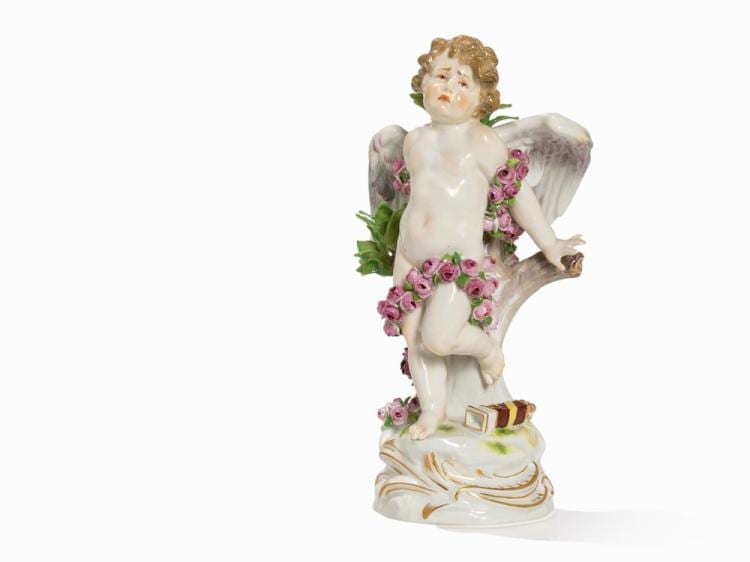
Porcelaine, polychrome and gold painted Meissen, c. 1910 Porcelain Manufactory Meissen, established in 1710 Model: Paul Helmig (1859-1939), 1898 Underglaze blue crossed sword mark, incised model mark R 123, painter's mark Height: 18.5 cm Good condition Object is regular taxed. 19% VAT is added to the purchase price for deliveries within the EU. Sad looking cupid, bound with rose garland on a trunk, on his feet his empfty quiver. Condition: The figure is in good condition. Some leaves and cupids left hand are restored by a specialist. The height measures 18.5 cm. Paul Helmig (1859-1839) Helmig studied at the Kunstgewerbeschule (School of Applied Arts) in Dresden, at the Meissen manufactory from 1872, modeller in 1882, retired in 1925, created numerous figures and groups, clock cases and vessels with figures, at first in Rococo style and subsequently in a restrained Art Nouveau. Porcelain Manufactory Meissen Porcelain has been known in Europe since the 13th century, but always had to be imported from China. Thus it was mostly of lower quality the Chinese rarely gave their best ware to the foreigners and extremely expensive. As demand for porcelain became greater, European alchemists tried to discover the formula to create hard-paste porcelain. The production of the first European hard-paste porcelain was the result of a collaboration between the alchemist Johann Friedrich Böttger and the scientist Ehrenfried Walther Graf von Tschirnhaus at the court of Augustus the Strong, Elector of Saxony, in Dresden. As a matter of fact, it was finally achieved for the first time in Europe in 1708 to produce a white hard paste porcelain and in 1710 Augustus established Europes first hard-paste porcelain factory in the Albrechtsburg, a palace in Meissen. The so-called Böttgerporzellan actually had more of a stoneware quality and it was not until the year 1713 that white porcelain was available for purchase. Initially unmarked, the motif of the crossed swords was developed in the early 1720s and used from 1723 onwards. Since then, beautifully modelled and painted figures and table services were produced at Meissen, establishing its reputation as the pre-eminent porcelain factory in Europe. Outstanding potters, modelers and painters, e.g. Johann Joachim Kändler (1706-1775), Johann Gottlieb Klinger (1701-1781) and Count Camillo Marcolini (1739-1814), were employed at the factory, which dominated the 18th century style of porcelain, and Meissen wares and figurines were imitated by craftsmen at other porcelain factories throughout Europe. Meissen celebrated its 300 years of existence in 2008. Until today, Meissen porcelain is known for highest quality and originality and greatly appreciated. (kre) Shipping costs excl. statutory VAT and plus 2,5% (+VAT) shipping insurance.