Have one like this?
Upload a photo for a free check of what yours may be worth.
Lot description
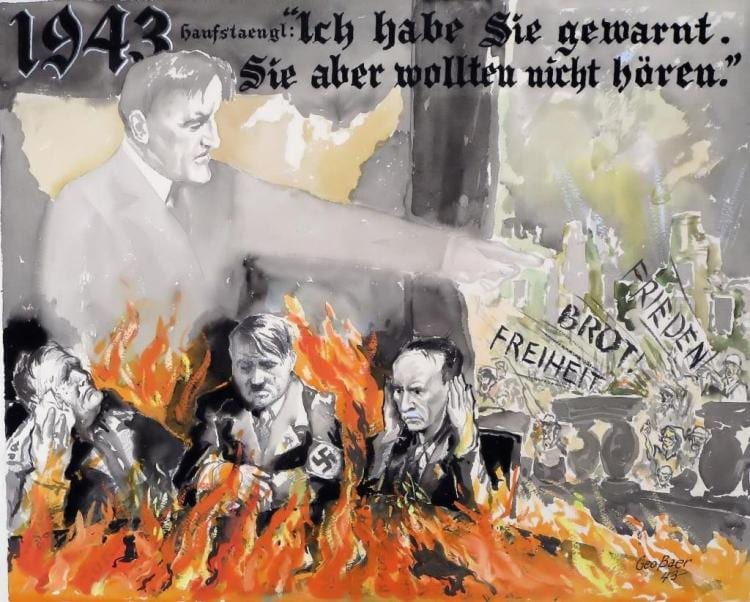
George Baer, American, 1895-1971, Collection of 5 works on paper, includes 2 Adolf Hitler Chants, watercolor on board, each signed and dated 1943, along with 3 Drawings of Dachau, Bavaria Germany, ink/watercolor on poster board, unsigned, one with mat board with graphite title and signature. Note: The influence of these works stems from the artist George Baers relationship with Ernst Hanfstaengl, nicknamed "Putzi",was born in Munich, Bavaria, Germany, the son of a German art publisher, Edgar Hanfstaengl, and an American mother. He spent most of his early years in Germany and later moved to the United States. His mother was Katharine Wilhelmina Heine, daughter of William Heine, a cousin of American Civil War Union Army general John Sedgwick. His godfather was Duke Ernst II of Saxe-Coburg and Gotha. Among his circle of acquaintances were the newspaper baron William Randolph Hearst, author Djuna Barnes (to whom he was engaged), and actor Charlie Chaplin.Returning to Germany in 1922, he was living in his native Bavaria Hanfstaengl was asked to assist a military attaché sent to observe the political scene in Munich. Just before returning to Berlin the attaché, Captain Truman Smith, suggested to Hanfstaengl to go to a Nazi rally as a favor and report his impressions of Hitler. Hanfstaengl was so fascinated by Hitler that he soon became one of his most intimate followers, although he did not formally join the Nazi Party until 1931. For much of the 1920s, Hanfstaengl introduced Hitler to Munich high-society and helped polish his image. He also helped to finance the publication of Hitler's Mein Kampf, and the NSDAP's official newspaper, the Völkischer Beobachter. Hitler was the godfather of Hanfstaengl's son Egon. Hanfstaengl wrote both Brownshirt and Hitler Youth marches patterned after his Harvard football songs and, he later claimed, devised the chant "Sieg Heil". In 1937 following a dispute Hanfstaengl had defected from the Nazi Party and he made his way to Switzerland and after securing his son Egon's release from Germany, he moved to Britain where he was imprisoned as an enemy alien after the outbreak of the Second World War. He was later moved to a prison camp in Canada. In 1942, Hanfstaengl was turned over to the U.S. and worked for President Roosevelt's "S-Project", revealing information on approximately 400 Nazi leaders. He provided 68 pages of information on Hitler alone, including personal details of Hitler's private life, and he helped Professor Henry Murray, the Director of the Harvard Psychological Clinic, and psychoanalyst Walter C. Langer and other experts to create a report for the OSS, in 1943, designated the "Analysis of the Personality of Adolph Hitler". In 1944, Hanfstaengl was handed back to the British, who repatriated him to Germany at the end of the war. William Shirer, a CBS journalist who resided in Nazi Germany until 1940 and was in frequent contact with Hanfstaengl, described him as an "eccentric, gangling man, whose sardonic wit somewhat compensated for his shallow mind." Hanfstaengl wrote Unheard Witness (1957) (later re-released as Hitler: The Missing Years) about his experiences. In 1974, Hanfstaengl attended his 65th Harvard Reunion, where he regaled the Harvard University Band about the authors of various Harvard fight songs. His relationship to Hitler went unmentioned.Hanfstaengl died in Munich in 1975. In 2004, his story was told by author Peter Conradi in his book Hitler's Piano Player: The Rise and Fall of Ernst Hanfstaengl, Confidante of Hitler, Ally of FDR. Biography: George Baer was born in Chicago. He attended the Chicago Art Institute, and after graduation, he and his brother, Martin officially opened the Holbein Studios, later known as the Anarchist Studios. The studio closed in 1921, and the Baer brothers went to Munich, Germany attending the Academy and studying with M. Heymann. In 1924 they went to Paris, and studied at the Ecole des Beaux Arts. They met many important artists including Picasso, Soutine and Kremin. Until 1940, they were based in Paris while taking extended trips to Algeria, Spain, England, Belgium and Holland. They spent two years on the outskirts of the Sahara Desert in North Africa. The Baer brothers George and Martin found the Algerians as much to their artistic liking as Gauguin found the Tahitians. They looked upon them with a lively, leavening curiosity, and transferred them quivering to their canvases the dancing girls, swaying to barbaric music; the camel drivers, ready to start for their long journeys across the Sahara; street vendors, beggars, women of the African demi-monde. George had in the 1930s having fled the Nazi invasion had moved to back to America to New Milford, CT. He taught Creative Design and Lettering in 1931 and 32 at the New York School of Applied Arts and Design for Women. In 1946 he settled in Litchfield County, Connecticut , opening an art school in Salisbury,Connecticut at the Scoville Memorial Library from 1933-38 where he taught painting, life drawing, watercolor, etching, pencil and all applied arts. Baer had instructed art to notable author Clyde Brion Davis and Thomas B.Costain. George was an art instructor at the Salisbury School for 21 years. George has a piece titled Masouba at the National Gallery of Art in Washington, D.C. (ALMA10110/5) {MM} Measurements: Adolf Hitler: 18 x 23, board 22 x 30. Dachau: 10 x 14, mat frame 15 1/2 x 19 Condition: toning to paper, edges stained and creased, pinholes surrounding watercolor,