Have one like this? Check yours freeOr have an appraiser value it
Lot description
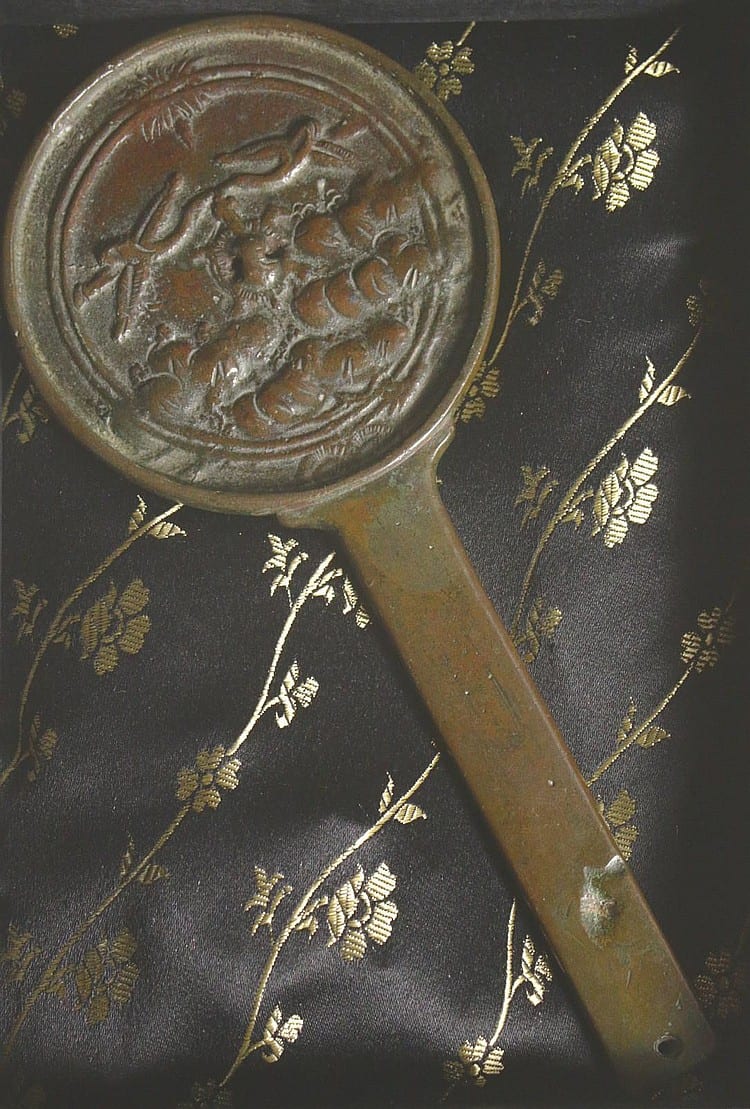
Description: A shadow box framed, cast bronze Japanese hand mirror having raised decoration of cranes feeding one another at the top center, etc. A central boss with turtle imagery. The opposite side is flat and unpolished for a very long time. 19th century or earlier. Material: Bronze Maker/Artist: Unknown Date: 19th century or earlier Provenance: Patricia & Dennis Della Penta estate Size of Artwork: L. 7" x W. 3 x D. .25" Weight (LBS) 3 Condition: In very good condition History: Bronze mirrors were introduced into Japan from China and Korea during the Yayoi period (about 300 BC - AD 300). At first they had a religious function and were regarded as symbols of authority. The Japanese soon learnt to make their own mirrors using the lost-wax technique, decorating them with Chinese or native Japanese designs. By the Nara period (AD 710 -794) mirrors were being made for everyday use, with the increasing use of Japanese designs, such as native plants and animals symbolizing good fortune. From the Kamakura period (1185-1333) a design showing Hôraizan (the Chinese 'Island of Immortality') became popular. Mirrors gradually became more robust. They mostly have a central boss, often in the shape of a tortoise, which was pierced and a cord passed through for holding. More new designs and the first handled mirrors appeared in the Muromachi period (1333-1568). During the Edo period (1600-1868), mirrors decorated with lucky symbols or Chinese characters were given at weddings. Mirrors became larger as hairstyles became more ornate; some mirrors in Kabuki theatre dressing-rooms were up to fifty centimeters across and were placed on stands. The faces of mirrors were highly polished or burnished, with itinerant tanners and polishers, specializing in this work. Since the mirror, together with the sword and the jewel, were symbols of Imperial power, mirror-makers were deeply revered and often given honorary titles such as Tenka-Ichi ('First under Heaven'). However, this title was often misused and was officially prohibited in 1682. Bronze mirrors were replaced by glass mirrors after the Meiji Restoration (1868).