Unlocking the Worth of Nostalgia a Guide to Schwinn Vintage Bike Values: appraisal and value basics
Unlocking the Worth of Nostalgia a Guide to Schwinn Vintage Bike Values research should start with identification, condition, provenance, and item-specific market evidence. Use this guide to compare the signals that matter before paying for a formal appraisal or deciding whether to sell.
Schwinn vintage bike appraisal checklist
Schwinn is more than a name on a headbadge—it’s a shorthand for an American cycling era. From balloon-tire cruisers to high-performance Paramounts and banana-seat Sting-Rays, Schwinn’s catalog mirrors changing tastes, technologies, and youth culture. For antiques and appraisal enthusiasts, that breadth offers opportunity—and pitfalls. This guide distills the signals that matter most when identifying, dating, and valuing vintage Schwinn bicycles so you can separate sentiment from fair market worth.
Why Schwinn Endures—and Why Values Diverge
Founded in 1895 in Chicago, Schwinn dominated mid-century U.S. cycling by mastering retail distribution and building everything from kids’ bikes to Olympic-caliber frames. Values vary widely because the brand spans:
- Prewar and postwar balloon-tire showpieces (e.g., Phantom).
- Youth culture icons (1963+ Sting-Ray and late-1960s Krates).
- Mass-market lightweights (Varsity, Continental).
- Hand-built racing frames (Paramount).
What does that mean for value?
- Desire and cultural significance matter: Sting-Rays and Krates often outperform common adult lightweights, even if the latter cost more when new.
- Originality and completeness are crucial: The right springer fork, tank, seat, and period-correct parts can double a price.
- Provenance and condition trump casual restorations: Correct detail is everything.
How To Identify What You Have (Model, Year, Variant)
Start with the basics: frame style, wheel size, and equipment.
- Wheel size and tires
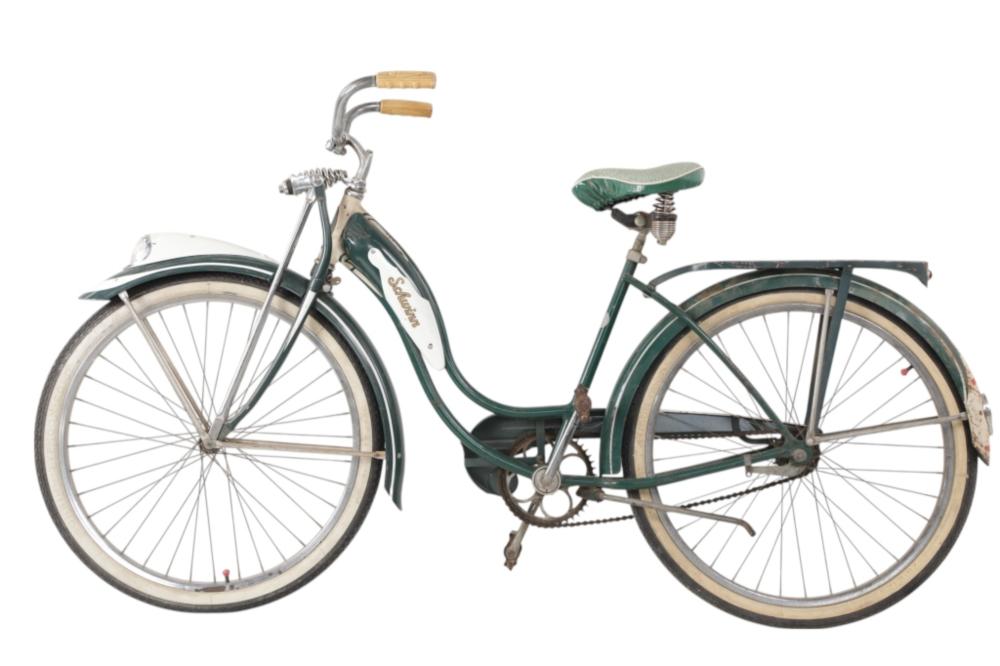
- 26-inch balloon or middleweight tires: cruisers (Phantom, Panther, Jaguar, Typhoon, Corvette).
- 20-inch slick rear/knobby front with banana seat: Sting-Ray family; Krates add suspension fork and 16-inch front wheel plus stick shift (on 5-speeds).
- 27-inch (or 700C later) with drop bars: lightweights (Varsity, Continental, Super Sport, Superior, Paramount).
- Frame and fork cues
- Springer fork, tank with horn, rear carrier, and chrome: hallmarks of Black Phantom and top-tier cruisers.
- Banana seat, high-rise bars, small front wheel on Krates; color-named variants (Apple, Orange, Lemon, Pea, Grey, Cotton).
- Nervex or similar lugs and high-quality tubes (Reynolds 531/Columbus) with clean brazing: Paramount.
- Drivetrain and hubs
- Sturmey-Archer 3-speed hubs (date stamped) on Jaguars and three-speed cruisers.
- Bendix red-band 2-speed kickback hubs add desirability.
- “Schwinn Approved” derailleurs/brakes on lightweights; component makers can hint at era.
- Badges and decals
- Chicago-made headbadges and period-correct decals help document. Many reproductions exist; scrutinize font, spacing, and finish.
Dating the bike
- Serial number location
- Pre-1970: typically stamped on the rear dropout or the bottom bracket area.
- Circa 1970 onward: generally on the head tube.
- Serial formats changed over the decades. Schwinn often used letter codes that require a chart to decode. Cross-check serial placement with component date codes (e.g., Sturmey-Archer hub dates, some brake or rim stamps) to confirm the year.
Note on reissues and reproductions
- Krate reissues from the late 1990s/2000s and reproduction Phantom parts are common. Head-tube serials, modern welds, contemporary decals, and non-period components often give them away. Reissues have collector interest but different value tiers than original 1960s–70s models.
Condition, Originality, and Provenance: What Drives Price
The three biggest levers of value:
- Originality
- Factory paint, decals, chrome, and parts carry a premium.
- “Period-correct” restorations are respected if done to an exceptional standard with proper parts.
- Aftermarket springer forks, incorrect tanks, or modern saddles can depress value.
- Accessories matter: correct headlight/tank horn, working speedometer, wheel reflectors, stick-shift and guard on Krates, and correct S-2/S-7 rims add up.
- Condition
- Vintage bicycles are often graded as: poor (project), fair (complete but rough), good (presentable rider), very good (clean original), excellent (high-grade original/restored), and show/museum quality.
- Original paint in “honest” patina can be more valuable than a mediocre repaint.
- Chrome pitting and deep rust on structural parts hurt value; mild patina is acceptable.
- Documentation and provenance
- Sales receipts, dealer decals, original owner stories, and period photos substantiate originality and help justify higher estimates.
- Matching date codes across components support originality.
Benchmark Values by Category (Typical Ranges)
These are broad, research-backed ranges for the current collector market. Local demand and specific condition/features can push results above/below the bands.
Balloon-tire and middleweight cruisers
- Black Phantom (late 1940s–1950s)
- Complete, good to very good original: roughly a value that must be established from current, topic-matched sales
- High-level, correctly restored: a value that must be established from current, topic-matched sales+
- Panther/Jaguar/Corvette and similar equipped cruisers
- Good originals: a value that must be established from current, topic-matched sales depending on completeness and extras
- Projects or repaints: a value that must be established from current, topic-matched sales
- Black Phantom (late 1940s–1950s)
Sting-Ray family and Krates (1960s–1970s)
- Early Sting-Ray (1963–1965, first-generation features)
- Good to excellent originals: about a value that must be established from current, topic-matched sales+
- Krate series: Apple, Orange, Lemon (1968–1973)
- Solid originals: a value that must be established from current, topic-matched sales
- Top specimens (disc brake years, superior originality): a value that must be established from current, topic-matched sales+
- Rarer Krates: Pea Picker (1970–1972), Grey Ghost (1971 only), Cotton Picker (1970 only)
- Desirable originals: a value that must be established from current, topic-matched sales+, dependent on condition and correctness
- Manta-Ray and specialty variants can exceed the above when documented and complete.
- Early Sting-Ray (1963–1965, first-generation features)
Lightweight derailleur bikes
- Varsity, Continental, Collegiate, World Sport
- Typical riders: a value that must be established from current, topic-matched sales
- Exceptionally clean, near-NOS examples: a value that must be established from current, topic-matched sales+
- Le Tour (many built by Panasonic in Japan), Super Sport, Superior
- Clean originals: a value that must be established from current, topic-matched sales (model and spec matter)
- Paramount (hand-built racing)
- Pre-1970s track/road: often a value that must be established from current, topic-matched sales depending on originality and size
- 1970s–1980s road frames complete: roughly a value that must be established from current, topic-matched sales+
- Late “PDG”/non-Chicago variants usually below earlier hand-brazed Chicago builds
- Varsity, Continental, Collegiate, World Sport
Premium add-ons and deductions
- Correct springer fork: +a value that must be established from current, topic-matched sales
- Tank with horn and wiring intact: +a value that must be established from current, topic-matched sales
- Bendix red-band 2-speed hub: +a value that must be established from current, topic-matched sales
- Incorrect repaint or heavy pitting: a category-dependent amount to a category-dependent amount depending on severity
- Missing key parts (tank, stick shift, chainguard): a category-dependent amount to a category-dependent amount each
Note: Ranges reflect general market patterns, not guarantees. Always corroborate with item-specific market evidence and local buyer interest.
Dating Your Schwinn: Serial Numbers and Component Clues
Because Schwinn reused serial formats and relocated stampings, use multiple data points:
- Where to look
- Rear dropout or bottom bracket area for many pre-1970 bikes.
- Head tube for circa 1970 onward.
- Letter and number codes
- Schwinn employed letter codes for months/years in certain periods; exact decoding requires a chart. Be wary of frames with erased or restamped numbers.
- Component date cross-checks
- Sturmey-Archer hubs are stamped with year-month (e.g., 65-10 for October 1965).
- Some rims, brakes, and derailleurs have date codes or era-specific logos.
- Consistency across parts and frame is a positive sign; mismatched dates may indicate replacements.
Tip: For Krates, verify the presence and correctness of the stick shift assembly, rear derailleur model, front brake type (drum or disc depending on year), and seat/post fit. For Phantoms, validate tank shape, headlight switch placement, rack style, and scripted parts (e.g., AS&CO bolts).
Restoration vs. Preservation: The Value Equation
- When restoration makes sense
- Top-tier balloons (Phantom) and Krates can justify professional, period-correct restorations if the bike is complete or nearly so.
- Paramounts with compromised paint may benefit from expert repainting with correct decals, preserving original tubing and geometry.
- When to preserve
- Clean originals nearly always outscore average restorations in value and collector esteem.
- Patina that reflects honest age is welcome; stabilize rather than erase it.
- Cost considerations
- Chrome plating, paint, decals, and parts sourcing add up quickly. It’s not unusual for a proper restoration to cost as much as, or more than, the bike’s eventual value if the model is common (e.g., Varsity).
- Documentation
- Keep photos and notes of as-found condition, original finishes discovered under clamps, and any maker’s stamps uncovered during work.
Market Trends and Selling Strategies
- Where to sell
- Vintage bicycle swap meets and shows
- Specialty and general auction platforms
- Local classifieds for bulky, mid-tier riders to avoid shipping friction
- Consignment with reputable bike shops or specialty auctioneers for high-end pieces
- Presentation matters
- Photograph both sides, headbadge, serial, key components, and any flaws.
- List measured frame size (center to top), wheel size, and notable parts.
- State what is original, what’s period-correct, and what’s reproduction.
- Shipping and risk
- High-value bikes often fare better with in-person transactions.
- If shipping, double-box the frame and wheels separately, protect dropouts with spacers, and insure for full value.
Quick Appraisal Checklist
- Identify the category: balloon cruiser, Sting-Ray/Krate, lightweight, or Paramount.
- Locate and record the serial number; note its location on the frame.
- Cross-check component date codes (hubs, rims, brakes) for consistency.
- Assess originality: paint, decals, chrome, fork type, tank, saddle, rims, hubs, shifters.
- Note condition honestly: rust, dents, chrome pitting, paint loss, mechanical function.
- Verify rare features (disc brake Krate, Bendix 2-speed, early Sting-Ray traits).
- Document provenance: receipts, dealer decal, original accessories.
- Research recent sales of the same model/spec in comparable condition.
- Decide on preservation vs. restoration based on value potential and completeness.
- For sale: measure frame, shoot clear photos, and disclose all details.
FAQ
Q: Are reproduction parts acceptable on a valuable Schwinn? A: They’re acceptable for making a rider complete, but originality drives top prices. On high-end models (Phantom, Krates, Paramount), reproduction parts typically reduce value. If used, specify which parts are repro and whether they’re period-correct style.
Q: How much does frame size affect value? A: It depends on the category. For adult lightweights and Paramounts, larger sizes (e.g., 58–62 cm) can command a premium due to rider demand. Sting-Rays and most cruisers are less sensitive to size since they were sold in fewer size options.
Q: Should I restore or sell “as is”? A: If the bike is a top-tier model and largely complete, a professional, period-correct restoration can pay off. Otherwise, clean it gently, leave the patina, and sell as-found with transparent photos. Many buyers prefer original finishes—even with wear.
Q: How do I tell an original Krate from a reissue? A: Check serial location (many originals pre-1970 are stamped at the dropout; 1970s often on the head tube), inspect decals and paint quality, verify component types (correct stick shift, brake, rims), and evaluate for modern manufacturing cues. Reissues have collector interest but are valued differently than late-1960s/early-1970s originals.
Unlocking the worth of a Schwinn is about reading details: serial placement, component dates, untouched paint, and the story those parts tell. Combine careful identification with item-specific market evidence, and you’ll turn nostalgia into a confident, defensible appraisal.