Antique Stoneware Crock Markings: appraisal and value basics
A plainly utilitarian crock is collectible; the same form with bold cobalt and a clear maker stamp can be worth many times more. Reproductions and later fantasy pieces are common.
Free. No card needed. Photo upload takes about two minutes.
Antique stoneware crock markings research should start with the maker stamp, capacity number, cobalt decoration, clay body, glaze, rim, handles, cracks, repairs, provenance, and item-specific market evidence. Use this guide with our antique stoneware crocks value guide to compare the signals that matter before paying for a formal appraisal or deciding whether to sell.
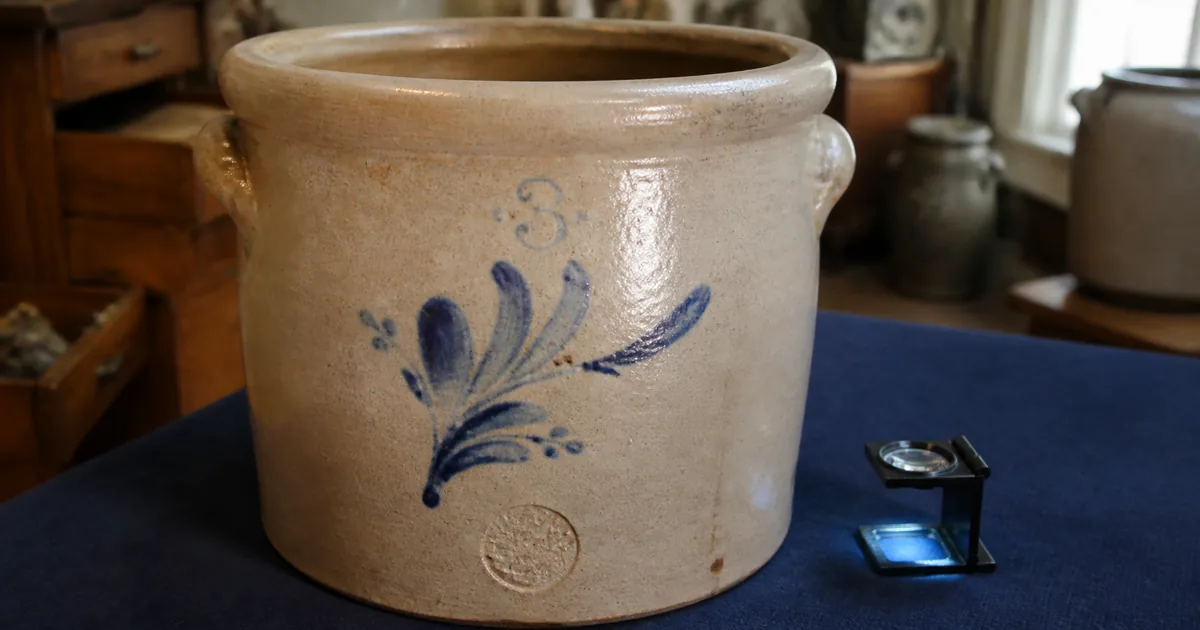
Antique stoneware crock markings checklist
Antique stoneware crocks carry more than pickles and preserves; they carry histories of local potteries, trade routes, and folk artistry. For collectors and appraisers, the key to unlocking those histories lies in the markings—maker’s stamps, incised signatures, stenciled names, capacity numbers, and painted cobalt decorations. This guide teaches you how to read those clues accurately so you can date, attribute, and value stoneware with confidence.
Why Stoneware Crock Markings Matter
- Attribution and dating: Marks and decoration styles can narrow a crock’s origin to a specific region, pottery, and often a decade-long window.
- Market value: A plainly utilitarian crock is collectible; a similar form with a bold bird in cobalt and a clear maker’s stamp can be worth many times more.
- Cultural story: Merchant advertising crocks record local businesses; early incised signatures reflect urban craft traditions; regional glazes map clay sources and kiln technology.
Understanding what was made where, when, and how lets you separate 19th-century artistry from 20th-century utility—and both from modern reproductions.
Anatomy First: Form, Fabric, Glaze, and Decoration
Before hunting for a stamp, read the object as a whole.
Form and construction
- Crocks are typically straight-sided or slightly ovoid with thick walls; churns taper and have lug handles for dashers; jugs have shoulders and spouts.
- Early pieces (late 18th–early 19th century) often show more ovoid shapes and pulled strap handles; later forms tend toward straight sides and standardized handles.
- Wheel-throwing lines and subtle irregularities point to hand craftsmanship; perfectly uniform cylinder forms often indicate later factory production.
Body (fabric)
- Northeast/Mid-Atlantic stoneware often fires to gray or blue-gray from high-iron clays.
- Some Midwestern bodies can be buff to light tan; inclusions or specks can hint at clay source.
- Southern alkaline-glazed stoneware (green to brown) is a different tradition than the salt-glazed crocks covered here; don’t misread glaze as “wrong” without considering region.
Glaze
- Salt glaze: Produced by introducing salt into the kiln at high temperature, yielding a thin, translucent glaze with an “orange-peel” texture. Dominant on 19th-century Northeastern and Mid-Atlantic crocks.
- Albany slip: Dark chocolate-brown iron-rich slip used on interiors (for sanitary lining) and sometimes exteriors; common mid-19th century onward.
- Bristol glaze: Opaque white glaze adopted widely in the 1890s and later. White-glazed crocks with bold printed capacity numbers are typically later than gray salt-glazed examples.
Decoration
- Cobalt blue is the signature accent: brushed birds, tulips, leaves, fish, and numerals; incised lines filled with cobalt; stenciled motifs and lettering.
- Hand-brushed decoration (folky birds, floral sprays) points to earlier and often higher-value pieces.
- Stenciled lettering becomes more common post-Civil War, especially on advertising and merchant pieces.
Studying these fundamentals puts any later “mark” in context—and context is everything when marks are faint or partial.
Decoding Maker’s Marks, Numerals, and Symbols
Stoneware markings take several forms. Learn to recognize each type and the information it reliably provides.
Impressed or stamped maker’s marks
- Usually in an oval, circle, or straight line, applied with a stamp before firing.
- Common placements: front center, shoulder below the rim, or above a handle lug.
- Typical content: pottery name, owner’s initials, town, and state abbreviation (e.g., “J & E NORTON / BENNINGTON, VT” or “WHITE’S UTICA”).
- Read carefully for abbreviations: “N.Y.” for New York; “PA” or “PHILA.” for Pennsylvania/Philadelphia; “W. VA” for West Virginia.
- “Stoneware Co.” or “Company” often indicates later 19th- to 20th-century factory production.
Incised signatures and inscriptions
- Early New York makers (Crolius and Remmey families) and some others incised names and places by hand, sometimes filled with cobalt to stand out.
- Incised capacity numerals and decorative lines are also common on earlier wares.
Stenciled marks and advertising
- Oil-paper stencils allowed crisp, repeatable lettering and motifs from about the 1860s onward.
- Merchant jugs and crocks (e.g., “Smith & Co. Grocers, Albany”) are popular and can narrow dating to a fairly tight range based on typography and glaze type.
Capacity numbers
- Numerals indicate gallons or fractional gallons (1/2, 1 1/2, 2, 3, etc.), usually brushed in cobalt or impressed.
- Style of numerals can be regionally distinctive; placement varies by pottery (front center versus near the rim).
- Capacity marks alone rarely date a piece, but combined with glaze and decoration they help distinguish circa-1850s hand-brushed numbers from late factory-stenciled versions.
Pottery symbols or motifs
- Some potteries adopted signature motifs: stylized birds and deer for Norton family pieces; exuberant tulips and birds for Cowden & Wilcox; elaborate figural scenes for White’s Utica.
- Study the brushwork. Confident, single-pass strokes with natural tapering are not easily faked and often reflect period workmanship.
Firing and kiln marks
- Stack marks on rims or shoulders (where crocks touched each other during firing) are normal.
- Small ash deposits, pinholing, or “blowouts” from iron inclusions can be period-appropriate and are not damage.
When reading a worn mark, side-light the area with a raking LED flashlight. Trace letters with a fingertip to feel impressed characters. Photograph the area and increase contrast to reveal faint content.
Regional Styles and Notable Makers
Stylistic and geographic context is powerful—especially when marks are partial or absent.
New York and New England
- New York City: Crolius and Remmey families (late 18th–early 19th century) known for incised, cobalt-filled signatures and ovoid forms.
- Upstate New York: White’s Utica produced some of the most elaborate brushed and stenciled cobalt scenes (birds, florals, figural vignettes) mid- to late-19th century. West Troy Pottery and Fort Edward Stoneware Company are frequently stamped and often show bold cobalt decoration.
- Bennington, Vermont: Norton family potteries (J & E Norton; E & L P Norton) famed for deer, birds, and floral sprays in rich cobalt.
Pennsylvania and Mid-Atlantic
- Harrisburg: Cowden & Wilcox (and F. H. Cowden) noted for energetic birds, tulips, and sweeping floral designs.
- Greensboro, Pennsylvania: Hamilton & Jones often used stencils and brushed flourishes; marks typically include “Greensboro, PA.”
- Philadelphia and Baltimore: Remmey family and others; Baltimore wares often feature strong cobalt and occasionally “watch-spring” style flourishes.
Ohio and the Midwest
- Numerous stamped and stenciled wares; clay bodies can be buff to tan. Some potteries adopted molded forms and more standardized production by the late 19th century.
- Later factories in the Upper Midwest (e.g., Red Wing, Western Stoneware, Monmouth) largely used white Bristol glazes and bold printed capacity numbers in the 20th century; these are collectible but distinct from earlier hand-decorated salt-glazed crocks.
The South (as a contrast point)
- Alkaline-glazed stoneware (green to brown) dominates in parts of the South; marked differently, with fewer cobalt motifs. If you see thick alkaline glaze and rich greens, shift your identification approach accordingly.
If the maker’s stamp reads only a town (e.g., “TROY, N.Y.”) or a merchant name, study the decoration and glaze in tandem with a list of known potteries active in that area and era.
Numbers on Old Crocks, and Crocks With No Markings
The large number on the side of a crock almost always gives its capacity in gallons. It tells you size, not age, and the same numeral can appear on a hand-thrown salt-glazed crock and on a factory crock made decades later. What helps with dating is how the number was put there and what surrounds it.
How the number was applied
- Brushed in cobalt by hand: uneven strokes, often near a maker stamp or decoration. Typical of salt-glazed crocks.
- Impressed with a stamp: a sunken numeral, sometimes inside a small frame, pressed into the clay before firing.
- Printed as part of a factory logo: common on white-glazed crocks. Red Wing pieces often show the number above a red wing, Western Stoneware used a maple leaf, and Robinson Ransbottom of Roseville, Ohio, set the number inside a crown.
Small numbers or letters impressed on the base are a different thing. They are often mold, size or production marks rather than gallons. Record them exactly, but do not read them as a year.
When a crock has no mark
Many crocks were never stamped. Some potteries rarely marked their ware, some sold through merchants and wholesalers under no name, and printed factory marks can wear away with years of scrubbing. A white crock with only a capacity number is one of the most common finds, and it was usually made by one of the larger Midwestern or Ohio factories.
For an unmarked piece, build the case from the body color, glaze, form, rim and handle shape, whether the walls show throwing lines or a molded evenness, and the style of any decoration. Then compare it with marked pieces of the same size and shape. These checks for dating an antique crock walk through that process step by step. An unmarked crock is harder to attribute, so buyers lean more heavily on decoration and condition when they compare it with the sold results on this page.
Dating And Authentication: Putting The Clues Together
Dating and authentication work best as a convergence of evidence rather than reliance on a single trait.
A practical timeline
- Late 1700s–1820s: Ovoid forms, incised signatures, simple cobalt accents; pronounced salt glaze; limited stenciling.
- 1830s–1860s: Flourishing cobalt decoration; widespread use of Albany slip interiors; impressed and some stenciled marks; hand-brushed capacity numerals.
- 1870s–1890s: Increased stenciling and merchant advertising; more standardized forms; continued salt glaze but growing experimentation.
- 1890s–1930s: Bristol (white) glaze widely adopted; bold printed numerals and logos; consolidated “Stoneware Co.” factory marks. Hand-brushed cobalt motifs largely decline on utilitarian wares.
Red flags for reproductions and later “fantasy” pieces
- Too-perfect, high-gloss cobalt on pristine white Bristol glaze paired with faux “old-timey” advertising is usually 20th-century or later decor ware.
- Artificial aging tells: uniform tea-staining, file marks to mimic wear, paint masquerading as cobalt (test with a damp cotton swab on an inconspicuous spot—modern paint can lift).
- Mold seams running sharply through the body or handle on a supposed early ovoid crock.
- “USA” or modern company names on the base; rubber-stamped marks in modern fonts.
- Glaze over chips (true period chips are unglazed and show the stoneware body).
Confirming period cobalt
- Cobalt brush strokes should sink into the salt glaze slightly; feel for texture transitions rather than a layer sitting on top.
- Under magnification, period brushwork shows varied line width and feathered edges at stroke ends.
Condition and value considerations
- Hairline cracks, rim chips, and base flakes affect value; a tight hairline may be acceptable on scarce pieces with strong decoration.
- In-kiln flaws (ash specks, minor pitting) are less damaging to value than post-use damage.
- Overpainting or epoxy repairs reduce value; a UV flashlight can help reveal inpainting along cracks and chips.
Reading partial or obscured marks
- Even two or three letters can be decisive when combined with known spellings (“…RNEY, VT” likely “BENNINGTON, VT”).
- Compare type style: serif vs sans serif stencils; oval vs rectangular stamp frames.
- Use capacity numeral style and placement as corroborating detail for a given pottery.
FAQ
Q: What’s the difference between stoneware, earthenware, and porcelain? A: Stoneware is a high-fired, vitrified ceramic that’s non-porous and durable, typically gray to tan. Earthenware is lower-fired, porous unless glazed, and often red or buff. Porcelain is very high-fired, white, and translucent in thin sections.
Q: Are white-glazed (Bristol) crocks antique? A: Many white-glazed crocks date from the 1890s through the mid-20th century. Some are “antique” by the 100-year rule; others are vintage. They are factory-made and usually lack hand-brushed cobalt decoration, but can be collectible, especially with desirable logos.
Q: How important is decoration versus maker’s mark for value? A: Both matter. Strong, large cobalt decoration can outweigh a faint or absent maker’s stamp. Conversely, a clear stamp from a rare pottery boosts a plain piece. The highest values often combine bold decoration with a legible mark and excellent condition.
Q: Can chips and cracks be professionally restored? A: Yes, conservators can fill and inpaint chips and stabilize cracks. For high-end pieces, disclosed, reversible conservation is acceptable. Undisclosed overpainting or structural rebuilds can hurt value. Always document restoration for resale.
Q: How should I clean an old crock? A: Use distilled water, a soft cloth, and a mild pH-neutral soap if needed. Avoid bleach, vinegar, abrasives, or soaking (water can creep into cracks). Dry thoroughly. Place felt pads under bases to prevent shelf scuffing.
Q: What does the number on the bottom of a crock mean? A: A large number on the side of a crock usually gives its capacity in gallons. Smaller impressed numbers or letters on the base are often mold, size or production marks used inside the pottery. They are worth recording and photographing, because they can help match a crock to a factory's known forms, but they do not give the year the crock was made.
Q: Can an unmarked stoneware crock still be antique? A: Yes. Many potteries left their crocks unstamped, and some printed marks wore off with use. Age is judged from the clay body, glaze, form, how the piece was made and the style of any cobalt decoration. An unmarked crock is harder to attribute to a maker, so buyers rely more on decoration, size and condition when comparing it with sold examples.
Quick Field Checklist
Use this concise process when you encounter a stoneware crock in the wild:
Survey the form
- Ovoid or straight-sided? Handles pulled or molded? Crock, churn, or jug?
Feel the fabric and glaze
- Gray salt-glaze with orange-peel texture? Dark Albany slip inside? Opaque Bristol white on exterior?
Locate and read marks
- Check front, shoulder, under handles, and near rim for impressed stamps or stencils. Note town/state abbreviations.
Assess decoration
- Brushed cobalt (birds, flowers, numerals) vs. stenciled lettering. Look for confident brushwork and period-appropriate motifs.
Note capacity and placement
- Numeral style (1, 2, 3, 1/2, 1 1/2) and whether brushed or impressed.
Cross-check regional cues
- New York/Vermont (Norton, White’s), Pennsylvania (Cowden & Wilcox, Hamilton & Jones), Upstate New York (West Troy, Fort Edward), etc.
Date by convergence
- Combine form, glaze, decoration, and mark type to slot the piece into a decade range.
Screen for repros
- Watch for faux aging, modern fonts, glossy overpaint, and “Stoneware Co.” logos paired with early-style birds.
Evaluate condition
- Distinguish kiln flaws from post-use damage. Inspect for hairlines, base chips, and restoration under UV.
Document
- Photograph marks and decoration; record measurements, weight, and any provenance.
Final Thoughts
Identifying antique stoneware crock markings isn’t about memorizing every stamp; it’s about reading the whole object. Start with form and glaze, let the decoration guide you to a region, then use marks and numerals to refine your attribution and date. With practice you’ll recognize the lively hand of a Harrisburg bird, the crisp oval of a West Troy stamp, or the regal stance of a Bennington deer at a glance. Most importantly, you’ll connect each utilitarian vessel to the people and places that made and used it—transforming a container into a story worth preserving.


