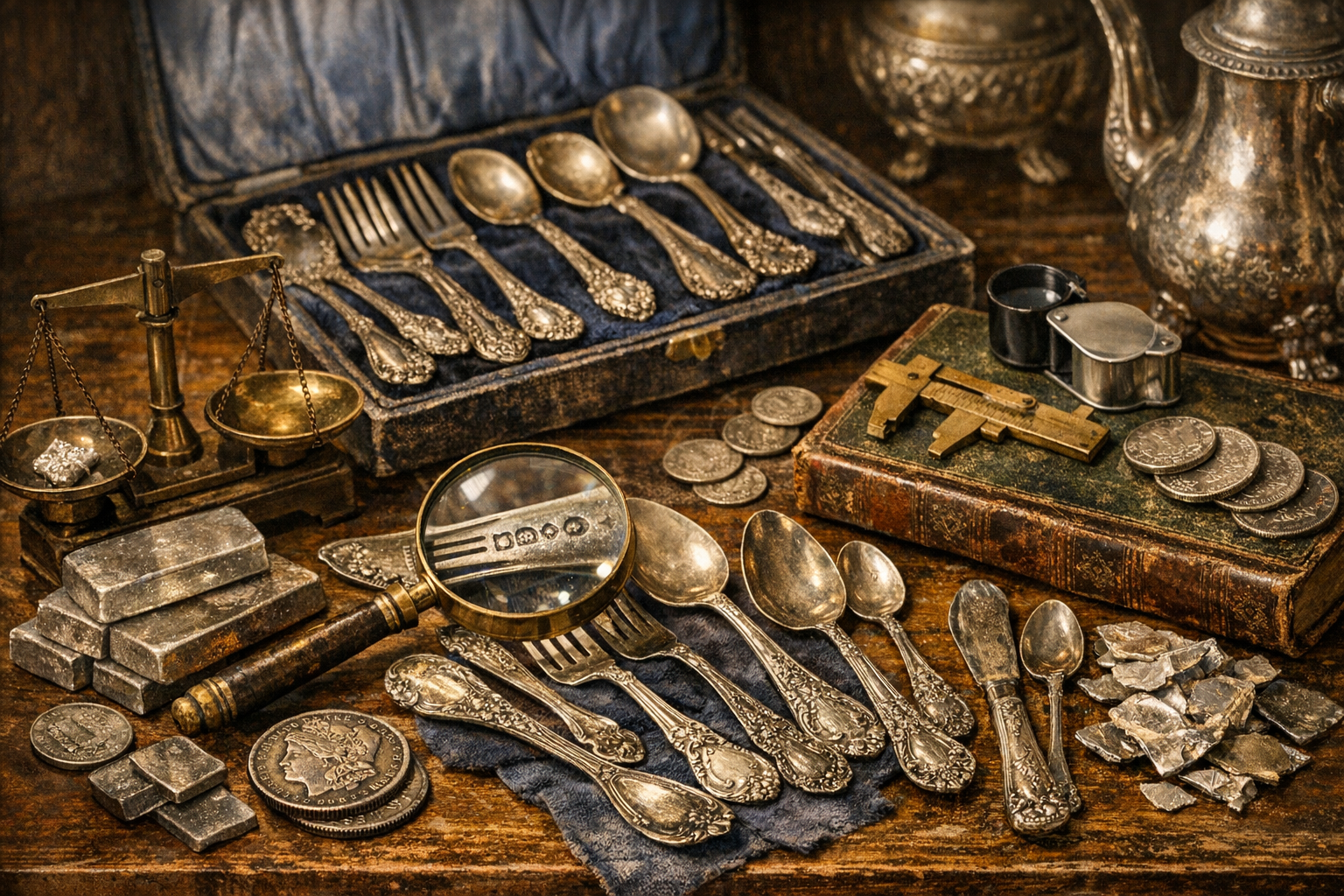
Old silverware value quick checks
Start by separating sterling, coin silver, continental fineness, silverplate, weighted handles, and mixed-material knives. Photograph hallmarks, maker marks, pattern names, monograms, dents, repairs, piece count, serving pieces, total weight, and any storage chest or provenance. Use nearby guides for sterling vs silverplate checks, old silverware pattern identification, and sterling silver hallmarks before pricing a set.
Old silverware value checklist
Antique and vintage silverware can hide remarkable value—monetary and historical. Whether you inherited a flatware set, found a box of serving pieces, or own a single ornate ladle, determining worth starts with correct identification. This guide walks you through the process used by appraisers: sorting types, reading hallmarks, calculating baseline melt value, assessing craftsmanship and condition, and choosing the right market to sell, insure, or conserve your pieces.
Know What You Have: Types, Terms, and Tells
Before you can value a piece, define it. The terminology below prevents common mistakes that can swing value dramatically.
- Sterling silver: Alloy with 92.5% silver content, usually marked “STERLING,” “925,” or with national hallmark systems. For valuation, sterling is the benchmark.
- Coin silver (U.S.): Typically ~90% silver, often marked “COIN” or unmarked on early American pieces. Can be more desirable when tied to notable makers or early periods.
- Continental standards: 800, 830, 835, 900, 925 stamps indicate fineness in parts per thousand. Regional hallmarking may accompany numerals.
- Silverplate: A thin layer of silver bonded to a base metal (often nickel silver). Look for “EPNS,” “EP,” “A1,” “Quadruple Plate,” or “Silverplate.” These have no melt value and trade on maker, pattern, and condition.
- Sheffield plate: 18th–early 19th century fused silver on copper. Some early pieces are collectible; later electroplate versions are less valuable.
- Weighted sterling: Items like candlesticks, compotes, and salt shakers marked “Weighted,” “Reinforced,” or “Sterling Weighted” contain filler materials. Only the thin shell is sterling; scrap yields are modest.
- Mixed-construction flatware: Knives often have stainless blades and hollow sterling handles; carving sets can incorporate steel and fill. Only sterling components count for melt.
Identify the form and function:
- Flatware: place settings (forks, spoons, knives), serving pieces (ladles, pie servers, cold meat forks), and specialty pieces (strawberry forks, asparagus tongs).
- Hollowware: bowls, teapots, coffee services, trays, candlesticks, vases, pitchers.
- Novelty and smalls: vinaigrettes, snuff boxes, baby cups, compacts, etuis.
Matching matters. Complete place settings in a desirable pattern can sell for more than the sum of individual pieces. Odd lots, monogrammed singles, and incomplete services usually sell at discounts unless rare or by top makers.
Hallmarks and Standards: Reading the Metal
Hallmarks and quality marks are the fastest route to authenticity and origin. Examine all surfaces—undersides of bases, backs of bowls, inside lids, and ferrules—and use a loupe.
What to look for:
- Purity/fineness: “STERLING,” “925,” “800,” “900,” etc. U.S. makers often used “STERLING” from the late 19th century onward; earlier pieces may be “COIN.”
- Maker’s marks: Initials, symbols, or full names identifying the workshop or brand (e.g., Gorham, Tiffany & Co., Reed & Barton, Wallace, Georg Jensen, Christofle). Some makers used different marks over time.
- Assay and town marks (common in the UK and parts of Europe): A series of symbols indicating standard, city, and sometimes date letters. Examples:
- Britain/Ireland: A standard mark (e.g., lion passant for sterling in England), an assay office mark (e.g., anchor for Birmingham, leopard’s head for London), a date letter, and a maker’s mark. Duty marks appear on certain periods.
- Germany: Crescent moon and crown with a fineness number from 1888 onward.
- France and other Continental nations use national symbols alongside fineness numerals; details vary by period and item size.
- Import/export marks: Indicate the country of import and standard compliance.
- Plate indicators: “EPNS,” “EP,” “A1,” “Quadruple Plate,” “Nickel Silver,” “ALPACA,” or a maker name without a fineness can suggest plating.
- Weighted/filled notices: “Weighted,” “Reinforced,” “Sterling Handle,” “Cement Filled.”
Red flags:
- Stamps reading “925 China” or “Italy 925” on modern tourist wares can be legitimate sterling but often carry limited collectible premiums unless by a known studio.
- Spurious British-style hallmarks on non-British silverplate are common; corroborate with fineness marks and feel.
- Overstamped or buffed marks suggest tampering; proceed cautiously.
If hallmarks are unclear, test methods include non-destructive XRF (used by appraisers and refiners) or careful acid testing on a discreet area. Acid testing risks etching and should be avoided on high-end pieces.
Baseline Math: Weight, Purity, and Melt Value
Even when collector demand is low, sterling has intrinsic value. Establishing melt value gives you a floor for pricing decisions.
- Separate by type:
- Remove knives and any items with non-silver blades or fill. Weigh sterling components only.
- Group pieces by fineness marks (e.g., 925 vs 800).
- Weigh correctly:
- Use a scale that reads grams to the tenth. Convert grams to troy ounces by dividing by 31.1035.
- Hollow handles and thin shells may surprise you; don’t assume solid.
- Calculate fine silver content:
- Sterling: weight × 0.925 = fine silver ounces.
- Coin silver: weight × 0.900 (or as marked).
- 800 silver: weight × 0.800, etc.
- Determine melt value:
- Melt value ≈ fine silver troy ounces × current spot price.
- Refiners pay a percentage of melt (commonly 85–95%) after removing non-silver weight and fees. Retail buyers generally pay less; collectible factors can push prices much higher.
Reality checks:
- Weighted candlesticks often contain far less silver than expected; many yield only a few troy ounces combined.
- Large trays and tea services can hold substantial weight; even without strong collector interest they can be valuable on metal alone.
- Silverplate has no melt value. Its worth depends entirely on brand, pattern, completeness, and condition.
Condition, Craft, and Completeness
Beyond metal, value pivots on what collectors actually want. Appraisers weigh these factors:
Condition
- Surface: Look for dents, deep scratches, bends, splits, seam separations, and repairs. Clean, crisp cartouches and unworn decoration bring premiums.
- Patina: Attractive patina is desirable. Overpolishing softens details and lowers value. Black tarnish is removable; loss of sharpness is not.
- Monograms: Neutral or historically significant monograms can be acceptable; removal scars or poorly chased erasures reduce value. Some buyers prefer untouched monograms to preserve originality.
Craftsmanship and technique
- Handwrought or hand-chased and repoussé work commands more than mass-stamped wares.
- Cast and assembled elements (finials, feet, handles) with fine chasing add value; obvious solder repairs subtract.
- Design periods: Georgian restraint, Victorian high-relief motifs, Art Nouveau organic lines, Arts & Crafts hand-hammered surfaces, and modernist Scandinavian minimalism each attract different buyers.
Completeness and scale
- Full services in sought-after patterns sell at substantial premiums, especially with original storage chest and consistent monograms.
- Scarcer forms (chocolate pots, asparagus servers, marrow scoops) and large presentation pieces can outpace melt value significantly.
- Matching sets (tea/coffee services with tray, creamer, sugar) typically outperform single odd pieces.
Maker and pattern cachet
- Top-tier names (Tiffany & Co., Gorham earlier works, Georg Jensen, Fabergé, some English and Irish silversmiths, Christofle for plate) add multiples.
- Certain patterns have strong “replacement” markets; a rare serving piece in a popular pattern can bring surprising sums.
Provenance and inscriptions
- Documented provenance (family records, presentation inscriptions tied to notable events) can elevate value. Keep any paperwork with the item.
Care notes:
- Avoid abrasive polishing or buffing wheels that erase detail. Use gentle silver polish sparingly and soft cloths.
- Do not dishwash sterling or plate. Avoid rubber bands and newspaper (sulfur causes tarnish).
Quick Valuation Checklist
- Identify metal: Is it clearly marked sterling/925/800/etc., coin, or plate (EPNS/EP/A1/Quadruple Plate)?
- Photograph and record: Front/back, hallmarks, dents, repairs, and any inscriptions.
- Sort by sets and patterns: Keep matching flatware together; list piece counts and lengths.
- Weigh accurately: Separate non-silver parts; record grams by fineness group.
- Compute floor value: Convert to troy ounces, apply fineness, multiply by spot; note expected refiner percentage.
- Evaluate premiums: Maker, pattern, period, craftsmanship, rarity, condition, completeness.
- Check comparables: Look for actual sale prices in your region and for your exact maker/pattern (not just asking prices).
- Decide market path: Scrap, replacement buyers, specialist dealers, auctions, or private sale—based on premiums vs speed.
- Preserve value: Clean lightly, avoid repairs unless essential and professionally done, keep monograms unless they harm marketability.
- Document for insurance: Inventory with photos and replacement values for significant pieces or sets.
Market Realities: Maker, Pattern, Period, and Selling Paths
Once you know the metal value and potential premiums, choose where and how to sell—or how to insure and care.
When weight rules
- Common patterns with heavy wear, mixed monograms, or incomplete sets often sell near melt. Selling to a reputable refiner or bullion buyer can be efficient.
- Weighted hollowware rarely commands premiums unless by a top maker or in exceptional condition.
When the market pays up
- Renowned makers and patterns: Early Gorham (esp. special order), Tiffany Japanese or Chrysanthemum, Jensen patterns and larger hollowware, distinctive Arts & Crafts studio work, and fine Georgian/Regency/Irish silver with clear hallmarks.
- Scarce forms and large presentation pieces: Tea urns, ewers, oversized trays, novelty or architectural forms, and early handwrought flatware.
- Matching services in demand patterns: Full place-settings with serving pieces and original canteens bring strong “replacement” values.
Choosing a selling venue
- Specialist dealer: Best for curated pieces; expect a dealer margin but quick, knowledgeable transactions.
- Auction: Good for rare or high-end items; wider exposure, but commissions apply and results can vary. Regional expertise matters.
- Replacement-market buyers: Pattern-specific buyers pay premiums for individual pieces in popular patterns.
- Private sale/consignment: Can net more but requires time, accurate descriptions, and buyer outreach.
- Scrap/refiner: Fastest and often best for common, worn, or damaged items; know the payout percentage and assay method.
Valuation types (for documentation)
- Replacement value: Higher, used for insurance; what it would cost to replace with a like item at retail.
- Fair market value: What a willing buyer and seller would agree to in a typical market; used for estate and donation contexts.
- Liquidation value: Fast, forced-sale scenario; typically lowest.
Preservation and storage
- Store in tarnish-inhibiting cloth or sleeves with anti-tarnish strips. Keep pieces dry; avoid direct contact with wood that off-gases acids.
- For tea/coffee services, remove stoppers before long storage; avoid leaving salt in cellars (it corrodes).
Ethical considerations
- Don’t scrap historically important or rare pieces without expert review. The premium above melt can be multiples—and preservation matters.
FAQ
Q: How can I quickly tell sterling from silverplate? A: Look for fineness marks like “STERLING,” “925,” “800,” or clear national hallmarks. Plate often reads “EPNS,” “EP,” “A1,” or “Quadruple Plate” and lacks a fineness stamp. A magnet won’t help—both silver and many base metals are nonmagnetic. When in doubt, weigh and test with professional XRF rather than scratch testing valuable items.
Q: Do monograms hurt value? A: It depends. Many collectors accept tasteful period monograms, especially on hollowware. Removal can leave a visible thin spot or dish-out, reducing value. In popular flatware patterns, monogrammed pieces may sell for less, but rare patterns and makers often sell regardless.
Q: Should I polish before selling or appraisal? A: Light hand-polishing to remove heavy tarnish is fine. Avoid buffing wheels and abrasive compounds that soften edges and erase fine detail—these permanently reduce value. Appraisers prefer to see honest surfaces; streaks of tarnish are not a problem.
Q: How do I weigh knives and weighted items? A: Separate what is truly sterling. Knives usually have stainless blades with hollow sterling handles—only the handles count. Weighted items have filler; you can’t simply weigh and multiply. Appraisers estimate silver shell weight by experience, or a refiner can remove filler to determine net silver.
Q: When is selling as a set better than piece-by-piece? A: Complete, consistent sets in active patterns or from top makers usually bring more together—especially with original cases. If only a few pieces are desirable (e.g., rare serving pieces), selling those individually can outperform a bulk sale.
By methodically identifying metal, reading hallmarks, calculating melt, and then layering in condition, craftsmanship, and market demand, you’ll move from guesswork to grounded valuation. Whether you keep, insure, or sell, a disciplined approach protects both value and history.


