
Michelle Stuart Niagara Chart Book Authentication and Value
Authenticate and value Michelle Stuart Niagara Chart Book pages by checking earth-pigment materials, edition evidence, provenance, condition, and comps.
Get confident before you sell
Get a price-ready appraisal for your Michelle Stuart scroll
Answer a few quick questions and we route your photos, paperwork, and measurements to a specialist who understands bookworks and conceptual art. Delivery timing is confirmed after the required item information is received.
Private upload. No obligation. We never publish your photos.
Continue reading first →What “Historical Scroll” usually means in Michelle Stuart’s work
Michelle Stuart (born 1940) is widely associated with material-driven, research-heavy conceptual works—scrolls, bookworks, and site-responsive installations that combine paper, cloth, pigment, maps, geology, and text fragments. In appraisal requests, the phrase “historical scroll” is often used loosely to describe any Stuart piece made from layered paper or fabric that references a specific place or archive.
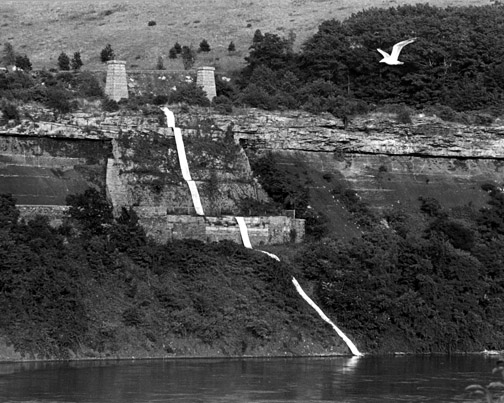
The legacy description that often travels with these works points to a small, portable bookwork connected to the 1975 project Niagara Gorge Path Relocated, sometimes described as a “chart book” or “chart book pages.” Collectors describe it as a stack of pages (around a dozen) arranged like a book, made with earth from the Niagara Gorge applied to muslin and mounted to rag paper.
Because this material is inherently fragile and the market is specialized, the single most important step before setting a price is confirming: what, exactly, you have (an original page, a later study, a reproduction, or documentation of the installation).
Free first read
Check the work before you pay for a report
Upload the page or book, closeups of pigment and paper, any signatures or labels, and the provenance story. The free screener can separate a likely Stuart bookwork, a related study, and a reproduction path.
Start with a free screener. Use a signed report only if you need insurance, estate, donation, or sale documentation.
How to tell whether you have an original work, a study, or a reproduction
Unlike a signed canvas, a conceptual bookwork can be authentic without a visible signature—especially if it was produced for an exhibition, as a gift, or as a component study tied to a larger temporary installation. That said, there are reliable ways to separate original material-based pages from later photographic reproductions or inspired works.
- Surface and material depth: Niagara-earth pigment tends to sit in the fibers and muslin weave, creating uneven density and micro-cracking. Flat, uniform “rust red” often signals printed ink.
- Edge construction: Look for rag paper deckle edges, hand trimming, and layered mounting that reveals muslin backing. Poster-stock or perfectly uniform paper thickness is a warning sign.
- Odor and handling: Earth pigments can retain an earthy/mineral scent (subtle, not musty). Laminated prints smell like adhesives or plastic films.
- Documentation: Contemporary letters, gallery invoices, curatorial notes, or exhibition checklists can authenticate even when the object is unsigned.
If your work includes multiple pages, verify whether they are a coherent set (consistent paper, consistent mounting approach, consistent pigment handling). Mixed sizes or different paper stocks can indicate an assembled group rather than a single issued bookwork.
Authentication checklist (what to photograph and measure)
To get an expert opinion quickly, your photo set matters as much as your written description. Aim for a “museum standard” documentation set: overall views, close-ups, and construction evidence.
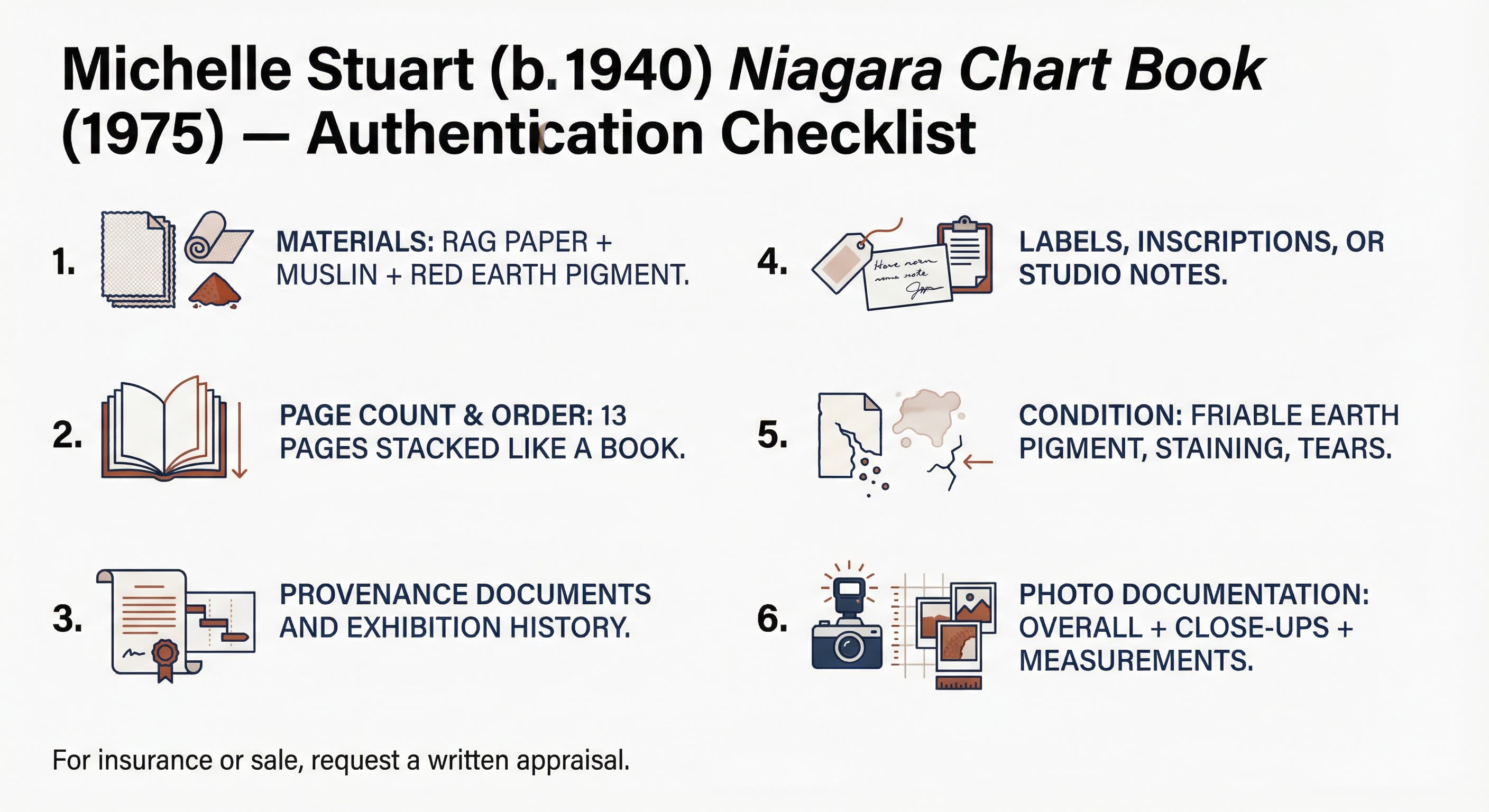
- Overall front/back of each page in natural light, photographed square-on.
- Close-up of the pigment surface showing the muslin weave and any cracking or friability.
- Edges and corners to show paper type (rag vs. modern) and any deckling/hand trimming.
- Mounting details (hinges, adhesive residue, taped edges, or stitching) without peeling anything up.
- Any labels, inscriptions, stamps, or notes on verso, wrappers, folders, or protective boards.
- Measurements (page size and the full stack/thickness if it’s truly “book-like”).
Avoid “testing” the pigment by rubbing or erasing. For earth-based surfaces, even a gentle cloth can remove original material and permanently reduce value.
Condition risks that affect value (earth pigment is not like paint)
The value of a material-based bookwork can drop quickly when the very thing that makes it special—earth, dust, pigment—starts to migrate. Appraisers and buyers focus on stability and documentation.
- Friability and loss: If pigment visibly sheds, it will require conservation consultation before most galleries or auction houses will accept it.
- Water staining and tide lines: These can be devastating on rag paper and often imply mold risk, even if there is no active growth now.
- Adhesive damage: Old tape, pressure-sensitive mounting, and acidic backings can discolor and embrittle paper.
- Handling creases: Deep folds and finger creases read as “improper storage” and reduce collector confidence.
If you’re storing the work at home, aim for stable, moderate humidity, interleave with archival tissue, and avoid direct contact between pigmented surfaces. When in doubt, leave it as-found and document condition rather than attempting DIY cleaning.
Note: We couldn’t find relevant auction comps in our database for this topic right now. If you’re valuing a specific item, try searching by maker/model/material and we’ll expand coverage over time.
What similar items actually sold for
To help ground this guide in real market activity, here are recent example auction comps from Appraisily’s internal database. These are educational comparables (not a guarantee of price for your specific item).
| Image | Description | Auction house | Date | Lot | Reported price realized |
|---|---|---|---|---|---|
| No relevant auction comps found for this topic right now. | |||||
Disclosure: prices are shown as reported by auction houses and are provided for appraisal context. Learn more in our editorial policy.
Have a Niagara Chart Book page?
Start with the evidence, then choose the report level.
Send the full page or book, pigment closeups, edges, backing, labels, and provenance notes. The free screener can flag whether the next step should be identification, auction prep, or a signed appraisal.
Upload photos for a free first lookHow to sell: gallery, auction, or private placement
Because the buyer pool is specialized, the best sales route is usually the one that can explain the work well. Your goal is to reduce friction: clear documentation, careful packaging, and the right venue.
- Specialist galleries / private dealers: Best when you have documentation and want discrete placement. Expect requests for extensive condition photos and provenance.
- Fine-art auctions: Works when the artist has steady secondary-market demand and the house has experience cataloging conceptual works on paper. A house may recommend consigning the set intact, or splitting if they believe individual pages will attract more bidders.
- Direct-to-collector sale: Can work if you already have a buyer network, but it’s the highest risk for returns/disputes unless you supply a thorough condition report.
If you suspect the work relates directly to a known installation and your documentation is strong, a professional appraisal (or at minimum a written condition summary) helps buyers, insurers, and auction houses align on expectations quickly.
References
- Wikimedia Commons: Michelle Stuart, Niagara Gorge Path Relocated image and material notes.
- Whitney Museum of American Art: Michelle Stuart artist record and material context.
- The Metropolitan Museum of Art: Michelle Stuart, Scanning Sequence, graphite and earth on paper.
- MoMA: Michelle Stuart artist page and exhibition history.
- Weschler's: Michelle Stuart Moonlight (Manhattan) auction result.
Collector search variations we cover
These long-tail questions come up in appraisal requests and are addressed in the guide above.
- how to authenticate a Michelle Stuart Niagara Chart Book page
- what is Michelle Stuart Niagara Gorge Path Relocated (1975)
- is a Michelle Stuart historical scroll signed or unsigned
- how to store earth pigment on paper artwork safely
- valuation factors for conceptual bookworks on rag paper
- should I sell Michelle Stuart pages separately or as a set
- what photos do appraisers need for bookwork authentication
- insurance appraisal for mixed-media scrolls and works on paper
Each phrase maps back to the identification workflow, condition guidance, and selling advice above.
How We Research Valuation Data
Our appraisal guides are based on auction results, dealer pricing data, and professional appraiser insights. We may earn a commission when you use our free professional appraisal service. Learn about our editorial standards.
Need more valuation help?
Explore trusted specialists and appraisal tools used by collectors.
Choose your next step
Use the path that matches the decision you need to make about the item.
Not sure it is worth appraising?
Start with a lower-friction screen to understand the likely category, evidence, and next step.
Upload photos for a free first lookWant proof before paying?
See how a signed report documents photos, comparable evidence, condition notes, and value conclusions.
View signed report sampleNeed a signed report?
Use this for insurance, estate, donation, resale, or documented value decisions.
Need documentation now? Start signed appraisalNeed local or specialist help?
Compare directory options when the work needs in-person review or a specialist near you.
Find local art specialistsSee what the report looks like
Sample reports show how photos, comparable evidence, condition notes, and a value conclusion are documented.