Hand Painted Japanese Tea Set: How to Tell Quality from Tourist Ware
Use visible clues first: marks, hand-paint pattern behavior, finish quality, and condition clues separate likely originals from mass-market tourist versions.
Auction comps and price ranges in this guide are sourced from Appraisily’s internal auction results database and are provided for education and appraisal context (not as a guaranteed price). For our sourcing and update standards, see Editorial policy.
By Appraisily TeamReviewed by Appraisily Valuation TeamEditorial policy
Hand-painted Japanese tea sets can move from “pretty” to “profitable” in one inspection point. The difference is not always obvious at first glance, but it is usually visible when you compare maker marks, paint structure, seams, hardware, and usage wear.
If you have a real set and you are still not sure, stop guessing and use the structured checks below. They are the same checks we use in first-read assessments.
Read this guide in order, because each step raises or lowers confidence. If you get to step six and still feel uncertain, the right move is to send photos for a free first read before you make price decisions.
Start with six quick identity checks
Your first read should not start with price guesses. Start with identity. A set can look old and still be recent if three small things are off: markings, paint age behavior, base construction, and how wear is distributed.
What material is it? Tea sets are commonly porcelain/china, sterling, and occasionally mixed silver/china combinations. The identity process differs by material.
Where are the marks? Look for a signature, maker stamp, factory imprint, and import/export code on the underside or hardware.
Is the decoration hand-painted? Inspect brush confidence and layering, not just motif beauty.
How does the glaze or silver finish age? Old wear tends to show in corners, contact points, and high-friction edges.
Is the set complete? Missing handles, lids, lids’ fittings, saucers, and trays reduce identification confidence and valuation stability.
Do all pieces share the same era? A mixed-age set can still be valuable, but it usually values as a collection, not a matched set.
Flip it over: what kiln, maker, and factory marks usually mean
For quality identification, marks are your first hard evidence, not your only evidence. Think of marks as a direction pointer:
Clear, consistent maker marks on matching pieces usually indicate deliberate workshop control.
Factory and export marks can indicate period and destination market focus, especially for tourist-facing production.
Wobbly, uneven, or obviously padded marks often indicate later additions or weak provenance.
On sets with weak marks, the next check is the brushwork. A hand-painted surface can still be copied, but copied surfaces usually drift in consistency under close light.
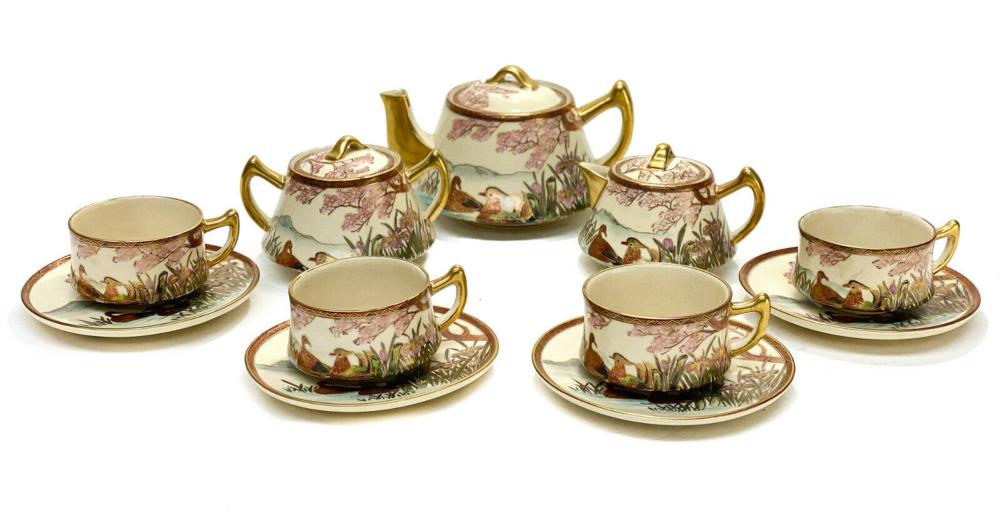
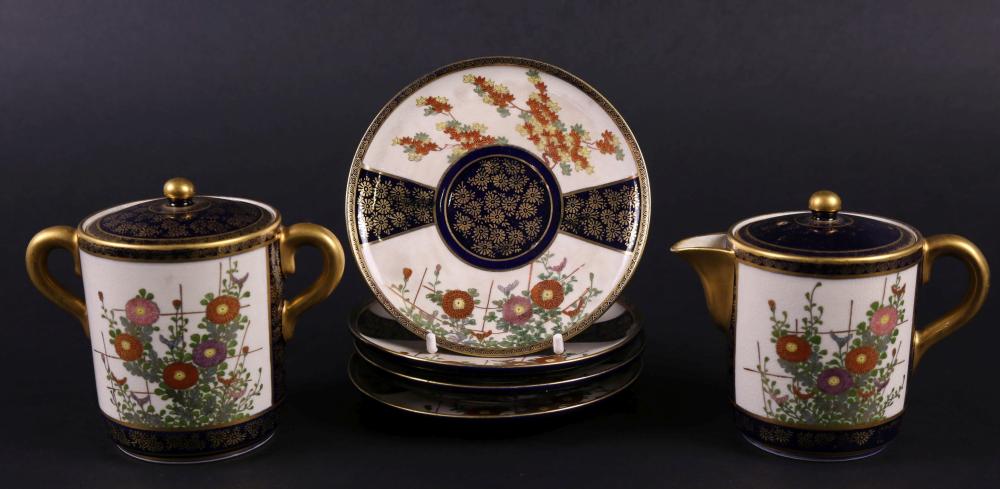
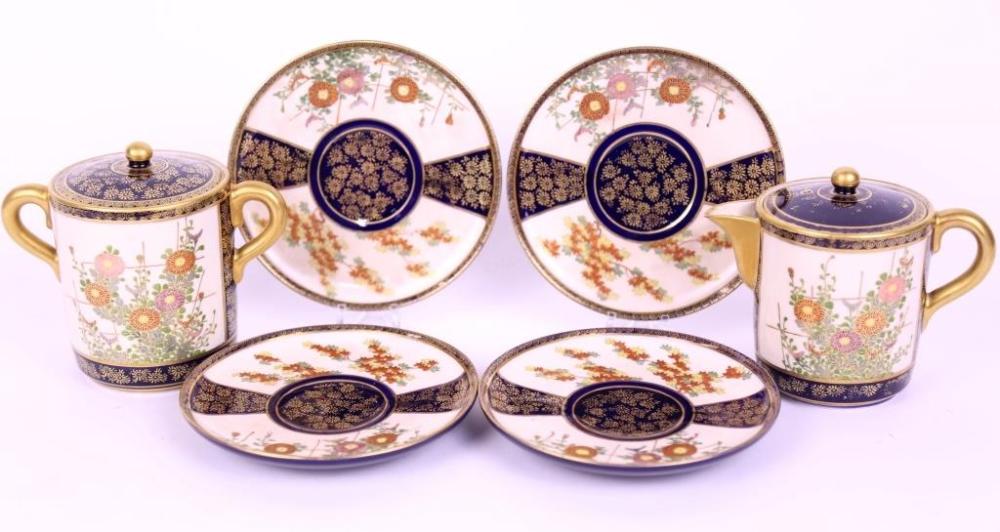
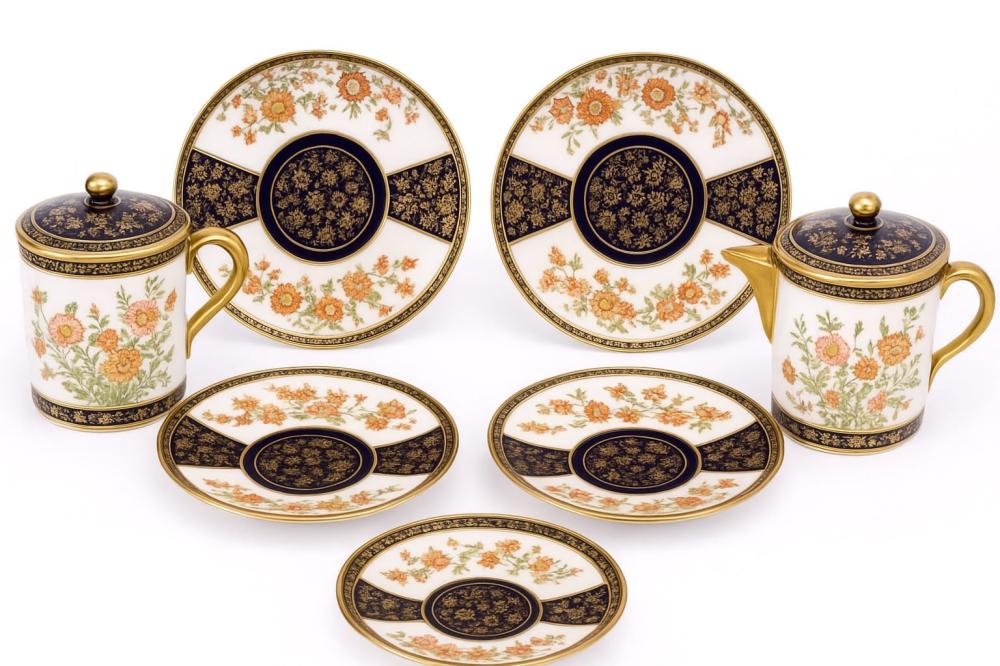
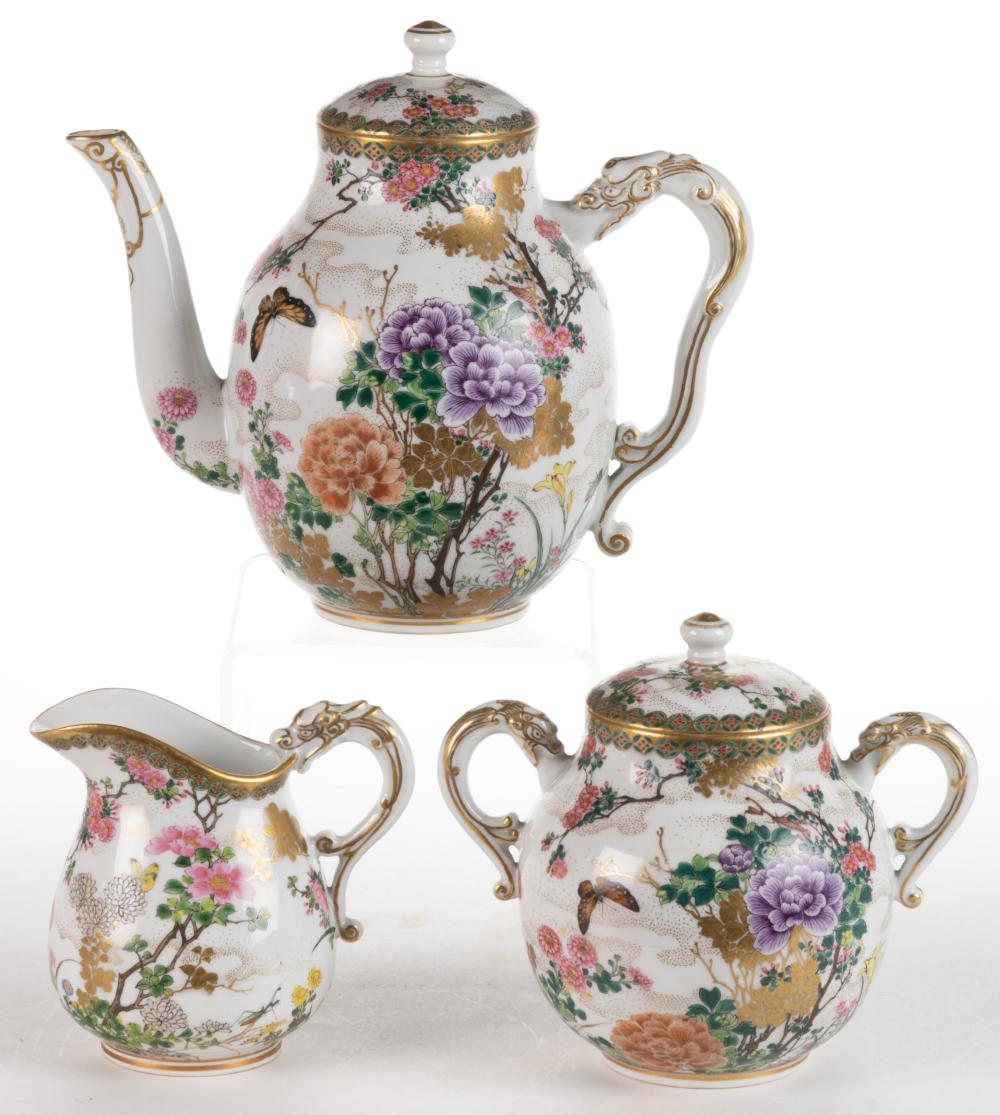
Auction-lot imagery is referenced for educational comparison only; use your own item photos for final identification.
Read paint quality for authenticity clues
Hand-painted pieces usually show confident strokes, small hesitation variation, and age-consistent glaze interactions. Tourist-painted mass-market sets often show one of three patterns:
Pattern repetition that is too perfect across pieces with different use histories.
Surface sheen that looks new and sealed while the body is mechanically worn in a different way.
Paint edges that sit on top of cleaned glaze rather than integrating with the fired surface layers.
This does not prove a set is fake alone. It lowers confidence and raises your due-diligence bar.
Use condition as your reality check
Evidence for value is stronger when condition clues match market expectations. Use this practical reading model:
Minor handling marks on edges and bases are common and usually recoverable.
Deep chips on rim, foot rings, and handle mounts can change buyer confidence quickly.
Restoration and re-gilding should be acknowledged; some restoration stabilizes appearance, but it can reduce uncertainty only if disclosed and dated.
Condition is often the point where “quality set” drops to “nice reproduction” or “nice decor with risk.” That is why this guide pushes condition to the center, not the end.
Sort by material and completeness before you compare prices
Do not compare a silver service to a porcelain tea set. Also do not compare a complete set against a missing-lid fragment set. Market buyers and insurance benchmarks value clarity first.
For identification, separate your photos into three buckets before valuation:
Primary material: porcelain, silver, mixed.
Completeness: complete, partial, partial but restorable.
When these buckets are consistent, your comp work becomes safer.
Use a short scenario: a real-world identification lane
Typical case: a family keeps a hand-painted tea set found in an estate box. It has mixed pieces, a heavy painted crest, and one modern-looking base. If the core pieces share matching mark clusters and similar paint aging, it may sit in an identifiable group. If the set has two eras of wear, it likely remains collectible but should be valued as assembled provenance, not a matched museum-grade set.
That distinction is practical: it affects what you say to buyers and what to document before selling or insuring.
What similar items actually sold for
To help ground this guide in real market activity, here are recent example auction comps from Appraisily’s internal database. These are educational comparables (not a guarantee of price for your specific item).
Shown AUD range: AUD 300-AUD 450. Median of these 4 AUD examples: AUD 375.
Disclosure: prices are shown as reported by auction houses and are provided for appraisal context. Learn more in our editorial policy.
Ready to compare your set to sold results?
If your set still feels unclear after the checks above, send photos and let us match your specifics against realistic sale direction, handling risk, and completeness profile.
Not sure if your item is worth appraising? Let us take a look.
Upload a photo, tell us what you know, and get a free first read. If a full appraisal makes sense, we will say so.
Free. No card needed. Takes about two minutes.
How market evidence should influence your next step
Appraisal comparisons are the final proof moment. The strongest way to use comps is directional: not to set your item’s final value, but to frame where confidence starts and where it should stop.
Recent internal auction references showed similar silver tea services in broad ranges, including a Camusso Sterling Silver Tea Set at USD 8,500, a Vintage Sterling Persian Silver Tea Set at USD 1,700, and another sterling lot near USD 650. Another Eldred’s lot with roughly 142 oz. sold around USD 2,700, while a substantial hand-hammered set from Hess Fine Art sold near USD 3,800.
The lesson is straightforward: material, matching quality, and condition can change outcome more than decorative style alone. If your set is hand-painted porcelain with weak marks but strong completeness, your outcome is usually different from matched sterling with coherent marks and low wear.
If you still need confirmation, this is the exact moment to send photos and let a specialist map your object against sold results.
When to send photos today
Marks do not agree across pieces.
Paint quality and finish aging do not line up with the story.
Set completeness is uncertain.
Potential buyer has asked for valuation language before pricing.
If two or more of these are true, send clear photos now. A free first read is usually the cheapest way to avoid overpaying or underselling.