Estate Appraisal Checklist: What to Gather Before Calling an Appraiser

Don

Auction comps in this guide are for appraisal context, not guaranteed prices. See our editorial policy.

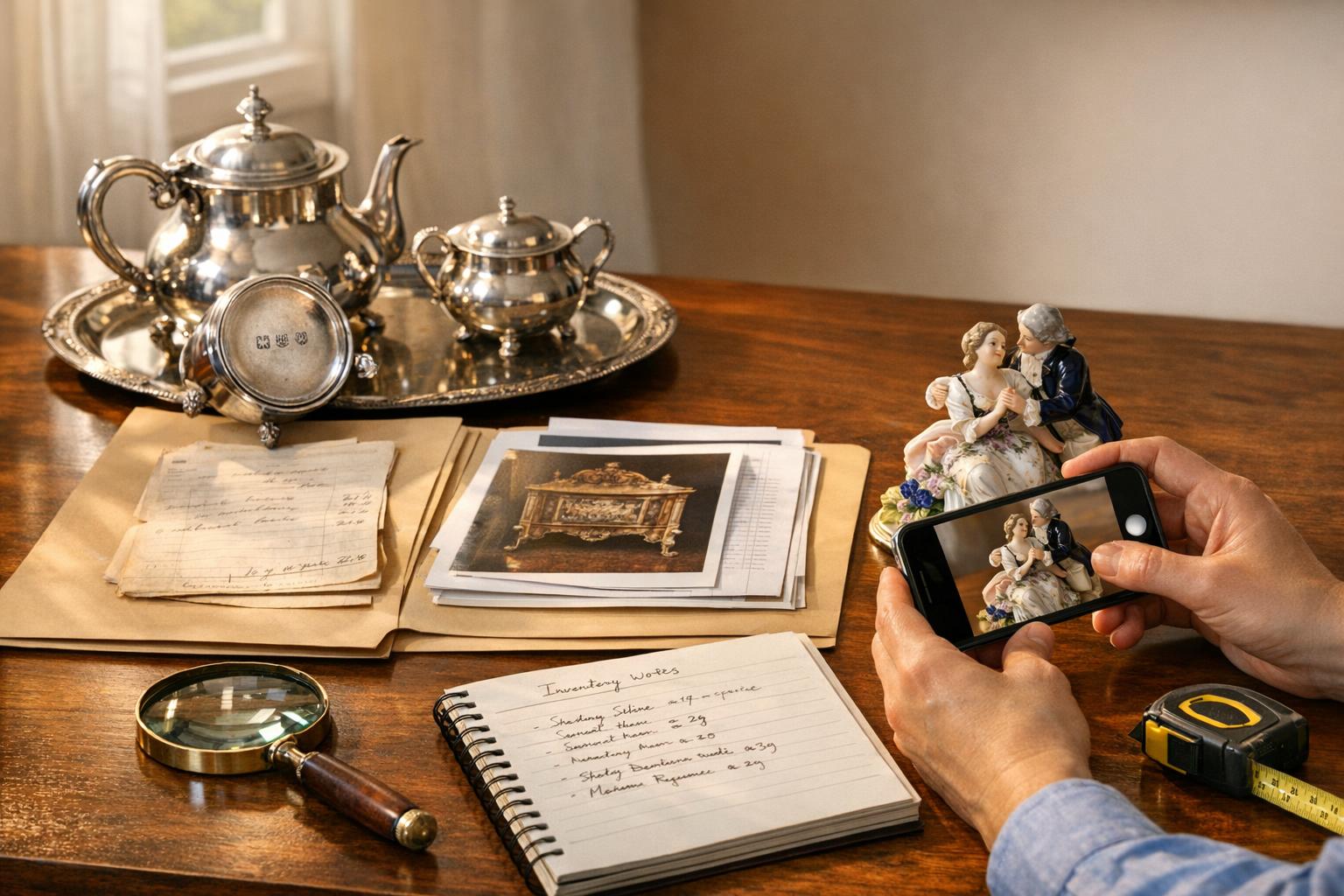
Organized desk with estate items ready for appraisal: silver tea service with hallmarks, photographs, provenance documents, magnifying glass, and inventory notebook
Estate appraisal preparation: photographs, provenance documents, and inventory notes organized for professional review.

Quick Answer: The 10-Minute Prep Workflow

Before you pick up the phone, set aside 10 minutes per item to gather: clear photographs from every angle (including the bottom and any marks), anything that proves where the item came from (receipts, auction catalogs, family letters), prior appraisals or insurance records, and basic measurements. This one step — documentation before the call — separates appraisals that close in days from ones that drag on for weeks.

Below is the full checklist with photo guidance and real examples from recent estate settlements.

Why This Checklist Exists

Estate appraisals happen for very different reasons — and each one demands different documentation:

  • Probate or estate settlement requires fair-market-value appraisals that can withstand court scrutiny. The appraiser must document methodology and comparable sales.
  • Insurance replacement focuses on what it would cost to replace the item in today's market — not what it would sell for at auction.
  • Charitable donation triggers IRS requirements. Donations over $5,000 require a "qualified appraisal" per IRS Publication 561.
  • Sale or consignment needs market analysis: what similar items have actually sold for at auction, not retail estimates.

In every case, the appraiser needs raw material from you. The Uniform Standards of Professional Appraisal Practice (USPAP) require appraisers to gather and verify information — but they cannot verify provenance you never handed them. The difference between a well-prepared estate file and a thin one often determines whether an item appraises at $500 or $5,000.

Consider this: complete estate appraisal ledgers from the Gertrude Vanderbilt Whitney archive — including mansion inventories, insurance appraisals, and deed-of-gift copies — sold as a group for $1,000 at a 2023 Richard Stedman auction. A single jewelry appraisal page from the same estate, annotated with family sale notes, brought $950. These documents mattered because they created an unbroken chain of ownership and value.

The Core Checklist: 10 Items to Gather

Work through this list for each item or lot you want appraised. You do not need every item on this list — but the more boxes you check, the more accurate your appraisal will be.

Decision tree showing when you need a professional appraisal: insurance claim, donation over $5,000, probate court, or sale/auction
Use this decision tree to confirm whether your situation requires a documented professional appraisal.

1. Photographs of every item — front, back, sides, top, bottom

Your phone camera is sufficient. Shoot in natural light near a window — never with flash. Capture the front, back, both sides, top, and especially the bottom where maker's marks, signatures, and manufacturer stamps are found. Each photo should fill the frame with the item. Avoid wide shots that show the whole room.

2. Close-up photos of all marks, hallmarks, signatures, and stamps

These are the fingerprints of authentication. On silver, look for the lion passant (sterling), date letters, and maker initials. On paintings, examine the front corner of the signature and the reverse of the canvas for gallery labels. On ceramics, check the base for manufacturer backstamps.

Close-up of sterling silver hallmarks showing lion passant, date letter, and maker's marks stamped into the metal base
Sterling silver hallmarks: the lion passant confirms British sterling, the date letter identifies the year, and the maker's mark identifies the silversmith.

3. Provenance documents — anything that proves where the item came from

This is the single most valuable thing you can gather. Provenance includes: original purchase receipts, auction catalogs with lot numbers and price annotations, exhibition labels from the back of a painting, insurance schedules listing the item, family letters that describe when and where an ancestor acquired something, estate sale tags, or appraisal documents from prior valuations.

Collection of provenance documents: aged auction catalog page, handwritten bill of sale, insurance appraisal, and family letter describing an antique purchase
Provenance documents: auction catalogs, bills of sale, insurance records, and family correspondence. Each one creates a link in the chain of ownership.

4. Prior appraisals or insurance records

Even an outdated appraisal tells the appraiser something: that a professional examined this item at some point, noted its condition, and assigned a value. Insurance schedules are especially useful because they often describe items in standardized language with replacement values that can be compared against current markets.

5. Condition notes — be honest about damage and repairs

Document every crack, chip, restoration, replacement part, and area of wear. An appraiser will spot these anyway — and discovering damage the owner did not disclose creates distrust. Note any cleaning or restoration work already performed. Do not attempt to repair or clean items before photographing them; improper cleaning can permanently reduce value.

Close-up of antique wooden furniture showing condition issues: repaired crack in table top, wear marks on drawer edge, replaced brass handle, and surface scratches
Condition evidence: repaired cracks, replaced hardware, and surface wear — all of which affect valuation and must be disclosed to the appraiser.

6. Measurements and weight

Height, width, depth, diameter — whatever applies. For flat items (paintings, prints), measure both the image area and the full framed dimensions. Weight matters for sculpture and metalwork. Record dimensions in both inches and centimeters when possible.

7. A written inventory list

One sentence per item: what it is, what it's made of, who made it (if known), when you think it dates from, and what condition it's in. This becomes the appraiser's working list and ensures nothing gets missed during the examination.

Organized estate inventory setup: laptop showing spreadsheet with item columns, labeled photographs of antiques, notebook with handwritten entries
A simple inventory system: spreadsheet or notebook with item descriptions, measurements, condition notes, and photo references — one line per item.

8. Purchase receipts or bills of sale

What was paid and when establishes a baseline. Even if the item has appreciated enormously, the original purchase price anchors the provenance chain and helps the appraiser understand acquisition context.

9. Comparable sales research (optional but helpful)

If you have time, search for similar items that have sold at auction. You do not need to determine the value yourself — but bringing auction results for comparable pieces gives the appraiser a starting point for market analysis and signals that you understand the difference between retail price and auction realization.

10. Estate paperwork: death certificate, will, trust documents

For probate or estate-related appraisals, the appraiser may need to understand the legal context: who the executor is, whether the appraisal is for date-of-death valuation or current value, and which items are included in the estate being appraised. Having these documents ready eliminates back-and-forth delays.

How to Photograph Your Items for the Appraiser

The quality of your photographs directly affects the quality of the appraisal. An appraiser who can see clear details remotely can triage which items need in-person examination and which can be valued from documentation alone.

The raking light technique

Place a desk lamp at a low angle to the side of the item so light rakes across the surface. This reveals texture, hairline cracks, craze patterns in glaze, and repair evidence that flat lighting hides. It is the same technique appraisers use when they examine items in person.

Raking light technique demonstration: a desk lamp positioned at a low angle casts directional light across a porcelain vase, revealing surface texture and hairline cracks in the glaze
Raking light: position a lamp at a low angle so light skims across the surface. This reveals cracks, repairs, and texture invisible under overhead lighting.

Smartphone photography tips

  • Natural light only. Window light from the side. Turn off overhead lights and flash.
  • Use a neutral background. A white sheet, piece of poster board, or clean wall works.
  • Include a scale reference. Place a ruler or common object (a coin, a pen) next to the item in one shot so size is clear.
  • Shoot in focus mode, not portrait mode. Portrait mode blurs edges that the appraiser needs to see.
  • Take more photos than you think you need. It is easier to delete extras than to request a second photo session.
A porcelain figurine photographed from five angles: front, back, left side, right side, and bottom showing the maker's stamp
Five angles per item: front, back, both sides, and the bottom. The base view is critical — that is where makers stamp their marks.

What Counts as Provenance — and Why It Drives Value

Provenance is the documented history of who owned an item and when. It is the difference between "my grandmother had this" and "this was purchased from Black, Starr & Frost in 1942, appraised by Witherbee in 1947 for $339,000, and annotated in the family estate sale records."

The second description — backed by actual documents — creates a valuation that can be defended. The first description leaves the appraiser guessing.

Strong provenance materials include, in order of weight:

  1. Original purchase documentation — receipts, bills of sale, gallery invoices
  2. Auction records — catalogs with lot numbers, hammer prices, buyer annotations
  3. Prior professional appraisals — signed reports from credentialed appraisers (ISA, ASA, AAA)
  4. Exhibition history — labels from the reverse of paintings, exhibition catalogs
  5. Insurance schedules — itemized lists with values from prior policies
  6. Family documentation — letters, diaries, estate inventories that mention the item
  7. Photographic evidence — historical photographs showing the item in situ with a known owner

What if you have zero provenance? This is common — and not a dealbreaker. The appraiser will rely on physical examination: materials analysis, stylistic dating, maker's mark identification, and comparison with documented examples. But you should still gather everything you do have, even if it is just a photograph of the bottom of a vase with a faint stamp. That faint stamp could be the difference between a $50 attribution and a $5,000 identification.

Two-step intake

Share your estate items details with an expert today

Share the basics and we’ll route you to the right specialist with a written quote and next steps.

Step 1 of 2

Secure intake. Routed to the right specialist. Checkout only if you decide to proceed.

How to Organize Everything Before the Call

Once you have gathered the materials above, organize them so the appraiser can review efficiently. The goal is a single folder — digital or physical — that contains everything about one item or lot in one place.

  • Digital folder per item. Create a folder named with a simple identifier: 01-silver-tea-service, 02-oil-painting-landscape, 03-porcelain-figurine. Put all photos, provenance scans, and notes inside.
  • Name photos descriptively. front.jpg, bottom-marks.jpg, signature-detail.jpg, reverse-gallery-label.jpg. Do not leave files named IMG_4821.HEIC.
  • One inventory document. A simple spreadsheet or notebook page that lists each item with its folder number, a one-line description, and any provenance highlights. The appraiser uses this as their roadmap.
  • Keep originals accessible. If you have physical documents (receipts, letters, catalogs), photograph or scan them at the highest resolution your phone allows. Store the originals safely — the appraiser may want to examine them in person.

What NOT to Waste Time On

Equally important: here is what you should avoid doing before your appraisal.

  • Do not clean or restore items before photographing them. Improper cleaning removes patina, erases maker's marks, and permanently reduces value. Let the appraiser advise whether professional cleaning is appropriate.
  • Do not obsessively Google values. Online estimate tools and retail price guides create inflated expectations. An appraiser's job is to determine what your specific item would actually realize in a defined market — not what a similar-looking item lists for on a retail website.
  • Do not assume online estimates equal appraisal values. Automated valuation models and "what's my item worth" widgets produce ranges based on keywords, not examination. They cannot account for condition, attribution, or provenance — the three factors that move value the most.
  • Do not attempt DIY authentication. If you suspect an item is by a particular maker or artist, do not try to confirm it yourself and present the conclusion as fact. Gather the evidence (marks, labels, provenance) and let the credentialed appraiser reach the attribution.

When to Escalate to a Professional Appraisal

Not every item in an estate requires a formal documented appraisal. But certain situations demand one — and failing to get one can cost you far more than the appraisal fee.

  • Insurance replacement needs. If you need to insure an item, you need a documented replacement value. Insurance companies will not accept your guess or an online estimate.
  • IRS donation thresholds. Charitable contributions of property valued over $5,000 require a qualified appraisal attached to your tax return. The IRS has specific requirements for who can perform this appraisal and what it must contain.
  • Probate court requirements. Estate settlements typically require date-of-death valuations that can withstand court and beneficiary scrutiny. A USPAP-compliant appraisal provides that defensibility.
  • High-value single items. Any individual item you believe may be worth $1,000 or more warrants professional examination. The appraisal fee ($150-$500+ per item or hourly) is small compared to the risk of undervaluing a $10,000 piece at $500.
  • Disputed estates. When multiple heirs have competing interests, a neutral, credentialed appraisal prevents accusations of bias.

If any of these apply to your situation, start with our pre-screening intake — you will be matched with an appraiser who specializes in your item category and jurisdiction.

Ready to get your estate items appraised?

Gather your photos, provenance notes, and inventory list — then send them through our pre-screening. We'll match you with a credentialed specialist who handles your type of property.

  • Credentialed appraisers (ISA, ASA, AAA)
  • USPAP-compliant reports for insurance, probate, and donation
  • Written quote within 24 hours
Start your appraisal

No obligation. We review your items and confirm the right specialist before you commit.

References & Sources

Related Guides

Search Questions This Guide Answers

Readers often search for these questions — each one is covered above:

  • what documents do I need for an estate appraisal
  • how to prepare items for professional appraisal
  • estate appraisal preparation checklist
  • what photos to send an appraiser
  • how to prove provenance for antiques
  • what is a qualified appraisal for IRS donation
  • how to photograph antiques for appraisal
  • what counts as provenance documentation
  • when do I need a professional estate appraisal
  • probate appraisal requirements for executors

Each question above is addressed in the guidance above. If your situation is more complex, start an intake and we'll route your details to the right specialist.

Estate items to appraise? Gather your photos and provenance — then start here.

Start your appraisal