Estate Cleanout Worksheet Before You Sell, Donate, or Throw It Away

Estate Cleanout Worksheet Before You Sell Donate or Throw It Away: free estate cleanout worksheet to sort, value, and decide every item

Auction comps in this guide are for appraisal context, not guaranteed prices. See our editorial policy.

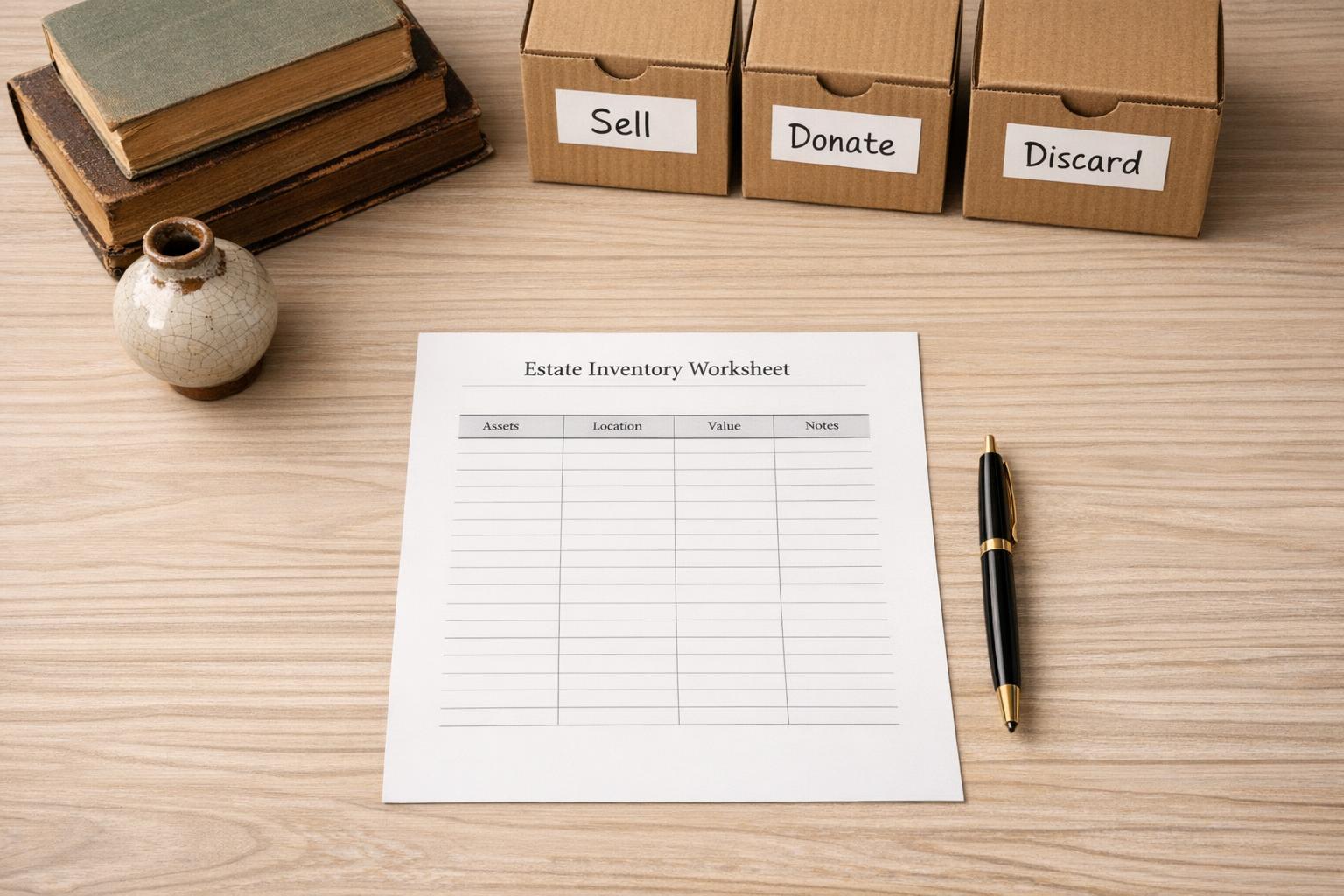
Estate Cleanout Worksheet Before You Sell Donate or Throw It Away example: Organized desk with estate inventory worksheet, pen, vintage items, and labeled boxes for sell, donate, and discard categories

Estate Cleanout Worksheet Before You Sell Donate or Throw It Away: appraisal and value basics

Estate Cleanout Worksheet Before You Sell Donate or Throw It Away research should start with identification, condition, provenance, and recent comparable sales. Use this guide to compare the signals that matter before paying for a formal appraisal or deciding whether to sell.

Quick Answer: Why You Need a Worksheet Before Touching Anything

An average estate cleanout service costs $1,250 (Angi 2026 data), with a range from $50 to $6,000 depending on home size and how much sorting you leave to professionals. The single biggest lever you have to reduce that cost — and avoid accidentally discarding something worth hundreds or thousands — is a systematic worksheet you fill out room by room before any item leaves the house.

This guide gives you exactly that: a printable worksheet template, a triage decision tree, and step-by-step instructions for documenting, valuing, and disposing of every item you encounter. Whether you're settling a parent's home after probate, downsizing before a move, or preparing for an estate sale, working through this worksheet methodically will save you money, time, and regret.

The Estate Cleanout Worksheet: Your Room-by-Room Tracking Sheet

The core of any effective estate cleanout is a simple spreadsheet or printed form with these columns:

Printable estate cleanout worksheet template with columns for item description, condition, maker's marks, estimated value, and disposition category
A blank worksheet template — one per room, one row per item. Print several copies before you start.
Column What to Write Why It Matters
# Sequential number (1, 2, 3…) Creates an audit trail; you can cross-reference photos and receipts
Item Description What it is, material, size, notable features Essential for insurance claims, auction listings, and donation receipts
Condition Excellent / Good / Fair / Poor Drastically affects resale value and disposition choice
Maker / Mark Brand, manufacturer, artist signature, hallmarks The #1 value driver — documented attribution can multiply prices 3–10×
Est. Value Low–high range based on research or gut check Helps triage: items above ~$100 deserve professional attention
Disposition Sell / Donate / Keep / Discard / Appraise Final decision — drives your next action for each item
Notes / Photo "Photo taken," receipt number, auction lot number Proof of condition and value for tax and insurance purposes
Done ✓ Checkbox when item is fully processed Prevents double-handling and tracks your progress room by room

Print one sheet per room. Work through items in the order you encounter them — don't skip around. The discipline of sequential documentation is what prevents valuable items from slipping into the discard pile during an emotional or exhausting cleanout.

Set Up Four Sort Zones Before You Start

Before you pick up a single item, designate four physical areas in the home (corners of the garage, separate rooms, or labeled boxes). Every item you log on your worksheet goes into one of these zones:

Three labeled cardboard boxes reading Keep, Sell, and Donate with vintage collectibles nearby including a brass lamp and porcelain figurine
Physical sort zones make the worksheet actionable — every logged item has a destination box.
  • Keep — Items with sentimental value, family heirlooms, or things you plan to use. Store these carefully; they're often the most irreplaceable.
  • Sell — Items with market value above your threshold (we suggest $100+). These go to auction houses, online marketplaces, or estate sales.
  • Donate — Items in usable condition that don't meet your sell threshold. Charities, thrift stores, museums, and historical societies are all options. Always get a receipt.
  • Discard — Broken, damaged, or worthless items. Recycle what you can; responsible disposal matters.

A fifth "parking" category — Appraise — catches anything you're unsure about. Set these items aside in a dedicated area and photograph them for a professional review later. This is the most important box on your worksheet.

The Triage Decision Tree

When you're holding an item and staring at your worksheet, use this four-question flowchart to decide its fate:

Estate item triage flowchart: Start → Is it sentimental? → Could it sell for $100+? → Is it in usable condition? → Are there salvageable parts? → Keep / Sell / Donate / Discard
Four questions resolve the fate of virtually every estate item. Print this flowchart and tape it to your worksheet clipboard.
  1. Is it sentimentally valuable to a family member?Keep. Note it on the worksheet, photograph it, and store it with care. Sentimental value often exceeds market value — that's fine, but document it anyway for insurance.
  2. Could it sell for over $100 at auction or online?Sell. Mark it for auction, photograph it, and research comparable sales. Items with maker attribution, rarity, or strong collector demand regularly clear this threshold.
  3. Is it in usable condition with no major damage?Donate. Log it, get a receipt from the charity, and note the fair market value for your tax deduction. The IRS requires written acknowledgment for donations of $250 or more.
  4. Are there salvageable parts (hardware, fabric, materials)?Parts. Sometimes a broken piece contains valuable components — brass hinges, working clock movements, intact drawer pulls. Salvage those first, then discard the rest.

If none of the above applies, the item goes to Discard — but recycle where possible. Many municipalities offer bulk pickup, and some junk yards pay for scrap metal.

What to Look For: Marks, Signatures, and Maker Attribution

The single most common mistake people make during estate cleanouts is not looking closely enough at what they're holding. A generic-looking ceramic vase might bear a maker's stamp on the base that turns it from a $15 thrift-store piece into a $500+ collectible. Here's your inspection checklist:

Person examining the base of a vintage ceramic vase with a magnifying glass to identify maker's marks and signatures in warm raking light
Always check the underside, back, and interior rim of items. Maker's marks, hallmarks, and signatures are the fastest path to identifying value.
Item Type Where to Look What to Look For
Ceramics & pottery Underside / base Maker's stamp, country of origin, pattern numbers, artist signatures
Silver & metalware Bottom rim, inside edge Hallmarks (purity stamps), maker's marks, assay office marks, date letters
Furniture Underside of drawers, back panels Manufacturer labels, hand-cut dovetail joints, branded stamps, paper labels
Artwork & prints Lower corners (front and back) Signatures, edition numbers (e.g., "12/100"), gallery labels, framing marks
Books Title page, copyright page First edition statements, publisher imprints, dust jacket price clippings
Jewelry & watches Clasp, inside band, case back Karat stamps (14K, 18K), brand engravings, serial numbers, movement markings

Document every mark you find in the "Maker / Mark" column of your worksheet. Even if you can't identify it immediately, a clear photo of the mark is something a professional appraiser or online collector community can help you decode later.

Photograph Every Item Before It Leaves the House

Once an item is logged on your worksheet, take at least three photos:

Person photographing antique silverware on a neutral backdrop with a smartphone for an online auction listing with natural window light
Three photos per item: a full shot, a maker's mark close-up, and a condition detail. This standard serves auction listings, insurance records, and donation documentation equally well.
  1. Full item shot — Clean background, good lighting, showing the whole piece.
  2. Mark / signature close-up — Whatever you wrote in the "Maker / Mark" column, photograph it clearly.
  3. Condition detail — Any chips, cracks, repairs, or wear. Honest documentation protects you in resale and is required for insurance appraisals.

Name your photo files to match the worksheet row number (e.g., room-living-01.jpg, room-living-01-mark.jpg, room-living-01-damage.jpg). This cross-referencing system means you can find any photo from the worksheet and vice versa — critical when you're dealing with hundreds of items across multiple rooms.

Don't Overlook Documents and Paperwork

Estate cleanouts aren't just about objects. Before you start sorting furniture and collectibles, sweep the home for important documents:

Organized filing cabinet with labeled manila folders for Jewelry, Furniture, Art, Collectibles, and Documents with a hand placing a folder into the correct drawer
Important documents should be the first things you locate and secure — before any sorting of physical items begins.
  • Will, trust, and probate documents — These govern what happens to the estate's assets.
  • Insurance policies and appraisals — Existing appraisals are gold: they give you baseline values and often include detailed descriptions you can copy directly into your worksheet.
  • Receipts and provenance records — Original purchase receipts, auction catalogs, gallery certificates, and letters of authenticity dramatically increase an item's value and saleability.
  • Financial records — Bank statements, tax returns, investment account information. These belong to the executor or attorney, not in the discard pile.

Place all documents in a locked box or with the estate attorney before continuing with the physical cleanout. Note on your worksheet's header page which documents you found and where they're stored.

Donation Receipts and Tax Deduction Basics

If you're donating items from the estate, proper documentation can yield meaningful tax deductions. Here's what the IRS requires:

Charity donation receipt with item descriptions and estimated values placed next to a clipboard with an estate cleanout checklist and pen
Every donation needs a dated receipt describing the items and their fair market value. For donations over $500, file Form 8283 with your tax return.
Donation Value Documentation Required
Under $250 Receipt from charity with date, description, and organization name
$250 – $500 Written acknowledgment from the charity stating what was received
$500 – $5,000 Form 8283 (Section A) filed with your tax return, plus the receipt
Over $5,000 Qualified written appraisal + Form 8283 (Section B) signed by appraiser and donee

Log every donation on your worksheet with the charity name, date, receipt number, and your estimated fair market value. Take photos of each donated item before it leaves. This documentation chain protects you if the IRS ever questions the deduction.

Important: you cannot deduct the full "retail" value of a used item — the IRS expects fair market value (what a willing buyer would pay a willing seller). Thrift store resale prices are a reasonable reference point for household goods.

When to Call a Professional Appraiser

Not everything needs a professional appraisal — but some items absolutely do. Use this checklist to flag items for the "Appraise" column on your worksheet:

  • Items you suspect are worth $1,000+ but can't verify online
  • Artwork with a signature you can't immediately identify
  • Jewelry with hallmarks you don't recognize (especially gold, platinum, or gemstone pieces)
  • Antique furniture with maker's labels, hand-cut joinery, or unusual materials
  • Coins, stamps, or collectibles in original packaging or albums
  • Anything the will or trust specifically identifies as requiring valuation
  • Items for insurance replacement — if you're keeping something and want to insure it, you need a current replacement value from a qualified appraiser

For the "Appraise" pile: photograph each item front, back, marks, and any damage. Bag and tag them with the worksheet row number. A professional appraiser can work from photos for an initial triage, then request physical inspection for the most promising pieces. This saves you the cost of a full on-site appraisal for an entire house.

Documented maker attribution can lift auction prices by 30% to several hundred percent — a verified Stiffel lamp, a Lladro figurine, or a first-edition book can transform what looked like a discard item into a four-figure sale. That's why the "Appraise" column on your worksheet is arguably the most important one.

What a Completed Worksheet Looks Like

Here's how a single room's worksheet might look after you've worked through it systematically:

Sample completed estate cleanout worksheet with rows for a brass Stiffel lamp, Lladró figurine, and encyclopedia set showing estimated values and disposition decisions
A sample worksheet for one room. Note how each item has a disposition decision, a photo reference, and a checkmark when fully processed.

The discipline of filling out every row — even for items you're confident are low-value — is what prevents the regrettable "I wish we'd looked at that more closely" moment. Most estate liquidation professionals will tell you that the most valuable find in a house was something everyone walked past for years.

The Estate Sales and Auction Market in 2026

The online estate auction market remains strong in 2026. Platforms like Maxsold and regional auction houses now handle 90%+ of estate lots online, which means your "Sell" items have a broader audience than ever. Recent spring cleanout auctions have seen brisk bidding on mid-century furniture, sterling silver, and signed artwork — categories that regularly appear in estate homes.

A few market signals to keep in mind as you fill out your worksheet:

  • Sterling silver continues to track with spot prices; even damaged pieces have scrap value.
  • Mid-century modern furniture by identifiable makers (Danish teak, Herman Miller, Eames) still commands strong auction prices.
  • Signed prints and original artwork — even by regional or listed-but-not-famous artists — are seeing renewed collector interest.
  • Vintage jewelry, particularly signed costume pieces and antique gold, remains a consistent auction performer.

Use these signals as a rough filter when you're estimating values on your worksheet. If an item fits one of these categories, mark it "Appraise" rather than guessing a number.

Note: We found 4 relevant comps in our database for this topic right now. We’ll continue to expand coverage over time.

What similar items actually sold for

To help ground this guide in real market activity, here are recent example auction comps from Appraisily’s internal database. These are educational comparables (not a guarantee of price for your specific item).

Image Description Auction house Date Lot Reported price realized
Auction comp thumbnail for WW2 British S.O.E. ‘throw away’ 3rd pattern Fairbairn and Sykes fighting knife/dagger by A. Wright and Son of Sheffield (JB Military Antiques, Lot 395) WW2 British S.O.E. ‘throw away’ 3rd pattern Fairbairn and Sykes fighting knife/dagger by A. Wright and Son of Sheffield JB Military Antiques 2024-09-15 395 AUD 700
Auction comp thumbnail for ANNE YEATS (1919-2001) Dish Cloth Thrown Away oil (Morgan O'Driscoll, Lot 22) ANNE YEATS (1919-2001) Dish Cloth Thrown Away oil Morgan O'Driscoll 2007-11-19 22 EUR 750
Auction comp thumbnail for Marcel Dzama: What ever you do, don't throw me into the void or the king off the nobodies (Van Ham Kunstauktionen, Lot 1134) Marcel Dzama: What ever you do, don't throw me into the void or the king off the nobodies Van Ham Kunstauktionen 2021-06-23 1134 EUR 1,300
Auction comp thumbnail for Escher, M.C. (1898-1972). 'Bezint nooit eer gij begint' (Never Think Before You Act). Woodcut, 1921, (Bubb > Kuyper: Auctioneers of Books, Fine Arts & Manuscripts, Lot 3923) Escher, M.C. (1898-1972). 'Bezint nooit eer gij begint' (Never Think Before You Act). Woodcut, 1921, Bubb > Kuyper: Auctioneers of Books, Fine Arts & Manuscripts 2020-05-28 3923 EUR 4,000

Disclosure: prices are shown as reported by auction houses and are provided for appraisal context. Learn more in our editorial policy.

Free worksheet + expert review

Share your estate cleanout details with an expert

Tell us about the items you're unsure about. We'll route your photos and notes to a qualified appraiser who can advise on what's worth selling, donating, or keeping — usually within 24 hours.

Step 1 of 2

Secure intake. Routed to the right specialist. Checkout only if you decide to proceed.

Related guides

Need a local expert? Browse our Art Appraisers Directory or Antique Appraisers Directory.

References & Editorial Standards

This guide was prepared by the Appraisily editorial team and reviewed by ISA- and ASA-qualified personal property appraisers. Our methodology prioritizes IRS-compliant documentation practices, current auction market data, and professional appraisal standards (USPAP). We do not receive compensation from any auction house, charity, or appraisal service mentioned.

For our full editorial policy, including how we source and verify market data, visit our Editorial Policy page.

Market cost data sourced from Angi 2026 estate cleanout cost survey and HomeAdvisor. IRS publication 561 and Form 8283 instructions govern donation documentation requirements.

Search Variations Collectors Ask

Readers often Google these questions — each one is addressed in the worksheet guidance above:

  • How do I make an estate cleanout checklist for a large home?
  • What items should I keep versus sell during an estate cleanout?
  • Estate cleanout worksheet printable PDF free download
  • How to value items before donating from an estate
  • Tax deduction rules for estate donation cleanouts
  • What to look for when cleaning out a deceased parent's house
  • How to tell if something in an estate is valuable
  • Estate sale prep worksheet room by room template

Every question above is covered in the worksheet sections and decision tree earlier in this guide.

Browse our full directory of appraisal resources and guides

Start your appraisal

Need Help Valuing Your Estate Items?

Our network of qualified appraisers can review your photos and provide written valuations — often within 24 hours. Start with the items you flagged as "Appraise" on your worksheet.

  • Photo-based triage from $79
  • Written reports for insurance & tax purposes
  • ISA/ASA/AAA-qualified professionals
Start your appraisal

No obligation — share photos, get a quote, decide on your terms.

Machine-readable summaries

Use these machine-friendly references for AI and crawler discovery of Appraisily content.

Get your estate items valued by a pro Start your appraisal