Patricia 78 rpm record: appraisal and value basics
Patricia 78 rpm record research should start with identification, condition, provenance, and item-specific market evidence. Use this guide to compare the signals that matter before paying for a formal appraisal or deciding whether to sell.
The phrase “Patricia pour son Papa” reads like a dedication rather than a commercial artist credit, and the warning “use prohibited for radio or public auditions” is a clue that this is not a retail record. In many countries, recording services offered “instantaneous” discs for birthdays, voice letters, or musical messages. Some were cut onto lacquer (often called acetate), others were pressed in shellac.
That matters because value in this category depends far more on content and provenance than on age alone. A famous performer or historically significant speech can bring strong money; a family message with unknown speakers is often modestly priced—but still worth preserving carefully.
Free instant estimate
Not sure if your item is worth appraising? Let us take a look.
Upload a photo, tell us what you know, and get a free first read. If a full appraisal makes sense, we will say so.
Free. No card needed. Takes about two minutes.
How We Research Valuation Data
Our appraisal guides are based on auction results, dealer pricing data, and professional appraiser insights. We may earn a commission when you use our free professional appraisal service. Learn about our editorial standards.
Quick value range (typical for anonymous private discs)
Most anonymous “home” or private-recording 78s with no known performer and no historically documented provenance trade more like ephemera than like collectible jazz/blues 78s. A practical range is often:
| What you have | What drives it | Typical range |
|---|---|---|
| Anonymous family message (playable) | Sentimental/private interest; modest collector demand | a value that must be established from current, topic-matched sales |
| Unusual content (local radio, choir, regional event) | Broader appeal + story value | a value that must be established from current, topic-matched sales |
| Identifiable notable person or historic event | Provenance + documentation dominates price | a value that must be established from current, topic-matched sales (case-by-case) |
Important caveat: a disc can look “clean” but still be damaged. Groove wear, cracking, delamination (on lacquer/acetate), and off-center cutting can make playback difficult—lowering value.
What is a “private recording” 78?
A commercial 78 RPM record was manufactured for public sale by a label (Victor, Columbia, Pathé, etc.). A private recording is different: it may have been cut at a studio service counter, through a mail-in service, or commissioned for personal use. The warning about radio or public auditions is essentially saying “this is not licensed for broadcast.”
In France and elsewhere, you’ll see similar language on custom-cut discs. The dedication “Patricia pour son Papa” strongly suggests a gift. It could be a spoken message, a song, or a child’s voice. If you can safely digitize the audio, content can dramatically change the value.
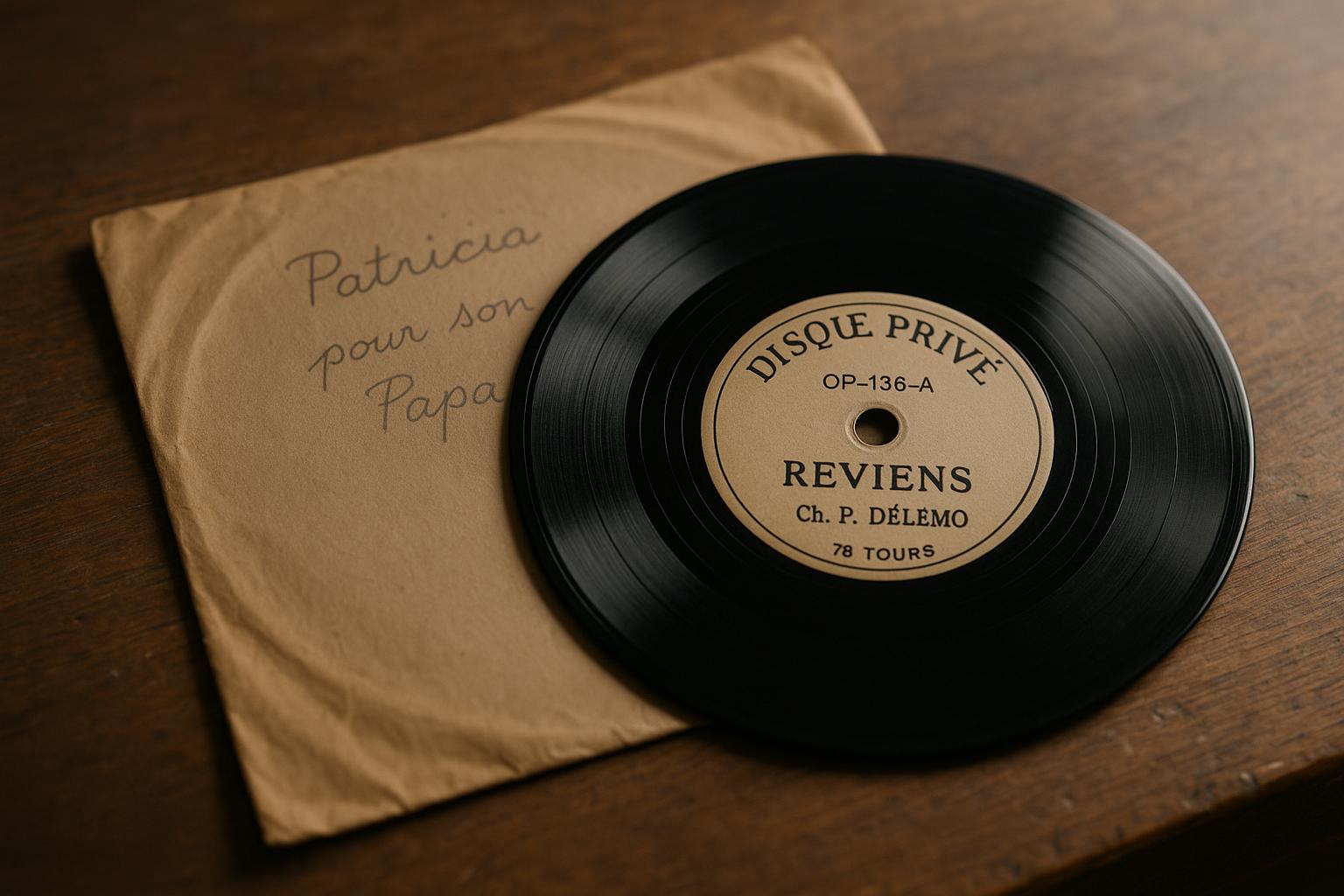
How to date a “Patricia pour son Papa” disc (1930s–1940s clues)
- Language and rights warnings: “use prohibited…” style text is consistent with private/broadcast-restricted use.
- Format and speed: 78 RPM strongly suggests pre-1950 mainstream consumer formats (though 78s persisted later).
- Material: shellac 78s feel heavier and more brittle; lacquer/acetate often show a glassy coating on an aluminum core.
- Typeface and printing quality: simple typography and generic fields often indicate a service label.
- Handwriting and sleeve style: can help narrow decade, but it’s supportive evidence—not definitive on its own.
If you can photograph the runout area (the smooth ring near the label), sometimes a studio or service name, a matrix number, or a date code appears there. That’s one of the best ways to corroborate a 1930s–1940s timeframe.
Condition checklist (what appraisers look for)
- Surface scratches: long radial scratches are the most audible; light scuffs may be cosmetic.
- Edge chips/cracks: common on shellac; can make shipping risky and playback unsafe.
- Warping: heat exposure can warp discs and make tracking difficult.
- Lacquer delamination: on acetates, the coating can lift or crack, permanently damaging the audio.
- Label condition: stains, tape, or missing information reduces collector appeal and makes identification harder.
What actually drives value?
For an unknown “Patricia for her dad” disc, the market is usually driven by curiosity and narrative. Collectors of vernacular audio, local history, and ephemera may pay for something that feels like a time capsule. But to exceed modest prices, you typically need one of the following:
- Identifiable people: a known singer, a notable family, or a historically important voice recording.
- Documented provenance: letters, photographs, studio receipts, or a clear chain of ownership.
- Rarity plus audience: regional language recordings, wartime voice letters, or rare genres with active collectors.
- Playback quality: clean, centered, playable grooves that can be digitized without major distortion.
Note: We couldn’t find enough auction records that directly match Patricia Pour Son Papa 78 RPM Record Guide to publish a defensible price table. If you are valuing a specific item, include its maker, model, material, photos, and condition so the search can be narrowed.
What similar items actually sold for
The current auction search does not contain at least three clean, directly matched sales for Patricia Pour Son Papa 78 RPM Record Guide yet. If you’re valuing a specific item, use the free estimate flow so the search can be narrowed by maker, material, photos, and condition.
Disclosure: prices are shown as reported by auction houses and are provided for appraisal context. Learn more in our editorial policy.
Want help checking a private 78 RPM record?
Upload label, runout or matrix, sleeve, edge, surface, and provenance photos for a free first read. Use it to decide whether the disc needs a full written appraisal or preservation-first handling.
Takeaway: the market can pay more for 78s tied to a recognized artist/label, even when they’re not rare grails. But lots described as home recordings (or anonymous private recordings) frequently sell for low double digits unless there’s a story or exceptional content.
How to sell (and how to describe it honestly)
- Online marketplaces (eBay, etc.): best for modest-value private discs. Photograph the label, sleeve, and any handwriting. Disclose chips and scratches.
- Specialist record communities: collectors may be interested if you can identify the content (genre, language, region).
- Local history organizations: if the recording documents a place, event, or language community, consider donation or sale to an archive.
Privacy note: if the disc contains personal messages, think about whether it should be publicly sold, digitized, or shared. That’s a human decision, not just a market one.
Care and safe playback (don’t destroy the audio)
- Store vertically in a sleeve; avoid stacking heavy records.
- Keep away from heat; warping and lacquer failure can be irreversible.
- Do not use a heavy vintage needle on potentially lacquer-coated discs.
- For digitization, use a modern turntable and consult a specialist on stylus size.
If you suspect it’s lacquer/acetate (rather than shellac), handle it gently: acetates can crack or delaminate from the core. In that case, preservation and transfer can be more important than resale value.
Search variations collectors ask
Readers often Google these variations while researching private 78 RPM recordings:
- what does “use prohibited for radio or public auditions” mean on a record
- Patricia pour son Papa record value
- how to tell if a 78 rpm record is shellac or acetate
- how to date a private recording disc from the 1930s
- where to sell home recording 78s near me
- is it safe to play a lacquer acetate disc
- how to digitize a 78 rpm private recording without damage
- are anonymous private recordings worth anything
- French 78 rpm private recording translation and identification
Each question maps to the identification, value, and care guidance above.
References
- Invaluable (auction results platform)
- Phonograph record (format background)
- Acetate disc (lacquer disc background)
Wrap-up
A “Patricia pour son Papa” 78 RPM disc is best understood as a private recording: meaningful, historically interesting, and sometimes valuable—but usually not priced like a commercial, collectible artist release unless you can document who is speaking/singing and why the recording matters. If you document the label, runout area, and condition (and digitize safely), you’ll have the information needed to decide whether to keep it as a family artifact, sell it as ephemera, or preserve it as local history.