
9 Writing Desk Details That Can Boost Antique Furniture Value: appraisal and value basics
9 Writing Desk Details That Can Boost Antique Furniture Value research should start with identification, condition, provenance, and recent comparable sales. Use this guide to compare the signals that matter before paying for a formal appraisal or deciding whether to sell.
Quick answer — who this list is for
If you own, are about to buy, or have inherited an antique writing desk, this guide tells you exactly what to look for before you commit to a sale or insurance appraisal. The nine details below are the same features professional appraisers check first — and each one can swing a desk's value by hundreds or even thousands of dollars.
The antique desk market has been gaining momentum. In December 2025, a writing desk once used by J.R.R. Tolkien sold at Christie's for £330,200 — six times its pre-sale estimate — driven by provenance, original condition, and maker quality. Even without literary celebrity, the right combination of details can multiply a desk's auction price dramatically.
1. Hand-cut dovetail joinery
Open a drawer and look at the corners. Irregular, slightly uneven pins and tails signal hand-cut dovetailing — a hallmark of pre-1860 craftsmanship. Machine-cut dovetails, by contrast, are perfectly uniform and typically indicate later factory production or a reproduction.
Why it matters for value: Desks with hand-cut dovetails routinely achieve 20–50% higher hammer prices at auction because they confirm age and craftsmanship. A desk attributed to the early 19th century with hand-cut dovetails and solid secondary wood is far more likely to be genuine than one with machine-cut joints.

2. Marquetry and decorative inlay
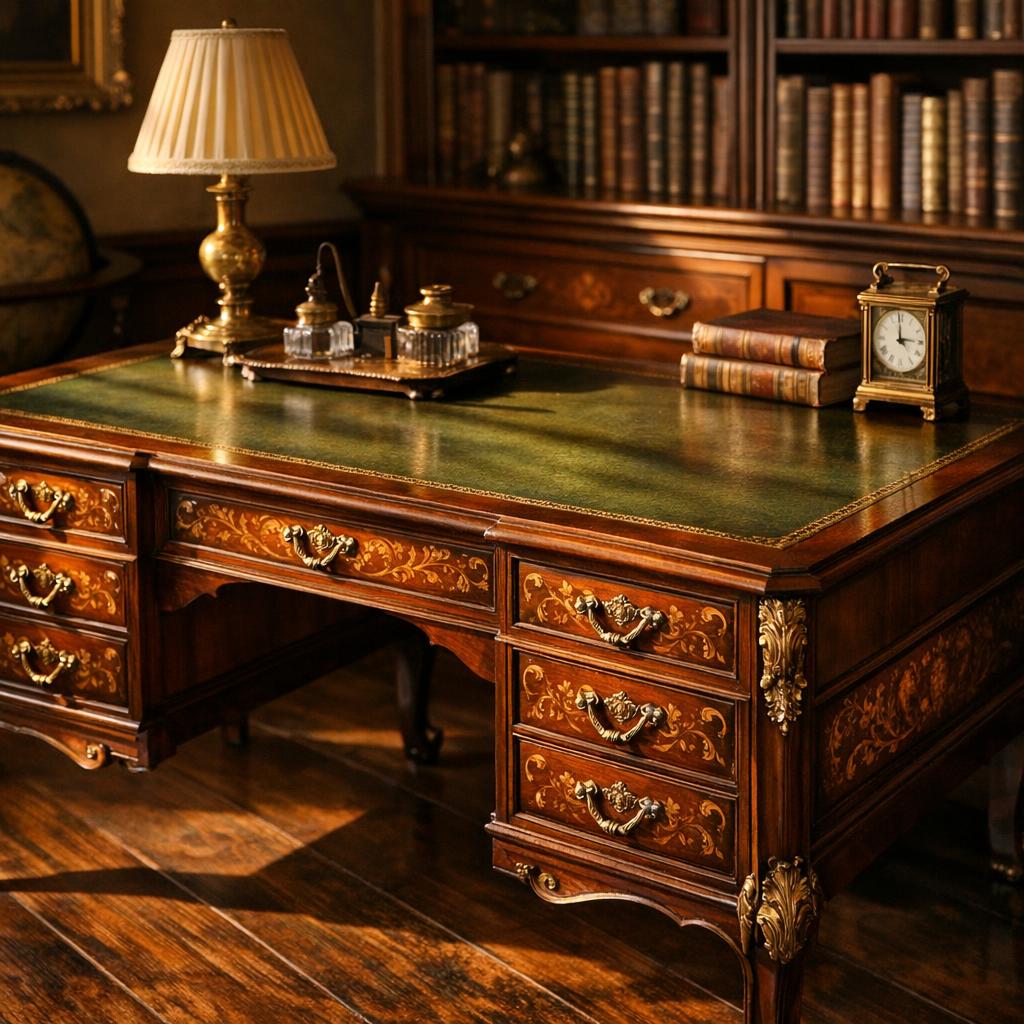
Marquetry — the art of assembling thin veneers of contrasting woods into floral, geometric, or pictorial patterns — is one of the fastest ways to elevate a writing desk's desirability. Banding (narrow strips of contrasting wood along edges) and parquetry (geometric tile-like patterns) also add visual distinction.
What the market shows: On sellingantiques.co.uk in early 2026, marquetry writing tables ranged from £295 to £45,000 — a 150× spread driven largely by inlay complexity, condition, and maker reputation. A Victorian inlaid rosewood marquetry desk recently listed at €4,115 through a UK dealer, while attributed pieces by known ébénistes reach five figures at major houses.

3. Original tooled leather writing surface
A genuine gilt-tooled leather insert — often in green, burgundy, or tan — is one of the most visually striking value indicators. Look for embossed border patterns, gilt tooling, and the natural patina of decades of use. Replaced or faux-leather inserts are common on mid-tier desks and depress value.
Value impact: Original leather with intact gilt tooling and minimal cracking can add 15–30% to a desk's realized price. The leather's condition also helps authenticate the piece — aged leather develops a distinctive mellow patina that reproductions struggle to fake.

4. Maker's label, stamp, or brand
Hidden inside drawers, on the back panel, or branded into the underside, a maker's label or stamp is the single strongest provenance signal. Named cabinetmakers — Gillows of Lancaster, Holland & Sons, Waring & Gillow, or American firms like Herter Brothers — can multiply a desk's value many times over.
The reality check: Maker marks are genuinely rare on ordinary writing desks. JustAnswer's antique desk appraisals frequently note that "it is very rare to find a maker on these desks." When you do find one, verify it against known references — a confirmed attribution to a listed maker is the most powerful single value booster.

5. Original brass hardware and escutcheons
Examine drawer pulls, keyhole escutcheons, and decorative mounts. Original brass hardware with a consistent aged patina — not shiny replacements — supports a desk's authenticity. Look for slotted screws (pre-Phillips era) and hand-filed burrs on the underside of pulls.
What to watch for: Replaced hardware is one of the most common "improvements" that actually hurts value. Collectors and auction houses prefer original, even if worn, over period-correct replacements. A desk with all-original brass hardware will outperform a refitted equivalent by 10–25%.

6. Secondary wood tells the true age
The wood used for drawer sides, backs, and the desk's carcass (often cheaper pine, oak, or poplar) reveals more about age than the showy exterior mahogany or walnut. Hand-planed secondary wood with saw marks, slight irregularities, and occasional bark edges points to pre-industrial production.
Appraiser insight: If a desk's exterior is mahogany but the drawer interiors are machine-milled pine with modern staples, the piece is almost certainly a later reproduction. Authentic period desks use secondary woods appropriate to their region and era — English oak in Georgian pieces, Baltic pine in Victorian, American white pine in early Federal pieces.

7. Hand-carved ornament and applied details
Acanthus leaf motifs, shell carvings, reeded columns, and applied brass galleries all signal a higher tier of craftsmanship. The key test: look for slight asymmetry and tool marks in the carving. Router-carved or CNC-reproduced ornament is perfectly symmetrical and lacks the chisel-defined texture of hand work.
Market context: Canonbury Antiques notes that "intricate carvings" are among the first details appraisers check. Carved ornament on a writing desk signals it was a status piece — built for a wealthy household or professional office — and commands accordingly higher prices.

8. Honest patina and period-appropriate wear
A desk's surface tells a story. Natural patina — the warm amber glow of hand-rubbed shellac darkened over decades — cannot be convincingly replicated. Look for wear patterns that make sense: slight edge wear on the writing surface, ink marks near the center, polished edges on frequently opened drawers.
Why refinishing hurts: A stripped and refinished desk may look "cleaner" but loses its historical surface and typically 20–40% of its value. The antique market overwhelmingly prefers honest, undisturbed patina over glossy restoration. If a desk looks too perfect, treat that as a red flag.

9. Provenance and historical association
The most dramatic value multiplier of all is documented ownership history. A writing desk linked to a notable figure — a writer, statesman, or prominent family — can exceed estimates by multiples. The Tolkien desk at Christie's (December 2025) hammered at £330,200 against an estimate of just £50,000–£80,000.
What counts as provenance: Estate inventories, auction catalogs, photographs, letters referencing the desk, or a clear chain of ownership from a known collection. Even modest provenance — "descended from the original owner, a Victorian solicitor in Bath" — can lift a desk above comparable unprovenanced examples by 25–50%.
What actually moves the needle on value
Not every detail carries equal weight. Based on auction results and dealer pricing patterns, here is the rough hierarchy of impact:
| Detail | Typical value impact | How often it appears |
|---|---|---|
| Confirmed maker label/brand | 2×–10× baseline | Rare (≤5% of desks) |
| Documented provenance | 1.5×–6× baseline | Uncommon (≤10%) |
| Complex marquetry/inlay | +50% to +200% | Moderate (15–25%) |
| Original tooled leather | +15% to +30% | Common on quality desks |
| Hand-cut dovetails | +20% to +50% | Common pre-1860 |
| Original brass hardware | +10% to +25% | Very common |
| Honest patina (unrefinished) | +20% to +40% vs. refinished | Increasingly rare |
Ranges are indicative; actual premiums depend on the desk's period, maker, and market conditions at sale.
Note: We couldn’t find enough auction records that directly match Antique Writing Desk Value: 9 Details That Matter to publish a defensible price table. If you are valuing a specific item, include its maker, model, material, photos, and condition so the search can be narrowed.
What similar items actually sold for
To help ground this guide in real market activity, here are recent example auction comps from Appraisily’s internal database. These matched sales are market context only, not an object estimate or identification, and they do not guarantee a price for your specific 9 writing desk details that can boost antique.
Shown USD range: USD 350-USD 1,600. Median of these 5 USD examples: USD 1,200.
| Comparable | What sold | Auction house | Date | Lot | Source-reported amount |
|---|---|---|---|---|---|
 |
Baker Furniture Mahogany Writing DeskSource blocked; provenance matched | J. Garrett Auctioneers | 2025-09-20 | 431 | USD 1,200 (buyer’s-premium treatment unknown) |
 |
19th C Renaissance Revival Library Writing Table DeskSource blocked; provenance matched | Public Sale Auction House | 2022-09-03 | 276 | USD 350 (buyer’s-premium treatment unknown) |
 |
BAKER WRITING DESK TABLE. THOMAS PHEASANT COLLECTION. ELEGANT SABER LEGS. THREE DRAWERS. METAL ACCENSource blocked; provenance matched | Uniques & Antiques | 2024-06-11 | 81 | USD 1,300 (buyer’s-premium treatment unknown) |
 |
ITALIAN CAMPAIGN EMPIRE STYLE WRITING TABLE DESK MADE IN ITALY. CLASSICAL ARCHED BASE. BRASS ACCENTSource blocked; provenance matched | Uniques & Antiques | 2024-04-09 | 220 | USD 375 (buyer’s-premium treatment unknown) |
 |
LARGE BAKER FURNITURE BRASS-BOUND LEATHER-TOP PARTNER'S DESKSource blocked; provenance matched | Austin Auction Gallery | 2026-02-22 | 3337 | USD 1,600 (buyer’s-premium treatment unknown) |
How these auction records were verified
Each row retains its exact source URL, lot identity, retrieval time, access result, and immutable record hash. Live source access was blocked; the exact record matched Appraisily's immutable pipeline provenance. Inspect the public comparable provenance record.
Disclosure: prices are shown as reported by auction houses and are provided for appraisal context. Learn more in our editorial policy.
Two-step intake
Get the right appraisal for your situation
Share the basics and we’ll route you to the right specialist with a written quote and next steps.
Secure intake. Routed to the right specialist. Checkout only if you decide to proceed.
When to escalate to a professional appraisal
If your desk checks three or more of the boxes above — especially a maker's mark, complex marquetry, or documented provenance — a formal written appraisal is worth the investment. Professional appraisals cost £150–£400 ($200–$500) but provide:
- Insurance replacement value — the cost to source a comparable desk today, which is often higher than auction estimates.
- Fair market value — the most likely sale price at auction, needed for estates, donations, or consignment decisions.
- Authenticated attribution — a credentialed appraiser (ASA, AAA, or ISA) can confirm or challenge a maker mark, which directly affects saleability.
Start your appraisal and share photos of any labels, joinery, or inlay you find. Our routing system connects you with a furniture specialist who can confirm whether your desk's details justify a full written valuation.
Search variations collectors ask
Readers often Google these questions — each is answered in the guide above:
- How to tell if an antique writing desk is valuable
- What makes a Victorian desk worth more at auction
- How to identify hand-cut dovetail joints on furniture
- Does original leather increase antique desk value
- How to find a maker's mark on an old writing desk
- Antique writing desk appraisal near me — what to expect
- What is marquetry on furniture and why does it cost more
- Should I refinish an antique desk before selling it
Every question above is covered in the valuation guide. Use the sections that match what you see on your desk.
Know what you own
Upload photos of your writing desk — labels, joinery, inlay, leather — and get matched with a furniture specialist who can confirm its value and next steps.
- Written valuation in under 24 hours
- Insurance, sale, or donation-ready documentation
- Access to credentialed ASA, AAA, and ISA appraisers
From £150 / $200 for a single-item written valuation.