
Does this furniture form belong on the list?
This list is for someone looking at a tall chest, secretary, sideboard, Windsor, settle, commode, hardwood cabinet, work table, campaign chest, or twentieth-century cabinet, and trying to decide whether that form still belongs in a specialist sale or only as old brown furniture.
The strongest tells are visible from a photo:
- Upper and lower cases, doors, and interiors that began as one object.
- A width and depth that can still move into a present-day room.
- A named maker, workshop, community, or model, not only a style word.
- Drawer bottoms, spindles, flush pulls, or joinery that match the outline.
Both objects sit on this list. A style word in a title is a lead, not proof that the whole piece was made together.
Check the tall chest and the secretary first
1. Highboys and chests-on-chests
Look past the stacked silhouette to the joint between the cases. Drawer graduation, backboards, feet, and brasses should agree from cornice to bracket foot.
Timber and width change the number. A walnut or yew two-case chest with a usable 95 cm width is not the same object as a later “Chippendale style” chest of drawers.
Check first: Compare drawer bottoms, backboards, and feet in both cases; a married tallboy is two objects stacked.
2. Secretary bookcases
A secretary is one architectural object only when the glazed doors, fall front, and writing interior belong to the same case.
The Doyle lot below is catalogued as Federal Style, which is why its number sits below the period chests-on-chests.
Check first: Open the fall front and see whether the pigeonholes, glazing bars, and base hardware are one interior.
What these Chinese hardwood cabinets sold for
These five sales are Chinese hardwood cabinets, one form on this list. They are market context only, not an object estimate or identification, and they do not price the other nine forms.
Shown USD range for these cabinets: USD 100–2,300. Median of these 3 USD examples: USD 150.
| Comparable | What sold | Auction house | Date | Lot | Source-reported amount |
|---|---|---|---|---|---|
| No auction photo supplied | 2PCS CHINESE HARDWOOD FURNITURE CABINET & TABLESource blocked; provenance matched | Ahlers & Ogletree Inc. | 2024-01-24 | 761 | USD 150 (buyer’s-premium treatment unknown) |
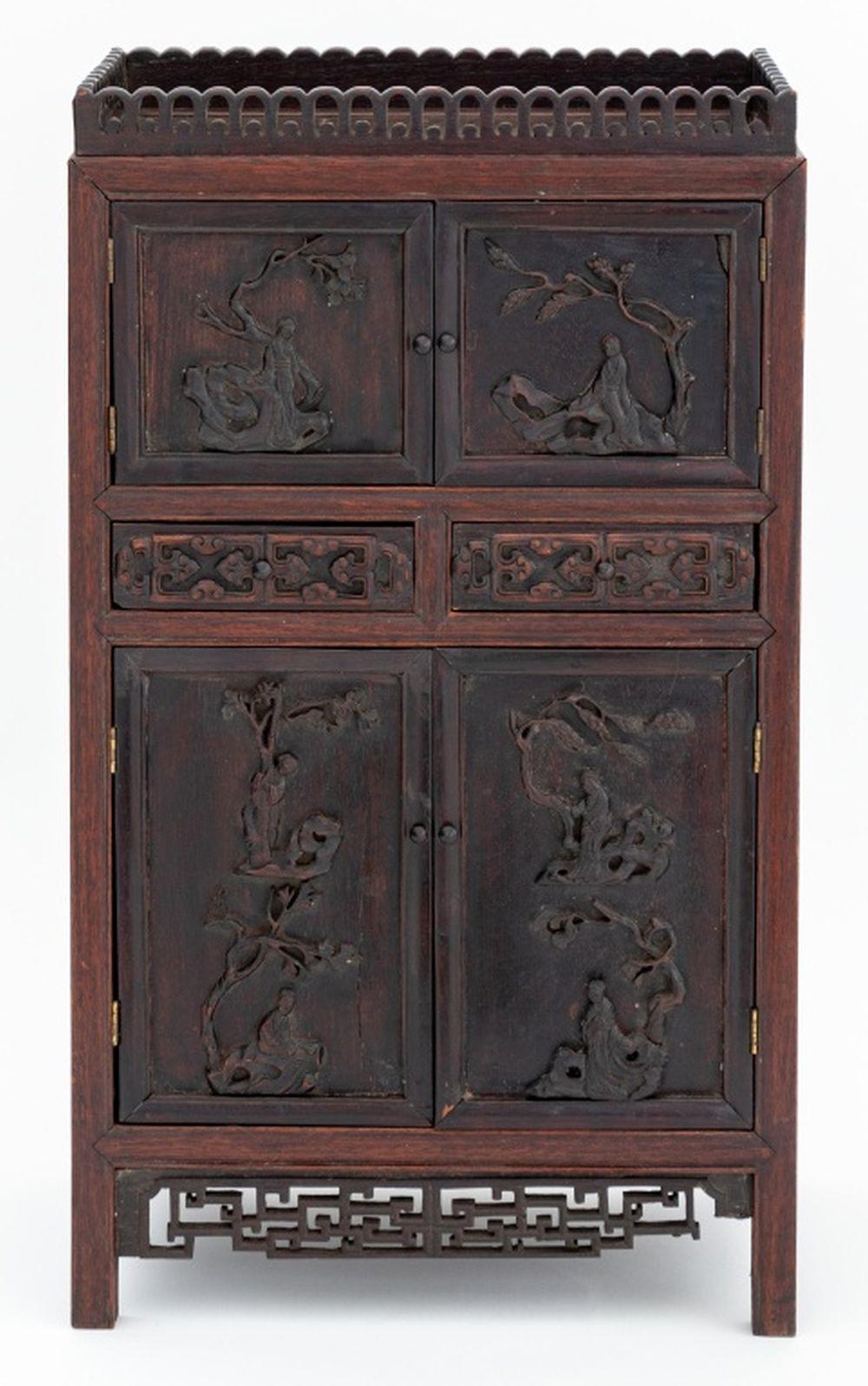 |
Chinese Hardwood Table CabinetSource blocked; provenance matched | Auctions at Showplace | 2025-08-28 | 321 | USD 100 (buyer’s-premium treatment unknown) |
| No auction photo supplied | A Chinese hardwood table cabinetSource blocked; provenance matched | Roseberys | 2024-11-07 | 661 | GBP 170 (buyer’s-premium treatment unknown) |
| No auction photo supplied | A CHINESE HARDWOOD INLAID TABLE CABINETSource blocked; provenance matched | California Asian Art Auction Gallery USA | 2021-03-06 | 6096 | USD 2,300 (buyer’s-premium treatment unknown) |
| No auction photo supplied | A Chinese hardwood desk-top cabinet, two enclosedSource blocked; provenance matched | Campbells | 2012-06-19 | 281 | GBP 55 (buyer’s-premium treatment unknown) |
How these auction records were verified
Each row retains its exact source URL, lot identity, retrieval time, access result, and immutable record hash. Live source access was blocked; the exact record matched Appraisily's immutable pipeline provenance. Inspect the public comparable provenance record.
Disclosure: prices are shown as reported by auction houses and are provided for appraisal context. Learn more in our editorial policy.
These auction results are market context, not an object estimate or identification.
Sideboards through twentieth-century cabinets
A typical estate-sale chest is priced as “antique” because it is tall and dark. If the upper and lower cases match and the width is usable, it can sit with the chest-on-chest lots above. If the feet are later and the sections were stacked for the sale, it does not.
3. Serpentine and bow-front sideboards
A shaped front still sells when the sideboard remains a dining-room object: readable drawers, stable legs, and a depth that can actually be placed.
The monumental example that fills a photograph is often the harder bid, because transport and room fit sit in the number.
Check first: Measure depth and look at the legs from the side; a front that will not fit the room is a harder bid than a compact serpentine case.
4. Windsor chairs and early seating
A Windsor is a construction system: a shaped seat receives the legs and spindles. Early fan-back or sack-back chairs with a coherent painted surface still attract a specialist even as single chairs.
Those specialist numbers are chair numbers, not case-furniture numbers.
Check first: Sight through the seat and spindles; mixed later parts make a newly assembled chair, not an early Windsor.
5. Arts and Crafts and Mission furniture
Buyers read joinery, oak or mahogany, hardware, and a workshop name as one story. A model number can outrank a broad “Mission style” label.
A maker mark still needs the form: a marked settle is not automatically a high number.
Check first: Find the shop mark or model number on the settle; “Mission style” without a maker is a different object.
6. French commodes
The commode sells as a compact case: shaped front, drawers that still run, and a top that belongs to the body.
From across a room, later pine or composite copies can resemble expensive period furniture. The sale below is a 19th-century pine three-drawer commode, not an ormolu showpiece.
Check first: Look at the top, mounts, and drawer sides as one case; a later stone top on a composite body is not a period commode.
7. Chinese hardwood cabinets and tables
International bidding still follows a clear cabinet form when joinery, proportions, and timber claims can be checked. Color in a photograph cannot name the timber.
The two cabinet lots below are the same object class at two houses, and they are not one number.
Check first: Measure the cabinet and photograph the joinery; a hardwood name from color alone is not evidence.
8. Shaker work tables and cupboards
Shaker furniture has almost no ornament, so proportion, tool work, old paint, and community documentation have to carry the case.
A practical 31-inch painted pine work table with a Harvard community attribution is the form buyers can still use. Spare country lines without that support are not enough.
Check first: Look for community documentation and old paint on a practical table; resemblance to Shaker lines is not proof.
9. Campaign chests
Campaign furniture was built to travel, so divided cases, flush pulls, corner mounts, and fitted feet are the form. The same portable design was widely copied.
A named maker on a complete cedar chest is a different object from generic brass-bound storage with a military story.
Check first: Confirm both halves, flush pulls, and feet still travel as one chest; separated cases are a storage box with a story.
10. Recognized twentieth-century case furniture
Documented Art Deco, studio, and postwar cabinets compete when the designer, manufacturer, or model is on the object, not only in a listing title.
“Vintage” is too broad. A named Paris workshop cabinet is the form this list means.
Check first: Find a workshop label or documented model; “vintage” without a designer is not this list.
Frequently asked questions
What antique furniture is currently in demand?
Buyer attention often concentrates on useful, well-proportioned forms with a credible maker, period, surface, and condition story. Chests, secretary bookcases, sideboards, Windsor seating, Arts and Crafts furniture, French commodes, Chinese hardwood furniture, Shaker pieces, campaign chests, and recognized twentieth-century case furniture can all attract bidding when the example is right.
What is the most sought-after antique furniture?
There is no single most-sought form across every auction. A documented work by a recognized maker or workshop can outrank a generic example, while construction, original surface, useful scale, and condition can make one chest or chair much more desirable than another.
Does refinishing always ruin antique furniture value?
No, but a replaced or aggressively stripped surface can remove evidence and reduce interest for period furniture. A clean restoration may be acceptable for some decorative or twentieth-century pieces. Document the present surface and repairs before making changes.
Why is some old brown furniture difficult to sell?
Age alone does not overcome large scale, high transport cost, generic design, major alteration, or weak attribution. A useful form, manageable dimensions, distinctive construction, and a clear maker or period story usually give bidders more reasons to compete.
How should I photograph antique furniture for an estimate?
Take one full view from the front, one three-quarter view, the back and underside, drawer interiors, hardware, labels, joinery, damaged areas, and a tape measure showing height, width, and depth. Photograph before cleaning or restoration.
Search variations answered in this guide
- What antique furniture is currently in demand?
- Which antique furniture sells best at auction?
- Are antique secretary desks still valuable?
- What makes an antique chest of drawers valuable?
- Do old sideboards still sell?
- Is brown furniture coming back at auction?
- What antique furniture is hard to sell?
- How do I photograph old furniture for an estimate?
Sources and method
Auction amounts cited here are source-reported results from AAG Auctioneers, Ahlers & Ogletree Inc., Bearnes Hampton & Littlewood, Bourgeault-Horan Antiquarians, Clarke Auction Gallery, Cottone Auctions, DOYLE Auctioneers & Appraisers, Dreweatts 1759, Eldred's, Leonard Joel, Schwenke Auctioneers, Thomaston Place Auction Galleries, and Tuckerbox Auctions. Native currencies are not converted. Results are examples, not predictions for another object.
Written and reviewed by the Appraisily Editorial Team. Our editorial and comparable-sales standards are explained in the editorial policy. Last reviewed August 19, 2026.