An Original Hand Made Painting Seascape Scene From Circa Mid Late 20th Century: appraisal and value basics
An Original Hand Made Painting Seascape Scene From Circa Mid Late 20th Century research should start with identification, condition, provenance, and recent comparable sales. Use this guide to compare the signals that matter before paying for a formal appraisal or deciding whether to sell.
An Original Hand Made Painting Seascape Scene From Circa Mid Late 20th Century
Mid–late 20th-century seascapes occupy a useful niche for collectors: accessible prices, abundant examples, and a rich mix of professional, regional, and hobbyist work. If you’re evaluating a canvas or board bearing a harbor at dusk, a storm-blown surf, or a fleet of fishing boats, the task is to determine originality, approximate date, quality, condition, and market position. This guide outlines what to examine, how to place a seascape within its context, and where value typically resides.
Context: Seascapes in the Mid–Late 20th Century
From about 1950 to the 1980s, seascapes were painted across numerous traditions:
- British and Cornish schools (e.g., St Ives) often adopted modernist simplification: planar rocks, blocky boats, and pared-back palettes.
- American regional painting—Cape Cod, Maine, the Pacific coast, and California plein-air revivals—retained realist tendencies with atmospheric light.
- Scandinavian and Dutch traditions offered crisp, cool light with robust marine craft.
- Postwar modernism introduced abstracted coastlines and emphatic texture through knife work and impasto.
- A booming hobbyist market (1960s–1980s) developed through TV instruction and art classes. These works can be charming but vary in technique and materials.
Materials and techniques of the period include:
- Oils remained dominant, frequently with titanium white (post-1930s prevalence) and modern pigments such as phthalo blue/green (broad use from the 1950s).
- Acrylics entered artists’ studios by the late 1950s and became widespread in the 1960s–70s. Acrylic handling often looks flatter and dries to a more uniform sheen unless varnished.
- Palette knives, scumbling, glazing, and impasto were common—especially in surf and rock textures.
- Supports include cotton duck canvases (often machine-primed), linen on better works, and hardboard (Masonite) panels, sometimes home-primed.
Recognizing the aesthetic lineage—whether a realist harbor, a mid-century modern abstraction, or a class-taught scenic—is foundational for quality assessment and value expectations.
Original vs. Reproduction: Confirming a Hand-Made Painting
To establish that a seascape is an original painting rather than a print or a hand-embellished reproduction, examine:
- Surface texture under a raking light:
- Original: Varied brush/knife ridges, with peaks and directional tool marks that terminate logically around forms (crest-of-wave ridges, dragged knife for rocks).
- Print: Uniform sheen and texture; surface texture that doesn’t align with image (printed canvas “tooth” replicated across shadows and highlights).
- Edge inspection:
- Original: Paint may wrap onto the tacking margins; impasto often drops off at the edge. On boards, look for paint caught on beveled edges.
- Print: Image stops before the edge; if “giclée on canvas,” you may see a continuous printed image even under the folded sides.
- Under magnification (10x loupe):
- Original: Pigment particles, interleaved strokes, occasional pentimenti (changed outlines).
- Print: Halftone dots or inkjet dot patterns; uniform microdot grids in shadows.
- Signature:
- Original: Signature in paint or pencil/charcoal integrated with the surface, sometimes with wet-over-wet blending.
- Print: Signature looks printed as part of the image; “hand-signed” reproductions may have a second, real signature in marker or pencil on top—distinguish from the printed one.
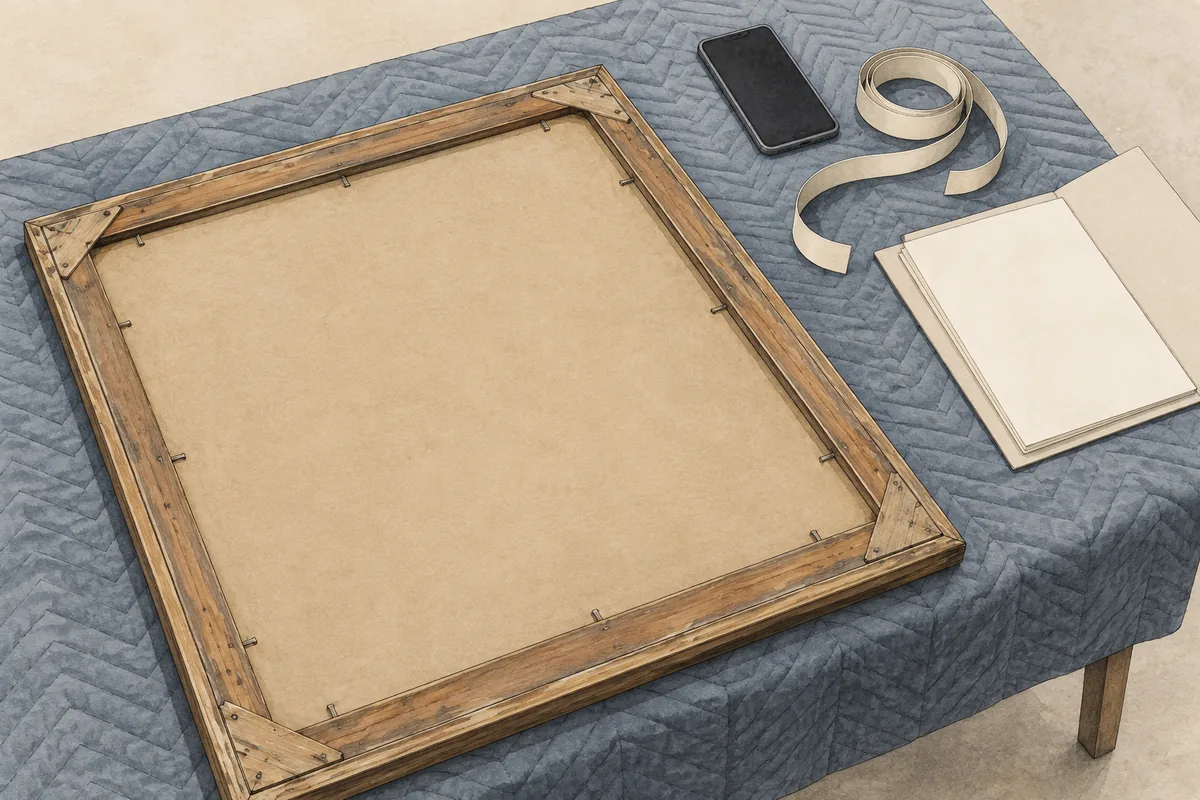
- Back of support:
- Original: Stretcher bars with tacks (earlier) or staples (later), keys for tension, drips of ground or paint, chalk notations, framer or gallery labels.
- Print: Mass-produced stretcher systems, publisher labels, edition numbers. Giclée often uses clean, uniform staples and commercial corner protectors.
Be cautious with “hand-embellished” prints. A thin layer of gel or clear acrylic with a few added strokes may mimic brushwork. Under the loupe, the underlying image remains dot-based and the embellishment sits as a distinct top film.
Dating Clues: Support, Hardware, Pigments, and Labels
While exact dating usually requires professional analysis, several cues help place a seascape in the mid–late 20th century:
- Canvas and attachment:
- Tacks vs. staples: Tacks dominate earlier 20th century; staples become common from the 1950s onward (especially 1960s+).
- Keyed stretchers: Most quality canvases have wooden keys for retensioning; mass-market craft store frames sometimes lack keys.
- Canvas branding: Stamps for makers like Fredrix or Winsor & Newton can help; note label designs change over decades.
- Hardboard (Masonite) panels:
- Smooth vs. textured side; home-primed white or off-white grounds. Warping or edge browning is common in older panels.
- Factory-stamped backs or framer labels assist in dating.
- Pigments and binders:
- Titanium white is near-universal mid-century; lead white persisted but declined after WWII.
- Phthalo blue/green (PB15/PG7) and Hansa/arylide yellows suggest post-1950s palettes.
- Fluorescent pigments appear in some 1960s–70s works.
- Acrylics: Brush marks dry crisp with less “fatty” ridge; early acrylic mediums can fluoresce under UV differently than oils/varnishes.
- Varnish:
- Natural damar was common; synthetic ketone/alkyd varnishes gained popularity post-1960s.
- Yellowed, uneven varnish layers often indicate age and exposure.
- Labels and inscriptions:
- Gallery, exhibition, or framer labels are top dating tools. US zip codes began in 1963; a five-digit zip on a label indicates 1963+.
- Price tags, sales receipts, or newspaper backings can provide a terminus post quem (earliest possible date).
- Framing clues:
- 1950s–60s: carved wood frames, gilt with real gesso, or modernist narrow profiles.
- 1960s–70s: linen liners (now often browned), driftwood or rustic frames for coastal themes.
- 1980s: wider polycomposite gold-tone frames, bright white liners.
- Technique and style:
- Bold knife-work texture and stylized surf motifs correlate with 1960s–70s studio practice.
- Minimalist, flattened color fields lean to mid-century modern idioms.
- Paint-by-number kits (1950s) and later teaching methods leave telltale repetitive tropes and standardized compositions.
Dating is an accumulation of evidence. One clue rarely suffices; together they describe a window.
Condition Assessment and Conservation Considerations
Condition has a direct impact on value and longevity. Inspect methodically:
- Paint and ground:
- Craquelure: Fine age crackle is less typical in mid–late 20th-century oils than in older works. Wide, interlocking cracks or cupping may indicate poor drying, heat exposure, or a too-brittle ground.
- Drying cracks (traction cracks) appear when thick impasto sits over lean layers. Check wave crests and sky impasto.
- Lifting/cleavage: Gently test with low-angle light; do not touch loose flakes.
- Support:
- Canvas slackness: Look for rippling; if keyed, a conservator can tension it. Over-tightening can cause tears.
- Edge wear: Abrasion along frame rabbet lines; paint loss at corners.
- Hardboard: Warping, corner delamination, or brown efflorescence along edges.
- Surface contamination:
- Nicotine/smoke films cause yellowing; kitchen oil aerosols attract dust.
- Mold/mildew: Speckling on reverse and a musty odor. Isolate immediately; consult a conservator.
- Insect debris and dust accretions in textured seas.
- Varnish:
- Uneven gloss, drip marks, and yellowing are common. UV light can reveal retouches (often fluoresce dark or differently).
- Prior interventions:
- Overpainting: Different gloss or fluorescence under UV; unnatural color patches.
- Pressure-sensitive tapes or non-archival adhesives on the back; these should be removed professionally.
Cleaning and minor care:
- Dry methods: Soft sable or goat-hair brush for loose dust. Microfiber lightly for non-fragile, unvarnished acrylics—test discreetly.
- Test cleaning: A conservator may use deionized water with adjusted pH; laypersons should avoid solvents. Never use household cleaners.
- Varnish removal/revarnish: Reserve for professionals; modern surfaces can be sensitive to common solvents.
- Frame and liner: Replace acidic or stained liners; keep original frames when structurally sound, as they can support provenance and period authenticity.
Document condition with photos under normal and raking light, and keep any labels intact.
Appraisal and Market: Where Value Lies
The market for mid–late 20th-century seascapes is stratified:
- Anonymous or hobbyist works:
- Typical value range: modest, often 50–300 USD depending on size, composition, and decorative appeal.
- Larger canvases with strong, balanced compositions and good frames can push higher.
- Regional listed artists:
- Provincetown/Cape Cod, Maine, California coast, Cornish St Ives, Brittany/Normandy fishing ports, and Scandinavian harbors often have collector followings.
- Typical value range: roughly 300–3,000 USD, with exceptions for particularly desirable artists or sizes.
- Established or blue-chip names:
- Well-documented mid-century modernists, notable marine painters, or artists with auction histories can exceed these ranges substantially.
Value drivers:
- Attribution: A legible, verifiable signature with an exhibition or gallery label dramatically improves confidence and value.
- Composition: Dynamic seas with convincing structure, well-drawn boats, and atmospheric skies outperform generic sunsets.
- Size: Larger works are usually more valuable, assuming quality holds.
- Medium: Oil tends to outprice acrylic, though exceptional acrylics compete strongly.
- Condition: Clean, original surfaces in sound frames sell faster and for more.
- Frame: A high-quality period frame can add a meaningful percentage to saleability, though it is rarely the main value component.
Research steps:
- Compare the signature and painting style to known examples by suspected artists.
- Check the back for gallery/framer labels, inventory numbers, or exhibition stickers.
- Note geographic clues: lighthouse forms, boat types, cliff profiles, and harbor architecture can indicate region.
- Track recurring motifs or idiosyncrasies (e.g., how the artist paints whitecaps or rigging) to match with known bodies of work.
Selling and documentation:
- For modest works, local galleries, regional auctions, or online marketplaces are common channels.
- For attributed or higher-value pieces, consult an appraiser or dealer specializing in mid-century or marine painting.
- Maintain a condition report and clear photographs (front, back, details, and labels). Accurate measurements (sight, canvas, and framed) are essential.
Care, Display, and Framing Best Practices
- Environment: Aim for stable humidity (about 45–55%) and moderate temperature; avoid rapid swings that stress paint and supports.
- Light: Limit direct sunlight. Oils tolerate light better than works on paper, but fading and heat damage are risks. UV filtration on windows helps.
- Hanging hardware: Use D-rings with plastic-coated wire; avoid sawtooth hangers on larger works. Anchor into studs or proper wall anchors.
- Backing: A dust cover (acid-free if possible) reduces dust and insect ingress. Avoid sealing in moisture.
- Spacers/liners: Maintain clearance between paint and frame to prevent abrasion. Replace degraded linen liners to preserve the surface.
- Handling: Carry by frame, not by wire; keep hands clean, preferably with nitrile gloves for dark frames that show prints.
Long-term, consider periodic inspections. If you observe new cracking, slackness, or mold, stop display and seek professional advice.
Practical Checklist for a Mid–Late 20th-Century Seascape
- Confirm originality:
- Inspect under raking light; check for real brush/knife texture and no halftone dots under a 10x loupe.
- Date indicators:
- Note tacks vs. staples, stretcher keys, canvas/board brands, labels with zip codes (1963+), and frame/liner style.
- Medium and pigments:
- Oil vs. acrylic cues; look for modern pigments (phthalo blues/greens). Consider UV response and surface gloss.
- Condition:
- Check for craquelure, cupping, slack canvas, warping, yellowed varnish, mold, and overpaint. Document with photos.
- Attribution:
- Record signature, inscriptions, and back labels. Compare to known signatures/styles.
- Market position:
- Assess composition quality, size, frame, and regional appeal. Estimate within a range (decorative, listed regional, or established).
- Care and display:
- Ensure stable environment, proper hardware, and adequate clearance in the frame. Avoid direct sunlight.
What similar items actually sold for
Real auction sales of items like your seascape oil. Open a sale to see the original listing.
Shown USD range: USD 35-USD 10,000. Median of these 9 USD examples: USD 125.


How these auction records were verified
These sales are market context, not an object estimate.
Each row is tied to its lot identity, retrieval time, access result, and immutable record hash. Live source access was blocked; the exact record matched Appraisily's immutable pipeline provenance. Inspect the public comparable provenance record.
Free photo check
Not sure if your painting is worth appraising? Let us take a look.
Upload a photo, tell us what you know, and get a free photo check. If a full appraisal makes sense, we will say so.
Free. No card needed. Takes about two minutes.
FAQ
Q: How can I quickly tell oil from acrylic? A: Oil typically shows softer, “fattier” ridges with a slight ambering in the impasto and may have a faint linseed smell, especially on the back. Acrylic often dries to a more uniform, plasticky surface, can feel cooler and less tacky to touch (do not touch the paint surface), and may look more matte unless varnished. Under magnification, acrylic films can appear smoother between pigment particles. These are tendencies, not absolutes.
Q: The varnish looks yellow. Should I remove it? A: Yellowed natural varnish is common. Do not attempt removal yourself; solvents that lift varnish can also solubilize paint. A conservator can test solubility and, if safe, remove and revarnish, which can significantly improve appearance and value.
Q: My painting smells musty and shows specks on the back. What should I do? A: Isolate the work from other art, reduce humidity, and avoid wiping the back. Mold remediation and backing material removal should be handled by a conservator to prevent spreading spores or damaging the support.
Q: Does the frame add value? A: A quality, period-appropriate frame enhances desirability and may add a modest percentage to the price. Original frames and labeled framer’s backs can contribute to provenance. Damaged or low-quality frames should be repaired or replaced, retaining any original labels.
Q: Are “hand-embellished” canvas prints collectible? A: They are decorative but usually have lower market value than original paintings. Added gel strokes or highlights do not substitute for full, layered paint structure. Value is primarily in the edition’s desirability and the artist’s market, not in the embellishment.
By combining material analysis, stylistic context, and condition reporting, you can confidently place a mid–late 20th-century seascape in its proper market segment and care for it appropriately. For higher-stakes decisions—significant attributions, complex condition issues, or conservation treatments—professional consultation is recommended.