Unlocking the Worth the Complete Guide to Valuing Your Antique Medicine Bottles: appraisal and value basics
Unlocking the Worth the Complete Guide to Valuing Your Antique Medicine Bottles research should start with identification, condition, provenance, and item-specific market evidence. Use this guide to compare the signals that matter before paying for a formal appraisal or deciding whether to sell.
Antique medicine bottles appraisal checklist
Antique medicine bottles offer a rare blend of science, advertising, and glassmaking history. Whether you’ve found a box of local druggist bottles, inherited patent medicine quackery, or chase cobalt poisons, understanding how collectors judge quality—and how the market prices it—will help you appraise your pieces accurately. This guide walks you through identification, dating, value drivers, attribution review, and preservation, so you can document and price your bottles with confidence.
What Makes Antique Medicine Bottles Valuable
Antique bottle value rests on a stack of interrelated factors. Learn these, and you’ll think like a seasoned appraiser.
Age and manufacturing method
- Pontiled, free-blown, and early mold-blown examples (rough pontil scar on base; c. 1840–1860) are generally scarcer and more valuable than later machine-made bottles.
- Tooled-finish bottles (mold seams stop below the lip; finish was tooled by hand) typically date c. 1880s–1910s.
- Machine-made bottles (mold seams pass through the lip/finish) appear c. 1903 onward (Owens machine), with mainstream production by the 1910s–1930s.
Rarity and distribution
- Short-lived brands, local druggist bottles from small towns, and unique color or mold variants are prime value drivers.
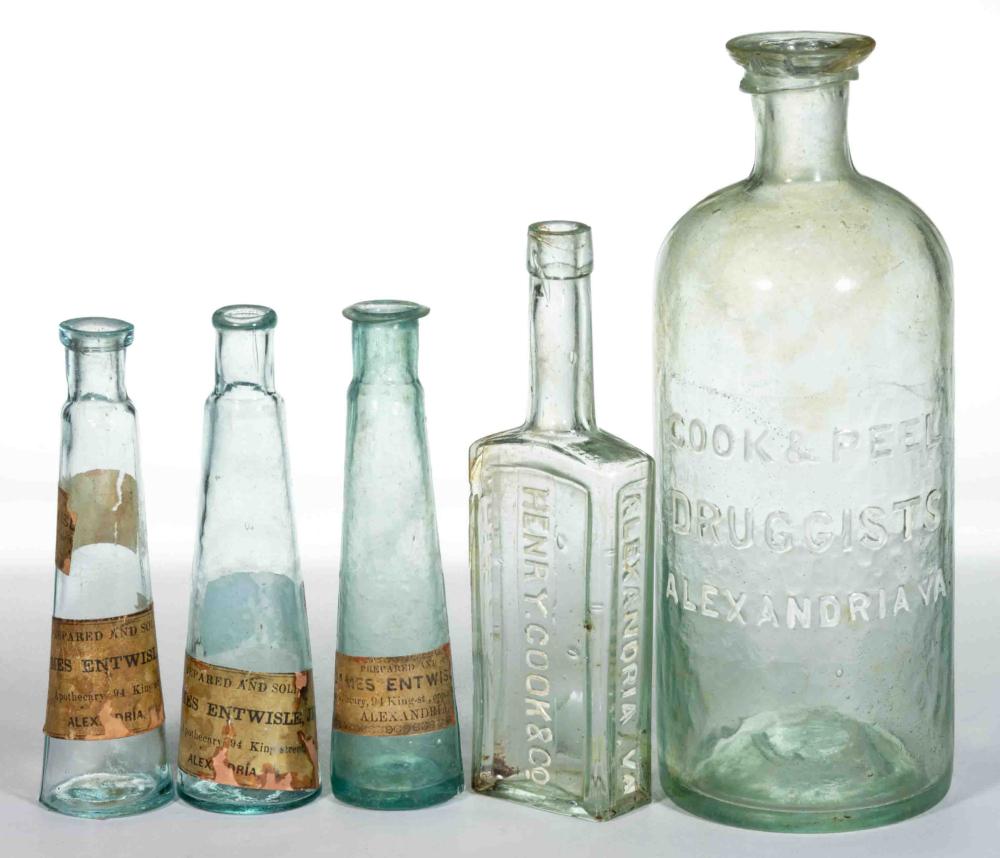
- Embossed local druggist names with town and state/county can be very collectible regionally.
Color and glass character
- Cobalt blue, deep emerald, teal, citron, puce, and milk glass are often more desirable than clear or aqua.
- “Whittled” texture (from mold cooling irregularities) is a plus in hand-blown bottles but is not the machine-etched texture seen on reproductions.
Form and use-category
- Poisons with ribbing/skull-and-crossbones or “NOT TO BE TAKEN” (often British/Commonwealth) are strong performers.
- Figural forms, paneled patent medicines, embossed liniments, and veterinary medicines can command premiums.
Embossing, labels, and packaging
- Crisp embossing enhances display and value; weak or smeared embossing lowers it.
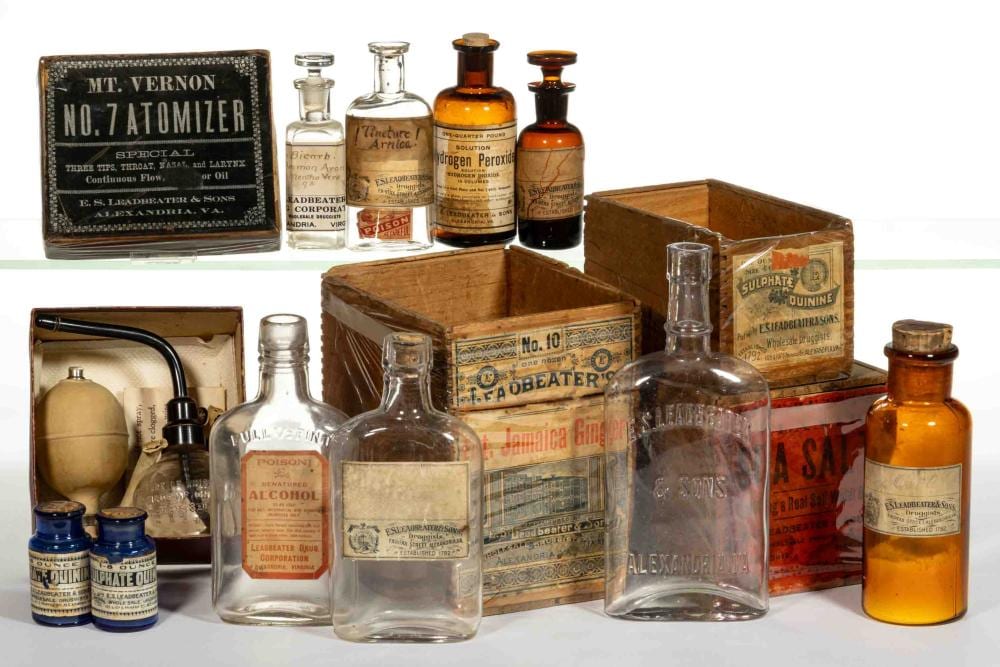
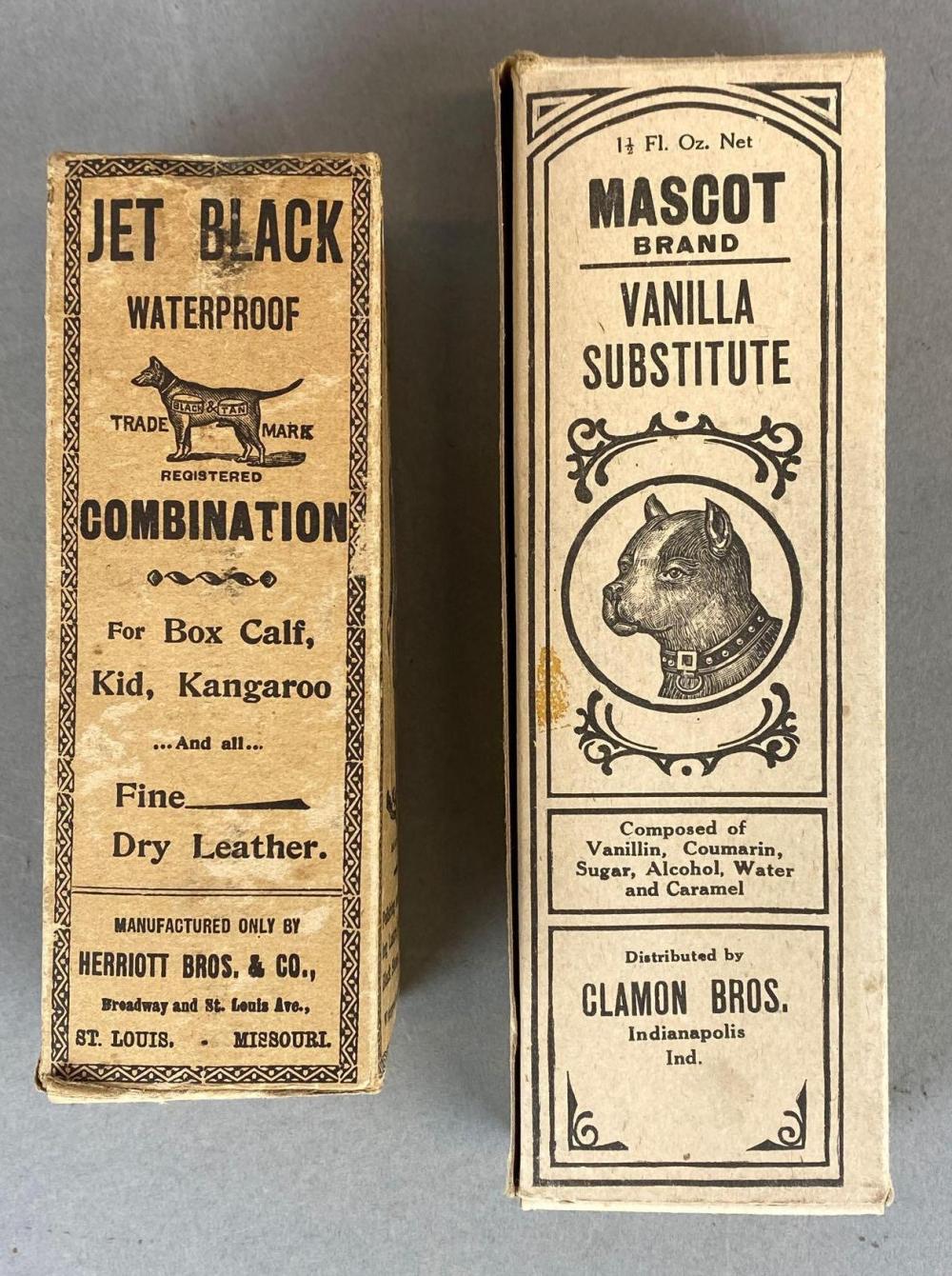
- Original paper labels, contents, dose cups, boxes, or instruction leaflets can multiply value—condition and legibility matter.
Condition and completeness
- No chips, cracks, bruises, heavy stain, or haze is ideal. Internal iridescence is tolerated in dug early bottles but still affects value.
- Period-correct closures (cork, ground-glass stoppers, metal lids) add value; mismatched or modern replacements may detract.
Historical interest and brand appeal
- Notable brands such as Dr. Kilmer’s Swamp Root, Mrs. Winslow’s Soothing Syrup, or Lydia Pinkham often draw dedicated collectors.
- Bottles linked to notable pharmacists, early patent medicine scandals, or particular epidemics have crossover appeal.
Expect wide price ranges: a common clear machine-made pharmacy bottle might fetch a value that must be established from current, topic-matched sales; a ribbed cobalt poison a value that must be established from current, topic-matched sales; an embossed local druggist a value that must be established from current, topic-matched sales; a figural patent medicine a value that must be established from current, topic-matched sales; a rare skull poison or exotic color example a value that must be established from current, topic-matched sales+. Exceptional pontiled cures or scarce local variants can go higher.
Dating and Identifying Features: Read the Glass
Dating is the backbone of valuation. Use multiple clues for accuracy.
Base clues
- Pontil scars: Rough, often ring-like or scarred circular mark on the base indicates hand-blown and snapped from a pontil rod (commonly pre-1860).
- Mold marks: Early post-pontil mold-blown bottles show base seams or cup-bottom molds without machine uniformity.
Mold seams and finishes
- Seam to lip: If the side seams run through the finish, you have a machine-made bottle (c. 1903+).
- Seam stops short with a tooled finish: Hand-finished lip (c. late 19th–early 20th century).
- Applied lips: A separate ring of glass added at the mouth (often 1850s–1870s).
- Sheared/ground lips: Top was cut and ground; common on lab ware and some apothecary bottles.
Maker’s marks and codes
- W.T. & Co. or Whitall Tatum: Major U.S. pharmacy supply maker (mid-19th to early 20th c.).
- IGCo (Illinois Glass Co.): Pre-1929; later merged into Owens-Illinois.
- Owens-Illinois mark: “I” in an “O” (with or without a diamond) and nearby plant/date codes, generally 1929 onward. Useful for post-1920s dating.
- C.L.G.Co (Carr-Lowrey Glass Co.) and other initials appear on bases of many pharmacy and cosmetic containers.
- European/UK bottles may carry “Co-op,” “Apothecaries Hall,” or local glassworks initials.
Color and composition
- Aqua and light green dominate mid-19th century medicine; clear colorless proliferates by late 19th/early 20th century.
- Manganese-decolorized glass (mid-late 19th c.) can turn amethyst under long UV exposure; see “Attribution review” for purple pitfalls.
Form and specialty indicators
- Poisons: Ribs, hobnails, scallops, or warning embossing; British examples often say “NOT TO BE TAKEN.”
- Graduated measures: Apothecary cylinders and some meds have embossed ounces/drams or metric—metric-only is typically later.
- Stoppers: Ground-glass stoppers and dose cups are earlier pharmacy features; screw caps indicate later manufacture.
Embossing content
- Proprietary names (e.g., “DR. KILMER’S”), disease claims (“COUGH CURE”), and street/town info for druggists are dateable using advertising and directory research.
- Spelling and typography evolve; overly modern fonts on “old” bottles are suspect.
Use a holistic approach: base, seams, finish, color, and markings together tell the story.
Categories and Notable Types Collectors Seek
Understanding categories helps set your expectations.
Patent medicines and “cures”
- Mass-marketed brands with bold claims. Embossed and labeled examples do best; rare molds and colors add multiples.
- Examples: Dr. Kilmer’s, Hostetter’s Bitters (figural, often amber), Hamlin’s Wizard Oil.
Druggist/apothecary bottles
- Embossed with pharmacist’s name and town; prized in local markets. Paneled rectangular forms, ovals, and cylinders appear often.
- Complete sets with ground stoppers or labels from the same shop display beautifully.
Poison and chemical bottles
- Cobalt blue, emerald, and teal in ribbed or hobnail forms are highly collectible. Look for “POISON” embossing, skulls, and tactile warning patterns.
Veterinary and specialty bottles
- Embossed horse/cattle imagery or veterinary claims; smaller production equals scarcity.
Labeled, boxed, and contents-intact examples
- Paper ephemera boosts value. Full contents can add value but raise safety concerns; never taste or open unknown substances.
Figural and novelty forms
- Shapes resembling people, animals, or objects cross into bitters/tonic categories and attract broader collector interest.
Researching and Comparing Values
Price is what the market will pay today, not a fixed number. Here’s a disciplined way to find it.
Precisely identify the bottle
- Record height, capacity, color, glass characteristics, finish type, embossing text, base marks, and any labels/closures. Photograph lip, base, embossing, and label details.
Establish age and category
- Use manufacturing clues to bracket the date. Assign the bottle to a category (poison, druggist, patent medicine, lab/apothecary).
Find market evidence
- Look for recent auction and show results, dealer lists, and collector club publications. Prioritize market evidence matching color, mold, embossing, and condition.
- Adjust for regional demand: a small-town druggist bottle sells best where it originated.
Adjust for condition and completeness
- Deduct for chips, cracks, stain, heavy wear, and replaced/missing closures. Add premiums for pristine labels, original boxes, dose cups, and stoppers.
Consider scarcity and desirability modifiers
- Unusual color variants, rare molds, and iconic brands shift values upward. Common clear, unembossed meds are at the low end.
Set a range, not a point
- Markets fluctuate. Set a conservative-low to optimistic-high range informed by multiple market evidence.
Example scenarios:
- Clear machine-made pharmacy bottle, no embossing, minor haze: a value that must be established from current, topic-matched sales.
- Embossed local druggist (small town), aqua, tooled lip, clean: a value that must be established from current, topic-matched sales locally; a value that must be established from current, topic-matched sales elsewhere.
- Ribbed cobalt poison (“POISON” embossed), clean, no damage: a value that must be established from current, topic-matched sales; ribbed skull-and-crossbones examples a value that must be established from current, topic-matched sales+.
- Pontiled mid-19th-century cure, strong embossing, nice color (teal/citron), light wear: a value that must be established from current, topic-matched sales higher for rare molds.
- Labeled patent medicine with original box, clear, excellent label: a value that must be established from current, topic-matched sales depending on brand and graphics.
Track actual sale prices, not just asking prices, to avoid overestimation.
Attribution review and Spotting Reproductions
Reproductions and altered pieces can trip up even seasoned collectors. Watch for:
Artificial amethyst/purple glass
- True manganese-decolorized glass turns pale amethyst with long UV exposure; modern irradiation can produce an unnaturally deep grape hue, often uniform and intense.
- Red flags: Brilliant purple on a bottle otherwise dating to post-1915 (when selenium replaced manganese), inconsistent aging of labels/closures, or a purple hue concentrated in thicker sections only.
Too-perfect surfaces
- Modern glass often lacks the subtle swirl, seed bubbles, and variation of hand-blown pieces, yet some fakes simulate “whittled” texture with acid etching. Etched texture feels different and often softens embossing edges.
Mold seam and finish mismatches
- A machine-made body with a crudely “applied” lip makes no sense. Ensure manufacturing logic: applied finishes should align with earlier, hand-blown bodies.
Modern fonts and spelling
- Crisp, contemporary typography on an “1850s” bottle is suspect. Compare with known period letterforms.
Fake pontils and ground bases
- Some repros grind a depression to mimic a pontil; a real pontil scar usually shows fractured, uneven surfaces consistent with glass break-off.
Added labels and reworked stoppers
- Antique-style labels printed recently and artificially aged are common. Ink should penetrate fibers and show period typefaces; adhesives should look appropriate. Ground stoppers should seat smoothly and match wear.
When in doubt, compare to documented originals and consult knowledgeable collectors or appraisers. If the price seems too good for a “rare” color or mold, pause.
Care, Cleaning, and Preservation
Conservation choices affect long-term value.
Cleaning
- Start gently: warm water, mild dish soap, a soft bottle brush, and patience. Denture tablets can help loosen residue.
- Avoid harsh acids, abrasives, or steel wool. Do not tumble bottles with labels or fragile glass; tumbling can increase eye appeal on dug bottles but may reduce originality for purists.
- Leave stable interior iridescence on early bottles if heavy cleaning risks micro-scratching.
Labels and paper
- Keep labeled bottles dry and out of direct sunlight. Stabilize flaking labels using conservation-grade sleeves or enclosures—avoid household tapes and glues.
- Do not submerge labeled bottles. Clean only the glass areas around the label with barely damp cotton swabs.
Closures and contents
- Retain original corks, stoppers, and lids. If a cork is crumbling, store the bottle upright and avoid removing it unless necessary.
- If contents remain, don’t open or taste them. Some historic medicines contain toxic compounds (e.g., opiates, mercury). Store upright, cool, and away from light. For disposal, consult local hazardous waste guidance.
Storage and display
- Avoid direct sunlight to prevent label fade and glass color changes. Use UV-filtering display cases if possible.
- Provide stable shelving with bottle stands or rings for tall cylinders. Moderate humidity and temperature reduce stress.
- Use inert, acid-free supports and tags for cataloging.
Documentation
- Photograph each bottle (front, side, base, lip, embossing, label) with a scale or ruler. Keep records of provenance and acquisition price.
Quick Valuation Checklist
Use this concise checklist to document any medicine bottle before pricing it.
- Dimensions and capacity: height, width, approximate volume.
- Color and clarity: note special colors (cobalt, teal, citron, milk glass).
- Manufacturing method: pontil scar, mold seams, finish (applied, tooled, machine-made).
- Embossing: exact wording, brand, town/pharmacist name; location on panels.
- Base and maker’s marks: initials, numbers, logos (W.T.&Co, IGCo, O-I, C.L.G.Co).
- Form/category: druggist/apothecary, patent medicine, poison/chemical, veterinary, lab.
- Closures and accessories: original cork/stoppers, dose cups, boxes, instructions.
- Condition: chips, cracks, bruises, stain/haze, wear, label legibility.
- Provenance: where found, local relevance, prior ownership.
- Market evidence: 3–5 recent market evidence with dates and prices; adjust for condition and region.
- Preliminary value range: conservative low and optimistic high.
FAQ
Q: Are purple (amethyst) bottles more valuable? A: Sometimes. Naturally sun-purpled manganese glass (often late 19th–early 20th c.) can be desirable, especially with strong embossing or a scarce mold. However, artificially irradiated purple—often an overly deep hue—can diminish collector interest. Value the bottle’s mold, age, embossing, and condition first; treat color as a secondary premium.
Q: How can I quickly tell hand-blown from machine-made? A: Check the side seams and the base. If seams run through the finish, it’s machine-made (c. 1903+). If seams stop below a tooled lip or the base shows a rough pontil scar, it’s earlier hand-crafted. Also look for subtle irregularities and bubbles in earlier glass.
Q: Should I clean or tumble my bottle before selling? A: Gentle hand cleaning is safe. Tumbling can improve appearance on dug bottles but may reduce originality and can blur embossing if overdone. Never tumble labeled bottles. When in doubt, present the bottle as found with light cleaning and disclose any treatments.
Q: Do chips and cracks kill value? A: Significant cracks are major value killers. Small, well-placed flakes or lip nicks reduce value but may be acceptable for rare molds or colors. Price reductions for damage vary by rarity—common bottles drop sharply; scarce ones tolerate minor flaws.
Q: Is a local druggist bottle worth more where it was made? A: Often yes. Local collectors and historical societies drive demand. A small-town embossed druggist bottle that brings a value that must be established from current, topic-matched sales online might fetch a value that must be established from current, topic-matched sales at a show in that region.
With the right eye for manufacturing clues, attention to detail, and disciplined comparison research, you can confidently unlock the worth of your antique medicine bottles—and preserve their history for the next generation of collectors.
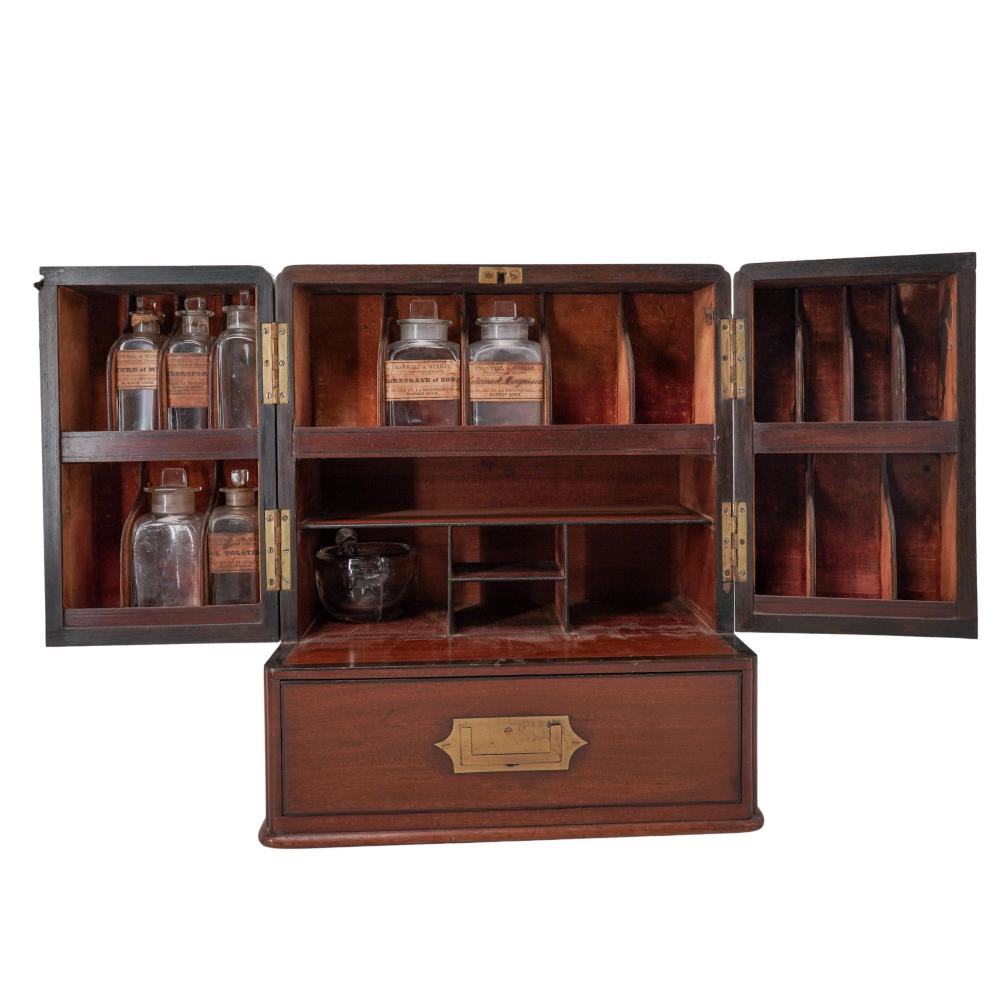
![GUNNISON, CO MEDICINE BOTTLES (5) [159312] sold by Holabird Western Americana, lot 2271 — auction record photograph](https://assets.appraisily.com/comps/auction-lots/176782148/thumb/h19286-l315105092.jpg)