Inventory codes vs maker marks: appraisal basics
Inventory codes, stock numbers, dealer labels, maker marks, hallmarks, factory marks, and edition numbers are not interchangeable. A professional appraisal separates administrative tracking marks from origin evidence before deciding whether the mark affects attribution, provenance, condition, or market value.
Free first read
Check what your mark or label may mean
Upload close photos of the mark, the whole object, the underside or back, and any documents. The free screener can flag whether it looks like a maker mark, inventory code, hallmark, or later label.
Start with a free screener. Use a signed report when the mark affects insurance, estate, donation, resale, or formal documentation.
1. Start with the job the mark performs
A maker mark is usually evidence of manufacture or authorship. It may identify a silversmith, factory, studio, foundry, publisher, workshop, artist, or edition. An inventory code is usually evidence of handling: a gallery stock number, auction consignment number, exhibition tracking tag, framer job number, restoration note, or collection catalog number.
The distinction matters because a maker mark can narrow attribution and comparable sales, while an inventory code usually needs outside documentation before it changes value.
2. Read placement, medium, and format together
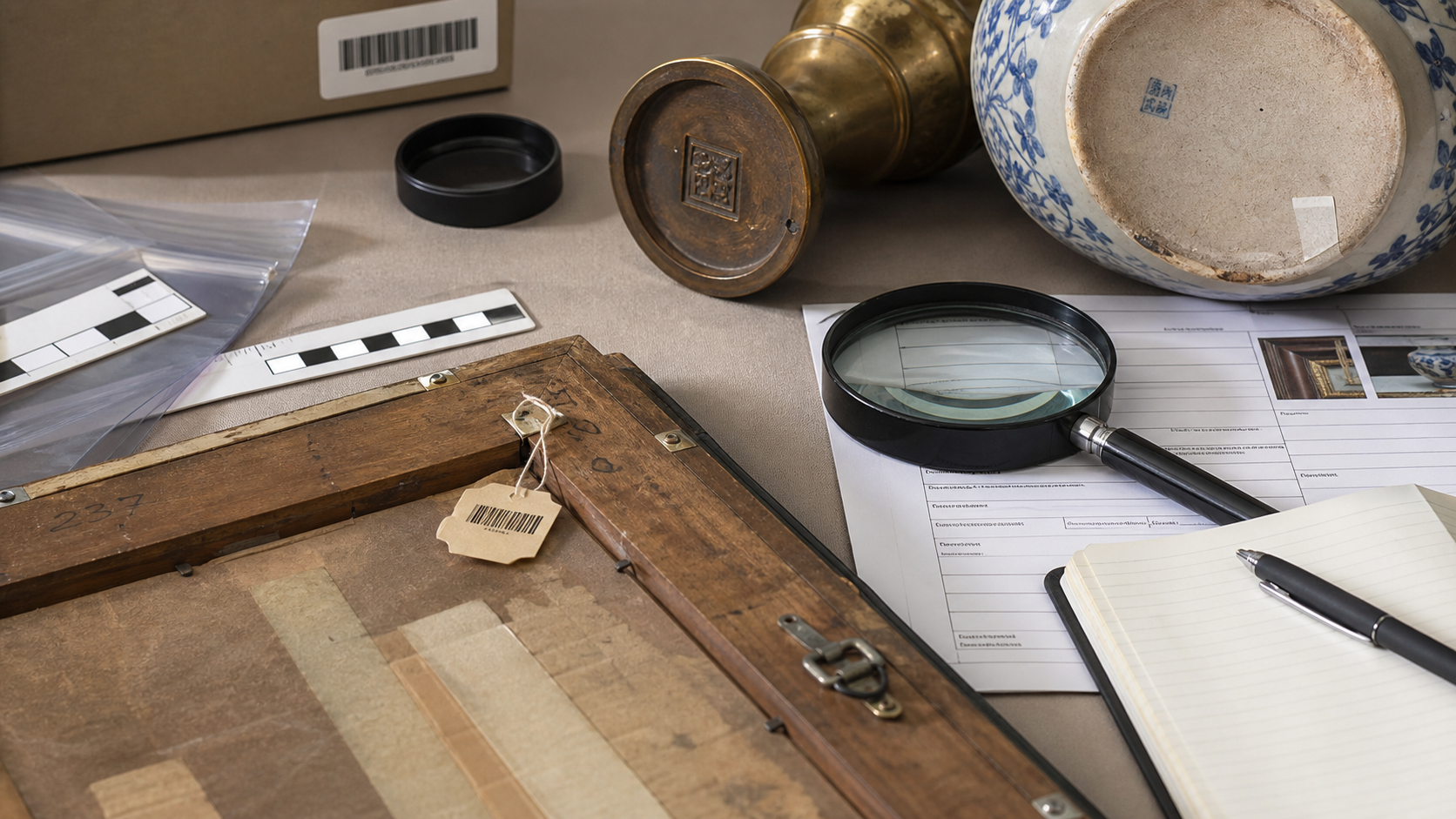
Long alphanumeric strings on labels, frame backs, undersides, backing boards, tags, or removable stickers are usually administrative. Short impressed, stamped, punched, molded, engraved, signed, or underglaze marks are more likely to be part of manufacture, but placement and object type still matter.
Do not rely on the characters alone. A number scratched into a metal object can be a service number, owner inventory number, or later retail code; a punched set of symbols in silver may be an assay and maker system.
Note: We couldn’t find relevant auction comps in our database for this topic right now. If you’re valuing a specific item, try searching by maker/model/material and we’ll expand coverage over time.
What similar items actually sold for
To help ground this guide in real market activity, here are recent example auction comps from Appraisily’s internal database. These are educational comparables (not a guarantee of price for your specific item).
| Image | Description | Auction house | Date | Lot | Reported price realized |
|---|---|---|---|---|---|
| No relevant auction comps found for this topic right now. | |||||
Disclosure: prices are shown as reported by auction houses and are provided for appraisal context. Learn more in our editorial policy.
3. Apply object-specific mark rules
Silver and jewelry often require a full mark set, not a single punch. Ceramics and glass may combine factory marks, pattern numbers, decorator marks, and retail labels. Paintings often carry canvas-maker stamps, dealer labels, framer labels, exhibition tags, and stock numbers on the verso. Prints and bronzes may have edition numbers, proof notations, publisher marks, foundry stamps, or later inventory labels.
The same alphanumeric string can mean different things depending on whether it is handwritten on a backing board, printed on a removable label, impressed into clay, struck into metal, or repeated on component parts.
4. Decide whether the mark changes value
A mark changes value when it changes attribution confidence, date, material standard, edition status, provenance, authenticity, or market category. A generic stock number with no source match may still belong in the report, but it should not be treated as a maker signature or proof of origin.
When a code links to a respected gallery, collection, exhibition, or prior auction, it can strengthen provenance and comparable selection. When it is modern logistics or retail inventory, its value effect is usually neutral.
5. Report confidence, not guesses
Use precise language: observed, likely, consistent with, not consistent with, unresolved, or unsupported. Record what sources were checked and what did not match. If a label or mark is removed during conservation, keep photos and the removed label in the object file.
FAQ
How can I tell an inventory code from a maker mark?
Inventory codes are usually administrative: long numbers or letters on labels, backs, undersides, frames, or stock tags. Maker marks are usually integral to manufacture, often stamped, impressed, punched, signed, or part of a known factory or assay system.
Can an inventory code affect appraisal value?
Yes, but only when it can be tied to provenance, exhibition history, a known dealer, an auction record, or a documented collection. A generic warehouse or retail stock number usually has little direct value impact.
Should I remove old labels or penciled numbers before selling?
No. Photograph and document them first. Labels and stock marks can preserve provenance clues, and removal can erase useful evidence even when the mark is not a maker signature.
Search variations people ask
Collectors often search for inventory code on antique, maker mark vs stock number, dealer label on painting back, silver hallmark appraisal, ceramic base mark value, and how labels affect provenance.
References
Wrap-up
Inventory codes and maker marks both belong in an appraisal file, but they do different work. Identify how the mark was made, where it sits, what system it resembles, and whether independent records support the interpretation before assigning value weight.