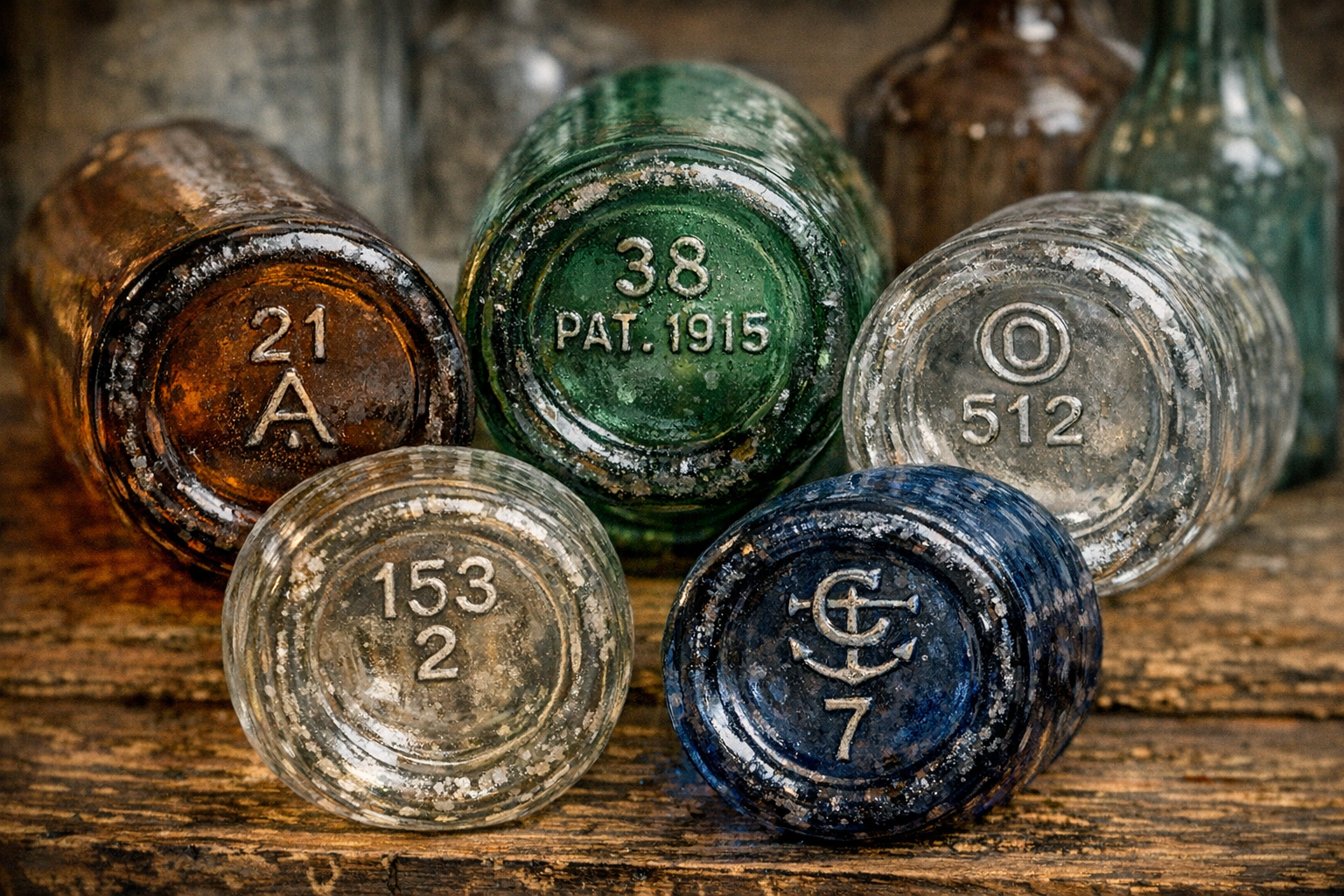
Bottle bottom numbers identification checklist
Start by photographing every base mark, number, letter, logo, mold code, pontil scar, valve mark, stippling pattern, glass color, seam height, bottle shape, and embossing. Bottom numbers usually need maker-mark and bottle-type context before they can support age or value. Compare related guides for how to identify bottle bottom numbers, antique bottle identification, old bottle value, and glass bottle bottom markings.
Discovering an old bottle with mysterious numbers on the bottom can feel like finding a secret code. These embossed digits and symbols are more than just manufacturing quirks—they’re valuable clues that can help you identify a bottle’s age, origin, and potential value. Whether you’re a seasoned collector or just curious about an old bottle you’ve found, understanding how to “read” these bottom marks is essential for proper identification.
Understanding Numbers on Bottle Bottoms
When examining the bottom of an old bottle, you’ll often find a variety of markings. These can include numbers, letters, symbols, or combinations of all three. While some markings clearly identify the manufacturer, others indicate more technical aspects of the bottle’s production.
In most cases, one- or two-digit numbers found on bottle bottoms are mold numbers. These numbers served to identify the specific bottle mold or section in an automatic bottle machine. If multiple identical molds were used in production, each one received its own identifying number.
Other numerical markings might indicate:
- Bottle style or catalog number
- Year of manufacture
- Plant location codes
- Glass formula identification
Understanding these codes requires some knowledge of glass manufacturing history and techniques. Let’s explore the most common types of bottle bottom markings and what they reveal.
Types of Bottle Bottom Numbers
Mold Numbers
The most common numbers found on bottle bottoms are mold numbers, typically appearing as single or double digits. These numbers were used by glass manufacturers to identify specific molds or sections of automatic bottle machines.
Glass factories often operated multiple molds simultaneously to increase production efficiency. By numbering each mold, manufacturers could:
- Track production output from each mold
- Identify quality control issues specific to a particular mold
- Document when molds needed maintenance or replacement
Mold numbers don’t typically provide information about the bottle’s age or origin—they were purely for internal factory use.
Date Codes
Some bottles feature numbers that indicate manufacturing dates. Date codes can appear in several formats:
- Single or double-digit year: A single number like “7” might indicate manufacture in 1937, 1947, etc. Context clues like bottle style help narrow down the decade.
- Two-digit year: Numbers like “42” commonly represent 1942.
- Date-month combination: Numbers like “15-6” might indicate June 1915.
Date codes became more standardized in the 20th century, particularly after the 1940s, when many glass companies adopted clearer dating systems.
Plant Codes
Many glass manufacturers operated multiple factories. Numbers on bottle bottoms sometimes indicated which plant produced the bottle. These codes were often used alongside manufacturer’s marks.
For instance, the Owens-Illinois Glass Company used a numerical plant code system, where the number to the left of their trademark indicated the manufacturing plant, and the number to the right typically indicated the year of manufacture.
Manufacturer's Marks and Codes
Manufacturer’s marks are perhaps the most useful markings for bottle identification. These are embossed symbols, letters, or logos that identify which glass company produced the bottle. When used in combination with numerical codes, they provide valuable dating information.
Some common manufacturer’s marks include:
- Owens-Illinois: An “I” inside an “O” or diamond, used from 1929 onwards
- Hazel-Atlas: An “H” over an “A”, used from 1923 to 1964
- Ball: The word “BALL” in script or block letters
- Brockway Glass: A “B” inside a circle or the letters “BGCO”
- Anchor Hocking: An anchor symbol or “AH” mark
The Society for Historical Archaeology (SHA) maintains an extensive database of bottle makers’ marks that can help you identify these symbols.
Value Ranges for Common Antique Bottles
Market values based on condition and rarity
Dot Codes and Stippling Patterns
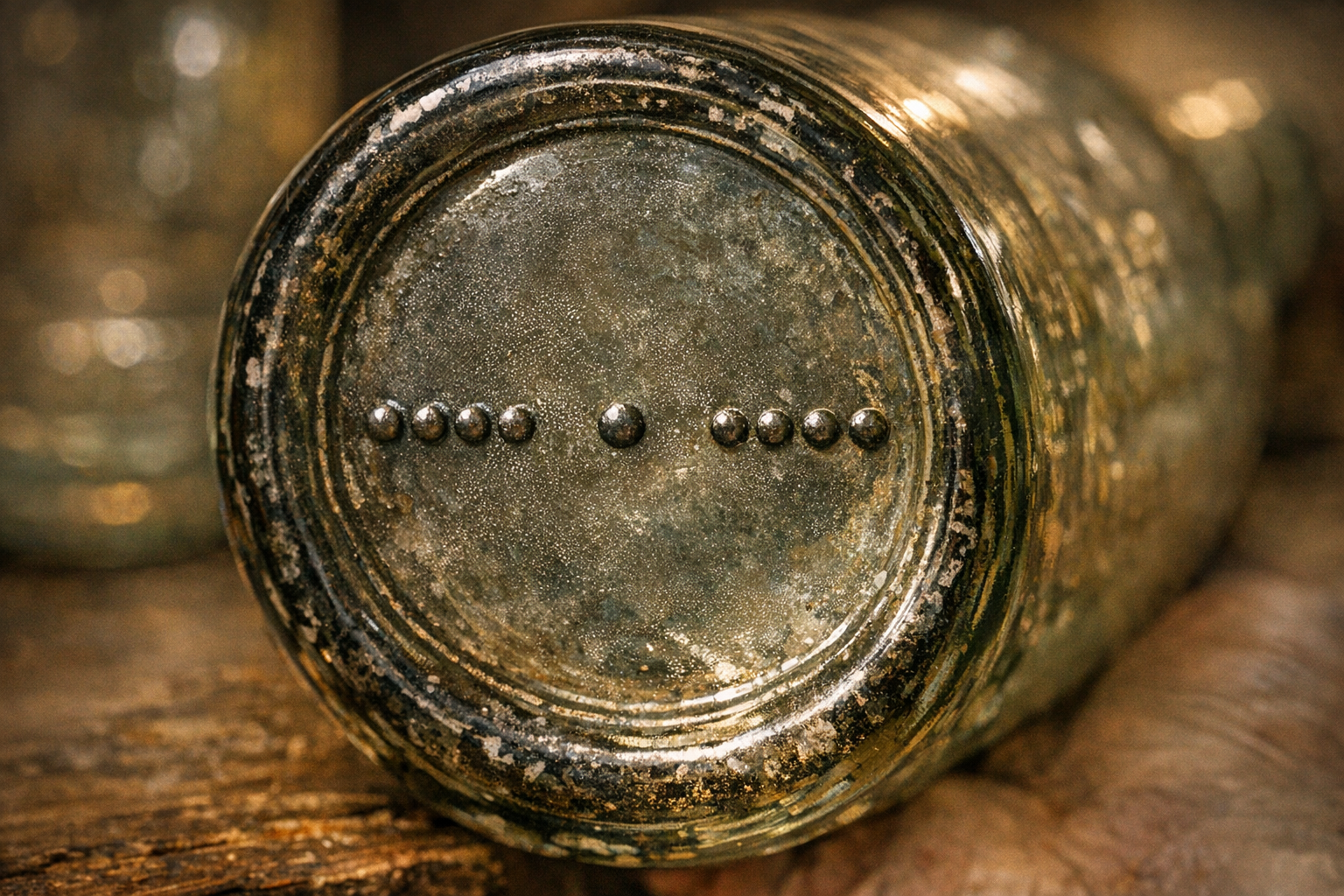
Modern bottles often feature dot patterns or stippling on their bases. While these dots serve practical manufacturing purposes (helping release the bottle from the mold), they can also contain encoded information.
Dot patterns might indicate:
- The specific mold cavity that made the bottle
- The date of manufacture (in a dot-code format)
- Quality control tracking information
For example, a pattern showing “four dots, space, one dot, space, four dots” could represent a specific mold position in the manufacturing line or a particular production date.
These dot codes became more common after the 1940s with the widespread adoption of automated bottle-making machines. The specific meaning of dot patterns often varied between glass manufacturers, making them challenging to decode without company-specific references.
Evolution of Bottle Base Markings
- 1800-1880
Early Hand-Blown Era
Bottles were predominantly handmade with few consistent markings. Pontil scars (rough circular marks) on bottle bases indicate hand-blown production.
- 1880-1910
Semi-Automatic Production
Introduction of semi-automatic bottle machines. Manufacturer marks began appearing with more consistency. Single-digit mold numbers became common.
- 1910-1930
Early Automatic Era
Widespread adoption of Owens Automatic Bottle Machine. Standardized manufacturer marks, plus mold numbers and basic date codes.
- 1930-1950
Standardized Coding Systems
Major manufacturers developed consistent date and plant coding systems. Two and three-digit date codes became standard.
- 1950-Present
Modern Coding Systems
Introduction of more complex dot codes, stippling patterns, and manufacturer symbols. Addition of recycling codes on plastic bottles.
Using Mold Seams and Production Techniques for Dating
Bottle production technology changed significantly over time, and these changes left visible marks on the bottles. When combined with base numbers, these manufacturing clues can help narrow down a bottle’s age:
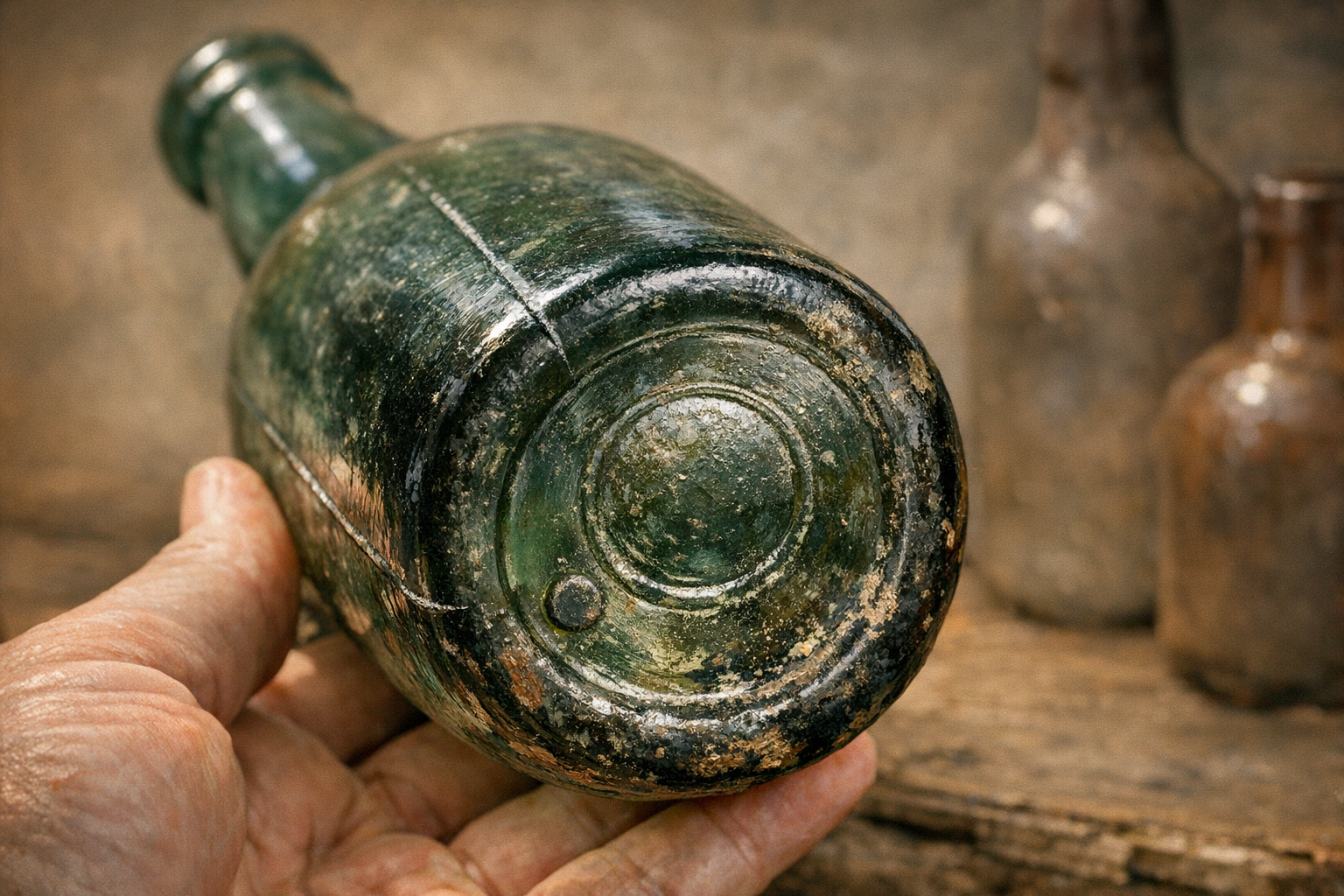
Pontil Marks (pre-1860s): A rough circular scar on the bottle base indicates it was handmade using a pontil rod. These bottles rarely have mold numbers.
Mold Seams (1860s-1920): Visible seam lines on the bottle’s body indicate it was made in a mold. The height of these seams helps date the bottle:
- Seams ending at the neck: 1860s-1880s
- Seams extending onto the neck: 1880s-1910s
- Seams all the way to the lip: After 1910
Suction Scars (1905-1920s): Distinctive circular or oval marks on the bottle bottom from Owens Automatic Bottle Machines.
Valve Marks (1930s-present): Small, off-center circular marks on the bottom from modern automated production.
The Society for Historical Archaeology offers excellent resources for dating bottles based on manufacturing techniques.
Bottle Authentication Checklist
Use this checklist to help determine if your bottle is genuinely antique
- Pontil mark or rough base scar present (indicates pre-1860s production)
- Visible mold seams that don't extend all the way to the lip (indicates pre-1920 production)
- Bubbles or imperfections in the glass (more common in older bottles)
- Asymmetrical or slightly lopsided shape (indicates handmade production)
- Glass has purple tint when held to light (indicates pre-1920 manganese glass)
- Embossed lettering with city names or product claims (common on pre-1950 bottles)
- Base markings consistent with known historical manufacturers
Step-by-Step Guide to Identifying Bottles by Base Numbers
Step 1: Examine the Base Thoroughly
Start by cleaning the bottle base gently to ensure all markings are visible. Use good lighting and a magnifying glass if needed. Look for:
- Numbers (single digits, double digits, or number sequences)
- Letters or letter combinations
- Symbols, logos, or trademarks
- Dot patterns or stippling
- Physical characteristics (pontil marks, valve marks, etc.)
Take clear photos or make detailed sketches of all markings.
Step 2: Identify Manufacturer’s Marks
Before focusing on numbers, try to identify any manufacturer’s marks or logos. These provide critical context for interpreting the numbers. Use reference resources like:
- The Society for Historical Archaeology’s makers marks database
- Bottle collector guides and reference books
- Online bottle collector forums
Step 3: Analyze the Numbers
Once you’ve identified the manufacturer (if possible), examine the numbers:
- Single digits (1-9) are typically mold numbers
- Two-digit numbers might be mold numbers, plant codes, or year codes
- Three or more digits often indicate catalog numbers or date codes
For Owens-Illinois bottles, for example, the number to the left of the logo is the plant number, and the number to the right is typically the year of manufacture.
Step 4: Consider Bottle Style and Use
The bottle’s shape, color, and intended purpose provide important context:
- Medicine bottles often have different coding systems than beverage bottles
- Food bottles might use different numbering than cosmetic bottles
- Milk bottles frequently used date codes related to dairy regulations
Step 5: Cross-Reference with Multiple Sources
Bottle identification is sometimes more art than science. Cross-reference your findings with multiple sources and consider joining bottle collecting forums where experts can help interpret unusual markings.
Bottle Identification Resources
Society for Historical Archaeology: Historic Bottle Website
Comprehensive resource for bottle identification, including detailed information about makers' marks, manufacturing techniques, and dating methods.
Glass Bottle Marks: Numbers on Bottoms of Glass Bottles
Detailed explanation of what various numbers on bottle bottoms represent, with examples and images of common markings.
Bottle Bases - Society for Historical Archaeology
Specific guide to bottle base markings, including manufacturing characteristics and how to interpret them.
Antique Trader: How to Identify Old Bottles
Guide to bottle trademark identification with information about how to value antique bottles based on their markings.
Antique Bottles, Glass, Jars Online Community
Active forum of bottle collectors who can help identify unusual or rare bottle markings that aren't documented in standard references.
Historic Glasshouse Forum
Another excellent community resource where experts and collectors discuss bottle identification and valuation.
Common Bottle Manufacturer Marks and Their History
Owens-Illinois Glass Company (1929-present)
- Mark: “I” inside an “O” or diamond
- Numbering System: Plant number (left) and year (right)
- Plant numbers range from 1-32, representing different factory locations
- Year numbers are single or double digits (e.g., “4” for 1934 or 1944, context determines decade)
Hazel-Atlas Glass Company (1902-1964)
- Mark: “H” over an “A”
- Numbering System: Often includes a single-digit mold number
- After 1923, may include a date code (single digit for year)
Ball Brothers Glass Manufacturing Company (1880s-present)
- Mark: “BALL” in script or block letters
- Numbering System: Simple mold numbers or sometimes year codes
- Style of the Ball logo itself helps date the bottle
Anchor Hocking Glass Corporation (1937-present)
- Mark: Anchor symbol, sometimes with “H” or numbers
- Numbering System: Plant and date codes vary by era
Brockway Glass Company (1907-1988)
- Mark: “B” in a circle or “BGCO”
- Numbering System: Mold numbers and later date codes after the 1950s
These major manufacturers had fairly consistent marking systems, but many smaller glass companies used less standardized approaches. Regional bottle makers might use their own unique marking systems or simply their initials.
Common Questions About Bottle Bottom Numbers
What do one- or two-digit numbers on the bottom of glass bottles mean?
How can I tell how old a bottle is from the bottom markings?
- Identify any manufacturer’s marks and research when that company was in operation
- Look for date codes (some manufacturers included year numbers)
- Examine production techniques (pontil marks, mold seams, etc.)
- Consider the bottle’s physical characteristics (color, shape, seams)
What are the dots or stippling patterns on modern bottle bottoms?
- Manufacturing function: The raised dots help release the bottle from the mold and allow even distribution of glass during formation
- Mold identification: Specific patterns can identify which mold cavity produced the bottle
- Date/batch coding: Some manufacturers use dot patterns as a form of code to indicate production date or batch
- Quality control: Dot patterns can help trace production issues back to specific manufacturing equipment
Are there apps that can help identify old bottles by their bottom markings?
- General antique identification apps: Applications like Google Lens can sometimes identify common bottle types or direct you to similar images online
- Collector community platforms: Apps and websites where you can upload images for identification by knowledgeable collectors
- Reference databases: Online databases of bottle makers’ marks and numerical codes
How do I read Owens-Illinois bottle codes?
[Plant Number] [Maker's Mark] [Year Number] [Other codes]
For example, if you see "7 ⬦ 46", this indicates:
- "7" = Plant #7 (Alton, Illinois)
- "⬦" = Owens-Illinois maker’s mark (diamond with "I" inside)
- "46" = Year 1946
Can the numbers on bottle bottoms determine their value?
- Confirm authenticity: Correct manufacturer marks and date codes can verify a bottle is genuinely from the period claimed
- Establish rarity: Some manufacturing plants or production years were more limited than others
- Identify special productions: Certain mold numbers or codes might indicate limited editions or special production runs
Conclusion: The Value of Understanding Bottle Bottom Numbers
The seemingly cryptic numbers and symbols on bottle bottoms are windows into manufacturing history, offering important clues about when, where, and how a bottle was made. While these markings were originally intended for factory quality control and production tracking, they now serve as valuable tools for collectors, archaeologists, and anyone interested in historical artifacts.
Learning to read these codes not only helps with accurate bottle identification but also enhances appreciation for the technological evolution of glass manufacturing. From handblown bottles with pontil scars to machine-made containers with precise dot codes, each marking tells part of the story of industrial development.
For collectors, proper identification through bottom markings can significantly impact a bottle’s value and historical significance. For casual finders, these marks transform an ordinary old bottle into a tangible connection to the past.
The next time you find an old bottle, take a moment to examine its base. Those numbers and symbols are more than random markings—they’re pieces of a historical puzzle waiting to be solved.
What similar items actually sold for
To help ground this guide in real market activity, here are recent example auction comps from Appraisily’s internal database. These matched sales are market context only, not an object estimate or identification, and they do not guarantee a price for your specific bottles.
| Comparable | What sold | Auction house | Date | Lot | Source-reported amount |
|---|---|---|---|---|---|
 |
A box of vintage apothecary bottles | Lawsons | 2025-11-06 | 2598 | AUD 40 (buyer’s-premium treatment unknown) |
 |
Set of 5 Antique Baccarat Amberina Swirl Bottles. | Direct Auction Galleries, Inc. | 2026-01-17 | 4 | USD 275 (buyer’s-premium treatment unknown) |
 |
SET OF 8 APOTHECARY BOTTLES, MID-20 | Historia Auctionata | 2025-09-01 | 4820 | EUR 100 (buyer’s-premium treatment unknown) |
 |
2pc Royal Doulton & Doulton Lambeth Stoneware Whisky Bottles | Lion and Unicorn | 2025-10-19 | 26 | USD 40 (buyer’s-premium treatment unknown) |
 |
SET OF 10 APOTHECARY BOTTLES, MID-2 | Historia Auctionata | 2025-09-01 | 4818 | EUR 100 (buyer’s-premium treatment unknown) |
How these auction records were verified
Each row retains its exact source URL, lot identity, retrieval time, access result, and immutable record hash. Inspect the public comparable provenance record.
Disclosure: prices are shown as reported by auction houses and are provided for appraisal context. Learn more in our editorial policy.
Free instant estimate
Not sure if your antique bottle is worth appraising? Let us take a look.
Upload a photo, tell us what you know, and get a free first read. If a full appraisal makes sense, we will say so.
Free. No card needed. Takes about two minutes.
Choose your next step
Use the path that matches the decision you need to make about the item.
Not sure it is worth appraising?
Start with a lower-friction screen to understand the likely category, evidence, and next step.
Upload photos for a free first lookWant proof before paying?
See how a signed report documents photos, comparable evidence, condition notes, and value conclusions.
View signed report sampleNeed a signed report?
Use this for insurance, estate, donation, resale, or documented value decisions.
Need documentation now? Start signed appraisalNeed local or specialist help?
Compare directory options when the work needs in-person review or a specialist near you.
Find local specialistsSee what the report looks like
Sample reports show how photos, comparable evidence, condition notes, and a value conclusion are documented.
Get a written bottle valuation
If the base numbers look promising, send photos now. We decode the maker marks, estimate value, and explain what affects demand.
- Base marks, embossing, color, lip, and pontil analysis
- Written appraisal with comps and context
- Fixed pricing before checkout
Written report · Secure upload
Continue your valuation journey
Find the right local specialist
Compare antique and art appraisers by location and specialty in one directory.
Antique & art specialists
Browse the Antique & Art Appraisers Directory
Choose a local specialist when the assignment needs in-person inspection or a specific credential.
Machine-readable summaries
Use these machine-friendly references for AI and crawler discovery of Appraisily content.
Need help decoding the base?
Start a bottle appraisal review
Upload the base, side profile, lip, and embossing so we can identify and value the bottle.
Upload photos for a free first look View signed report sample