What similar items actually sold for
To help ground this guide in real market activity, here are recent example auction comps from Appraisily’s internal database. These are educational comparables (not a guarantee of price for your specific item).
Shown GBP range: GBP 360-GBP 1,300. Median of these 4 GBP examples: GBP 810.
| Image | Description | Auction house | Date | Lot | Reported price realized |
|---|---|---|---|---|---|
 |
A pair of Canton famille rose porcelain vases, a Chinese blue and white porcelain vase and Chinese export porcelain punch bowl 18th/19th century and later (4) | Bonhams | 2023-09-27 | 101 | GBP 1,200 |
| A pair of Canton famille rose porcelain vases, a Chinese blue and white porcelain vase and Chinese export porcelain punch bowl 18th/19th century and later (4) | Bonhams | 2022-09-07 | 178 | GBP 1,300 | |
| A similar pair of Chinese Canton famille rose vases, 19thC, H 44,5 cm - added a Chinese Canton pomegranate-shaped vase, 19thC, H 21,5 cm | Carlo Bonte Auctions | 2022-10-05 | 762 | EUR 800 | |
| An elegant Chinese Canton famille rose pear-shaped vase, the neck applied with a pair of dragons, 19thC, H 61 cm | Carlo Bonte Auctions | 2023-06-21 | 332 | EUR 950 | |
| A LARGE 19TH CENTURY CHINESE CANTON FAMILLE ROSE PORCELAIN VASE | Hutchinson Scott Limited | 2023-08-02 | 208 | GBP 360 | |
 |
A Canton famille rose vase, | Sworders | 2025-01-14 | 60 | GBP 420 |
Disclosure: prices are shown as reported by auction houses and are provided for appraisal context. Learn more in our editorial policy.
A Pair Of Chinese Famille Rosa Ceramic Vases From Circa Late 19th Century Canton Area
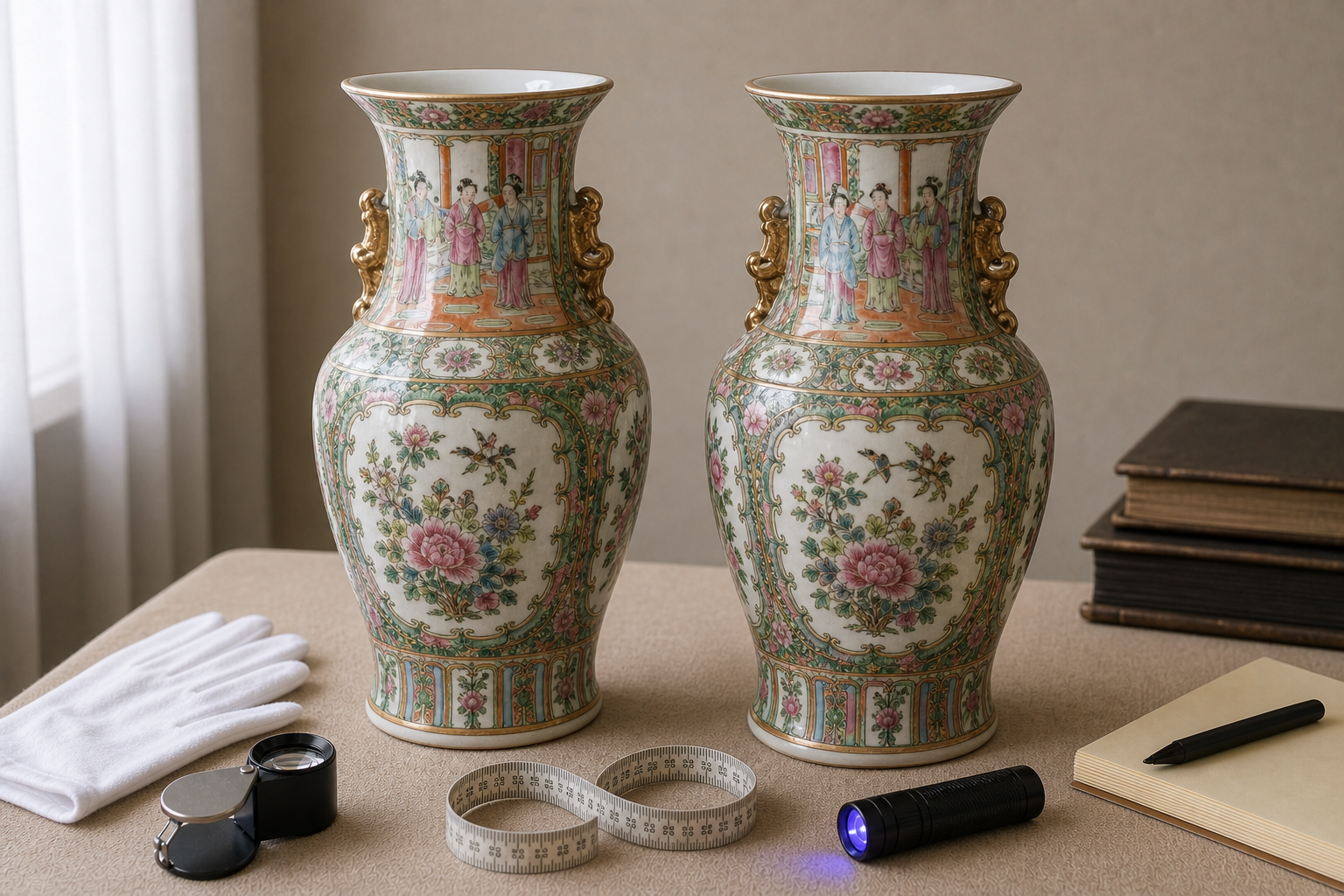
Among Chinese export porcelains, few categories capture the exuberance of color and storytelling quite like famille rose (famille rosa) wares from the Canton (Guangzhou) workshops. A matched pair of late 19th-century Canton-decorated vases combines the romance of Qing dynasty taste with the global history of trade, and it presents a satisfying challenge for the appraiser’s eye: discerning date, workshop quality, and condition in a field full of reproductions and apocryphal marks. This guide outlines how to identify, date, and value such a pair, with practical check-points and pitfalls to avoid.
What “Famille Rosa” Means and How Canton Workshops Worked
“Famille rose” (French for “pink family”) refers to an overglaze enamel palette—called fencai in Chinese—dominated by a colloidal gold-derived pink, joined by opaque whites, greens, yellows, blues, iron reds, and black, often heightened with gilding. The palette first gained prominence in the 18th century (Yongzheng period), but the visually dense “Canton famille rose” style matured in the 19th century for export to Western markets.
Production during the late Qing period typically followed a two-stage process:
- Bodies thrown and fired in Jingdezhen kilns (Jiangxi province).
- White-glazed blanks shipped to Canton, where specialist enamellers applied colorful overglaze decoration and gilding, then refired at lower temperatures in muffle kilns.
This division explains hallmark traits of Canton-decorated vases:
- Thick, glossy enamels with slight surface pitting or “seediness.”
- Raised reserves (panels) framed by scrolling borders and gilt.
- Frequent use of turquoise enamel to line interiors (necks and mouths), masking imperfections and providing a luxurious contrast.
Canton famille rose is often grouped into patterns collectors call “Rose Medallion,” “Rose Mandarin,” and “Rose Canton”:
- Rose Medallion: Alternating panels of courtly figures and birds/flowers around a central peony medallion; elaborate borders.
- Rose Mandarin: Focus on figural panels with narrative domestic or court scenes; sometimes fewer flowers/birds.
- Rose Canton: No figures, emphasizing butterflies, birds, and florals.
Late 19th-century vases frequently mix these elements, but figural reserves and butterflies with gilt highlights remain standard.
Distinguishing Late-19th-Century Canton Vases from Earlier and Later Examples
Dating a pair to circa late 19th century (roughly Tongzhi 1862–1874 to Guangxu 1875–1908) benefits from multiple converging clues:
Enamel execution: Canton late-19th-century enamels are rich and thick, often with finely shaded pinks, grass-green leaves with darker veining, and extensive gilding that shows honest high-point wear. Faces in figural scenes are outlined in iron red or black and shaded, but not as minutely as top-tier mid-18th century fencai; eyes are expressive yet stylized.
Palette and motifs: Expect bright pink peonies, multicolored butterflies, scrolling lotus or peony borders, cartouches with auspicious emblems (bats for “fu”/good fortune, shou medallions for longevity), and lavish gilt trellis or key-fret patterns. The color harmony is bold but balanced; Republic-era (1912–1949) examples can skew either more pastel with fine linework or, conversely, less harmonious with harsher reds and oranges depending on workshop.
Ground treatment: White grounds with crowded reserves and gilt borders are common. Coral-red sgraffito grounds are more associated with earlier imperial styles; in Canton export, the white ground with dense reserve work dominates.
Interior glaze: A turquoise enamel interior to the neck and shoulder is typical for Canton work in this period, though celadon or white interiors also occur.
Footrim and base: Jingdezhen biscuit footrim typically unglazed, slightly granular, with kiln grit adhering; a cleanly cut, slightly rounded foot with a narrow inner bevel is expected. Glazed bases with handwritten iron-red marks appear but are often later or apocryphal.
Marks and tariff clues: Late 19th-century export wares may be unmarked. After 1891 (U.S. McKinley Tariff), some pieces bear “CHINA” in red or black; “Made in China” generally indicates post-1919. Four-character Qianlong nian zhi marks in iron red are frequently apocryphal and cannot date a piece alone; on Canton export vases they’re decorative and should be treated cautiously.
Wear patterns: Gilt abrasion at shoulder and rim, scattered enamel scratching, and gentle wear to protruding butterflies/peony petals are consistent with age. Uniform, overly bright gilt with no wear can indicate later re-gilding or newer manufacture.
Scale and proportions: Many Canton pairs from this era range from 12 to 24 inches in height; slimmer rouleau forms and broader baluster forms are both encountered.
When comparing with Republic-period pieces, look closely at the finesse of faces and calligraphic outline. Republic enameling at its best shows very crisp brush control, legibly refined calligraphy, and smoother enamel fields; late-19th-century Canton work tends to be slightly thicker, with borders that prioritize visual impact over micro-precision.
Decoding Motifs, Borders, and Gilding on Canton Pairs
Motif reading aids both connoisseurship and dating:
Figures (Mandarin scenes): Courtyard gatherings, immortals, and attendants with lavish textiles. Hands, eyes, and headdresses are key—more delicate rendering and naturalistic shading usually correlate with higher workshop quality and earlier window within the Guangxu era.
Birds and butterflies: Butterflies rendered with multiple color blocks and fine antennae are classic. Birds perched amid peonies echo literati paintings via export prism. The complexity of feather detailing and leg articulation is a quality indicator.
Florals: Peonies (wealth and honor) dominate. Chrysanthemums, prunus, and lotus appear in reserves or border sprays. The balance of large blossoms with scatter of smaller “fill” flowers separates accomplished hands from formulaic painting.
Borders: Gilt key-fret, ruyi-head bands, fish-roe trellis, floral scrollwork, and jewel-like diaper patterns. In strong late-19th-century examples, borders are crisp with repeated units that maintain spacing around the vase circumference.
Auspicious emblems: Bats (fu), shou roundels, endless knots, and occasionally the Eight Buddhist Emblems appear as cartouche fillers or interstitial motifs.
Gilding: Abundant but not smeared. Look for tiny stopping points and even thickness. Widespread oxidation or flaking can indicate age; complete absence of wear on raised gilt may warrant closer inspection with a loupe for recent re-gilding.
The overall composition should read rhythmically around the vase: reserves spaced to avoid visual congestion at the shoulder and foot, with consistent design logic across the pair.
Forms, Proportions, and How to Tell a True Pair
Common late-Qing Canton-decorated vase forms include:
- Baluster (hu) with flared mouth: A workhorse export shape, often with a pronounced shoulder.
- Rouleau (gun) or sleeve: Cylindrical body and straight neck, suited to large figural reserves.
- Temple or palace vases: More sculptural, with swelling bodies and wide mouths.
- Gu-form variants: Flared trumpet mouth, waisted midsection, sometimes adapted in export contexts.
Identifying a true pair:
- Dimensional match: Height within a few millimeters, same body profile and mouth diameter.
- Mirrored decoration: Reserves and figure orientations mirror left/right across the pair, or at least present balanced alternation of motifs. In Canton export, near pairs (same pattern, not mirror-imaged) are common and collectible, but true mirror pairs carry a premium.
- Consistent palette and hand: Flesh tones, outline colors, and border execution should match; subtle differences are normal for hand-painted work, but a different green tone or border grammar suggests association rather than original pairing.
Beware later “marriages,” where two vases of similar size and pattern are paired after the fact. Incongruent foot treatments, different interior glazes, or mismatched panel sequencing are red flags.
Alterations to watch for:
- Cut-down necks: Ground rims with unnaturally thick lips, truncated border bands, and abrupt scene cropping signal reduction due to damage.
- Lamp conversions: Drilled bases or shoulders; look for circular drill holes and wiring residue. Conversion does not preclude collectability but affects value.
- Replacements: New hardwood stands, faux covers, or added metal mounts can hide condition problems or drilling.
Marks, Inscriptions, and Export Clues
Canton vases in this period present a mixed marking picture:
- Unmarked bases are common.
- Apocryphal four- or six-character reign marks (Qianlong nian zhi, Guangxu nian zhi) in iron-red or overglaze blue often appear, applied in Canton. They are decorative and do not guarantee imperial manufacture or the stated date.
- Stamped or hand-written “CHINA” indicates export post-1891. “Made in China” generally suggests post-1919 manufacture.
- Shop marks or collector inventory numbers in ink or pencil may occur on the base; these are useful provenance hints rather than factory marks.
Pay close attention to the footrim and glaze junction. An unglazed biscuit foot with a neatly wiped edge and a subtly pooled clear glaze at the inner edge is consistent with Jingdezhen bodies destined for Canton enameling. Heavy grinding or re-levelling of the foot may indicate later repairs or adaptation to a stand.
FAQ
Q: Are apocryphal Qianlong marks a red flag? A: They’re common on 19th-century Canton export porcelain and, by themselves, don’t imply fakery. Treat them as decorative, not diagnostic. Rely on body, enamels, and painting quality for dating.
Q: How can I tell if the rims were cut down? A: Look for unusually thick, rounded lips, interrupted border bands at the neck, or scenes abruptly truncated at the mouth. Under magnification, ground porcelain shows fine concentric abrasions; regilding often masks the work.
Q: Do drilled holes for lamps ruin value? A: They reduce value, sometimes significantly, but well-painted, large pairs still draw interest. Document the drilling and adjust expectations.
Q: Is turquoise interior glaze a guarantee of Canton decoration? A: It’s a strong indicator but not a guarantee. Assess in tandem with enameling style, palette, and foot treatment.
Q: What size is most desirable? A: Larger pairs (18–24 inches) with strong painting and mirror-image decoration tend to command premiums, provided condition is sound.
By synthesizing body construction, enamel technique, motifs, borders, and condition, you can confidently identify and appraise a pair of Canton famille rose vases from the late 19th century. True pairs with coherent design and honest wear remain both historically evocative and actively collected.