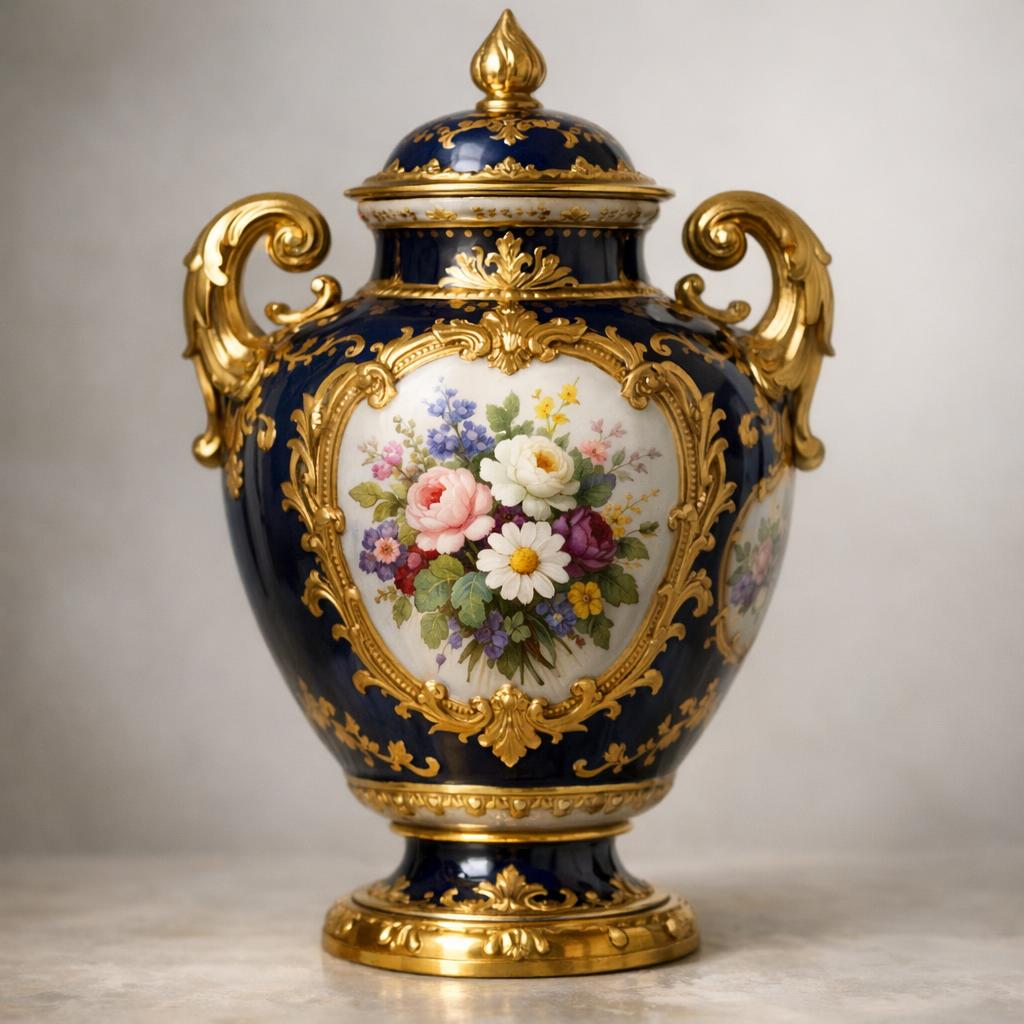
Is this porcelain vase hand-painted?
This list is for someone holding a porcelain vase and trying to decide whether the decoration was painted by hand, and whether that work is strong enough to justify an appraisal.
The strongest tells are visible from a photo:
- Stroke width that changes mid-petal instead of a repeating stencil.
- Enamel that stands proud of the glaze.
- Cobalt that blooms into the paste.
- An unglazed foot with grit, not a machine-sanded ring.
- Gold worn at the rim and handles, not faded evenly all over.
A named Meissen Schneeballen cover and a later famille-rose cabinet vase can share a silhouette and still sit in different quality tiers. A mark is a lead, not proof that the body, palette, and scale belong together.
Start with the painted surface
1) Brush edges show human variation.
Hold the vase at an angle so light rakes across one petal, one face, or one border. A hand-drawn line thickens, skips, or crosses itself. A transfer usually repeats the same motif length around the body and can leave a regular stipple.
Christian McCann Auctions catalogued a Chinese blue-and-white porcelain vase with all-over hand-painted decoration, 42 cm high, as lot 264 on 8 December 2024. Bruce Kodner Galleries catalogued an antique Vienna Ernst Wahliss hand-painted porcelain vase as lot 777 on 14 July 2013. O'Gallerie catalogued a Royal Bonn German porcelain vase as hand painted, lot 737, on 23 February 2011.
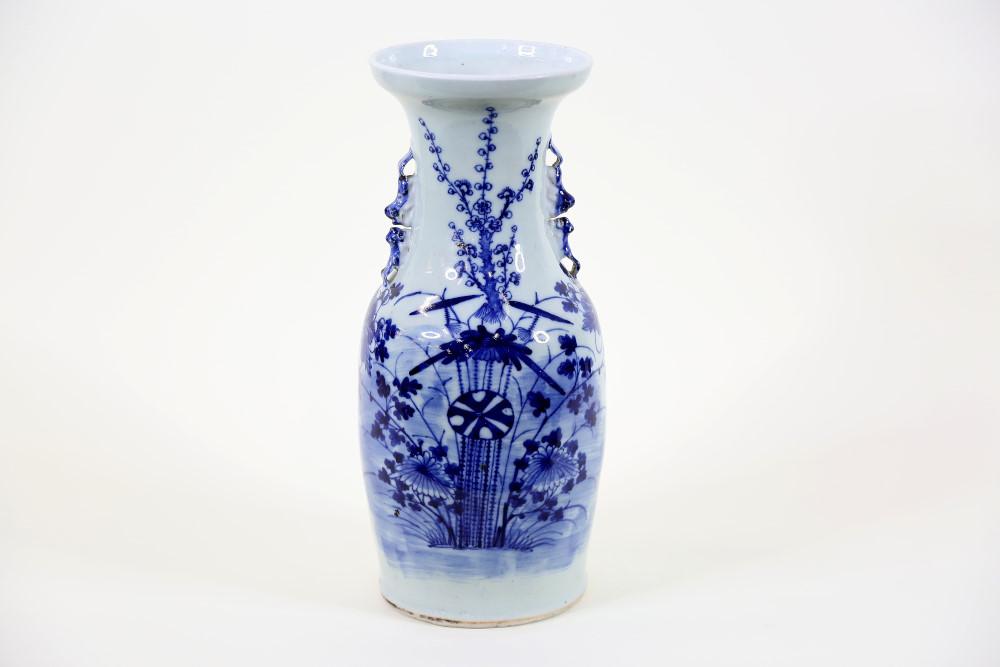
Check first: Photograph one motif at an angle and compare it to the next repeat around the body.
2) Overglaze enamel sits slightly proud.
Run a fingernail lightly over a flower, a gilt highlight, or a raised dot. Famille-rose color and Meissen enamel sit on the glaze as a built-up layer. Printed decoration usually feels as smooth as the surrounding skin.
Linwoods Auction catalogued a Chinese famille-rose porcelain vase as lot 6718 on 8 April 2015. Piers Motley Auctions catalogued a Louis XV ormolu-mounted Meissen Maiblumen porcelain vase, c.1750, as lot 402A on 2 February 2015. Wealthier Art & Auction, G & B Auction Gallery, and China Arts Auction each catalogued the same famille-rose vase form at other houses.
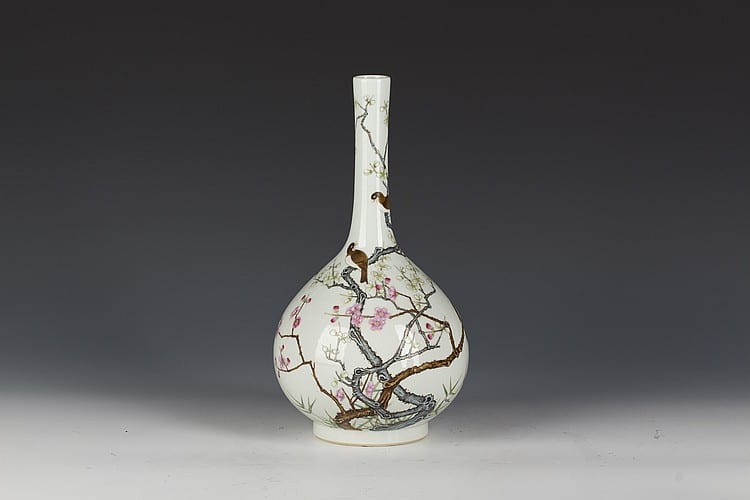
Check first: Drag a fingernail across a flower or gilt highlight; if the color is level with the glaze, treat it as printed until a closer look says otherwise.
What similar items actually sold for
To help ground this guide in real market activity, here are recent example auction comps from Appraisily’s internal database. These matched sales are market context only, not an object estimate or identification, and they do not guarantee a price for your specific porcelain vase.
| Comparable | What sold | Auction house | Date | Lot | Source-reported amount |
|---|---|---|---|---|---|
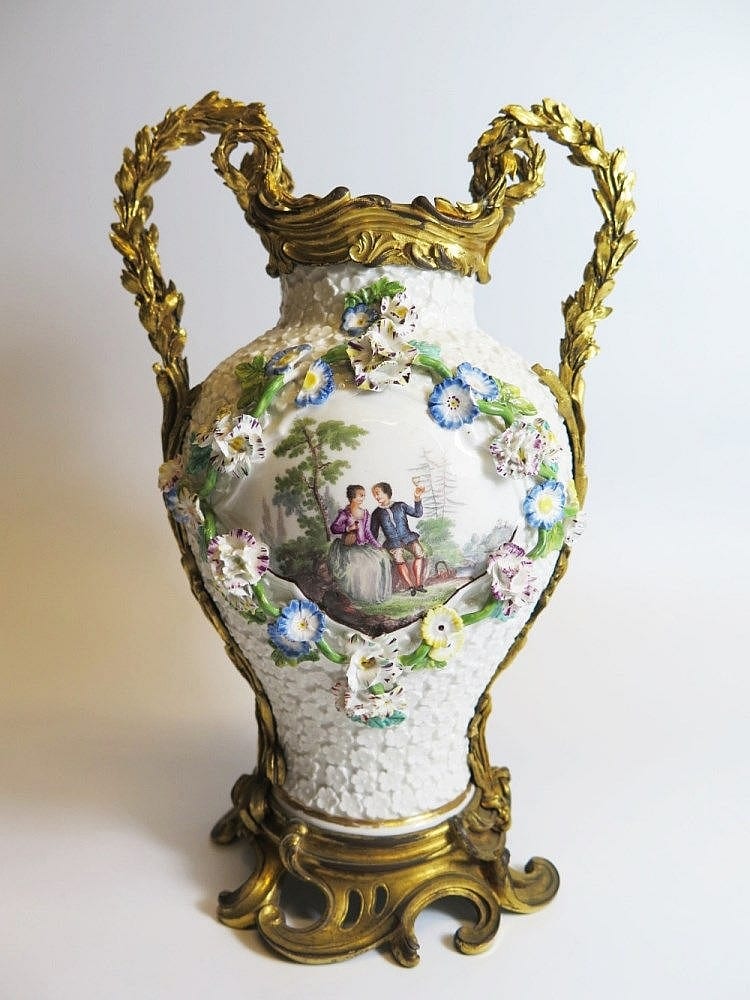 |
A Louis XV Ormolu Mounted Meissen 'Maiblumen' Porcelain Vase, c.1750 The baluster shaped body p | Piers Motley Auctions | 2015-02-02 | 402A | GBP 2,900 (buyer’s-premium treatment unknown) |
| No auction photo supplied | Large Porcelain vase, Meissen, 2.H.20.th. century | Henry's Auktionshaus | 2025-06-28 | 5007 | EUR 320 (buyer’s-premium treatment unknown) |
| No auction photo supplied | Meissen Porcelain Figurine & Figural Spill Vase | Ahlers & Ogletree Inc. | 2016-03-06 | 516 | USD 175 (buyer’s-premium treatment unknown) |
| No auction photo supplied | Pompous plate and small funnel vase, Meissen sword mark, 1st choice, plate | Auktionshaus am See | 2025-06-15 | 616 | EUR 220 (buyer’s-premium treatment unknown) |
| No auction photo supplied | Vintage Floral Porcelain Meissen Trumpet Vase | Monarch Auction and Estate Services | 2023-02-12 | 12 | USD 30 (buyer’s-premium treatment unknown) |
How these auction records were verified
Each row retains its exact source URL, lot identity, retrieval time, access result, and immutable record hash. Inspect the public comparable provenance record.
Disclosure: prices are shown as reported by auction houses and are provided for appraisal context. Learn more in our editorial policy.
From cobalt to market tier: the rest of the clues
A typical estate-sale vase is labeled “Chinese” because a Qianlong-type mark is on the base. If the paste, palette, and height do not belong to that claim, the mark is a check, not period proof.
3) Underglaze blue looks absorbed into the body.
Look at cobalt where it meets white paste. A true wash feathers and blooms. A printed outline stays hard and even.
New Orleans Auction Galleries catalogued a Japanese Imari porcelain floor vase as lot 661 on 7 December 2025. Historia Auctionata catalogued an Arita Imari double-gourd porcelain vase as Edo period, c.1800, lot 6357, on 3 April 2023. The Christian McCann blue-and-white vase above is the Chinese underglaze example cited on this page.
Check first: Look at where cobalt meets white paste; a hard mechanical outline is not a soaked wash.
4) The foot rim shows honest kiln finish.
Turn the vase over. Unglazed biscuit, kiln grit, and uneven wear are the kiln story. A uniformly sanded ring is the later-production tell.
None of the selected lot titles describe the foot, kiln grit, or a sanded ring. Use the underside as an inspection surface on the same vase forms already catalogued: the McCann blue-and-white, the Motley Meissen baluster, and the Arita Imari double gourd.
Check first: Photograph the entire unglazed ring, not only the mark in the well.
5) Gilding wear appears where hands touch.
Natural burnish collects where people lift the vase: rim, handles, and high points. Gold that fades evenly around the whole body looks like a later wipe or a thin factory gilt.
The Motley Meissen Maiblumen vase is ormolu-mounted. The Linwoods famille-rose vase is the overglaze palette that often carries gilt reserves. Neither title records gilt wear, so this remains a handling check, not a priced gilt-loss example.
Check first: Compare gilt at the rim and handles with gilt inside a protected painted reserve.
6) Painted scenes show depth and modeling.
A painted reserve earns attention when a face, sleeve, or flower is built with more than one tone and a visible stroke direction. A single flat color field is fill, not modeling.
Famille rose is the overglaze palette that needs this check. The Wahliss Vienna and Royal Bonn lots are the European named-factory versions of a hand-painted scene on a vase body.
Check first: Look inside a petal or a sleeve for a second tone and a stroke direction.
7) Marks and body style align.
Glaze tone, paste, foot, and palette should fit the claimed maker. A later body wearing an older mark is a common mismatch.
Sworders catalogued a large Meissen porcelain Schneeballen vase and cover as lot 166 on 14 March 2023. Leonard Joel catalogued the same named form as lot 147 on 4 June 2024. Those titles name a factory and a technique. A reign mark on a different body is a different claim.
Check first: Read glaze, paste, foot, and palette before you trust the mark on the base.
8) Color pooling and brush-tip overlaps are visible up close.
Pigment gathers at line ends and where two strokes meet, leaving a tiny pool or overlap. That is a close-up of how the brush stopped, not the same observation as overall edge irregularity.
The McCann all-over blue-and-white, Wahliss Vienna, and Royal Bonn titles are the hand-painted vase forms cited here. No public-safe appraisal in the evidence for this page describes pooling, so this stays a loupe check.
Check first: Use a loupe at line endings and intersections, not only along a long stem.
9) Scale matches collector demand.
Taller baluster forms, pairs, covers, and unusual silhouettes usually outrank a small cabinet vase. Measure height before you compare the object to a floor-vase or covered-vase record.
The Sworders and Leonard Joel Schneeballen lots are covered collector-scale Meissen. New Orleans Auction Galleries catalogued the Imari as a floor vase. Henry's Auktionshaus catalogued a large Meissen porcelain vase as second half of the 20th century, lot 5007, on 28 June 2025 — useful as a later scale contrast, not as an 18th-century example.
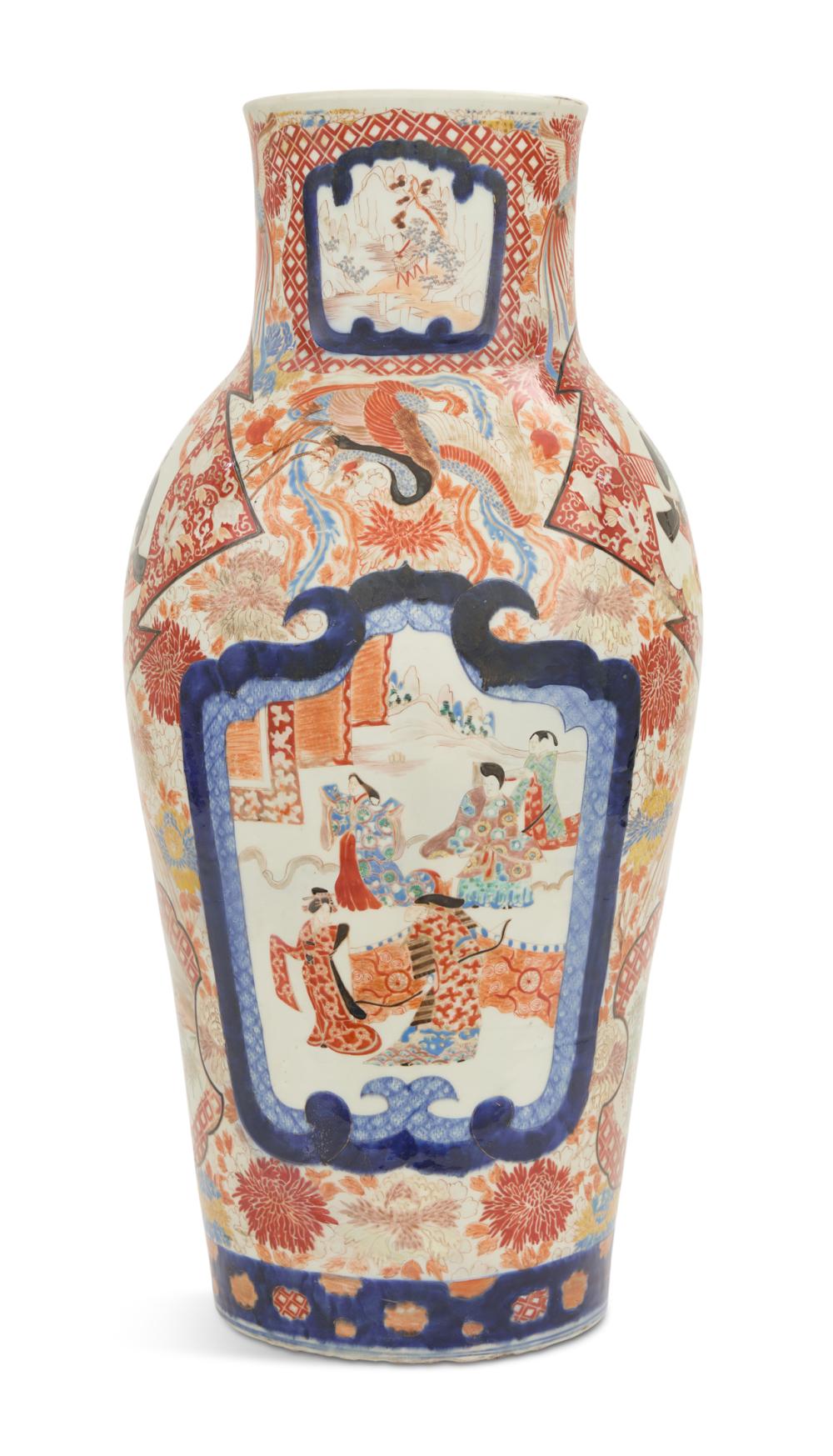
Check first: Measure height and note whether the form is a pair, a cover, or a floor vase.
10) Condition issues are limited and documented.
Hairlines, rim chips, and restoration have to be visible in the photos if they are going to be priced in. Heavy repainting cuts collector confidence faster than a small, honest rim nick.
None of the identity-complete lots cited here have hairline, chip, restoration, or repaint in the title, and no public-safe completed porcelain-vase appraisal at the evidence threshold records those issues. Treat condition as an inspection step until a catalogued example exists.
Check first: Shoot the rim, interior, and any gloss shift as separate frames.
11) Market evidence exist in the same quality tier.
A comparable is useful when decoration method, factory or palette, and size line up with the vase in hand. A later cabinet famille-rose vase is not the same tier as a named Meissen covered form or an Imari floor vase.
Use the auction-comps section above as the proof set: Sworders, Piers Motley, Linwoods, New Orleans Auction Galleries, and Christian McCann. Native currencies stay as reported. Match your vase to one of those quality bands before you treat a row as relevant.
Check first: Match decoration method, factory, and size before treating a porcelain-vase result as the same quality tier.
Photos that support the 11 clues
Five frames are usually enough for a first pass. Send the whole silhouette from front and back, the full underside including the foot, a raking close-up of the painted reserve, and any rim, hairline, or repair as its own shot. Add a ruler when the vase is unusually tall or you have a pair.
Leave gilt and enamel untouched until someone who will write the report says otherwise.
People also ask about hand-painted porcelain vases
How do I tell a hand-painted porcelain vase from a transfer print?
Start at one motif under raking light. Hand work changes pressure. A transfer repeats the same length and often leaves a stipple. Raised enamel is a separate tactile check, not the only proof.
Does a factory mark confirm that a porcelain vase is valuable?
No. A factory or reign mark names a claim. Whether paste, palette, and form belong to that claim is the next question. Later bodies carry older marks often.
What condition issues matter most for porcelain vases?
Hairlines, rim chips, overpaint, and foot grinding change the number because buyers price repair risk. Photograph each issue. UV can show restoration that room light misses.
Should I clean a hand-painted porcelain vase before appraisal photos?
Cleaning can smear overglaze and erase the gilt-wear pattern buyers use as a handling check. Send the photos first; a specialist can say whether any washing is safe.
Are modern hand-painted porcelain vases worth appraising?
Named atelier work and limited editions can still justify a closer look. Mass-market souvenir vases with printed decoration usually do not. Run the 11 clues on the object in front of you.
References
- Pack lots cited in this draft: Sworders, Piers Motley Auctions, Linwoods Auction, New Orleans Auction Galleries, Christian McCann Auctions, Bruce Kodner Galleries, O'Gallerie, Henry's Auktionshaus, Leonard Joel, Historia Auctionata, Wealthier Art & Auction, G & B Auction Gallery, and China Arts Auction.
- Appraisily public-safe appraisal example: matching pair of monumental Rose Medallion-style porcelain vases, proposed value as recorded in the evidence pack.
- Auction comps and price ranges in this guide are sourced from Appraisily’s internal auction results database and are provided for education and appraisal context (not as a guaranteed price). See Editorial policy.