
Sterling Silver vs Silver Plate What Appraisers Actually Look for: appraisal and value basics
Sterling Silver vs Silver Plate What Appraisers Actually Look for research should start with identification, condition, provenance, and recent comparable sales. Use this guide to compare the signals that matter before paying for a formal appraisal or deciding whether to sell.
Quick answer: the difference that changes value
Sterling silver is a regulated alloy of 92.5% pure silver mixed with copper for strength. Every piece is silver all the way through, and it carries intrinsic melt value tied to the current spot price of silver. In early 2026, with spot prices hovering around $30–$35 per troy ounce, a pound of sterling silver contains roughly $420–$490 of raw metal value alone.
Silver plate is a microscopic layer of silver — often less than 0.5 microns thick — electroplated onto a base metal such as copper, brass, or nickel-silver. Once that thin coating wears through, the underlying metal is exposed and the piece has no precious-metal scrap value. A silver-plated fork that weighed the same as its sterling counterpart might be worth $1–$3 at a refiner versus $35–$55 for the sterling version.
Yet the story is not quite that simple. A desirable silver-plate pattern from Reed & Barton, International Silver Co., or Walker & Hall can command $50–$300 at auction purely for design pedigree and condition — even though the metal underneath is base. The distinction matters because how you intend to sell or insure the piece determines which value metric applies.
Sterling silver vs silver plate: at a glance
The table below summarizes what appraisers check within the first 60 seconds of examining a piece.
| Attribute | Sterling Silver | Silver Plate |
|---|---|---|
| Composition | 92.5% silver + 7.5% copper (regulated standard) | Base metal (copper, brass, nickel-silver) with a thin electroplated silver layer |
| Hallmarks | "925", "STERLING", lion passant (UK), maker's mark, assay office mark | "EPNS", "EP", "A1", "Silverplate", pattern numbers, maker name only |
| Magnet test | Non-magnetic — magnet will not stick | May show slight attraction if the base metal contains iron or steel |
| Weight | Noticeably heavier; silver density is 10.49 g/cm³ | Lighter for the same size piece (base metals are less dense) |
| Wear pattern | Uniform patina darkens with age; no base metal bleed-through | Copper or brassy tones show at edges, handles, and high-wear points |
| Tarnish behavior | Tarnishes evenly across the surface; polishes back to bright silver | Tarnish may appear patchy; worn spots do not polish to silver |
| Melt / scrap value | Yes — tied to spot silver price (≈ $30–$35/oz in early 2026) | Negligible — refiners will not plate-recover silver economically |
| Decorative / collector value | Can be significant, especially with maker attribution and form | Moderate — desirable patterns from known makers still sell for $50–$300 |
| Typical use cases | Fine flatware, holloware, jewelry, coinage, liturgical objects | Everyday flatware, serving trays, decorative objects, hotel/restaurant ware |
Step 1: Read the hallmarks — what appraisers look for first
The fastest way to separate sterling from plate is to find the stamps. Professional appraisers flip a piece over, grab a 10× loupe, and read the marks in this order:
- Purity mark: "925" or "STERLING" confirms sterling silver. British pieces may show a lion passant (a walking lion) alongside a date letter and assay office symbol (leopard's head for London, anchor for Birmingham, etc.).
- Maker's mark: The manufacturer's initials or symbol. On sterling, this adds provenance; on plate, it may be the only value driver.
- Plate marks: "EPNS" (Electro-Plated Nickel Silver), "EP" (Electro-Plate), "A1" (first-quality plate), or the word "Silverplate" itself. Any of these confirm the piece is not solid silver.
- Pattern numbers: Many plate manufacturers stamped a pattern or catalogue number. These help identify the line but do not indicate precious-metal content.
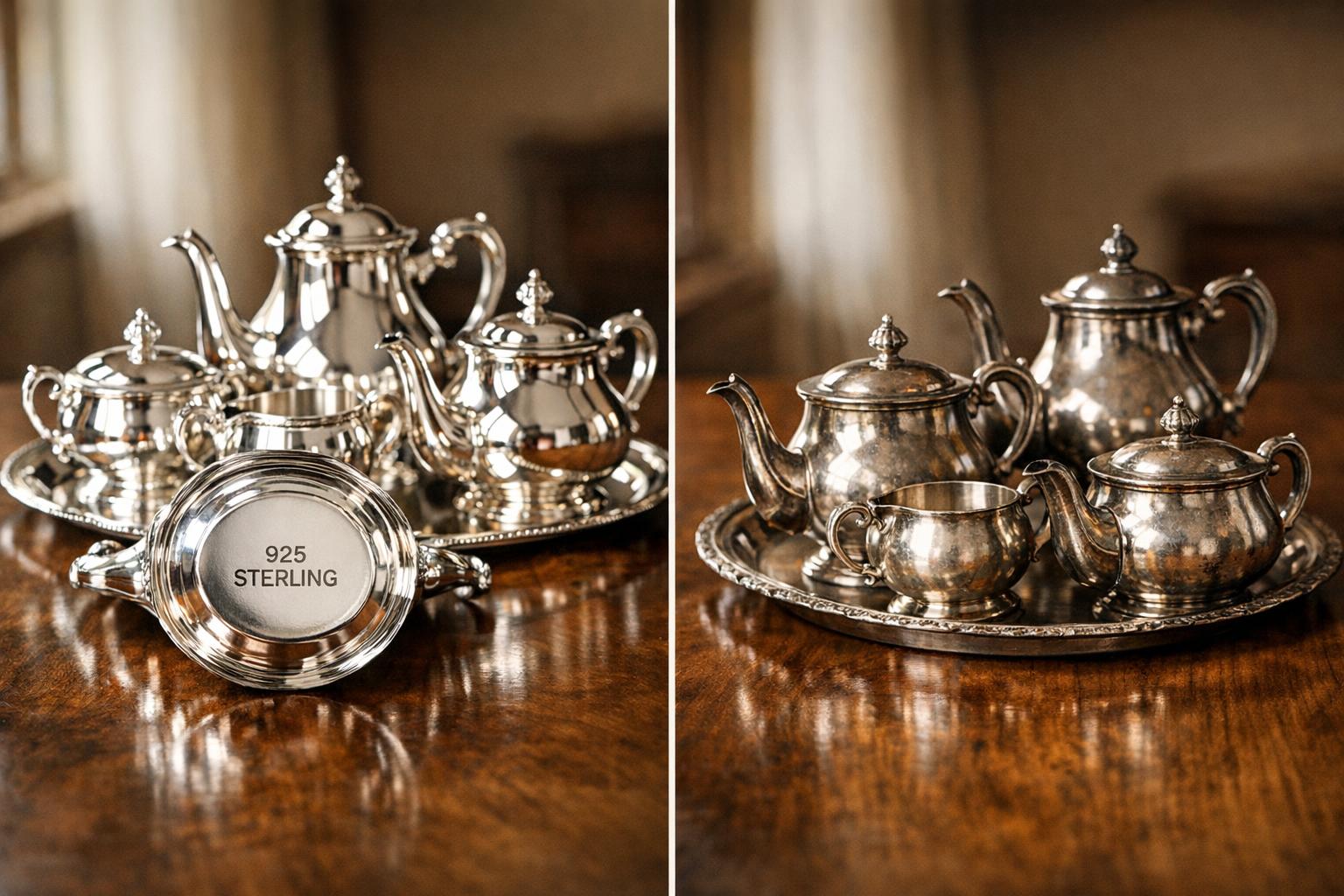
What can go wrong: Some American silver manufacturers from the late 1800s used "coin silver" marks (90% silver, marked "COIN" or "DOLLAR"). British "Britannia silver" (95.84%) uses a different hallmark — a seated figure of Britannia — and is even more valuable. If you see only a maker name with no purity stamp, assume plate until proven otherwise.
Step 2: Understanding plate marks — EPNS, EP, and A1 explained
If you find "EPNS" stamped on the underside, the piece is electro-plated nickel silver — meaning the substrate is a copper-nickel-zinc alloy that looks like silver but contains no precious metal. The silver layer on top is typically applied at 10–30 micro-inches (0.25–0.75 microns) for standard flatware, and up to 100 micro-inches for "heavy plate" or "triple plate" restaurant ware.
"A1" was a quality grading term used by Sheffield manufacturers to indicate the first (highest) quality of plating. It does not mean the piece is solid silver — only that the plate layer was applied to the best standard of the day. Even so, A1 pieces from well-known Sheffield firms retain decorative value and can sell for meaningful sums at auction when the pattern is sought after.
Step 3: At-home tests appraisers use when hallmarks are worn or missing
Not every piece has legible marks. Wear, over-polishing, and damage can obliterate stamps. In these cases, appraisers fall back on physical tests that anyone can perform with simple tools.
The magnet test
Sterling silver (92.5% Ag + 7.5% Cu) is non-magnetic. Hold a neodymium or even a standard refrigerator magnet against the piece. If it sticks firmly, the substrate is ferrous and the piece is plate. A slight tug can indicate a steel or iron base — a dead giveaway for plating over cheap metal.
The weight test
Silver is dense — 10.49 g/cm³, significantly heavier than brass (8.5 g/cm³) or copper (8.96 g/cm³). Experienced appraisers can often tell sterling from plate by heft alone. A sterling silver serving spoon typically weighs 80–120 grams; a similarly sized silver-plated spoon may weigh 50–75 grams. For larger holloware pieces, the difference becomes even more pronounced.
The ice test
Silver has the highest thermal conductivity of any common metal. Place an ice cube on the piece — if it melts unusually fast, that is consistent with sterling silver. Plate on a base metal will conduct heat less efficiently and the ice will melt at a normal rate. This test is informal but surprisingly reliable when used alongside other checks.
Edge and wear inspection
Examine the rims, handle edges, and any raised decorative elements under good light. On silver plate, these high-contact areas will show the base metal bleeding through — typically a warm copper, yellow brass, or grey nickel tone. Sterling silver, by contrast, develops a uniform dark patina from oxidation and sulfide exposure, and it polishes back to bright silver consistently across the entire surface.
Putting it together: a four-step identification workflow
Professional appraisers do not rely on a single test. They combine multiple signals — hallmark, weight, magnet response, and wear pattern — into a convergent identification. The flowchart below maps the sequence they follow:
What the distinction means for your piece's value
This is where the rubber meets the road. The sterling-vs-plate distinction creates fundamentally different value frameworks:
Sterling silver: melt value + craftsmanship premium
Every piece of sterling silver has a floor value equal to its silver content multiplied by the current spot price. At early-2026 prices of $30–$35/oz, a 12-ounce sterling bowl contains roughly $280–$340 of raw metal. Add craftsmanship, maker attribution, age, and condition, and auction prices for desirable forms (Georgian tankards, Art Nouveau bowls, Tiffany flatware) regularly reach $500–$5,000+.
Recent auction activity supports this. In January 2026, Ryedale Auctioneers reported silver sales "surpassing expectations" with silver prices at multi-year highs. Roseberys' Victorian silver sale that same month achieved a 93% sell-through rate — a signal that collector demand for sterling remains strong. Doyle Auctions in October 2025 sold an assembled set of eight Georgian sterling silver plates (Lot 158) at a premium that reflected both maker attribution and period craftsmanship.
Silver plate: decorative and maker-driven value only
Silver plate has no melt value. The silver layer is too thin to recover economically. However, that does not mean silver plate is worthless. Desirable patterns from recognized manufacturers — Reed & Barton's "Francis I," International Silver Co.'s "First Love," or Oneida's community patterns — can sell for $50–$300 per place setting or $200–$800 for full service sets in good condition.
The key is pattern recognition and condition. A complete 45-piece silver-plate dinner service in a sought-after pattern with no worn-through spots will outperform a battered, incomplete sterling set of unknown origin in many auction scenarios. But the ceiling is lower: even the best silver plate rarely exceeds $1,000–$2,000 at auction, whereas exceptional sterling pieces routinely break five figures.
When plate can outvalue anonymous sterling
There are edge cases. A heavily decorated silver-plate centerpiece by a知名 design house (Christofle, WMF, Elkington) in excellent condition may sell for more than a dented, unmarked sterling trinket bowl. Appraisers weigh four factors: maker reputation, pattern desirability, condition and completeness, and current market demand. Metal content is the starting point, not the finish line.
Inside the appraiser's workflow: what happens beyond the hallmarks
Once an appraiser has confirmed sterling vs plate, the real valuation work begins. Here is what separates a professional assessment from a quick pawn-shop glance:
- Maker attribution: Who made it? A Tiffany & Co. sterling bowl commands a significant premium over an unmarked piece. Appraisers reference maker mark dictionaries, assay office registries, and auction databases.
- Form and function: Holloware (teapots, bowls, pitchers) typically carries a higher premium than flatware per ounce, because the craftsmanship investment is greater and the form is more collectible.
- Condition grading: Dents, monogram removal, repairs, and over-polishing all reduce value. A re-tinned silver-plated teapot interior is normal; a re-plated piece that was originally sterling is a red flag.
- Market comparables: Appraisers check recent auction results for similar form + maker + condition combinations. This is where the gap between sterling and plate becomes quantifiable — comps reveal what buyers actually paid, not what a price guide suggests.
- Purpose of appraisal: Insurance replacement value (retail cost to replace today) differs from fair market value (what a willing buyer pays a willing seller) and from liquidation value (what a dealer or refiner would offer). Sterling's melt floor makes all three values meaningful; for plate, only FMV and decorative comparables apply.
Free instant estimate
Not sure if your item is worth appraising? Let us take a look.
Upload a photo, tell us what you know, and get a free first read. If a full appraisal makes sense, we will say so.
Free. No card needed. Takes about two minutes.
Pricing reality check: what sold comps tell us
Auction results paint the clearest picture of the sterling-vs-plate value gap. Here are representative patterns drawn from recent sales and the Appraisily auction database:
- Sterling flatware place settings: Anonymous or unmarked sterling pieces typically sell for $35–$85 per piece at auction. Named patterns from Tiffany, Gorham, or Whiting can reach $120–$300 per place setting.
- Sterling holloware: A mid-size sterling bowl (12–20 oz) from a recognized maker in good condition sells in the $200–$800 range. Georgian or Victorian pieces with assay marks and original finish can exceed $1,500–$5,000.
- Silver-plate flatware: Most silver-plate forks, spoons, and knives sell individually for $3–$15 in the secondary market. Full sets in desirable patterns (Reed & Barton, International Silver) achieve $80–$250 for 40+ piece services.
- Silver-plate holloware: Decorative teapots, trays, and centerpieces from notable manufacturers range from $25–$150 each. Exceptional Christofle or Elkington pieces in pristine condition can reach $300–$800.
The takeaway: sterling silver carries a high floor and a high ceiling, while silver plate depends entirely on pattern desirability and condition. A professional appraisal tells you exactly where your piece falls on each spectrum.
When to get a professional appraisal
Use the following thresholds to decide whether a DIY identification is enough or whether you need a formal written appraisal:
- Insurance coverage: If you need a documented replacement value for your homeowner's policy or a scheduled personal article floater, a formal appraisal from an ISA or ASA-accredited professional is required.
- Estate settlement: Executors need FMV documentation for tax filings. Sterling silver estates with 50+ pieces can easily represent $5,000–$25,000+ in total value.
- Charitable donation: The IRS requires a qualified appraisal for donated property valued over $5,000. A single sterling holloware piece or a complete silver service can cross this threshold.
- Before selling: Knowing whether you have sterling or plate — and which maker — determines whether you approach a refiner, an auction house, a dealer, or a private collector. The channel you choose can double or triple your return.
What similar items actually sold for
To help ground this guide in real market activity, here are recent example auction comps from Appraisily’s internal database. These are educational comparables (not a guarantee of price for your specific item).
Shown USD range: USD 275-USD 3,000. Median of these 4 USD examples: USD 1,000.
| Image | Description | Auction house | Date | Lot | Reported price realized |
|---|---|---|---|---|---|
|
Attractive Vintage Mother-of-Pearl Sterling Silver, Plated Silver and Silver-Tone Flatware in Wood Case (Circa 1900) - Approx 61 Pieces @ Approx 82 Troy Ounces Together | Apple Tree Auction Center | 2025-12-03 | 3231 | USD 275 |
|
CARTIER, REF. 6600, GOLD-PLATED STERLING SILVER 'CEINTURE' WATCH | Freeman’s | Hindman | 2025-07-24 | 66 | USD 3,000 |
|
Antique handmade 9ct & 18ct yellow gold plated sterling silver flower brooch with seed pearls, 18.26 grams | Pfeffer's Auctions | 2025-06-06 | 163 | AUD 300 |
|
CARTIER, GOLD-PLATED STERLING SILVER 'MUST DE CARTIER TANK' WATCH | Freeman’s | 2025-07-24 | 74 | USD 1,400 |
|
Group Sterling Silver, Silverplate, & 800 Silver | Revere Auctions | 2023-05-16 | 30 | USD 600 |
Disclosure: prices are shown as reported by auction houses and are provided for appraisal context. Learn more in our editorial policy.
Search variations collectors ask
Readers often Google these questions — each is answered in the guide above:
- How to tell sterling silver from silver plate at home
- What does EPNS mean on silver — is it worth anything
- Does sterling silver stick to a magnet
- How much is silver plate worth per pound
- What hallmarks to look for on old silver flatware
- Can silver-plated items have collector value
- Sterling silver melt value calculator 2026
- How to identify Reed and Barton sterling vs plate patterns
Each question is covered in the identification steps and value sections above.