
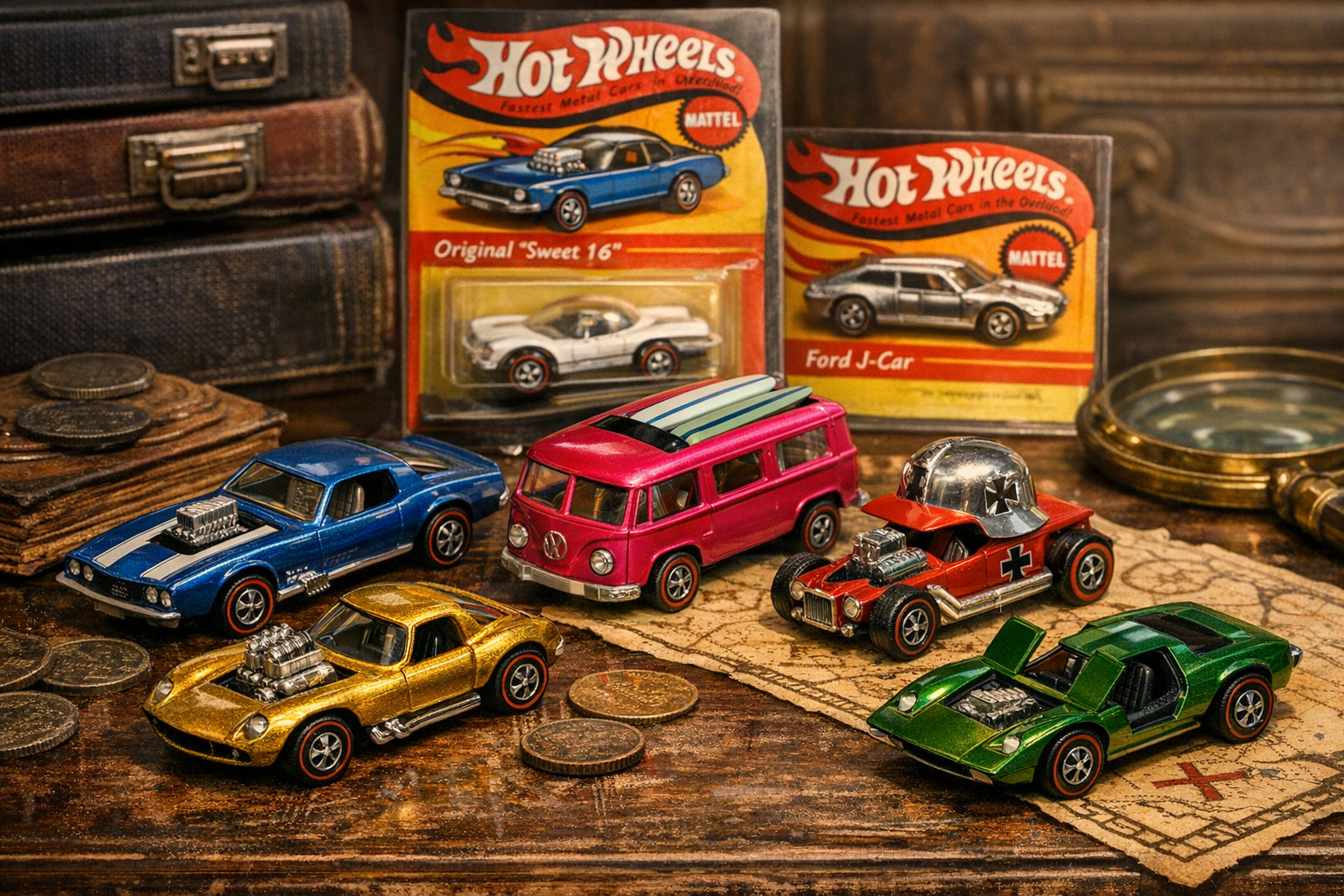
What is an old Hot Wheels worth right now?
Short answer: old Hot Wheels value starts with evidence, not stories. Some cars are ordinary toys; a smaller but real group can be significant collector pieces. In 2026, buyer interest is still concentrated in documented, complete, and condition-visible examples from early runs, especially when those items have strong evidence.
The fastest way to decide whether your set is likely ordinary or noteworthy is to test three things in order: first, identify the exact casting family and year range; second, check whether the item is complete and carded; third, compare recent similar sales before you infer rarity.
This article gives practical identification steps, a comp-reading framework, and a clear trigger for when to request a full appraisal review. It is written for the people asking “is my old Hot Wheels worth anything?” and not for collectors hunting generic toy catalog values.
Free instant estimate
Not sure if your item is worth appraising? Let us take a look.
Upload a photo, tell us what you know, and get a free first read. If a full appraisal makes sense, we will say so.
Free. No card needed. Takes about two minutes.
Use a concrete value-driver checklist before any estimate
Collectors buy certainty. If two cars look similar, value comes down to visible proof of production intent, rarity, and condition. Use this checklist as your first pass:
| What to check | What matters in Hot Wheels valuation | How it changes price |
|---|---|---|
| Casting era and base marking | Compare wheel style, base shape, and early-mintage indicators against trusted references. | Early production often starts from a higher baseline, but only when other clues agree. |
| Packaging status | Unopened packaging generally preserves condition evidence and helps confirm model and variant claims. | Packaged or near-packaged examples usually attract more interest than loose items with missing parts. |
| Color and variation clarity | Specific variations can matter much more than “standard” examples. | Rare color combinations may increase interest, but only with supporting photos and lot history. |
| Wear, repairs, and damage | Document visible chips, wheel wear, cracks, repaints, and broken parts. | Repairs can either narrow or widen value depending on originality and integrity. |
| Comparable sales evidence | Use completed sales and photos for the exact variant and condition level. | Comparables often influence value more than guide pages or forum snippets. |
If one item checks all five boxes, you move it from “toy box curiosity” to “potentially valuation-worthy.” If only one or two boxes line up, that usually points to a fun collection piece rather than a large appraisal target.
Identify quickly: practical steps for older Hot Wheels
Step 1: Lock the model identity first
Start with base shape and wheel cues. Older Hot Wheels collections are broad, and many models share styling. Use closeup photos from top, side, and base to avoid mistaking a neighboring casting as equivalent.
Step 2: Record lot context, not just the lot photo
If you have a carded or boxed example, photograph the front, back, any inserts, and any markings. For unboxed items, photograph every side, wheel, window area, and underside details. Keep one image on a white background for scale and one in ambient context.
Step 3: Normalize condition language before pricing
Use a simple scale: loose-and-played, carded-with-light wear, complete-and-untouched, or restored/modified. That language is what buyers and specialists compare first, even more than model name.
Use recent auction sales as your proof point
Auction comps are the proof moment in a valuation guide. A strong comp directly connects what you have to what already sold. You should expect meaningful spread: two close-looking lots can trade far apart when condition or completeness differs.
Available recent comps show outcomes from low-to-mid hundreds and, in outlier cases, much higher results. This reinforces that completeness and condition drive real market outcomes more than label hype.
What similar items actually sold for
To help ground this guide in real market activity, here are recent example auction comps from Appraisily’s internal database. These are educational comparables (not a guarantee of price for your specific item).
Shown USD range: USD 275-USD 600. Median of these 4 USD examples: USD 413.
| Image | Description | Auction house | Date | Lot | Reported price realized |
|---|---|---|---|---|---|
 |
Hot Wheels Redline Beach Bomb & RLC Beach Bomb Too | Kraft Auction Service | 2024-10-12 | 1447 | USD 275 |
 |
Hot Wheels Redline Blackwall & RLC Cars | Kraft Auction Service | 2025-01-31 | 1993S | USD 500 |
 |
(20) Hot Wheels Redline Cars w/ Carry Case | Kraft Auction Service | 2025-01-31 | 1993O | USD 325 |
 |
Lot of 17 Vintage Hot Wheels Redline Cars. | Direct Auction Galleries, Inc. | 2021-09-25 | 214 | USD 600 |
Disclosure: prices are shown as reported by auction houses and are provided for appraisal context. Learn more in our editorial policy.
Read this as: if the comps are broad, your job is to prove which side of that spread your item belongs to with stronger photos and provenance notes.
Think your item might be worth more than guide ranges?
Upload photos and get a free instant read of where your item sits against current market signals.
Use the free screener first. If the evidence supports a full written review, we can help you move to the next step.
Get my free estimateWhen an older Hot Wheels should move from screener to full review
Use the screener result as a gate, then escalate when two criteria are met:
- You have a likely high-value variant or packaging context that does not match common market examples.
- You can provide photos that show base marks, wheel style, paint condition, and provenance details clearly.
A full review is usually worthwhile when the likely upside is meaningful for insurance, resale, estate, or legally sensitive situations. For casual collector curiosity, the free screener output is often enough to decide keep, list, or pass.
Appraisal trigger checklist
- Go full review if your item includes unusual variants, strong provenance, and near-complete components.
- Stay in screener mode if it is largely played with and common without clear unique cues.
- Request specialist help only when physical inspection is needed to confirm material differences.
This sequence saves time and prevents overpaying for certainty. A stronger position usually comes from disciplined documentation, not assumptions.
Common scenario
Someone finds a mixed lot in an estate sale and notices one car has period-correct body and wheel details but is unlabeled. They submit it with closeup photos and learn it does not match the broadest market group. Instead of pricing it immediately, they capture clearer photos of the base, packaging remnants, and closeups. That stronger evidence shifts the lot from “unknown” to “possible valuation target,” which is the exact point a full review becomes useful.
This is the practical difference between “it feels collectible” and “it is supported by market signals.”
How to prepare photos so the valuation is useful
Most inaccurate estimates come from incomplete evidence. For better reliability, photograph:
- Clear closeups of base, wheel arches, and tampo marks
- Overall side profile for silhouette and scale
- Any wear at axles, tire edges, interior, and paint transitions
- Packaging text at readable resolution
- Any non-original repair indicators (gloss changes, color mismatch, glue)
Need a full report? Start a full review.
Keep files unedited, use natural lighting, and include one ruler-sized scale reference when possible.
Common questions about old Hot Wheels value
Can one old Hot Wheels be worth thousands?
Do all 1968–1977 Hot Wheels cars have high value?
Does packaging always increase value?
Are social media rumors enough to price old Hot Wheels?
Should I start with the free screener or direct review?
Useful valuation support links
Hot Wheels price guides
A quick reference index for production years and broad model families.
Most valuable Hot Wheels
Useful context for rare variants and known top-end examples.
Vintage Hot Wheels marketplace
Real-world price range reference for current buyer behavior across conditions.
Appraisily free screener
Run your item through a fast comparison step before committing to a full review.
Conclusion
Old Hot Wheels valuation is not a matter of one headline claim; it is a chain of evidence. Start with clean identification, prove your condition, test comparable sales, and only then move into paid review. That sequence avoids overpaying for certainty and keeps your decision anchored to market reality.
If your lot checks more than one high-confidence signal, a full written review can help convert collector signals into a stronger action plan.
Related value questions readers also ask
These are short search-style questions mapped to this guide and answered above.
- Are old Hot Wheels cards and packaging more valuable than loose cars?
- How much is a 1968-1977 Hot Wheels collection worth?
- What makes a Hot Wheels Redline more collectible?
- Can a used Hot Wheels be worth money without packaging?
- Should I use auction results for an old Hot Wheels estimate?
- Free estimate for old Hot Wheels appraisal: what to expect
- How do I check if my Hot Wheels model is authentic?
- What evidence should I photograph before selling vintage Hot Wheels?
- When should I request a written Hot Wheels appraisal?