A shelf of matching encyclopedia volumes looks substantial, and sometimes the market agrees. More often, age and weight create an impression of value that the buyer pool does not support. The quickest way to separate those outcomes is to identify the edition, count the set, inspect the bindings and plates, then compare it with sales of genuinely similar material.
There is no honest universal price for “old encyclopedias.” Familiar twentieth-century general-reference sets can be difficult to sell, while an early, illustrated, finely bound, or specialist set may reach a much stronger result. The difference is specific evidence, not a dramatic story about age.
Check your set in five minutes
Start with these six checks before looking at asking prices. Record the answer to each one; a buyer will ask for the same information.
- Read the title pages. Record the full title, publisher, edition statement, publication years, and printing—not just the date on a decorative spine.
- Collate the set. List every numbered volume plus indexes, atlases, supplements, yearbooks, and plate volumes. “Twenty books” is not the same as “complete in twenty volumes.”
- Check the subject. A specialist encyclopedia may have an active academic or collector audience even when a common general-reference set does not.
- Inspect the bindings. Note full leather, half leather, cloth, gilt decoration, matched bindings, loose boards, split hinges, and repairs.
- Inspect the contents. Look for missing maps or plates, damp, mold, odor, brittle paper, tears, annotations, library marks, and clipped illustrations.
- Test current demand. Compare exact editions in sold results and ask whether the likely buyer is a collector, researcher, decorator, bookseller, or local reader.
Fast answer: if you cannot name the edition, prove completeness, and describe condition, you do not yet have enough information for a useful value comparison.
What similar items actually sold for
To help ground this guide in real market activity, here are recent example auction comps from Appraisily’s internal database. These are educational comparables (not a guarantee of price for your specific item).
Shown USD range: USD 250-USD 6,000. Median of these 4 USD examples: USD 610.
| Comparable | What sold | Auction house | Date | Lot | Reported price realized |
|---|---|---|---|---|---|
|
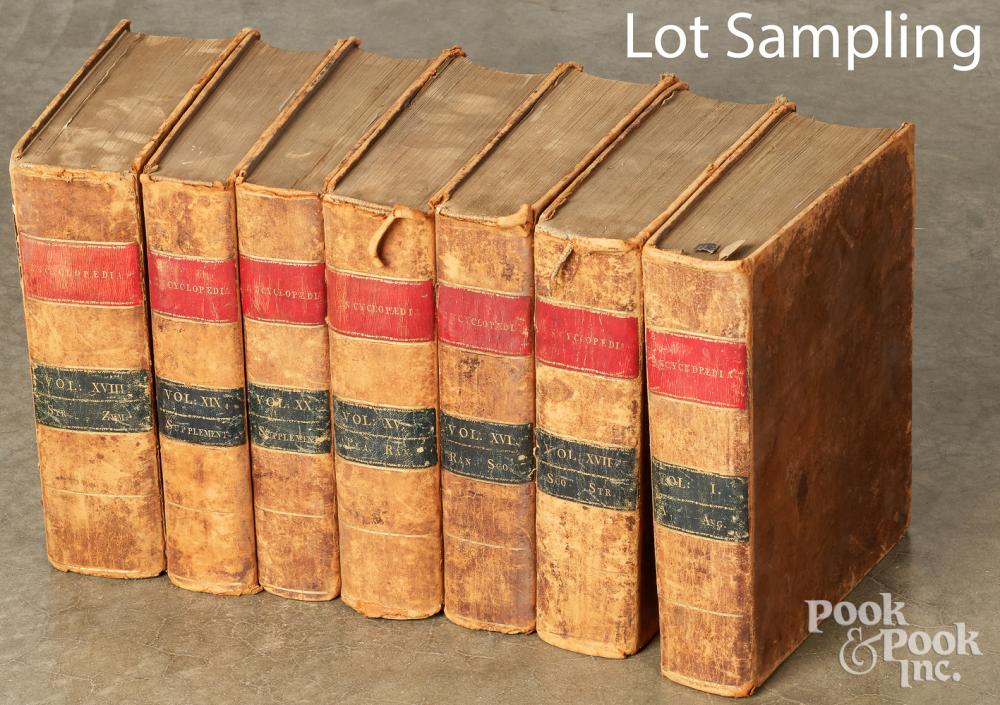
Two incomplete sets of Encyclopedia; or... | Pook & Pook Inc. | 2023-12-06 | 9473 | USD 320 |
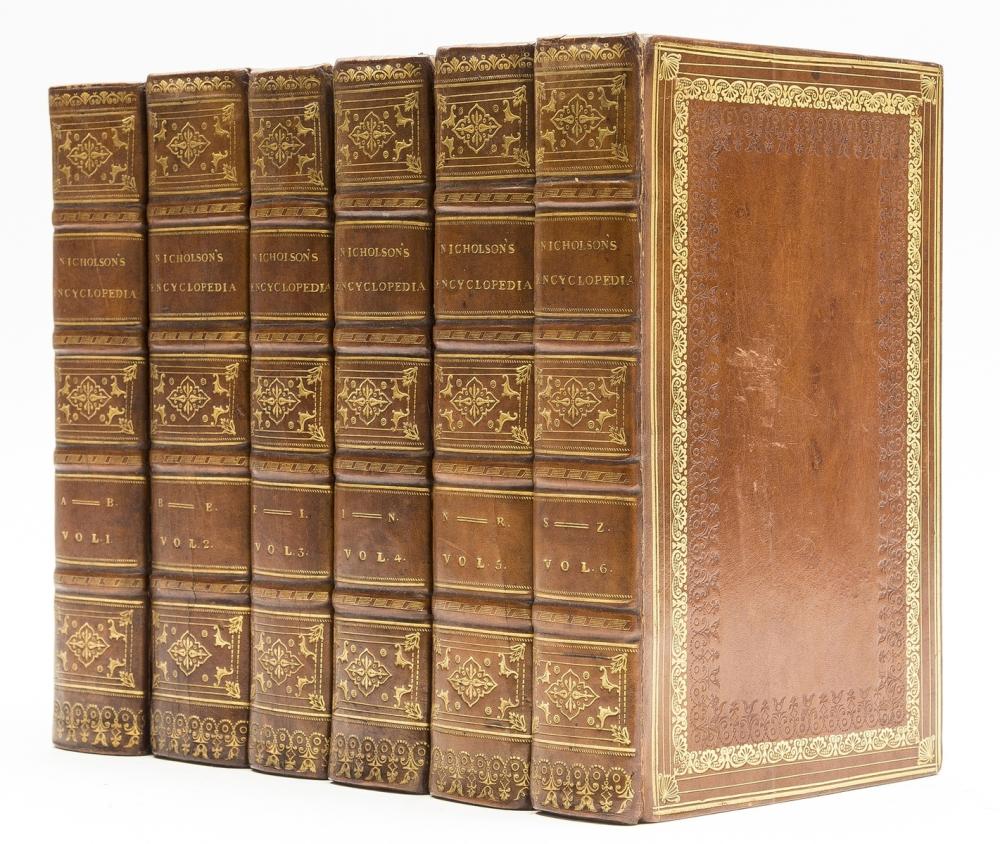 |
Nicholson (William) The British Encyclopedia, or Dictionary of Arts and Sciences, 6 vol., engraved plates, handsome contemporary russia, gilt, 1809. | Forum Auctions - UK | 2021-03-04 | 58 | GBP 320 |
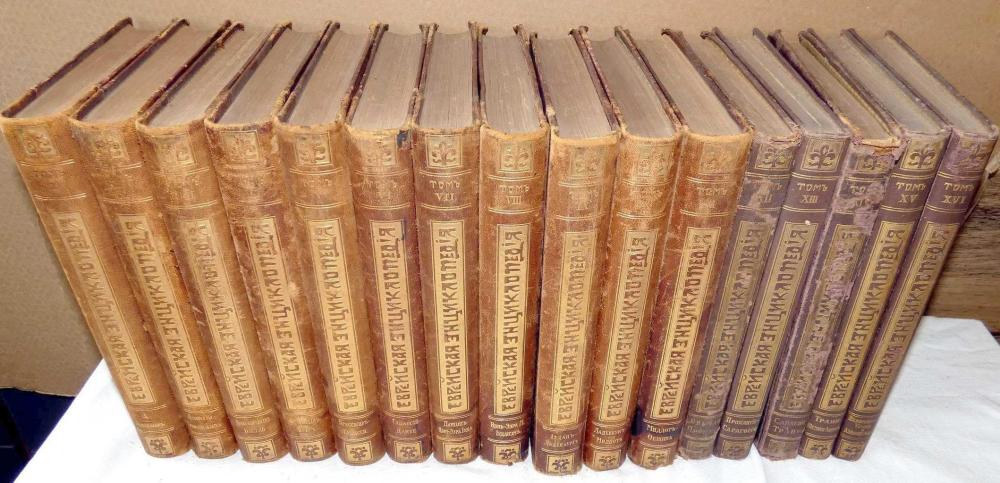 |
Jewish Encyclopedia 16 vol. Complete, illust., 1st ed., The Brockhaus and Efron, 1908-1913, in Russian | The Bidder | 2025-09-25 | 502 | USD 900 |
| [ENCYCLOPEDIA - LIMC]. Lexicon Iconographicum Mythologiae Classicae. Zurich und Munchen: Artemis Verlag, 1981-1997. | Hindman | 2024-05-23 | 268 | USD 6,000 | |
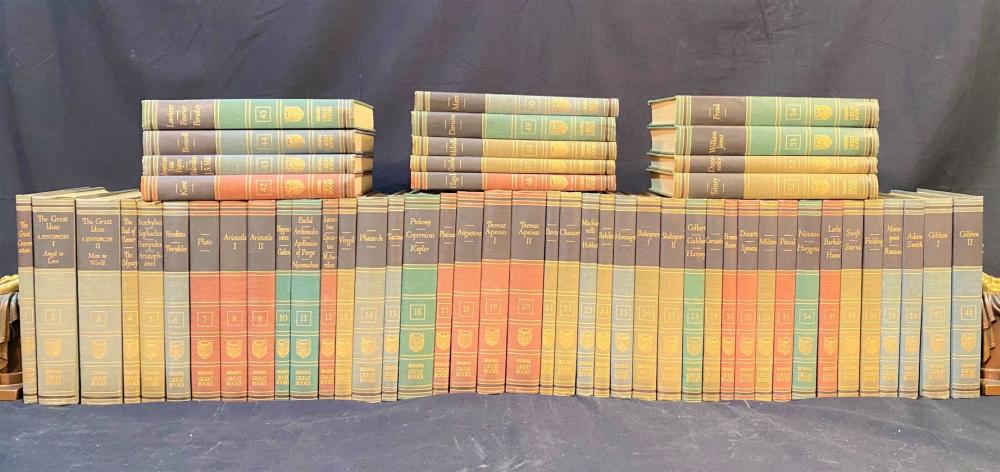 |
GREAT BOOKS OF THE WESTERN WORLD BY THE UNIVERSITY OF CHICAGO - ENCYCLOPEDIA BRITANNICA INC – COMPLETE SET OF 54 VOLUMES – 1952 | The Rug Life Auctions | 2022-11-01 | 86 | USD 250 |
Disclosure: prices are shown as reported by auction houses and are provided for appraisal context. Learn more in our editorial policy.
Free instant estimate
Upload your encyclopedia set for a free first read
Show us the title page, the complete row of spines, and the worst condition issue. We will help you judge whether the set deserves deeper research.
Free. No card needed. Takes about two minutes.
Read the title page, not the spine
The spine tells you what the set was meant to look like on a shelf. The title page and copyright page tell you what it is. Photograph both pages in the first volume and any volume whose date or imprint differs.
Record the exact edition statement, publisher, place of publication, date range, and whether the wording says revised, reprinted, facsimile, subscribers’ edition, or another named issue. A first edition can matter, but only where buyers care about that work and the copy matches the first-edition points. “Copyright 1911” printed in a later reissue is not proof of a 1911 first printing.
Edition details that can change demand
- An early or historically important edition rather than a later reprint.
- A complete edition with its original index, atlas, maps, or plate volumes.
- A named editor, publisher, illustrator, or contributor followed by collectors.
- Original bindings that are attractive and internally consistent.
- Useful subject coverage that is not easily replaced by a common later set.
The practical rule is simple: match edition to edition. A result for another year, publisher, binding, or volume count is context, not a direct comparable.
Count every volume and supplement
A neat row can still be incomplete. Start with the set’s own index, prospectus, final volume, or a reliable library catalogue record to establish the expected collation. Then check the sequence one book at a time.
| Check | What to record | Why buyers care |
|---|---|---|
| Numbered run | Every volume number and any duplicated or missing number | A gap can turn a usable reference set into parts or decoration |
| Indexes and atlas | Separate index, atlas, maps, plate books, or appendices | These may be essential to the edition’s intended use |
| Supplements | Which supplements belong to the edition and which were optional | Extra books do not automatically make a set complete |
| Matched issue | Publisher, dates, height, binding, and edition wording across volumes | A married set may be less desirable than a uniform original run |
| Contents | Missing plates, maps, title pages, or text leaves | All volumes can be present while the copy itself is incomplete |
Do not buy a replacement volume until you confirm the edition and binding match. A volume with the right letter range can still be the wrong issue, size, or binding.
Inspect the damage buyers cannot ignore
Light rubbing is not the same as structural failure. Check each book with the covers supported. Loose or detached boards, split joints, broken sewing, damp, mold, missing leather, brittle paper, and absent plates change both value and the cost of making the set saleable.
Separate cosmetic wear from structural damage
- Usually cosmetic: minor shelf rub, small scuffs, faded spines, an owner’s neat name, or light foxing, depending on age and market.
- Potentially structural: cracked hinges, loose text blocks, detached covers, failing leather, water tide lines, mold, insect loss, and missing leaves.
- Set-level problems: several unmatched bindings, smoke or basement odor, heavy sun fading across part of the row, or repairs performed with pressure-sensitive tape.
Attractive leather and gilt can support decorative demand, but binding quality does not rescue missing text or an edition nobody wants. Conversely, a plain specialist set can sell well when its subject remains useful and complete copies are scarce.
Ask who wants this exact set now
Current demand is the factor owners most often skip. General information that is easier to search online may have little reference value. A specialist encyclopedia can still attract researchers, collectors, institutions, or practitioners. A visually consistent leather set may appeal to decorators. Those are different markets, and they do not pay the same prices.
For scale, The Rug Life Auctions reported USD 250 for lot 86, a complete 54-volume 1952 Great Books of the Western World set published by Encyclopaedia Britannica Inc., on November 1, 2022. The size of the set did not by itself create a high result.
By contrast, Hindman reported USD 6,000 for lot 268, the specialist Lexicon Iconographicum Mythologiae Classicae, on May 23, 2024. This is evidence of demand for that exact scholarly reference, not a price guide for ordinary household encyclopedias.
The Bidder reported USD 900 for lot 502, a complete illustrated first-edition Russian-language Jewish encyclopedia in 16 volumes, on September 25, 2025. Its subject, edition, illustrations, language, and completeness traveled together in the sale record.
These are gross reported results from particular auctions. They do not equal what every seller would receive after commission, taxes, packing, shipping, or a local buyer’s discount.
Choose the selling path that fits the set
- Common modern set, modest demand: try a local marketplace, decorator, school, theater, or donation route. Heavy shipping can consume the price.
- Early, illustrated, finely bound, or specialist set: approach an antiquarian bookseller or auction house that regularly handles books and works on paper.
- Incomplete but visually attractive: describe it honestly as incomplete. Do not imply that matching spines prove a full set.
- Formal decision: use a written appraisal when insurance, estate administration, donation, division, or documented resale planning requires a defensible value and effective date.
A typical estate-clearance mistake is to price the set from a single optimistic listing, then discover that no local buyer will move forty heavy volumes. Sold results, exact edition matching, and realistic transport costs give a better answer.
Photograph the evidence before requesting a value
A useful first review does not need studio photography. It needs the right evidence in a logical order.
- One straight-on photograph showing every spine in sequence.
- The title and copyright pages from volume one.
- The edition or collation statement and the final numbered volume.
- Indexes, atlases, supplements, yearbooks, and separate plate volumes.
- The front board, spine, hinges, page edges, and one representative opening.
- Close-ups of the worst damage and any missing or replaced volume.
- Measurements of one typical volume and the total shelf length.
Keep the books in order while photographing them. Do not oil dry leather, erase ownership marks, tape loose boards, or remove institutional labels before a specialist has assessed the set.
Questions owners ask about old encyclopedias
Are old encyclopedias worth anything?
Some are, but age alone is not the reason. Edition, completeness, illustrations, subject matter, binding, condition, and active buyer demand decide whether a set is collectible, decorative, useful, or difficult to sell.
Does a complete set always have more value?
Completeness usually helps an already desirable set. It cannot manufacture demand for a common edition. An incomplete early or specialist work may still sell, but it must be compared with similarly incomplete examples.
How do I find the edition?
Start with the title and copyright pages, then compare publisher, dates, edition wording, volume count, and physical format with a reliable library catalogue or bibliography. Do not rely on the spine date alone.
Should I sell the volumes separately?
Not before checking demand. Breaking a complete set can destroy its strongest selling point. Separate-volume sales make more sense when owners of the same edition actively seek replacements and your copies can be matched exactly.
Is an online asking price a valid comparable?
No. It shows what a seller hopes to receive. Give more weight to exact sold records, while accounting for condition, edition, venue, buyer’s premium, currency, and the costs of getting the set to its buyer.
Search variations answered in this guide
- How much is a complete old encyclopedia set worth?
- Are Encyclopedia Britannica sets valuable?
- Does a first edition increase encyclopedia value?
- How do missing volumes affect an encyclopedia set?
- What condition problems reduce old book-set value?
- Are leather-bound encyclopedias worth more?
- Where can I sell a vintage encyclopedia set?
- Should I donate or appraise old encyclopedias?
Sources and method
- John Carter and Nicolas Barker, ABC for Book Collectors, for book-collecting terminology and copy completeness.
- Encyclopaedia Britannica, history of the work and its editions.
- Appraisily internal auction-results records, retrieved July 18, 2026. Exact house, date, lot, currency, amount, and source identity appear in the comparable-sales module.
Auction results are historical examples, not guarantees. Market value depends on the exact set, condition, venue, location, and effective date.