

Old picture frame identification basics
Start by comparing the front and back: gilding, compo ornament, corner joinery, backboards, hanging hardware, labels, oxidation, and repair evidence. A bright gold finish alone does not prove age.
The 10-Minute Identification Checklist
Set the frame on a clean, flat surface with good daylight or a bright LED lamp. You will need a 10× loupe (or your phone's macro camera), a small magnet, and a soft cloth. Work through each step in order — the earlier a single red flag appears, the less likely the frame is genuinely old.
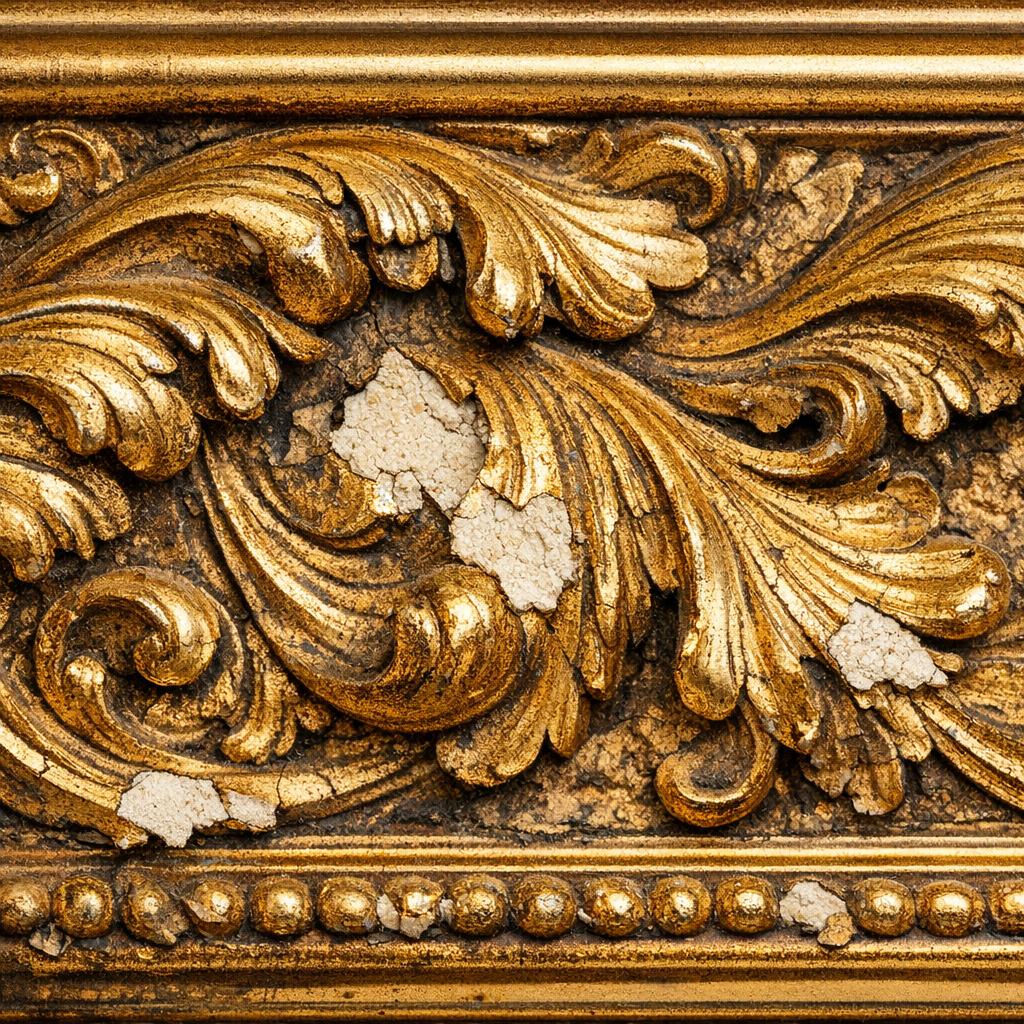
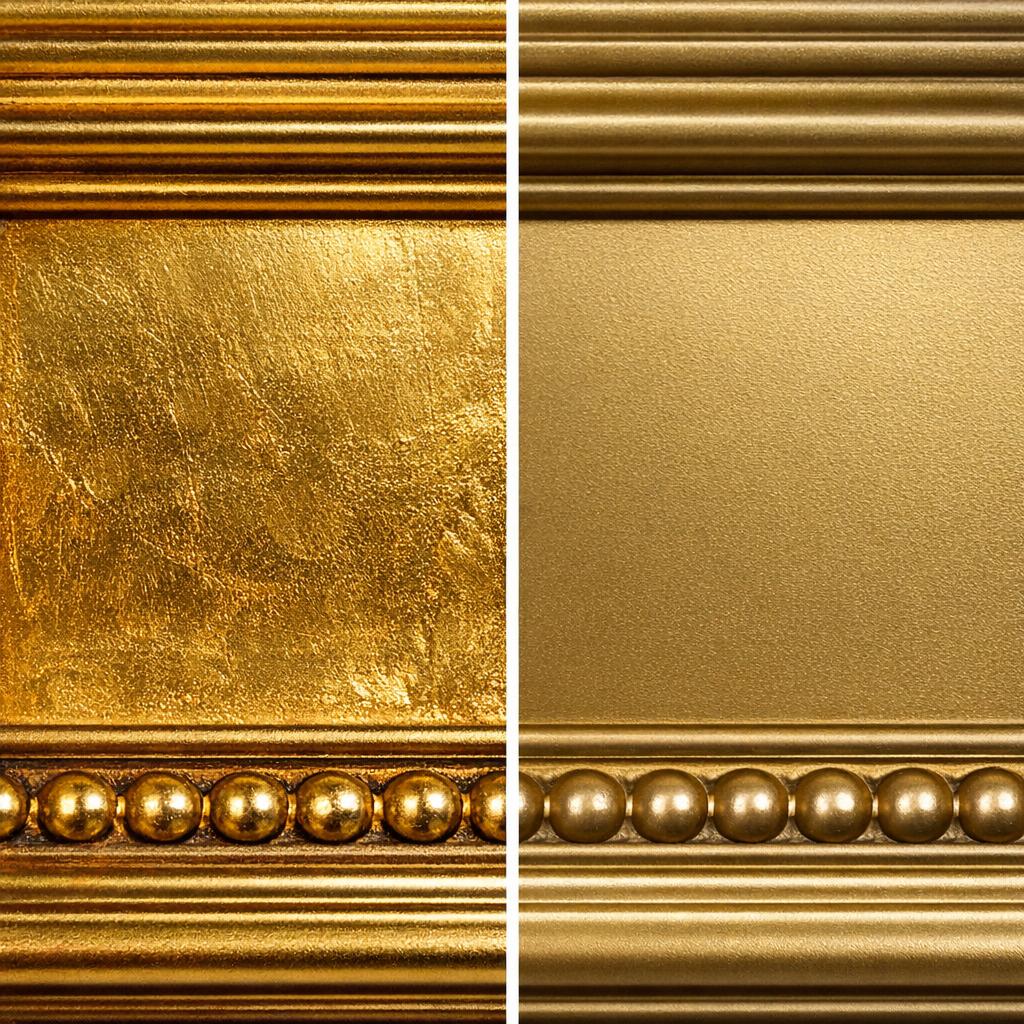
- Inspect the gilding surface under raking light. Hold a lamp at a shallow angle to the frame face. Genuine gold leaf shows faint parallel lines where individual sheets overlapped ("gilding lines"). Gold paint or electroplate looks flat and uniform.
- Test with a magnet. A magnet that sticks suggests a ferrous base metal under the gold — almost certainly modern electroplating or brass-tone paint. Real water-gilded wood frames will not attract a magnet.
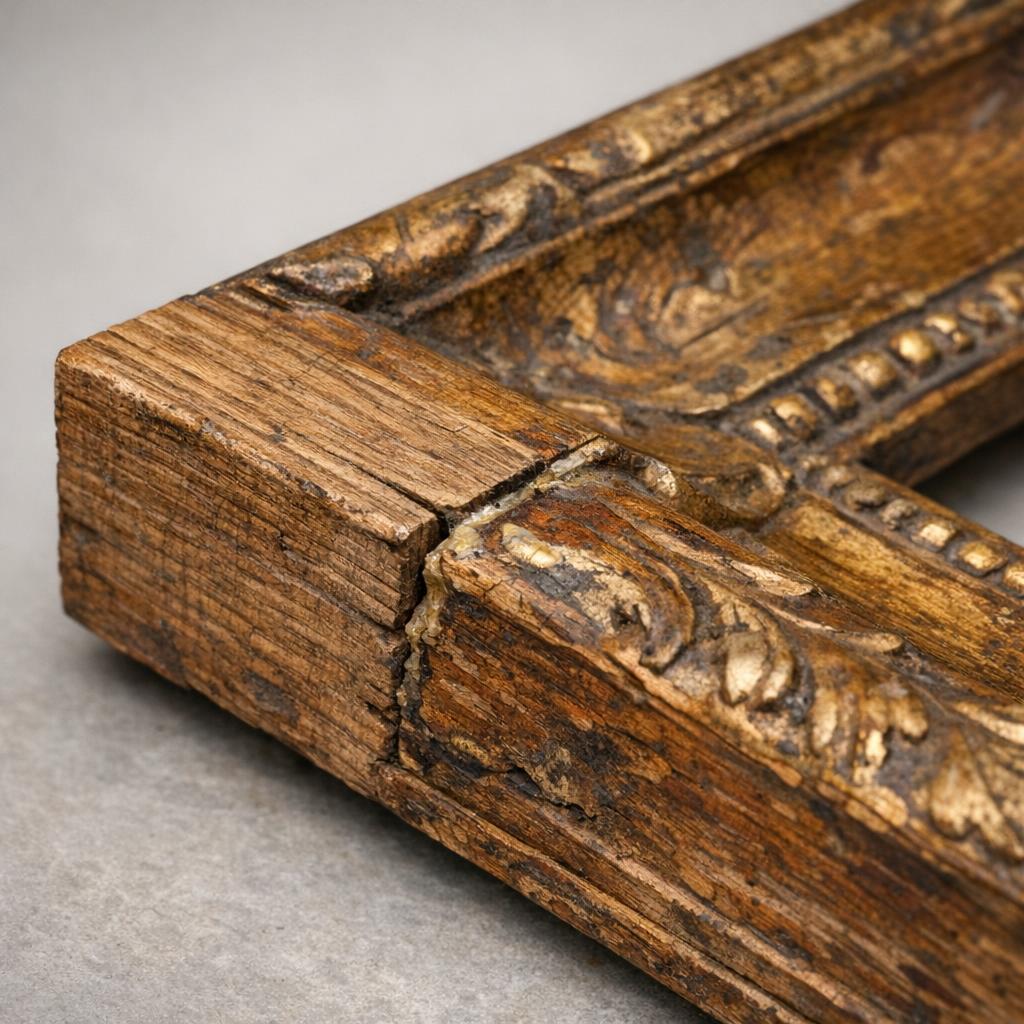
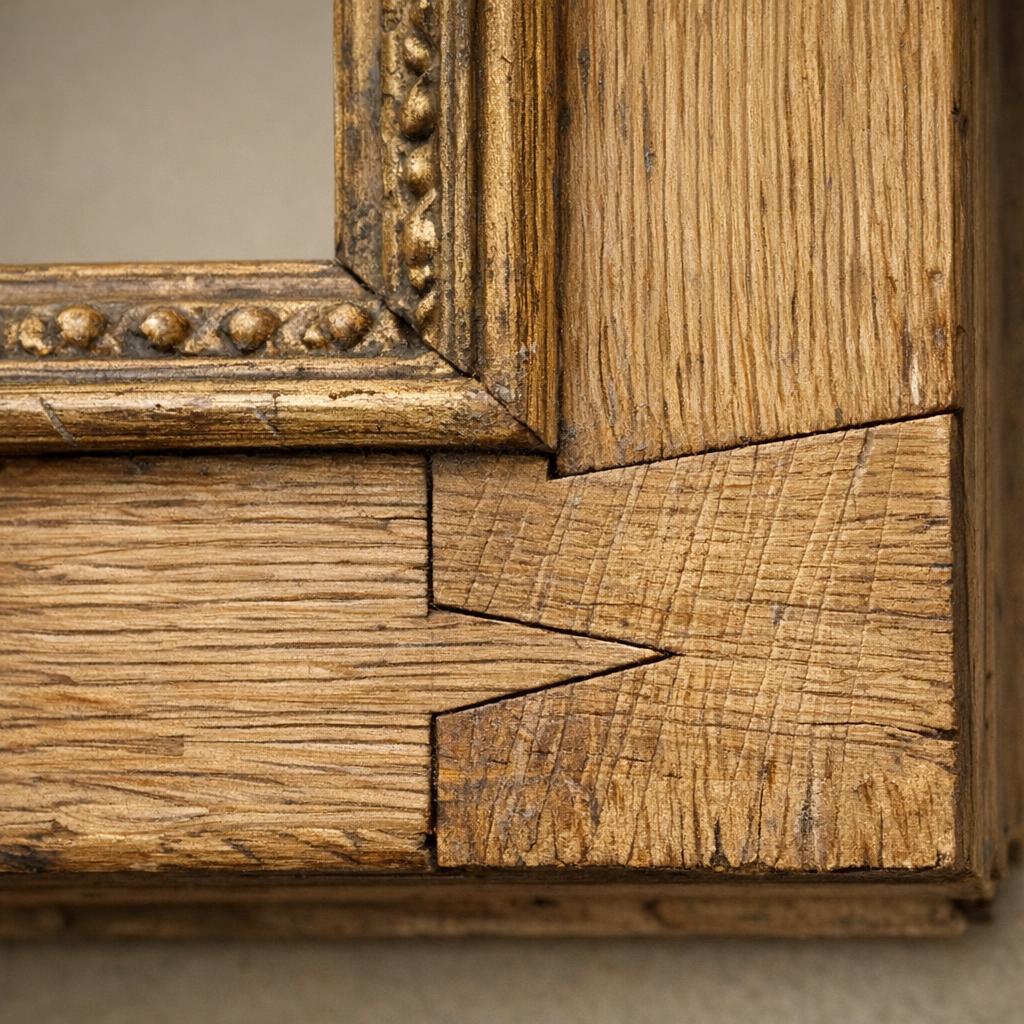
- Look at the corner joints. Hand-cut miters (pre-1860) show slight irregularities, visible saw marks, and tight wood-to-wood contact. Machine-cut miters (post-1860) are perfectly uniform with a flat, sawn surface. Dovetail or spline joints on the back indicate 18th- or early 19th-century work.
- Check for composition ornament (compo). Press a fingernail gently into a carved detail. If the material underneath the gilding is creamy, slightly soft, and shows mold seams, it is composition — a Victorian-era shortcut. Hand-carved wood will be hard and show tool marks.
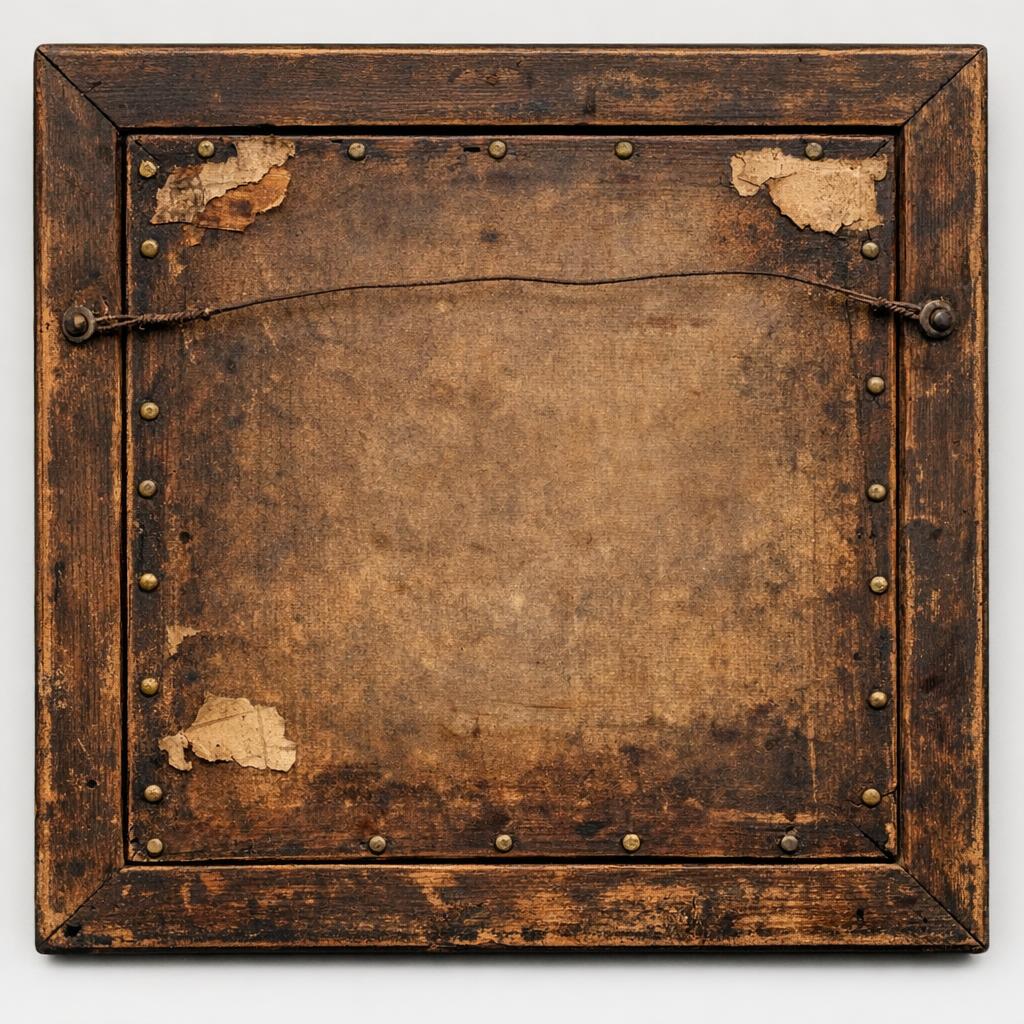
- Examine the backboard. Flip the frame. Original backings are raw pine or oak boards that have darkened with age. Modern replacements use acid-free foam-core, corrugated cardboard, or bright white mat board — all post-1950 materials. Look for old brass tacks, paper lining fragments, and gallery labels.
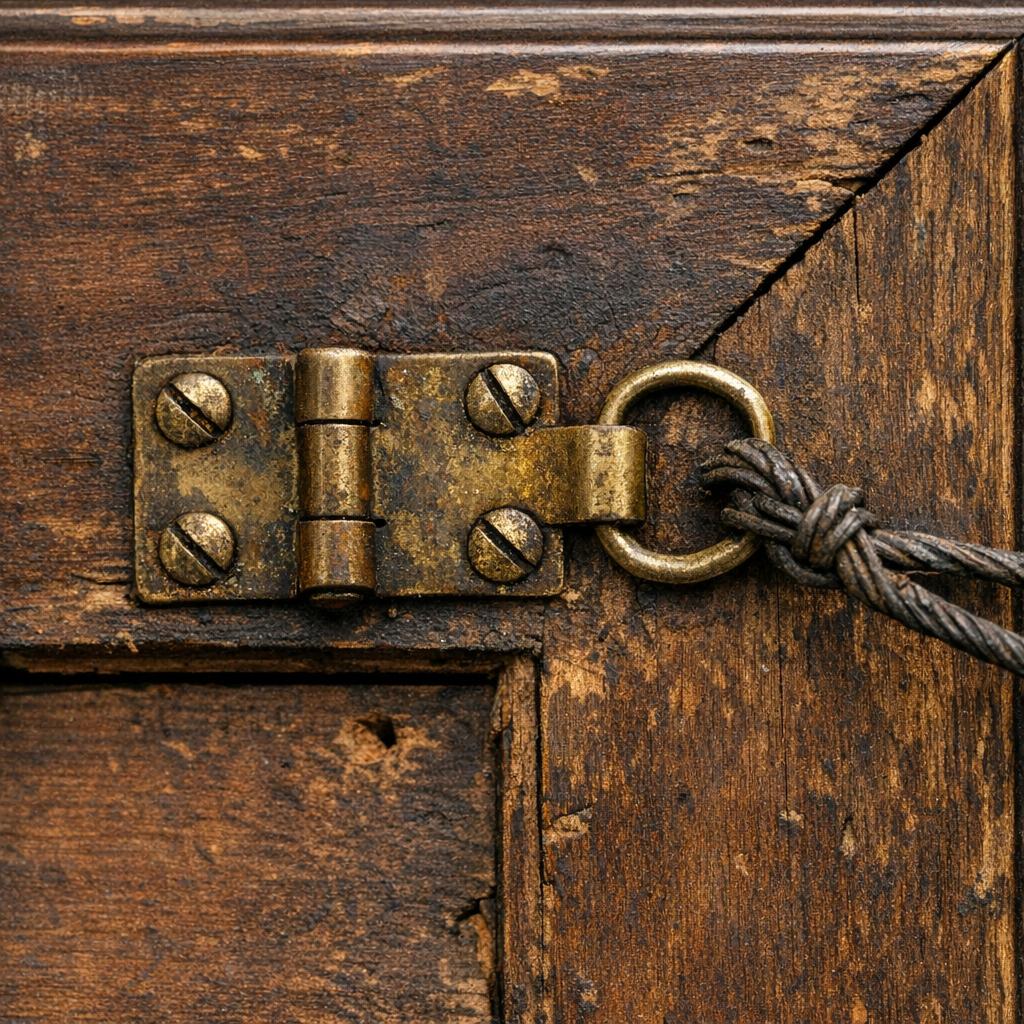
- Inspect the hardware. Original brass hinges, slotted screws, and wire hangers have a dark, uneven patina. Phillips-head screws, stamped steel hangers, or D-rings are 20th-century additions (not automatically bad, but they date any subsequent work).
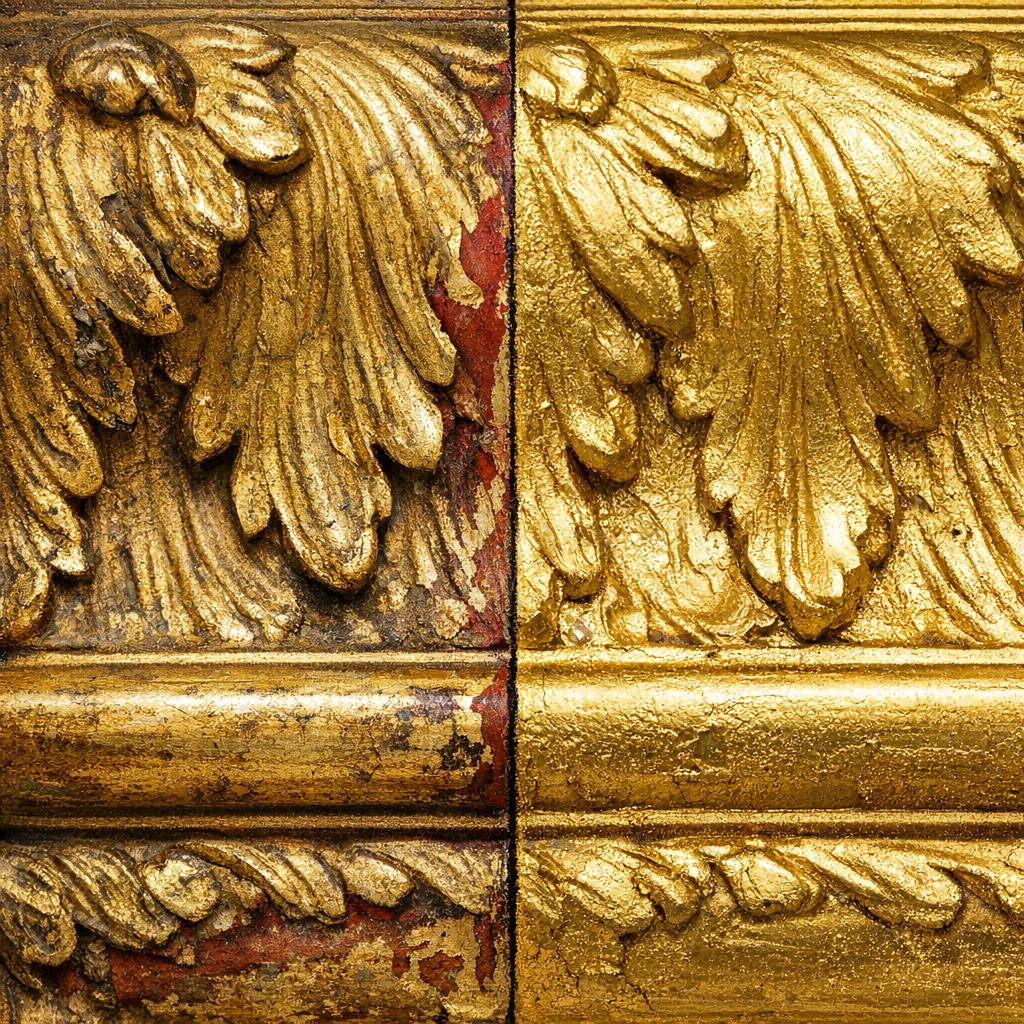
- Check for regilding evidence. Look at inside corners and recessed areas. Modern regilding often pools gold paint in crevices where the original leaf has worn away. If you see red or yellow bole (the clay underlayer) peeking through worn spots, that is a strong sign of original water gilding.
- Read any labels, stamps, or inscriptions. Gallery labels, exhibition stickers, or handwritten notes on the backboard add provenance weight. Even partial addresses or prices can be cross-referenced with historical records.
Quick rule of thumb: If a frame passes steps 1, 3, and 5 without a single red flag, it is worth taking to a professional for a written appraisal — especially if the profile is ornate or the backboard carries labels.
What Counts as "Original" Versus Reproduction
The single most expensive mistake in the frame trade is buying a newly gilded reproduction sold as "antique-style." The frame may be old, but if the surface has been completely regilded or the profile is a modern CNC copy, the value collapses to a fraction of a genuinely period piece.
Original period frame
- Carved from solid timber (oak, pine, limewood, or walnut depending on region and period).
- Water-gilded with genuine gold leaf on a gesso and bole ground.
- Hand-cut joinery: miters, splines, or dovetails with visible tool marks.
- Age-darkened backboard with original tacks and, ideally, period labels.
Period frame, later regilded
- The wood and profile are genuinely old, but the surface has been re-gilded (often with oil gilding or gold paint instead of traditional water gilding).
- Value is reduced 40–70% compared to an original surface, but the frame still has decorative and historical merit.
- Key tells: brassy tone, no gilding lines, gold pooling in crevices, modern bole color underneath.
Modern reproduction
- CNC-routed or molded resin profile with a sprayed gold finish.
- Machine-perfect miters joined with staples or modern adhesives.
- Bright white foam-core backboard, no oxidation, no labels.
- Often sold on online marketplaces as "antique gold frame" — the word "style" in the listing is your warning.
Common False Positives: What Tricks the Eye
Even experienced dealers can be caught out by these look-alikes:
"Hand-embellished" reproduction gilding
Some modern framers add deliberate distress marks, darkened corners, and rubbed-through edges to make a new gold finish look old. The tell is the uniformity: every "damage" spot looks too similar, and the underlying wood is bright and fresh at the cut edges.
Composition ornament mistaken for hand-carving
Victorian composition (compo) ornament is itself collectible — but it is not hand-carved wood. Compo was pressed into molds from a mixture of glue, whiting, and linseed oil, then applied to a wooden substrate. If you find mold seams or a uniform repeating pattern across multiple frames, it is compo, not carving. This matters for value: a fully hand-carved Rococo frame commands significantly more than a molded compo equivalent.
Electroplated "ormolu" on mass-produced frames
From the late 19th century onward, electroplated bronze powder coatings (often called "ormolu" in listings) replaced fire-gilded bronze. The finish is attractive but lacks the warmth and depth of true fire gilding. A magnet test will reveal a ferrous base underneath.
Transfer-printed "oil painting" reproductions in old-style frames
A frame can be genuinely old while holding a modern canvas transfer — a photograph or print mounted to canvas and varnished. Always check the artwork surface under magnification: halftone dot patterns mean it is a reproduction, regardless of the frame's age.
How Value Changes: Period, Maker, and Condition
An old picture frame's value depends on a small set of drivers that auction houses and private collectors evaluate consistently:
| Driver | What to Look For | Impact on Value |
|---|---|---|
| Period | Renaissance, Baroque, Rococo, Neoclassical, Victorian — the rarer and earlier the style, the higher the ceiling. | 17th–18th century frames routinely sell for $1,000–$12,000+ at auction when attributed to known workshops. |
| Maker attribution | Stamped, labeled, or documented links to frame-making dynasties (e.g., the Parris family in Boston, or Whiteley in London). | Attribution can multiply realized prices by 3× to 10× over an anonymous period frame. |
| Original surface | Intact water gilding with visible bole, gilding lines, and minimal loss. | Original surface commands 2–4× the price of a regilded equivalent. |
| Condition of joinery | Tight corners, no modern staples or epoxy repairs. | Loose or repaired joints reduce value 20–40%. |
| Backboard provenance | Gallery labels, exhibition stickers, handwritten inscriptions. | Provenance documentation adds 15–30% premium and aids authentication. |
In the 2025–2026 auction cycle, a documented 18th-century Italian Baroque giltwood frame sold for €8,400 at a Milan house, while an anonymous Victorian compo frame in similar condition realized just £180 at a regional UK auction. The spread is enormous — which is why identification accuracy matters so much.
When to Get a Professional Appraisal
Not every old frame needs a formal valuation. But you should commission a written appraisal from a certified specialist (ASA, ISA, or RICS-registered) when any of the following apply:
- Insurance scheduling: Your homeowner's policy requires a documented value for frames worth over $2,000 individually.
- Sale or consignment: You plan to sell through an auction house or gallery and need a reserve price. A $250–$500 appraisal fee can prevent underselling a $5,000 frame by a factor of ten.
- Donation or tax claim: The IRS requires a qualified appraisal for charitable donations exceeding $5,000.
- Authentication uncertainty: The frame passes your checklist but you cannot confirm the period, maker, or originality of the gilding. A professional can use UV fluorescence, cross-section sampling, and archival records to settle the question.
If you are still unsure after working through the checklist above, send clear photographs (front, back, both corners, and one close-up of the gilding under raking light) to a specialist. Written guidance is inexpensive and can save you from a costly misidentification.
Free instant estimate
Not sure if your item is worth appraising? Let us take a look.
Upload a photo, tell us what you know, and get a free first read. If a full appraisal makes sense, we will say so.
Free. No card needed. Takes about two minutes.
Need an old picture frame identified before selling or restoring it?
Upload the front, back, corners, gilding, backboard, hardware, labels, and repair areas. We can help separate period clues from later alterations.
- Written identification report within 48 hours
- Market value range based on recent auction comps
- Next-step guidance for insurance, sale, or conservation
No obligation. If we cannot add value, we will tell you honestly.
References & Further Reading
- Picture Framing Magazine, "How to Identify Antique Picture Frames" (August 2020) — technical overview of oil vs. water gilding and bole color as origin indicator.
- Frinton Frames, "Is My Frame a True Antique?" (October 2025) — four-step identification checklist.
- Trefler Restoration, "Giltwood Frames: Identifying Age & Value" — practical guide to gilding line inspection and period styles.
- Stanford, J., The Picture Framer's Art (2nd ed., 2018) — comprehensive reference for frame construction methods across periods.
- Appraisily auction database, 2025–2026 realized price records for giltwood and composition frames.
Note: We couldn’t find enough auction records that directly match How to Identify Old Picture Frames: Gilding, Joinery and Backboards to publish a defensible price table. If you are valuing a specific item, include its maker, model, material, photos, and condition so the search can be narrowed.
What similar items actually sold for
To help ground this guide in real market activity, here are recent example auction comps from Appraisily’s internal database. These matched sales are market context only, not an object estimate or identification, and they do not guarantee a price for your specific picture frame.
Shown USD range: USD 5-USD 225. Median of these 6 USD examples: USD 85.
| Comparable | What sold | Auction house | Date | Lot | Source-reported amount |
|---|---|---|---|---|---|
 |
A PLAIN EDWARDIAN OVAL GILT PICTURE FRAME, withSource blocked; provenance matched | Keys Fine Art Auctioneers | 2009-12-11 | 21 | GBP 30 (buyer’s-premium treatment unknown) |
 |
ANTIQUE CARVED PICTURE FRAMESource blocked; provenance matched | Converse Auctions | 2022-08-05 | 573 | USD 20 (buyer’s-premium treatment unknown) |
 |
Victorian Carved Oak Picture FrameSource blocked; provenance matched | Roland Auctions NY | 2024-07-27 | 656 | USD 150 (buyer’s-premium treatment unknown) |
 |
AN ANTIQUE CARVED AND GILT PICTURE FRAME French or English, mid 19th centurySource blocked; provenance matched | Leonard Joel | 2026-05-03 | 186 | AUD 450 (buyer’s-premium treatment unknown) |
 |
Folk Art Carved Heart Picture FrameSource blocked; provenance matched | Davis Brothers Auction | 2025-11-07 | 1189 | USD 15 (buyer’s-premium treatment unknown) |
 |
Antique Oak Picture Frame Corners AdornedSource blocked; provenance matched | Ace Of Estates | 2024-01-28 | 124103 | USD 5 (buyer’s-premium treatment unknown) |
 |
Sterling Silver Oval Antique Picture Frame, Cornucopia & Crown Motif, 8"hSource blocked; provenance matched | Bill Hood & Sons Arts & Antiques Auctions | 2024-09-03 | 753 | USD 150 (buyer’s-premium treatment unknown) |
 |
An Edwardian Neo Classical gilt picture frame, 32cm x 24cm.Source blocked; provenance matched | Golding Young & Mawer | 2014-12-10 | 589 | GBP 38 (buyer’s-premium treatment unknown) |
 |
ANTIQUE CARVED WOOD ROCOCO PICTURE FRAMESource blocked; provenance matched | Antique Arena Inc | 2023-03-04 | 249 | USD 225 (buyer’s-premium treatment unknown) |
How these auction records were verified
Each row retains its exact source URL, lot identity, retrieval time, access result, and immutable record hash. Live source access was blocked; the exact record matched Appraisily's immutable pipeline provenance. Inspect the public comparable provenance record.
Disclosure: prices are shown as reported by auction houses and are provided for appraisal context. Learn more in our editorial policy.
Search variations collectors ask
Readers often Google these related questions. Each one is answered in the identification guide above.
- How to tell if a gold picture frame is real gold leaf or painted
- How to date an antique picture frame by its corners and joinery
- What is composition ornament on old picture frames
- How to spot a regilded or restored picture frame
- What does the back of an antique picture frame look like
- How to identify Victorian giltwood frames from reproductions
- What are gilding lines on an old picture frame
- How much is an antique gilt picture frame worth at auction
Use these phrases to refine your search or confirm what you have already learned above.