
How to Identify Gold Hallmarks
Decode gold hallmarks such as 10k, 14k, 18k, 375, 585 and 750, then check maker marks, assay marks, weight, stones, and condition before valuing jewelry.
Auction comps and price ranges in this guide are sourced from Appraisily’s internal auction results database and are provided for education and appraisal context (not as a guaranteed price). For our sourcing and update standards, see Editorial policy.
Read the hallmark first, then trust your own photo workflow.
If you can capture the marks clearly, you can tell what this item is likely to be worth before you list it, insure it, or move on. Start free and get a first read in seconds.
Get my free estimateThe answer you can use right now
Most people overestimate one thing and miss two things: that hallmark numbers are only one data point, and that every object has an internal hierarchy of evidence. If your first gold mark is not backed by clear photos, maker context, and condition evidence, you are looking at a partial truth. The short answer is:
Start by reading the symbol block on the whole item, then test consistency. If mark, metal type, craftsmanship, and market comparison agree, confidence improves. If they conflict, treat the piece as unconfirmed until reviewed in context.
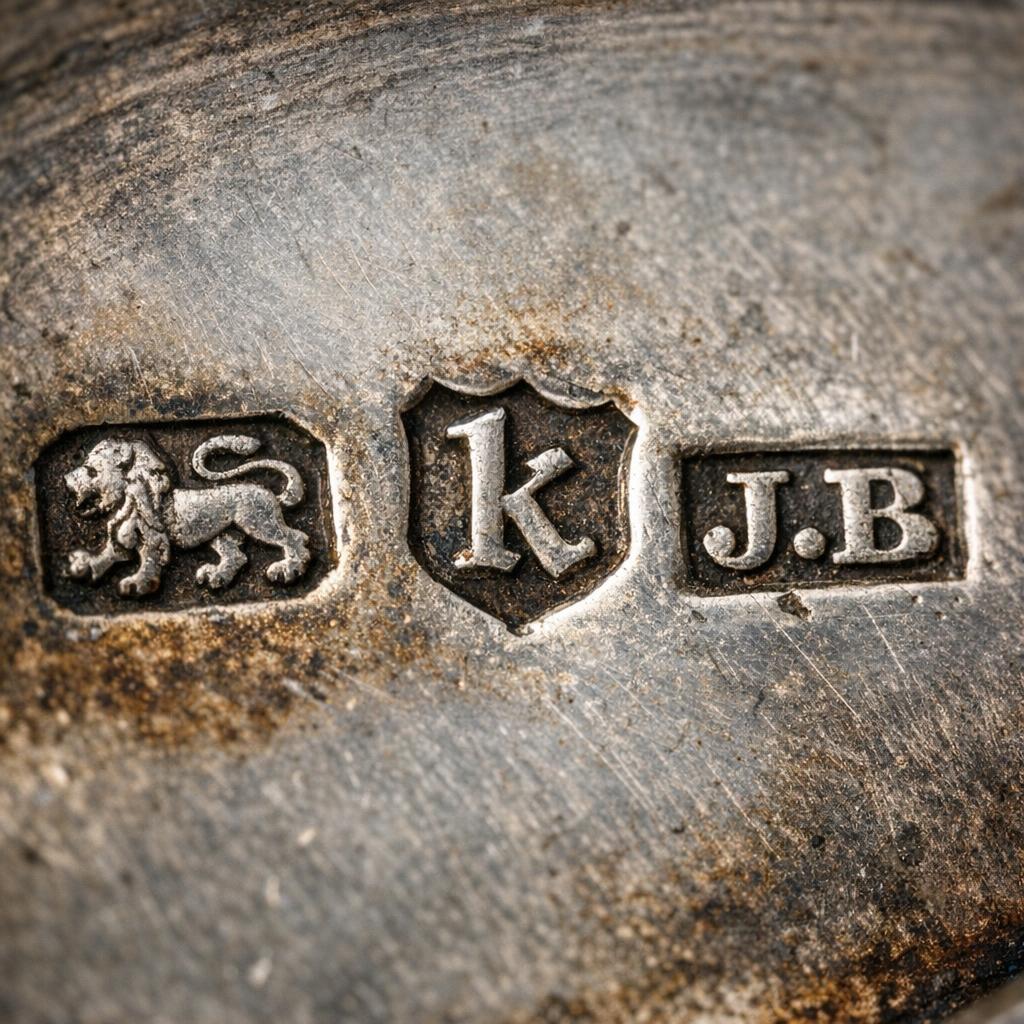
Flip it over: read the hallmark stack in order
Do this in order before making any value call.
- Is it a purity mark? Typical numeric marks on gold jewelry include 375, 585, 750, and sometimes 916. These usually indicate content in parts per thousand: 585 is commonly 14k, 750 is commonly 18k, and so on.
- Is there a maker mark? Makers may use initials, logos, script, or symbols. A maker mark helps with attribution confidence but does not replace purity and condition checks.
- Is there an assay office or city mark? For UK and some regional systems, lettering and symbols encode issue date and jurisdiction. The date can narrow when the object was finished and who likely supplied it.
- Is the mark family consistent with the item type? A delicate filigree ring, vintage signet ring, or chain should show mark placement and punch depth that align with age and manufacture.
- Is wear and repairs affecting mark quality? Heavy wear can distort edges; refinishing or polishing can soften, flatten, or remove marks.
What each mark family usually indicates
Purity marks (most people check first)
Purity marks are often the first number you see, but they are only one layer. On old or altered pieces, a clear 585 or 750 is a strong lead, not a final conclusion. When a purity mark appears with signs of later work, the number can reflect only original composition of a component.
- 9k / 375: common in smaller, budget, or older trade pieces.
- 10k / 417: often a less standard notation in some markets and may need region-specific interpretation.
- 14k / 585: a common modern purity standard for many markets.
- 18k / 750: higher-value gold class, usually with less common decorative patterns in some price bands.
- 22k / 916: less frequent in some categories and often tied to specific regions and traditional production lines.
Maker marks and origin marks (often decisive for quality clues)
Maker marks can be tiny, stylized, or worn down. Compare spacing, alignment, and punch shape against known mark sets. You can use maker marks to separate two otherwise similar-looking objects: one with coherent attribution context and one with generic trade signatures.
Assay or sponsor marks (useful for era and geography)
These marks often map to a place and period. They can help answer whether the item likely belongs to a later substitution story, a regional copy, or a genuine piece from a specific tradition.
Collect the photos and metadata that make this decision verifiable
The better your photos, the less this becomes guesswork. A low-resolution image of marks is worse than no image. For an ID-strong response, build this file immediately:
- Straight macro image of every mark (front and side angle), plus a full shot of the item.
- Inside band, clasp, closure, seam joins, setting contact points, and solder lines.
- Back-of-item image, including box, chain tags, inscriptions, and serial stamps if present.
- Any repairs, rewiring, dents, missing stones, and previous service marks.
- Weight, measurements, and purchase or estate documentation if available.
How to decide what the marks are actually saying
Use this quick decision sequence:
- Step 1: Confirm whether marks are complete. Partial stamps or smudged marks reduce confidence; flag as inconclusive and do not force a final claim.
- Step 2: Match symbol families: purity, maker, and assay should not contradict each other.
- Step 3: Check market context. If a similar-marked piece with comparable form and weight sold in a different range, revisit the marks and workmanship assumptions.
- Step 4: Watch for red flags: relaid edges, modern solder, inconsistent lettering, and mark overstrikes near high wear points.
- Step 5: Escalate to a formal review when the item is high-value, mission-critical, or legally sensitive.
Think your hallmark may be real but still uncertain?
Upload full photos and get a free instant estimate. A specialist review follows if the evidence supports a stronger conclusion.
Upload for a free estimateFree instant estimate
Not sure if your item is worth appraising? Let us take a look.
Upload a photo, tell us what you know, and get a free first read. If a full appraisal makes sense, we will say so.
Free. No card needed. Takes about two minutes.
When to start a professional appraisal
Use a written report when the next decision is legal, insurance, estate, donation, or resale-focused, or when exact provenance is required. For all other first-pass questions, start with the free screener and use the first two evidence layers (hallmarks + photos) as your baseline.
How to avoid common identification errors
- Assume nothing from one mark. A clean purity number with a weak maker context can still be copied, altered, or worn down.
- Never force a system. Different countries and periods use different mark families. Map region first, then apply the mark meaning.
- Do not rely on marketing photos alone. Studio lighting can hide edge damage and prior refits that matter for authentication and value confidence.
- Keep receipts and provenance with the review packet. A small context packet can move an uncertain item into a more confident interpretation.
FAQ
Can I trust all 585 marks?
Use 585 as a strong indicator only when the full stack is consistent. If maker and assay marks disagree, or wear has changed symbol edges, treat it as a review item.
Can plated jewelry carry familiar marks?
Yes. Some marks can be copied or later re-stamped. That is why photos, solder quality, and provenance are needed alongside mark scans.
Do date letters always tell me the year?
Only in systems where date logic is documented and clear. Missing or blurred letters are common on worn pieces.
Can a high auction price prove authenticity?
No. A sold comp is market context, not a guarantee. Use it with maker, condition, and technical consistency checks.
Should I clean marks before photographing?
Use minimal cleaning only. Aggressive polishing can erase important edge detail and hurt evidence quality.
What if I cannot find a maker mark?
Move to other evidence layers quickly: weight, hallmark family, construction style, and provenance cues. Strong conclusions require cross-confirmation.
Note: We couldn’t find enough auction records that directly match How to Identify Gold Hallmarks to publish a defensible price table. If you are valuing a specific item, include its maker, model, material, photos, and condition so the search can be narrowed.
What similar items actually sold for
The current auction search does not contain at least three clean, directly matched sales for How to Identify Gold Hallmarks yet. If you’re valuing a specific item, use the free estimate flow so the search can be narrowed by maker, material, photos, and condition.
| Image | Description | Auction house | Date | Lot | Reported price realized |
|---|---|---|---|---|---|
| No relevant auction comps found for this topic right now. | |||||
Disclosure: prices are shown as reported by auction houses and are provided for appraisal context. Learn more in our editorial policy.
Related gold hallmark identification searches
- how to identify gold hallmarks on vintage rings
- what does an ivory 585 mark mean
- are gold hallmarks fake on secondhand jewelry
- how to tell if a 18k gold item was refined
- gold hallmark meanings by country
- identify maker marks on old gold jewelry
- how to check if a gold item is real gold
- can 14k ring with 750 mark be trusted
- what to check before buying used gold jewelry
- how to read stamped gold markers from 1920s
Choose your next step
Use the path that matches the decision you need to make about the item.
Not sure it is worth appraising?
Start with a lower-friction screen to understand the likely category, evidence, and next step.
Upload photos for a free first lookWant proof before paying?
See how a signed report documents photos, comparable evidence, condition notes, and value conclusions.
View signed report sampleNeed a signed report?
Use this for insurance, estate, donation, resale, or documented value decisions.
Need documentation now? Start signed appraisalNeed local or specialist help?
Compare directory options when the work needs in-person review or a specialist near you.
Find local specialistsFastest next step
Upload a hallmark photo and get a free instant estimate.
No card needed. We will return actionable next steps in plain language.
Upload photos for a free first look View signed report sampleSee what the report looks like
Sample reports show how photos, comparable evidence, condition notes, and a value conclusion are documented.
Have a gold hallmark question this article did not answer?
Send your item details. If it is worth a full appraisal, we will recommend the next route clearly.
Start with the free estimate