
Cut Nails, Square Nails and Hand-Forged Nails: Field ID
Use head shape, square or rectangular shafts, taper, clinching, iron grain, and raking-light marks to identify old cut nails and hand-forged nails in furniture or buildings.
Auction comps in this guide are for appraisal context, not guaranteed prices. See our editorial policy.
Visual Identification Reference Gallery
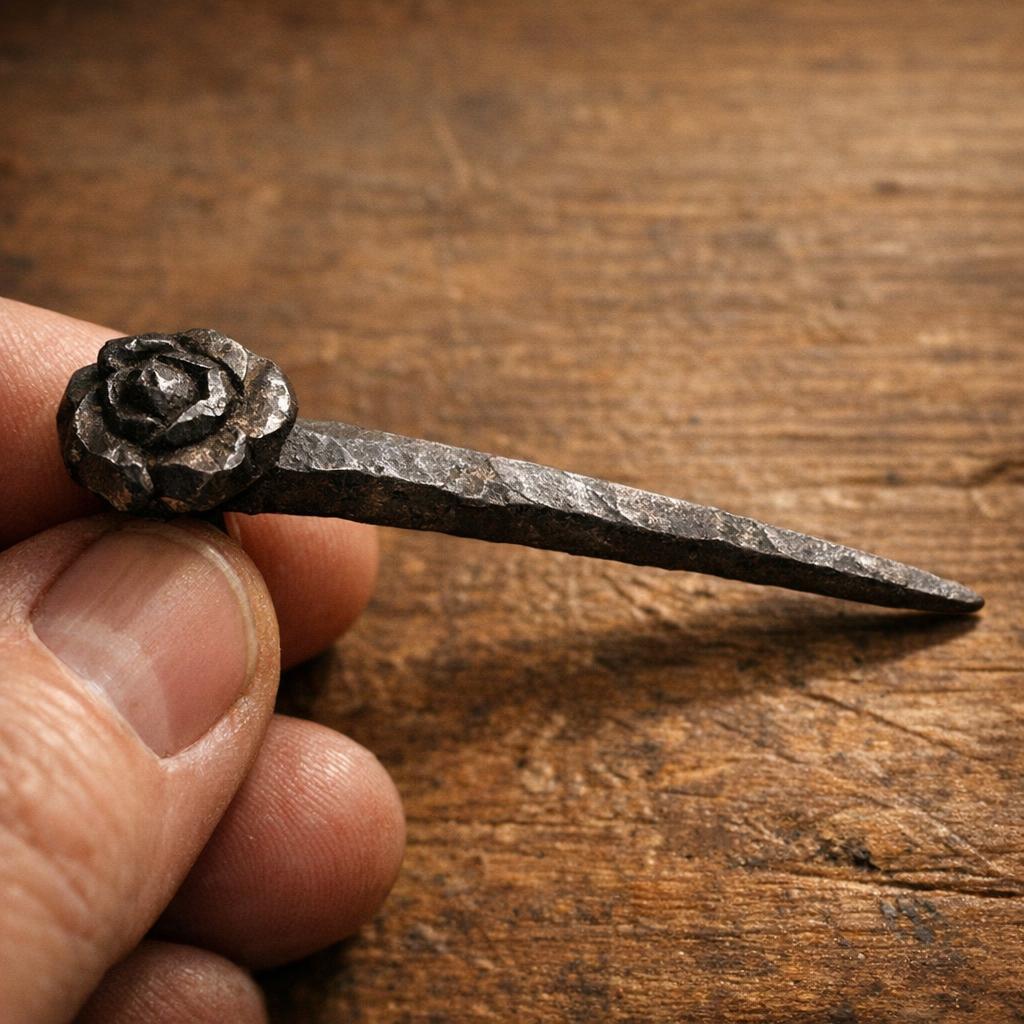
Use these images as reference when examining nails in your own collection, furniture, or historic property. Each photograph illustrates a key identification feature covered in the checklist below.


Quick Answer: Identify Your Nail in 30 Seconds
Look at the shaft cross-section first — this is the single fastest way to classify an antique nail:
- Square tapered shaft with an irregular, faceted head → Hand-forged (pre-1800). Each nail was hammered out individually by a blacksmith. No two are identical.
- Rectangular tapered shaft (wider than thick, not square) with a flat, stamped head → Cut nail (1790s–1890s). Machine-sheared from iron plate, more uniform but not perfectly symmetrical.
- Round shaft with a flat circular head → Wire nail (post-1880). Mass-produced from drawn wire stock. Not antique and carries negligible collector value.
If the shaft is square but the head looks too perfect or uniform, you may be looking at a modern reproduction — the natural rust patina and slight surface irregularities are what authenticate a genuine period nail. Original hand-forged nails in good condition can sell for $8–12 each on the collector market, with lots of reclaimed cut nails fetching $15–40 per batch on eBay and Etsy.
Free instant estimate
Not sure if your item is worth appraising? Let us take a look.
Upload a photo, tell us what you know, and get a free first read. If a full appraisal makes sense, we will say so.
Free. No card needed. Takes about two minutes.
The Complete Step-by-Step Identification Workflow
Once you know the three-way split above, you can narrow down the date range with a more thorough examination. Here is the full workflow that architectural historians, preservation specialists, and furniture authenticators follow — and you can replicate it at home with minimal equipment.
Step 1: Extract a Representative Nail
If the piece is furniture or architectural, look for nails in inconspicuous areas — the back of a drawer, the underside of a table top, or the interior face of a framing joint. These are least likely to have been replaced during restoration. Do not pull nails from visible or structural faces unless you are prepared to repair the damage. A single loose nail found in or around the piece is often enough.
Step 2: Examine the Shaft Cross-Section
Hold the nail so you can look directly at the end of the shaft (the tip side). This is the most diagnostic feature:

- Square shaft — all four sides are approximately equal in width, with a gentle taper from head to tip. The sides may not be perfectly flat; slight undulations from blacksmith hammering are normal and confirm hand-forged origin.
- Rectangular shaft — noticeably wider than it is thick (roughly 2:1 ratio). The faces are flat and parallel, with sharp edges where the cutting blade sheared through the iron plate. This is the hallmark of a cut nail.
- Round shaft — perfectly cylindrical, drawn from wire stock. These are modern wire nails and do not indicate an antique origin.
Step 3: Inspect the Head Shape and Surface
The head tells a complementary story. Use a magnifying loupe (10× is sufficient) and raking light — shine a desk lamp across the head at a low angle so shadows reveal the surface texture.

Hand-forged heads are irregular. The blacksmith shaped each one by striking the heated end on a hardy or swage tool, producing a faceted "rose" or "T" head — or sometimes a butterfly or paddle shape. Each nail is subtly different. You may see slight bends in the shaft from individual hammering.
Cut nail heads are flat and rectangular, produced by a die-stamping machine. The edges are sharp and the surface is relatively uniform, though early machines left slight misalignments that are actually helpful for dating (see timeline below).
Wire nail heads are perfectly round and flat, machine-punched from wire stock. They are unmistakable once you have seen one.
Step 4: Check for Manufacturing Marks and Grain Direction
This is the step that separates early cut nails from late ones and confirms hand-forged identity:
- Hammer marks — visible striations or facets on the head and along the shaft. Exclusive to hand-forged nails. If you see them under raking light, the nail predates mechanized production.
- Cut burrs — small ridges of metal along the edges of a rectangular shaft where the cutting blade sheared through the plate. These confirm a cut nail origin.
- Grain direction — if the nail shows longitudinal splits (cracking along the length of the shaft), it was made from rolled iron, which became common after the late 1830s. Earlier cut nails used cross-grain iron that would snap if bent. This is why pre-1830s cut nails are rarely found clenched (bent over), while post-1830s nails often are.
Step 5: Look for Clinching Evidence
In furniture and timber framing, nails were often driven through the wood and the protruding tip was hammered over (clenched) on the opposite face. This is a strong indicator of pre-wire-nail construction.

If the nail tip is clenched and the shaft shows lengthwise grain splits, you are looking at a post-1830s cut nail made from rolled iron. If the nail is not clenched and the iron is cross-grain (it would break if you tried to bend it), it may pre-date the 1830s transition.
Nail Manufacturing Timeline
The chart below summarizes the manufacturing transitions that define each nail type. Use it alongside the identification workflow above to narrow the date range of any piece.

Key transitions to remember:
- ~1790s: First machine-cut nails appear in the United States, produced alongside hand-forged nails in early blacksmith-operated cutting shops.
- ~1815–1825: Header machines begin stamping heads rapidly. Cut nails become the dominant construction fastener.
- ~1830s: Rolled iron replaces cross-grain iron. Cut nails can now be clenched without breaking, changing construction practice.
- ~1880s: Wire nail production ramps up. By 1910, wire nails represent over 90% of all nails produced in the United States.
Identification Decision Tree
Print or save this decision tree. When you encounter a nail in the field, follow the questions from top to bottom. Each answer narrows the identification until you reach a type and approximate date range.

Authentic Nails vs. Modern Reproductions
The architectural salvage and antique furniture markets have seen a rise in reproduction cut nails sold as period originals. Here is how to tell the difference:

- Patina — genuine antique nails develop a natural, even rust patina over decades or centuries. The rust is integrated into the surface. Reproductions often have an artificially applied "rust wash" that sits on top and can be scraped off, or they are bright new steel with no aging at all.
- Edge uniformity — authentic cut nails have slightly irregular cut edges because the shearing blades wore and shifted over time. Modern reproductions are cut from fresh plate with laser-sharp consistency.
- Weight and feel — older iron nails tend to feel lighter than their modern steel equivalents of the same size, due to differences in iron composition and porosity.
- Context — if a seller has hundreds of identical-looking "antique" nails, be skeptical. Genuine reclaimed nails from a single demolition or salvage source vary in length, wear, and patina.
Are the Nails Original or Later Replacements?
One of the most common mistakes in furniture dating is assuming that every nail in a piece is original to its construction. Preservation work routinely introduces newer fasteners, and a single wire nail in an otherwise hand-forged assemblage tells you about a repair, not the original build date.
How to check:
- Sample multiple locations — examine nails from at least three different joints or faces of the piece. If two locations have hand-forged nails and one has cut nails, the cut nails are likely replacement fasteners from a later repair.
- Look for mismatched hole patterns — if a nail sits in a hole that is clearly too large or too small for its shaft, it was likely driven into an existing hole during a repair. Original nails fit their holes snugly.
- Check for tool marks around the hole — original nail holes in hand-built furniture often show slight splitting or compression around the entry point from the initial drive. Replacement holes may look cleaner or show evidence of re-drilling.
- Corroborate with other dating evidence — nails should be one data point among several. Always cross-reference with joinery style, wood species, tool marks on the surface, and any maker's marks before committing to a date range.
Note: We couldn’t find enough auction records that directly match Cut Nails, Square Nails and Hand-Forged Nails: Field ID to publish a defensible price table. If you are valuing a specific item, include its maker, model, material, photos, and condition so the search can be narrowed.
What similar items actually sold for
The current auction search does not contain at least three clean, directly matched sales for Cut Nails, Square Nails and Hand-Forged Nails: Field ID yet. If you’re valuing a specific item, use the free estimate flow so the search can be narrowed by maker, material, photos, and condition.
| Image | Description | Auction house | Date | Lot | Reported price realized |
|---|---|---|---|---|---|
| No relevant auction comps found for this topic right now. | |||||
Disclosure: prices are shown as reported by auction houses and are provided for appraisal context. Learn more in our editorial policy.
What Are Antique Nails Worth?
The market for antique nails is niche but active. Here is a practical pricing framework based on current market data:
| Nail Type | Date Range | Typical Value Range | Market Notes |
|---|---|---|---|
| Hand-forged (good condition) | Pre-1800 | $8–12+ each | Individual sales on eBay, Etsy; lots at auction houses |
| Cut nails (reclaimed) | 1790s–1890s | $3–8 each / $15–40 per batch | Popular for historic restoration projects; batches of 25–50 common |
| Hand-forged nail lots (auction) | Mixed | $20–100+ per lot | Invaluable and regional auction houses sell assorted iron forging lots |
| Decorative hand-forged (clavos, rosettes) | Pre-1800 | $15–30+ each | Ornamental heads command premium; architectural salvage market |
| Modern wire nails | Post-1880 | Negligible | No collector or antique value |
Recent market activity: Invaluable auction houses sold assorted antique iron forging lots — including hand-forged nail specimens — as recently as December 2025. Meanwhile, the architectural restoration boom continues to drive demand for period-correct cut nails, with reclaimed batches selling regularly on Etsy and eBay. If you are restoring a period piece, using correct nail types is not just historically accurate — it protects the piece's authentication narrative for future buyers.
When to Call a Professional Appraiser
The identification workflow above will get you a reliable classification for the vast majority of nails. But there are situations where a specialist adds real value:
- Insurance or estate documentation — if the nails are part of a significant piece (e.g., an 18th-century documented-maker chest), a formal appraisal report establishes provenance and value for insurance, sale, or donation.
- Architectural salvage at scale — if you are cataloging nails from a historic demolition, a professional can classify hundreds of specimens efficiently and produce a report suitable for preservation grants or tax documentation.
- Unusual or ornamental specimens — decorative nail heads (clavos, rosettes, butterfly heads) from Spanish Colonial, Mission Revival, or early American furniture can carry significant value. A specialist can attribute these to specific regional traditions.
- Authentication disputes — if a seller claims a piece is pre-1800 but the nails are cut or wire, you need a professional opinion on whether the fasteners are original or replacement.
If your identification leaves you unsure, send photos to our specialist team. We review nail specimens alongside the piece's other dating evidence and provide a written assessment within 24 hours.
References & Further Reading
- U.S. National Park Service. Nail Chronology as an Aid in Dating Old Buildings, Technical Leaflet No. 48.
- Smith, Bradley. The Chronological Development of Nails, 1966.
- Wells, Camille. "Nail Chronology: The Use of Technologically Derived Data." SHATE (Society for Historical Archaeology).
- Harper, Russell. "Early Nails." InspectAPedia — Hand-Wrought Nail Identification Key.
- Harp Gallery. The Humble Nail: A Key to Unlock the Past, January 2026.
Search Questions This Guide Answers
Readers often search for these phrases — each one is addressed in the sections above:
- how to tell if a nail is hand-forged or machine-made
- difference between cut nails and square nails
- how to date furniture using nail types
- are square nails worth anything
- how to identify antique cut nails
- what do hand-forged nails look like
- how to spot reproduction antique nails
- when were round wire nails first used
- antique nail identification chart
- old square head nails value and appraisal
Each question is answered in the identification guide above. If your specific question is not covered, submit your nail photos through the intake form and our team will review them.
Auction comparable sales sourced from Appraisily's internal valuer-agent database and verified through partner auction houses. Historical nail chronology references the U.S. NPS Technical Leaflet No. 48 and Bradley Smith's Nail Development Guide. For our full editorial standards, see our Editorial Policy.
Unsure whether the nail is original or a later repair?
Send photos of the fastener and the object around it. A written appraisal can weigh nail evidence alongside joinery, material, construction, and condition.
- Free initial review — no obligation
- Written assessment delivered within 24 hours
- Options for formal appraisal if needed
No credit card required. Available for items worldwide.
Choose your next step
Use the path that matches the decision you need to make about the item.
Not sure it is worth appraising?
Start with a lower-friction screen to understand the likely category, evidence, and next step.
Upload photos for a free first lookWant proof before paying?
See how a signed report documents photos, comparable evidence, condition notes, and value conclusions.
View signed report sampleNeed a signed report?
Use this for insurance, estate, donation, resale, or documented value decisions.
Need documentation now? Start signed appraisalNeed local or specialist help?
Compare directory options when the work needs in-person review or a specialist near you.
Find local specialistsSee what the report looks like
Sample reports show how photos, comparable evidence, condition notes, and a value conclusion are documented.