Autograph collecting is one of the most faked corners of memorabilia. Use this checklist to triage the ink/strokes, the item context, and the documentation (COA + provenance) before you buy, insure, donate, or sell.
Free instant estimate
Not sure if your item is worth appraising? Let us take a look.
Upload a photo, tell us what you know, and get a free first read. If a full appraisal makes sense, we will say so.
Free. No card needed. Takes about two minutes.
Turn this research into action
Get an autograph reviewed
Upload autograph photos, COA details, provenance, ink and pressure clues, paper or object details, condition notes, and the report purpose.
Secure checkout · Full refund if we can’t help
Start autograph appraisalThe 10-minute autograph attribution review checklist
Before you pay for an opinion (or pay more for a “certified” piece), do this quick triage:
- Item first. Confirm the signature is on the correct surface (not a reprint or swapped panel).
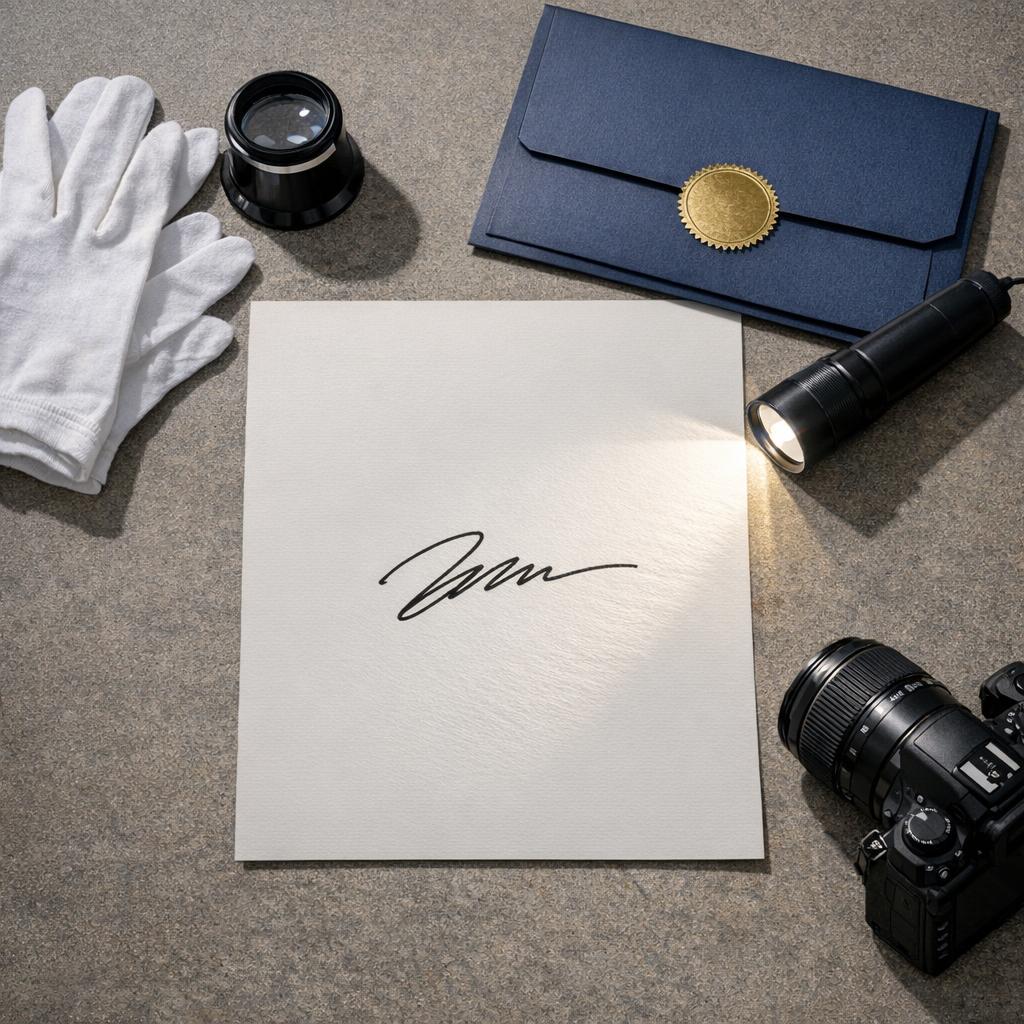
- Raking light. Look for indentation and pressure patterns.
- Ink behavior. Zoom for feathering, pooling, skips, and marker sheen.
- Rhythm. Natural signatures show confident speed changes; copied ones hesitate.
- Materials vs story. Pen/marker type and substrate should fit the claimed era.
- Paperwork test. COA must be traceable; provenance must be specific and consistent.
COA vs. provenance (and what each one can actually prove)
Collectors often treat “COA” and “provenance” as interchangeable. They’re not: a COA is a claim; provenance is the chain-of-custody evidence. The best items have both.
| Document type | Strong when… | Weak when… |
|---|---|---|
| COA (certificate) | Issuer is identifiable, certificate matches the item, and there’s a verification record. | Generic language, no item-specific details, no way to verify, or the issuer is unclear. |
| Letter/LOA | Includes item description and specific reasoning (ink, comparison points, context). | Only says “documented” without describing what was examined. |
| Chain of custody | Ownership history is consistent (estate docs, invoices, reputable dealers). | Vague stories, missing dates/places, or sudden “found in attic” leaps. |
Autograph red flags and common scams
These are the patterns that show up again and again in bad memorabilia listings:
- “COA included” but no verification path. If you can’t verify it, treat it as packaging.
- Too-perfect inventory. Many “fresh” autographs with identical placement/pen tone is suspicious.
- Autopen patterns. Repeated identical stroke paths and mechanical starts/stops.
- Slowly drawn signatures. Hesitation/tremor can signal copying.
- Wrong medium for the era. Marker type, substrate, and aging don’t match the story.
Decision tree: when to walk away vs. pay for a real opinion
Use this triage flow before you pay for attribution review — it helps you avoid weak paperwork and stacked red flags.
Photo checklist: what to photograph for an attribution review review
Most attribution review failures happen because the reviewer can’t see the right things. Use this photo checklist (no filters; avoid heavy HDR):
- Full item front/back (show edges so it’s clearly one piece).
- Signature close-up straight-on + in raking light.
- Two macro crops showing starts/ends of strokes.
- Any COA/LOA full page + serial/hologram close-up + verification record.
- Context evidence (tickets, photos, invoices, letters).
Handling and preservation (don’t destroy evidence)
- Avoid cleaning the signature area. Solvents can lift ink; abrasion can change surface sheen.
- Document now. Photograph the item + paperwork and store a written note of where/when you obtained it.
FAQ
Is a COA enough to document an autograph?
Sometimes — but only when the COA is traceable (issuer identity, matching database entry, item description that clearly matches your piece). A generic certificate without verification is not the same as an opinion with supporting reasoning.
How do you spot an autopen signature?
Autopen detection is largely about repeatability. If you can find multiple examples that match stroke-for-stroke (or if your seller offers many “different” items with identical signatures), that’s a major red flag. High-resolution overlays can be surprisingly revealing.
Should I clean a signed item before attribution review?
No — not without expert guidance. Cleaning can remove ink, smear marker, or erase subtle indentation evidence that helps reviewers. Keep it as-is and provide clear photos.
2026 appraisal checklist update
We refreshed this guide with a tighter valuation workflow so readers can move from rough estimates to defensible numbers faster. Start by defining the appraisal purpose (insurance replacement, fair market value, estate reporting, or pre-sale pricing), because each purpose can change the final range and supporting evidence requirements.
Before requesting opinions, prepare a clean evidence pack: overall photos, detail photos, dimensions, material notes, signatures/marks, condition issues, and provenance records (receipts, family history, prior appraisals). Then compare at least three recent sold market evidence with similar maker, period, condition, and size. If market evidence vary widely, note why (restoration, attribution confidence, venue quality, buyer demand).
If you need local in-person support, compare experts in the Art Appraisers Directory and Antique Appraisers Directory. For faster remote turnaround, you can start an online appraisal with Appraisily.
Search variations collectors ask
Readers often Google:
- is a COA enough to document an autograph
- how to tell if a signed photo is a preprint
- how to spot autopen signatures at home
- autograph attribution review checklist for ebay purchases
- difference between provenance and certificate or opinion
- what photos to take for autograph attribution review
- should I document an autograph before selling
- how to verify a hologram sticker on a COA
- how to document originality a signed jersey with no paperwork
Each question is answered in the guide above.