
The Short Answer
An authenticated painting is accepted as by the named artist through strong evidence and market recognition. An attributed painting is a work that may be by the artist, or is reasonably connected to the artist, but the authorship has not reached the same level of acceptance.
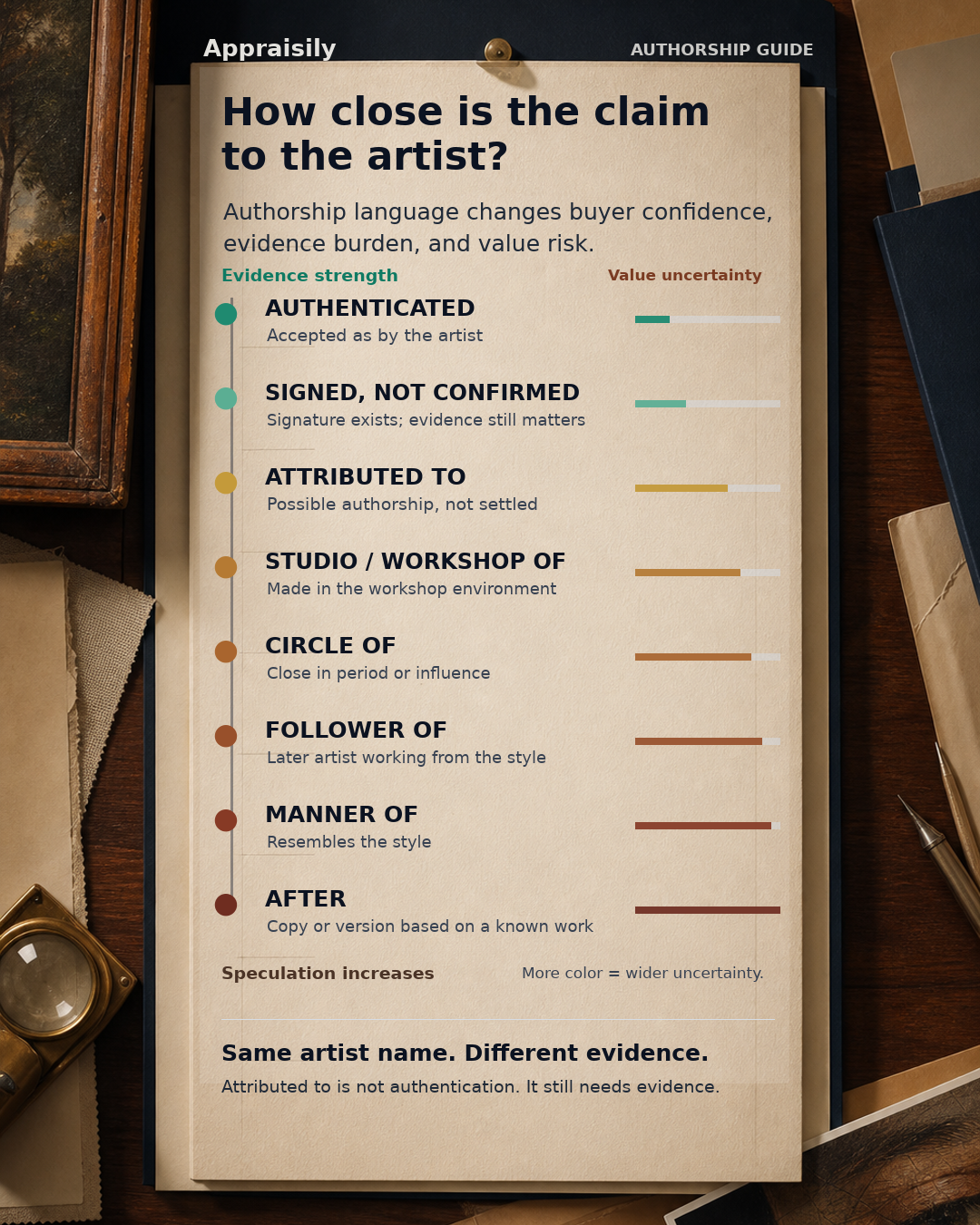
This matters because buyers, insurers, estates, and appraisers do not price all authorship phrases the same way. "By," "attributed to," "studio of," "circle of," "follower of," "manner of," and "after" each carry a different level of confidence.
Authenticated Means Accepted, Not Just Claimed
Authentication usually means the work has been accepted as by the artist by the relevant authority structure for that artist or market. Depending on the artist, that may involve a recognized expert, catalogue raisonne, foundation, committee, estate, archive, documented provenance, technical analysis, or a long record of market acceptance.
A signature can support authentication, but it does not complete it. A convincing file also asks whether the materials, subject, handling, labels, inscriptions, ownership history, restoration record, and comparable sales all make sense together.
Attributed To Means Possible, Not Settled
"Attributed to" is best read as a serious hypothesis. It usually means there is some evidence pointing toward the artist, but not enough to use the stronger "by" language with confidence.
That is why attributed works can feel like lottery tickets. The upside can be real if the evidence improves, but the uncertainty is also real. In valuation terms, the range may be wide because the market is pricing both the possibility and the doubt.
The Authorship Ladder
Different auction houses, dealers, catalogues, and appraisal contexts may define these terms with slightly different language. Still, the broad risk ladder is useful when reading a description.
Why The Signature Is Not Enough
A painting can be signed and still be misattributed. Signatures can be added later, strengthened during restoration, copied from known works, or simply misunderstood. The back of the painting can be just as important as the front: stretcher marks, labels, old inventory numbers, gallery stickers, inscriptions, frame evidence, and repairs may all change the reading.
If your first clue is a signature, photograph it clearly and then widen the file. Our related guide on how to identify artist signatures explains what to document before making an authorship claim.
What Evidence Helps Close The Gap?
For valuation, comparable sales should match the authorship category. A fully authenticated work by a major artist is not a clean comparable for a work described only as "after" or "manner of" that artist.
Condition Still Matters
Authorship is only one part of value. A strong attribution can still be heavily affected by condition: craquelure, flaking paint, overcleaning, inpainting, tears, relining, blistering, staining, and missing paint can all change the final result.
Read the related condition guide: 9 painting condition problems that cut value fast.
How To Read Value Uncertainty
The point is not that every weaker authorship term creates the same percentage discount. The better rule is: as authorship certainty weakens, the value range usually widens. A small decorative painting "after" a famous artist may have modest value. A compelling but unresolved "attributed to" work by a major artist may still have meaningful market interest.
For insurance, estate, donation, sale, or legal contexts, the language has to be explicit. The appraisal should say what is known, what is visible, what is assumed, what is not being authenticated, and which sales evidence supports the value conclusion.
What To Photograph Before An Appraisal
- Full front image in even light.
- Full back image, including stretcher, panel, frame, labels, and inscriptions.
- Close-ups of the signature, date, monogram, and any writing.
- Detail shots of brushwork, edges, canvas texture, panel, paper, or support.
- Condition issues such as cracks, flaking, tears, repairs, overpaint, staining, or surface grime.
- Documents: invoices, prior appraisals, certificates, letters, exhibition labels, gallery paperwork, or estate records.
Can Appraisily Authenticate A Painting?
Appraisily can help identify the work, organize the visible evidence, compare relevant market data, and provide a signed appraisal report for the appropriate use case. For some artists, formal authentication may require a recognized committee, foundation, estate, archive, catalogue raisonne specialist, or other market authority outside the appraisal itself.
That distinction is important. A good appraisal should not pretend an attribution is stronger than the evidence supports.
FAQ
Is "attributed to" valuable?
It can be. The value depends on the artist, quality, evidence, condition, market demand, and how close the work is to accepted authorship. The phrase signals opportunity and uncertainty at the same time.
Is a signed painting authenticated?
No. A signature is one piece of evidence. Authentication requires a stronger file and, for many artists, recognition from the appropriate expert or market authority.
What does "after" mean in an auction listing?
"After" usually means the work was made as a copy, version, or later interpretation of another artist or known composition. It should not be valued as a fully accepted work by the named artist.
Should I clean or restore the painting first?
No. Photograph the painting as-is before cleaning or restoration. Restoration can change evidence, condition, and value.
Note: We couldn’t find enough auction records that directly match Attributed To vs Authenticated Painting: What the Difference Means to publish a defensible price table. If you are valuing a specific item, include its maker, model, material, photos, and condition so the search can be narrowed.
What similar items actually sold for
The current auction search does not contain at least three clean, directly matched sales for Attributed To vs Authenticated Painting: What the Difference Means yet. If you’re valuing a specific item, use the free estimate flow so the search can be narrowed by maker, material, photos, and condition.
| Image | Description | Auction house | Date | Lot | Reported price realized |
|---|---|---|---|---|---|
| No relevant auction comps found for this topic right now. | |||||
Disclosure: prices are shown as reported by auction houses and are provided for appraisal context. Learn more in our editorial policy.
Free instant estimate
Not sure if your painting is worth appraising? Let us take a look.
Upload a photo, tell us what you know, and get a free first read. If a full appraisal makes sense, we will say so.
Free. No card needed. Takes about two minutes.
Choose your next step
Use the path that matches the decision you need to make about the item.
Not sure it is worth appraising?
Start with a lower-friction screen to understand the likely category, evidence, and next step.
Upload photos for a free first lookWant proof before paying?
See how a signed report documents photos, comparable evidence, condition notes, and value conclusions.
View signed report sampleNeed a signed report?
Use this for insurance, estate, donation, resale, or documented value decisions.
Need documentation now? Start signed appraisalNeed local or specialist help?
Compare directory options when the work needs in-person review or a specialist near you.
Find local art specialistsSee what the report looks like
Sample reports show how photos, comparable evidence, condition notes, and a value conclusion are documented.
Have a painting with uncertain authorship?
Start with photos and documents. Appraisily can help separate visible evidence from market assumptions and show which appraisal path makes sense.
Start an appraisal See art appraisals View sample report