
Auction comps and price ranges in this guide are sourced from Appraisily’s internal auction results database and are provided for education and appraisal context, not as a guaranteed price.
One glance is not enough: two lamps can look similar and still be worth very different things
One of the most expensive mistakes in this category is trusting first impressions.
You can see an old-style base, warm brass, and a soft patina, and still be looking at a modern reproduction. Equally, a plain-looking lamp with a few wear marks can be the one with better collectible upside because its construction details are period-correct.
Think of the process as a short proof chain. A genuine antique lamp is not defined by age alone; it is defined by what matches the object's documented era across materials, construction, finishing, and behavior under close light. If you learn those checkpoints, you can avoid overpaying by mistake and catch the better value before it leaves the seller’s table.
Flip it over first: what to inspect in 60 seconds
When people ask this for the first time, they often ask where to start. Start with a single pass:
- Weight and balance: Antique metal frames and old glass often feel dense in a way that modern reproductions can miss, especially when there is substantial cast structure.
- Base and stem transitions: Look at where the stem meets the base. Reproductions can leave tiny tool-ridges or perfect symmetry where older hand-work has softer transitions.
- Finish consistency: Check whether patina, oxidation, or enamel wear follows natural aging or looks like uniform “new-looking age.”
- Wiring context: Confirm cord type, plug style, and socket compatibility with claimed age, plus any safety upgrades that change resale expectation.
- Joinery and screws: Reproduction assembly often uses recent fasteners, adhesives, or modern screw-head geometry even when outer styling is old.
Do not treat this as an expert verdict. Treat it as a quick confidence gate. If the lamp passes this gate, move to details that are much harder to fake.
Keep a close eye on maker language and labels
Maker marks are often the sharpest signal because they combine style, location, and date context. They are not always present, but when they exist they narrow risk fast.
What to look for
- Stamped names: Confirm spelling and punctuation. In many originals, engraving is subtle and often partly worn rather than perfectly centered and pristine.
- Backplate etching: Older etching may sit under grime and oxidation, while new fake etching may be too even.
- Catalog references: Some antique makers use catalog, pattern, or batch codes. If the code style mismatches known records, treat the item as a reproduction until proven.
- Country and era clues: A Paris-made piece should not carry marks common to mid-century industrial production unless restoration history explains it.
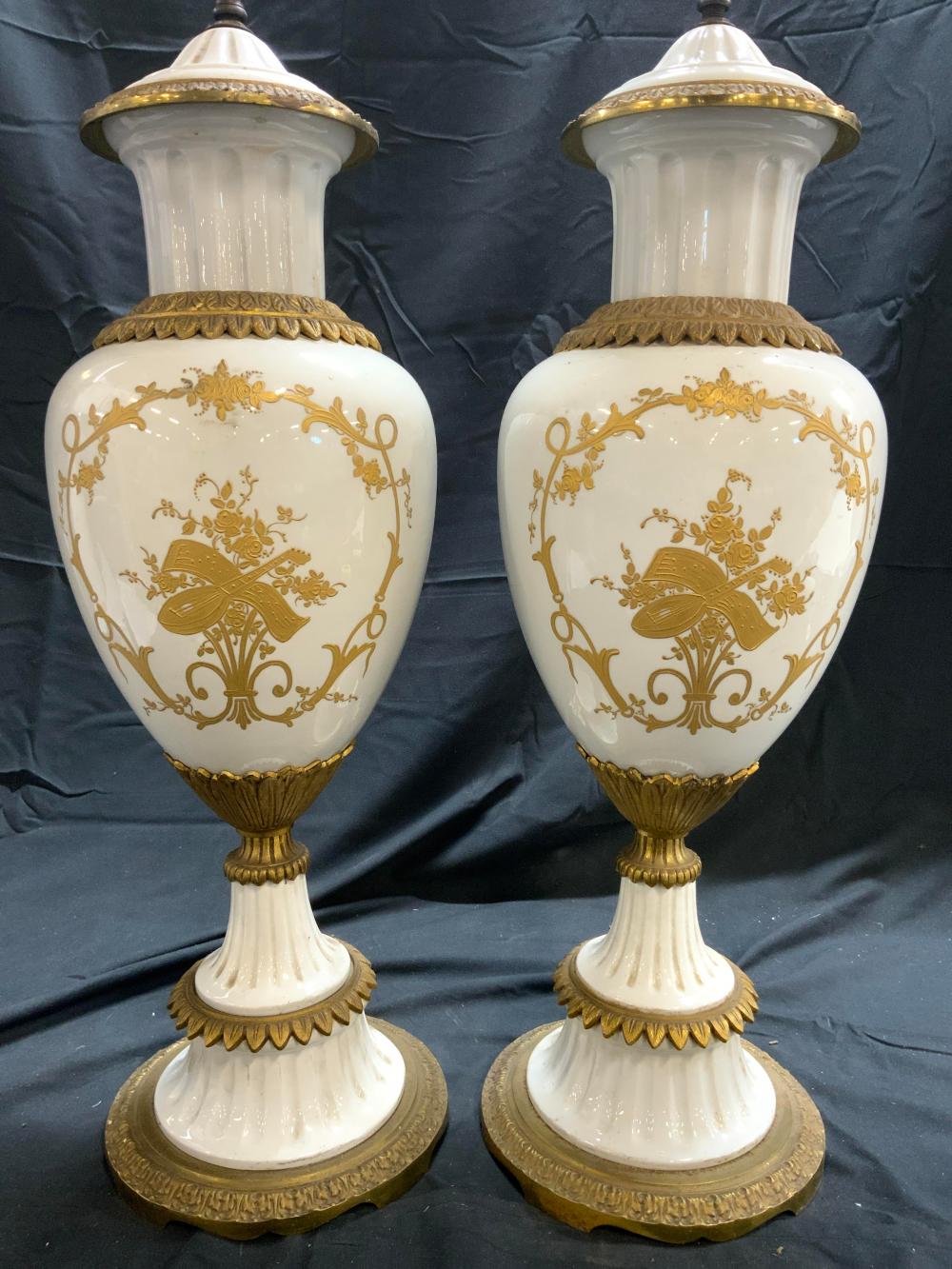
The goal is not to “spot everything.” The goal is to get the list of plausible claims down to one or two and force contradictions. If claims cannot be reconciled with marks and tooling, the lamp is likely a later copy.
How to read construction clues under magnification
Construction details are where reproductions usually fail, because the finish and surface can hide well but the internals are harder to mimic consistently.
Common high-signal checks
- Hardware texture: Screws, rivets, and threaded joins should match the claimed era’s engineering logic, not just appearance.
- Glass and glaze behavior: Aged glass often carries tiny tool marks and historical variation in edge roughness; a uniform new pour edge is a warning flag.
- Surface repairs: Repair work can be historic, or recent. Old restorations are often visible in subtle ways, but a fresh repair can reduce top-end value without removing all beauty.
- Socket families: The socket, base thread, and fitting style should align with era, especially on table lamps and arc-lamp adapted pieces.
- Metal transitions: Older transitions often show hand blending at joins; modern machines can produce near-perfect but lifeless geometry.
Condition is not a binary factor. A repaired lamp can still be an antique, but it changes destination value. Reproducers can also add convincing patina, so matching marks and hardware matters even more than color alone.
Free instant estimate
Not sure if your lamp is worth appraising? Let us take a look.
Upload a photo, tell us what you know, and get a free first read. If a full appraisal makes sense, we will say so.
Free. No card needed. Takes about two minutes.
Value implications: why identical-looking lamps can diverge in price
Collectors, home buyers, and estate sellers tend to overfocus on visible beauty and underweight context. A practical way to avoid that is to score each lamp by five buckets:
1) Authentication strength
If marks, construction, and wiring context support the same era narrative, a lamp can support stronger value arguments. If they conflict, the item usually performs lower because authenticity confidence is weaker.
2) Structural integrity
Cracks, soft solder, hidden breaks, or replaced limbs reduce the immediate buyer confidence. Repair quality matters: a clean, documented repair is often acceptable; hidden or cosmetic-only repair can be hard to resell.
3) Completeness and provenance
Base, shade, hardware, and docs are part of market value. Missing pieces are not a failure by themselves, but each missing component narrows your buyer universe.
4) Condition visibility
Painting flakes, burns, and socket wear can lower bid floor more than collectors expect, especially when damage is recent. Older, even wear can sometimes look better than recent over-restoration.
5) Buyer segment fit
A decorative pair that fits a specific interior trend might sell faster than a rarer but less practical style. Utility can beat rarity at retail-level sales, while rarity can dominate in collector circles.
Use comps as context, not a promise
Internal auction data shows how wide the spread can be. One pair of small porcelain lamps in one category sold for under $300, while carved or estate-significant pieces can clear closer to $1,700. That does not mean every similar lamp reaches those ranges; it means range is broad and driven by condition, completeness, and certainty of origin.
Practical takeaway: if two lamps look similar in photos but only one has stable maker signals, clear hardware chronology, and clean structure, the buyer should treat the uncertainty spread as significant. That spread is often bigger than frame material or base style alone.
A conservative buyer model is simple: verify authenticity first, then valuation. If authenticity confidence is below 70%, valuation decisions become mostly guesses. If confidence is high, use comps to judge whether current offers compensate for condition and repair risk.
Scenario you can use today
Imagine two buyers see a brass-and-glass street lamp pair and both have budgets for a feature purchase. Buyer A skips the hardware check, trusts finish alone, and bids for an unproven pair near the top end. Buyer B inspects maker marks, checks socket type, and notices inconsistent screw geometry around the base feet. Buyer B asks for wiring photos and one seller note before bidding, then either lowers the offer or walks.
Buyer B often wins a better outcome. You can use the same pattern as a private shopper or seller. Ask the same two questions:
- Do period clues reinforce each other?
- Do those clues justify the asking price if repaired versus untouched?
If the answer to both is “yes,” you likely have a stronger valuation position.
What to do now, before you commit
- Gather 8 photos: full front, full back, base, stem/arms, socket area, any marks, and any damage close-ups.
- Write a 30-word description: claimed era, suspected maker, current condition, and what changed if restored.
- Run one practical test: maker mark alignment, then check wiring style and hardware period, then compare with 2–3 known auction examples.
- Only then set your max offer based on confidence and market condition, not emotional finish appeal.
If you are ready for a fast, no-pressure reading, use the free estimate option. It helps separate strong candidates from decorative risks before you spend a full appraisal fee.
References and useful readings
What similar items actually sold for
To help ground this guide in real market activity, here are recent example auction comps from Appraisily’s internal database. These are educational comparables (not a guarantee of price for your specific item).
Shown USD range: USD 275-USD 4,750. Median of these 4 USD examples: USD 500.
| Image | Description | Auction house | Date | Lot | Reported price realized |
|---|---|---|---|---|---|
| pair of 'antique' lamps each with a sculpture with Cupid in sliver- and goldplated bronze on a base | DVC | 2026-02-28 | 8 | EUR 400 | |
| ANTIQUE TABLE LAMPS | Intervendue | 2023-12-21 | 894 | USD 275 | |
| Pair Of Maison Millet Bronze & Marble Antique Cassolette Lamps | Akiba Galleries | 2026-03-10 | 179 | USD 4,750 | |
| Antique Arts & Crafts Bronze Table Lamps | Greenwich Auction | 2021-08-14 | 370 | USD 300 | |
| Antique French Empire Style Bronze & Marble Lamps | Akiba Galleries | 2026-01-27 | 11 | USD 700 |
Disclosure: prices are shown as reported by auction houses and are provided for appraisal context. Learn more in our editorial policy.
Search variations readers ask most
- How to tell if an antique lamp is original or reproduction
- Can a Tiffany-style lamp be fake and still be valuable
- How does wiring age affect antique lamp price
- What maker marks prove an antique lamp is genuine
- How much do reproduction lamps usually go for
- Why two antique lamps can sell at very different prices
- Which lamp conditions hurt collector value most
- Can a replated lamp still be an antique
FAQs
Do all antique lamps have maker marks?
No. Many do, but some periods and regions relied on local casting systems, labels, or retailer-only marks. Missing marks do not immediately fail an item but require stronger construction proof.
How much should I pay if condition is uncertain?
Start with the lowest realistic bid range and factor in testing, transport, and repair. In mixed-condition items, condition can reduce realized value by more than any visible finish upgrade.
Can I trust one auction comp for pricing?
One comp helps, but it is directional only. Use multiple examples plus your own evidence, especially provenance, workmanship, and wear profile.