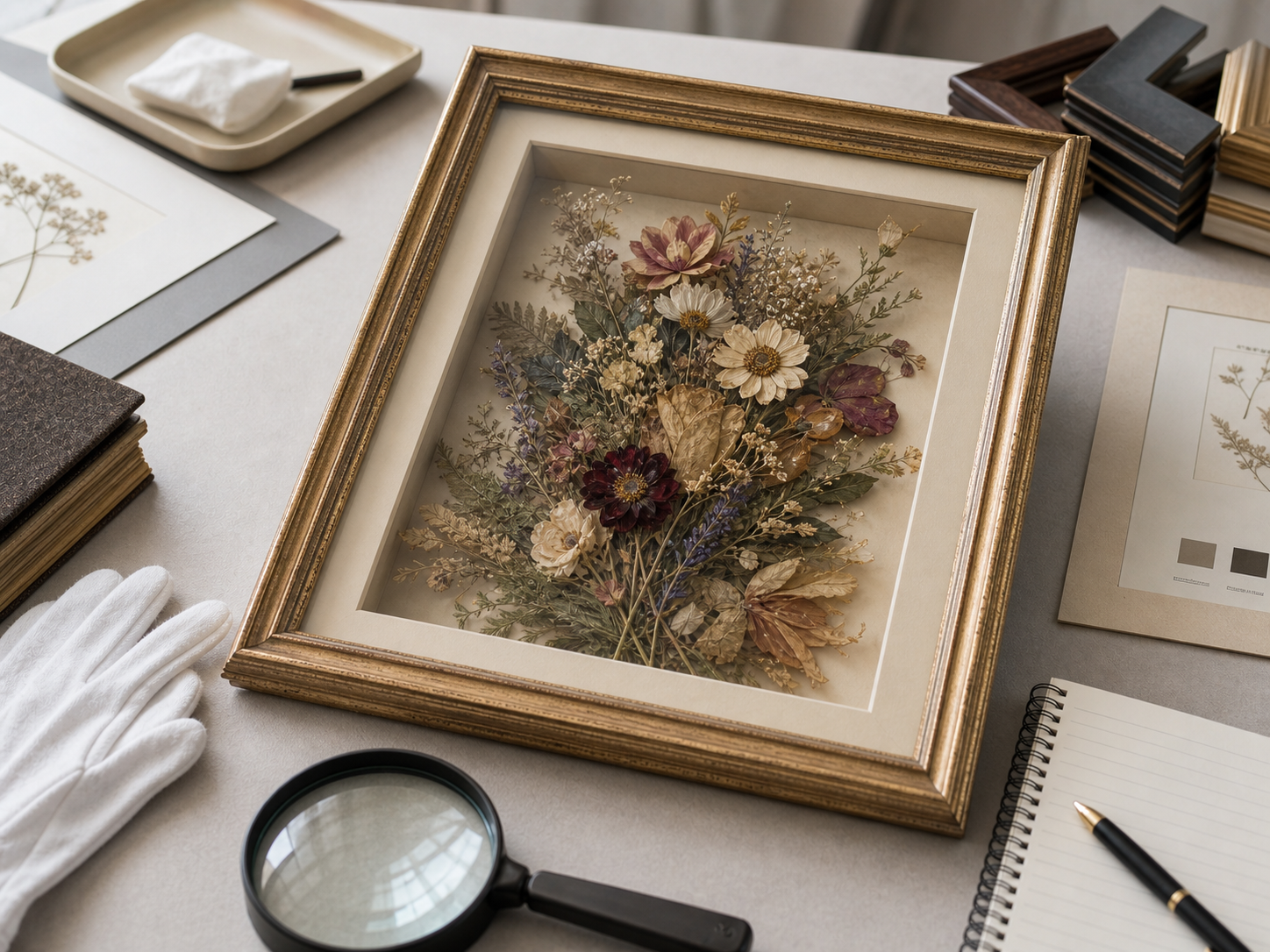
Note: We couldn’t find relevant auction comps in our database for this topic right now. If you’re valuing a specific item, try searching by maker/model/material and we’ll expand coverage over time.
What similar items actually sold for
To help ground this guide in real market activity, here are recent example auction comps from Appraisily’s internal database. These matched sales are market context only, not an object estimate or identification, and they do not guarantee a price for your specific a pressed flower 3d artwork.
Shown AUD range: AUD 800-AUD 1,300. Median of these 3 AUD examples: AUD 850.
How these auction records were verified
Each row retains its exact source URL, lot identity, retrieval time, access result, and immutable record hash. Inspect the public comparable provenance record.
Disclosure: prices are shown as reported by auction houses and are provided for appraisal context. Learn more in our editorial policy.
A Pressed Flower 3d Artwork
Pressed flowers arranged in three dimensions occupy a fascinating niche at the intersection of botanical study, decorative arts, and sentimental keepsakes. For appraisers and collectors, they present distinct challenges: fragile organic media, a range of techniques and materials across eras, and a market that blends folk art with fine craft. This guide demystifies the category—how to identify what you have, date it with reasonable confidence, assess condition, and estimate value.
What Collectors Mean by “Pressed Flower 3D Artwork”
Pressed-flower art, or oshibana in the Japanese tradition, typically involves flattening botanical material between absorbent papers, then arranging the preserved pieces on a substrate. The “3D” aspect comes in when artists mount layered petals, leaves, seed heads, mosses, feathers, or ribbons within deep frames, shadow boxes, or under glass domes to create dimensional compositions—bouquets, wreaths, landscapes, memorials, or heraldic emblems.
Key historical contexts:
- Early–mid 19th century: Romantic-era and Victorian enthusiasm for nature, botanical collecting, and domestic crafts spurred thousands of amateur and semi-professional examples. Mourning and memory pieces sometimes combined hairwork with flowers.
- Mid–late Victorian: Elaborate arrangements under glass domes on ebonized wood bases, often with velvet grounds, were popular parlor displays. Some include wax or paper flowers in combination with pressed material to enhance form.
- Late 19th to early 20th century: Shadow boxes with turned or ogee frames, reverse-painted glass mats, and hand-lettered botanical labels appear. Herbarium-style works, while more scientific, occasionally cross into decorative composition.
- Mid 20th century onward: Revival craft movements; kits using pre-cut mounts; commercial cards and pictures with pressed flowers sealed under cellophane; later, resin-encased pieces. Contemporary makers produce high-skill oshibana with painterly effects.
Not every floral relief is pressed plant material: some are wax, silk, paper, or dried-but-not-pressed components. Appraisers need to determine the actual medium because it affects conservation risk and value.
Materials, Techniques, and Tells
Understanding substrates, adhesives, and enclosures provides reliable identification clues.
- Substrates:
- Paper and card: Earlier quality pieces often use rag-content, laid or wove papers; later works commonly use wood-pulp card, susceptible to acid migration. Watermarks can help date.
- Fabric grounds: Velvet, satin, or silk, especially in Victorian domed arrangements. Note fading and pile wear.
- Wood panels: Occasionally used to support heavy or layered arrangements.
- Adhesives:
- 19th-century: Gum arabic, starch pastes, fish or animal glue. Age may show as amber halos or slight cracking; generally not plasticky.
- 20th-century: Casein and later PVA (white glue) or hot-melt. Dried PVA can appear glassy or form pronounced menisci at edges.
- Mounting wires or pins: Some 3D works discreetly pin thicker stems or seed pods through the substrate.
- Glazing and enclosures:
- Glass domes (“cloches”): Early examples have subtle waviness or seed bubbles; bases often ebonized wood, with turned profiles.
- Shadow boxes: Deeper frames (often 3–8 cm) with spacers; older glass may show ripples. Reverse-painted glass mats (“verre églomisé”) appear in higher-end 19th-c pieces.
- Sealed frames: Dust covers made from kraft paper, marbled paper, or newspaper are date clues; mid-20th century backs often use fiberboard or corrugated cardboard.
- Botanical material:
- Genuine pressed plant fragments reveal leaf venation, serration, and cellular texture under magnification. Edges are irregular and brittle, not uniformly laser-cut.
- Color: Naturally faded to earth tones on older pieces; aniline or watercolor touches might enhance petals. Intense, unfaded cherry reds and blues may suggest modern dyes or recent work.
Construction tells:
- Layers and spacers create depth; mounted elements should not touch the glazing in quality work.
- Compositions mixing moss, lichens, and seed heads often indicate Victorian taste; purely pressed-flat compositions lean toward oshibana traditions or later craft.
Dating and Attribution Clues
Dating relies on cumulative evidence rather than a single feature. Consider these signposts:
- Frames and fasteners:
- Hand-cut or square nails suggest pre-1890; round wire nails predominately post-1890; staples common mid-20th century onward.
- Screw types: Slotted screws are earlier; Phillips-head screws become common from the 1930s.
- Frame profiles: Deep ogee, ripple, or ebonized frames with gilt slips are typical mid-late 19th century. Aluminum or plastic frames indicate post-1960.
- Glazing:
- Cylinder or crown glass with ripples/bubbles is earlier; perfectly flat float glass is modern (post-1950). Acrylic glazing appears late 20th century.
- Paper and printing:
- Laid paper with chainlines and watermarks points to 19th-century or earlier substrates; wood-pulp boards darken with a characteristic brown tone at edges.
- Backing paper from old newspapers can be dated by typography or content—save and document any clippings.
- Inscriptions and labels:
- Latin binomials with author abbreviations (e.g., Rosa centifolia L.) appear in scientifically inclined 19th-c pieces. Copperplate or Spencerian hand supports this date range.
- Retail labels of fancy goods shops or frame-makers can be traced regionally and chronologically.
- Styling and iconography:
- Memorial or mourning motifs (willow trees, urns, black borders) especially 1820–1860.
- Domed parlor displays peak c. 1860–1890.
- Brightly colored, commercially uniform pressed-flower pictures, often souvenir-style, appear widely c. 1950–1975.
- Techniques:
- Resin embedding is a hallmark of late 20th-century and contemporary work; earlier resin-like coatings (copal, shellac, varnish) were used as surface consolidants but not for full embedding.
Attribution to a named maker is uncommon unless signed, labeled, or part of a known circle (e.g., some oshibana artists or educators). Provenance (letters, photographs showing the piece in situ) is especially valuable.
Condition and Conservation Risks
Pressed botanical artworks are among the most vulnerable decorative forms. Key risks and care strategies:
- Light and UV:
- Fading of plant pigments (anthocyanins, carotenoids) can be rapid. Display at low light levels (generally under 50–100 lux) and eliminate UV with filtering glazing. Rotate displays and rest in dark storage.
- Acidity and migration:
- Wood-pulp boards, low-quality mats, and brown tape cause acid burn. Replace backing with acid-free, lignin-free materials. When dyes’ sensitivities are unknown, conservators often prefer unbuffered boards for mixed-media; buffered boards can be appropriate for plant materials but may shift certain colors—consult a paper conservator before switching.
- Humidity and mold:
- Organic matter fosters mold above ~65% RH; desiccation below ~35% RH can embrittle petals further. Aim for stable 40–55% RH in a sealed frame with spacers. Avoid hanging in kitchens, bathrooms, or direct sunlight.
- Insects:
- Dermestids and silverfish will feed on plant remains, adhesives, and paper. Seal enclosures and inspect periodically. Quarantine newly acquired pieces.
- Physical damage:
- Vibrations and contact with glazing cause loss. Ensure spacers keep botanical material off the glass. Under domes, verify the dome seats properly on its base; avoid tilting during handling.
- Cleaning:
- Clean domes and glazing exterior with a dry microfiber cloth. Never spray liquids near the enclosure. Do not attempt to dust interior elements.
- Repairs:
- Amateur re-gluing, re-coloring, or re-pressing often devalues pieces and can cause irreversible damage. Keep interventions reversible. For lifting elements, tide lines, or mold, engage a qualified paper or objects conservator.
Documentation is part of preservation: photograph high-resolution images of the arrangement and any inscriptions; note dimensions, frame construction, and condition issues.
Free instant estimate. No card needed. A specialist review is only the next step if the evidence supports it.