What similar items actually sold for
To help ground this guide in real market activity, here are recent example auction comps from Appraisily’s internal database. These are educational comparables (not a guarantee of price for your specific item).
| Image | Description | Auction house | Date | Lot | Reported price realized |
|---|---|---|---|---|---|
| ENGLISH SCHOOL PAIR OF EDWARDIAN PAINTED AND STAINED GLASS PANELS, CIRCA 1905 61cm x 38cm | Lyon & Turnbull | 2017-04-26 | 185A | GBP 2,500 | |
| A set of four Edwardian leaded and stained glass window panels | Bonhams | 2005-09-06 | 133 | GBP 336 | |
 |
LARGE NEOCLASSICAL STYLE STAINED GLASS PANEL | Ahlers & Ogletree Inc. | 2025-05-08 | 320 | USD 350 |
Disclosure: prices are shown as reported by auction houses and are provided for appraisal context. Learn more in our editorial policy.
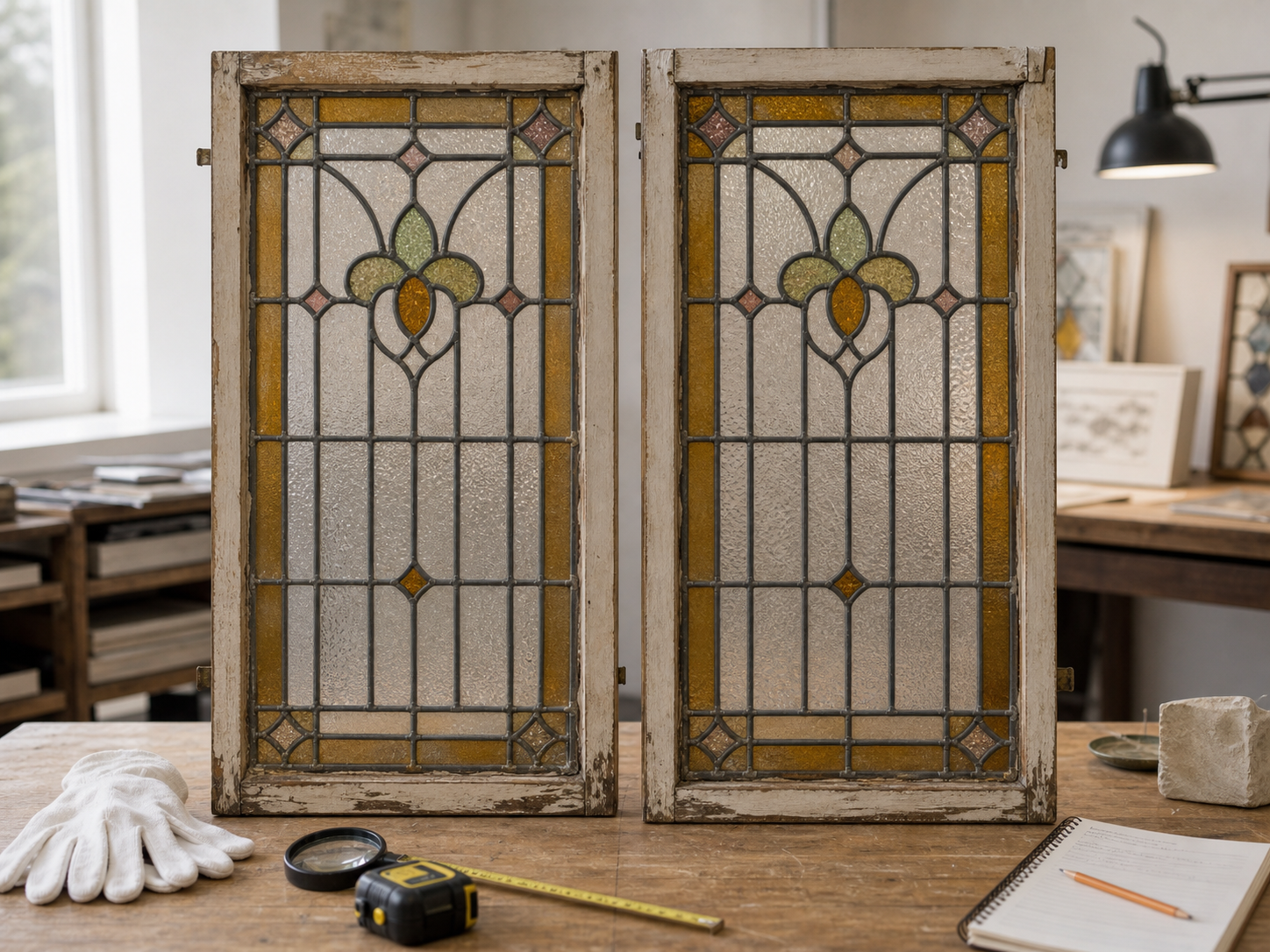
A Pair Of Stained Glass Windows From Edwardian Era With Colonial Style Circa Early 20th Century
A matched pair of Edwardian stained-glass windows in the Colonial Revival mode offers a compelling blend of historical charm, architectural value, and collectible interest. For appraisers and enthusiasts, understanding what defines this type, how to date it, and what drives value can turn a salvage find into a well-documented, well-cared-for asset. This guide unpacks the stylistic vocabulary, construction details, authentication cues, and market dynamics surrounding such pairs, with a focus on practical appraisal and preservation.
What “Edwardian Colonial Style” Means
The Edwardian period (1901–1910, with stylistic momentum into the 1910s and early 1920s) favored lighter palettes, refined geometry, and an eclectic embrace of revival styles. One of those revivals—especially in domestic architecture in Britain and North America—was the Colonial or Georgian Revival. In stained and leaded glass, that typically translates into:
- Symmetry and small panes: Rectilinear or diamond leaded “quarries,” often in clear or lightly tinted glass, arranged in balanced grids.
- Neoclassical motifs: Urns, laurel wreaths, swags, ribbons, shield cartouches, sunbursts or fanlight-inspired arcs, sometimes etched or formed with colored highlights.
- Restrained color: Soft ambers, pale greens, powder blues, with clear textured glass and modest ruby or sapphire borders; bevelled accents appear in more upscale work.
- Domestic scale: Frequently installed as pairs of sidelights flanking a door, stair landing windows, or as book-matched casements; the pair format heightens symmetry and curb appeal.
In contrast to the florid late-Victorian and Art Nouveau windows of the preceding decade, Edwardian Colonial Revival glass tends to be cleaner in line and lighter in feeling—yet not austere. Bevel clusters and acid-etched flashed glass may provide refined “sparkle,” while borders and cartouches introduce polite color.
How to Authenticate and Date a Pair
Dating and confirming an early 20th-century pair requires triangulating stylistic, material, and construction evidence.
Style and layout
- Paired design: Look for mirrored or complementary orientation—central cartouches facing inward, borders of identical widths, and consistent pane counts left-to-right. Asymmetry is possible, but matched pairs typically echo one another.
- Colonial vocabulary: Gridded quarries, fan- or sunburst motifs, swags, and urns point to Georgian/Colonial revival tastes popular from ca. 1905–1920.
Glass type and surface clues
- Mouth-blown “antique” sheet: Subtle waviness, “seeds” (tiny bubbles), and striations suggest pre-war production. Crown or cylinder glass was still in circulation.
- Machine-rolled glass: Widely used by the 1900s; uniform thickness with light texture (e.g., hammered, reamy) is common in domestic Edwardian leaded windows.
- Flashed glass: Thinly cased ruby or blue over clear, then wheel-engraved or acid-etched for motifs—typical of quality work c. 1890–1920.
Lead came and solder
- Came profile: Early 20th-century domestic windows often show relatively narrow face widths (approx. 3/16–1/4 inch) and milled uniformity. Heavier, clunkier cames can indicate earlier Victorian or later heavy re-leading.
- Solder: Even, slightly domed joints suggest workshop production; dull, textured solder with flux residue may mark later repair.
Framing and fixings
- Original softwood or oak frames with period joinery and old putty are strong indicators. Saddle bars (flat steel supports) tied with tinned copper wire align with period practice.
- Paint layers: Multiple, old oil paint layers and patina on perimeter came hint at age.
Maker’s or glazier’s marks
- Domestic windows were seldom signed. However, you may find a studio job number scratched into a border pane edge, a penciled note under putty, or, rarely, a faint glasshouse mark. Absence of a mark is normal and does not preclude period authenticity.
Provenance and context
- Original house plans, photographs, or a known address with period architecture (Edwardian/Colonial Revival) help anchor date and place.
- Removal notes from a reputable salvage firm or restorer can support attribution.
Red flags for later reproductions include overly uniform, ultra-clear float glass with no visual distortion, modern silicone-only edge glazing without putty in older timber frames, and copper-foil construction in a purely Colonial geometric layout (foil is more associated with Tiffany-style opalescent work).
Materials and Construction Details
Understanding how these windows were built will help you assess quality and condition—and explain value to clients.
Glass
- Thickness: Typically around 2–3 mm (~3/32 inch), varying slightly across sheets.
- Palette: Clear or lightly colored cathedral glass, occasional bevels, flashed ruby/blue accents, and pressed rondels in some higher-grade work.
- Texture: Light reamy or hammered textures add sparkle without overpowering the restrained Colonial palette.
Lead came
- Alloy: Lead with modest antimony/tin for hardness; hearts sufficient to grip edges. A caliper can reveal face width; narrower profiles are common for Edwardian domestic windows.
- Joints: Soldered on both faces; studs for tie-wires soldered at strategic points to saddle bars.
Supports
- Saddle bars: Mild-steel flats set horizontally or vertically, tied with pre-tinned copper wires twisted around cames. Their presence (and old oxidation) supports age.
Frames
- Timber: Pitch pine and oak were common in Britain; in North America, softwoods and oak. Mitered corners, old nails, and layers of paint signal originality.
- Putty: Traditional linseed oil putty at the outer perimeter; look for aged cracking and oxidation appropriate to age.
Design format typical of pairs
- Matching borders: Uniform border glass widths on both panels.
- Centerpieces: Inward-facing cartouches, urns, or wreaths that “speak” to one another across a doorway or stairwell.
- Dimensions: Residential pairs often range 10–18 inches wide by 30–50 inches tall each; transoms are shorter. Larger stair windows may be taller and reinforced with multiple saddle bars.
Free instant estimate. No card needed. A specialist review is only the next step if the evidence supports it.