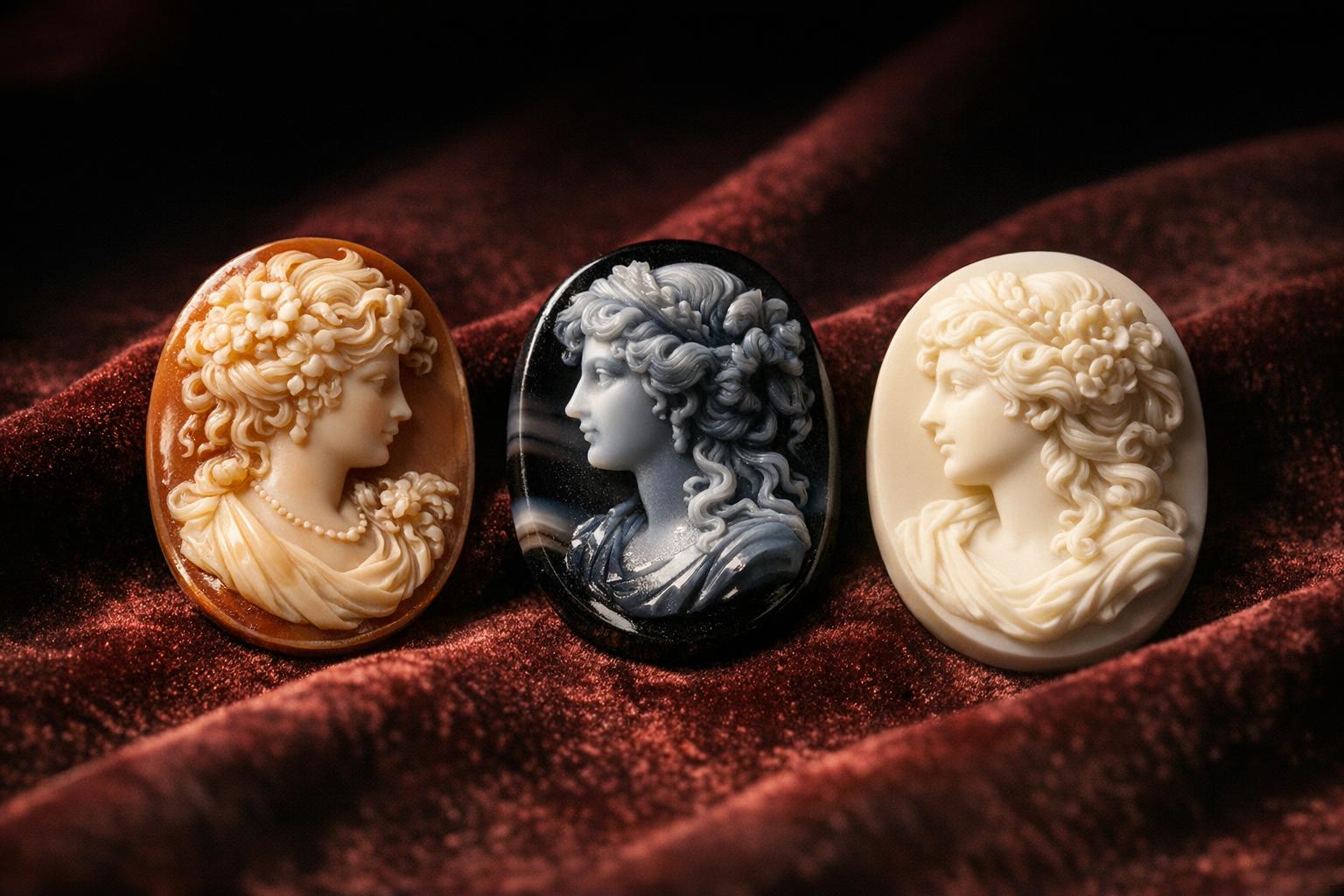
Cameo identification and appraisal checklist
Start by separating shell, stone, glass, lava, coral, and resin clues before pricing. Document weight, temperature, translucency, carving marks, back surface, setting metal, hallmarks, clasp, cracks, repairs, provenance, and comparable sales. For related pricing context, compare antique cameo brooch value, cameo brooch appraisal factors, and antique cameo value signals.
Free. No card needed. Photo upload takes about two minutes.
A cameo can sit in a jewelry box for decades before anyone asks what it's actually made of. The answer matters. A hand-carved queen conch shell cameo in 14k gold can carry a replacement value of $500 to $2,000 or more. A hardstone agate cameo by a known Italian workshop has reached $5,000+ at auction. A pressed-resin reproduction from a modern mold might be worth $15 to $40 as a costume accessory.
The difference isn't always obvious from the front. Modern injection-molded resin cameos have improved dramatically — some now mimic the color stratification of genuine shell well enough to fool a casual glance. But under the right tests, the material reveals itself quickly. Below are 11 signs collectors and appraisers use to separate shell from stone from resin, and to gauge whether your piece warrants a professional valuation.
What you'll learn
- Weight and density feel
- Temperature to the touch
- Back surface inspection
- Magnification reveals tool marks
- Color layering and stratification
- Carving depth and crispness
- Metal quality of the setting
- Translucency under bright light
- Smell and hot-pin test
- UV/blacklight response
- Provenance markers and hallmarks
Sign 1: Weight and Density Feel
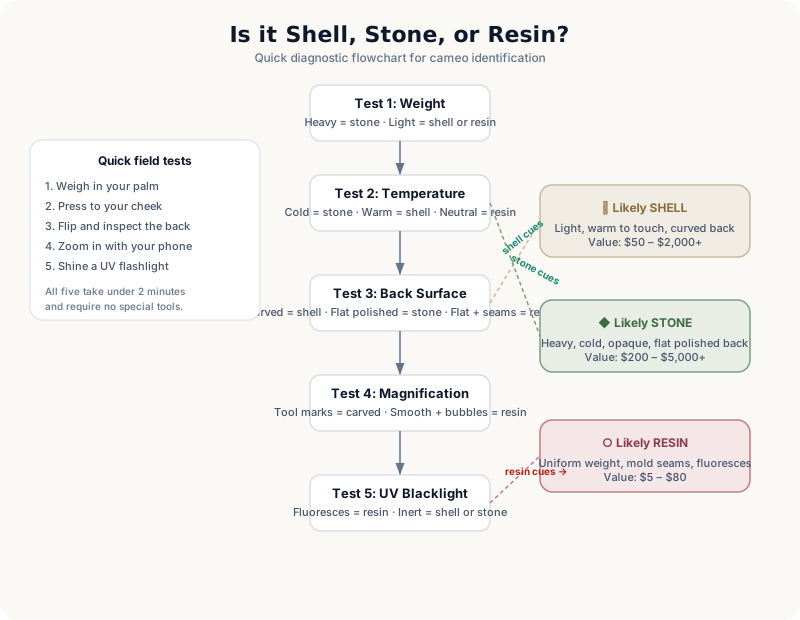
Pick the cameo up in your palm. The heft tells you something immediately. Shell cameos are notably light — a typical 30–50 mm portrait carved from queen conch shell weighs barely more than a large coin. Hardstone cameos (agate, onyx, lava stone) feel dense and substantial, often two to three times heavier than a shell cameo of identical dimensions. Resin cameos tend to fall in between, but the distribution is suspiciously uniform: every piece from the same mold weighs nearly identically, whereas hand-carved shell pieces vary slightly.
If you have a kitchen scale, a 40 mm shell cameo typically lands between 3–8 grams. A comparable hardstone piece runs 10–25 grams. Resin copies cluster around 5–12 grams depending on thickness. The overlap between shell and resin means weight alone isn't conclusive — but combined with other signs, it's a fast first filter.
Sign 2: Temperature to the Touch
Press the cameo against your cheek or the inside of your wrist — areas sensitive to subtle temperature differences. Shell cameos feel warm or neutral, adapting quickly to body temperature because the organic material has low thermal conductivity. Hardstone cameos feel distinctly cold and stay cool for several seconds, the way a river stone feels on a winter morning. Resin cameos feel neutral to slightly cool but warm up faster than stone and slower than shell.
This test is fast, requires no tools, and is surprisingly reliable once you've handled a few confirmed examples. It's the quickest way to separate stone from the other two materials in the field.
Sign 3: Back Surface Inspection
Turn the cameo over. The reverse side often reveals more than the carved front. Genuine shell cameos show a subtle convex curve that follows the original shape of the conch shell — the back is not perfectly flat. You may also see faint growth lines or a faintly textured surface where the carver left the natural shell structure intact.
Hardstone cameos typically have a flat, polished back, sometimes with a frosted finish if the workshop wanted to emphasize the material. Resin cameos often reveal a perfectly flat back with mold seams — thin raised lines along the edges where the two halves of the injection mold met. On higher-quality resin copies, these seams are sanded away, but the surface will look too uniform under close inspection, lacking the organic variation of real shell.
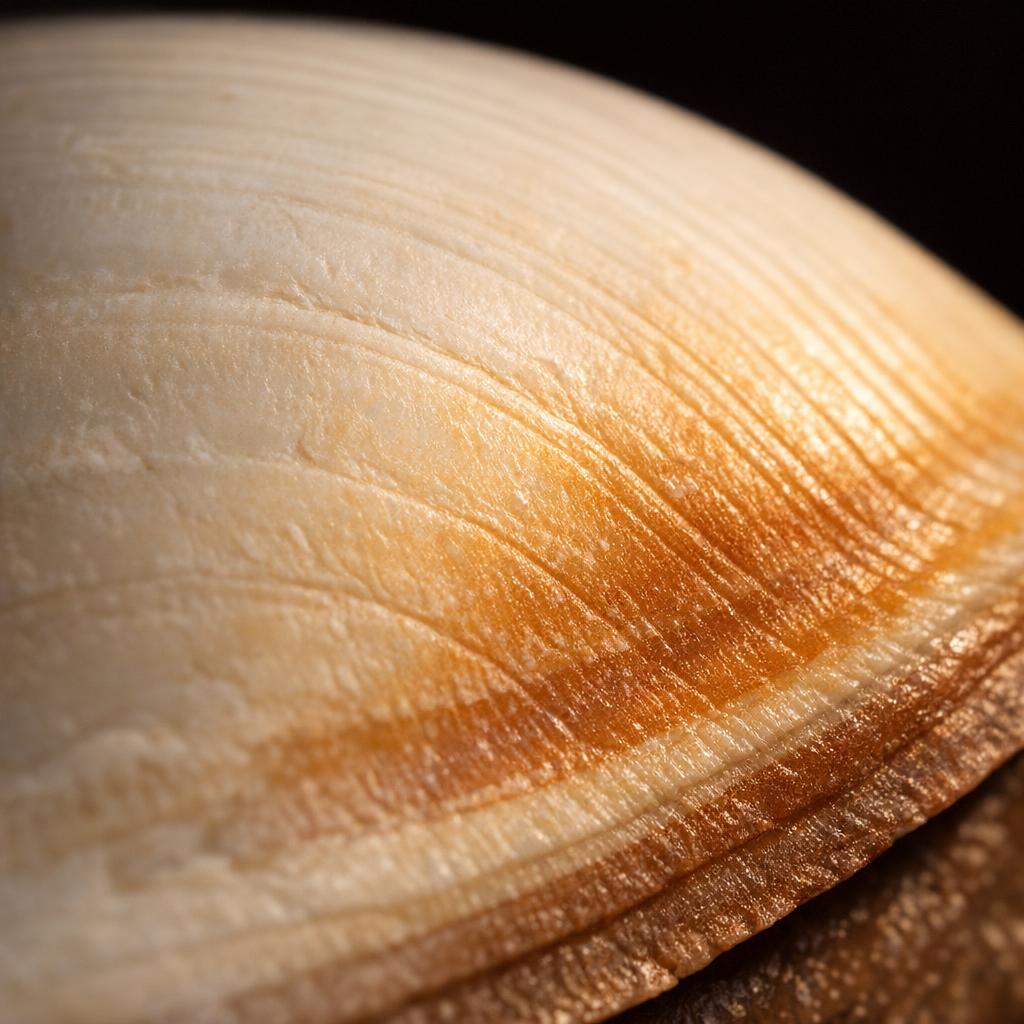
Sign 4: Magnification Reveals Carving Tool Marks vs. Molded Uniformity
Use a 10× loupe, a smartphone macro lens, or even the zoom function on your phone's camera. Under magnification, hand-carved shell cameos show tiny, irregular tool marks — microscopic gouges, varied line widths, and slight asymmetries that signal a human hand at work. The carved relief has depth variation: deeper cuts in shadow areas, shallower grazing strokes in highlights.
Resin cameos under magnification look almost too perfect. The surface is uniformly smooth with no tool marks. The transition between foreground and background layers is a soft, rounded edge from the molding process rather than a sharp carved boundary. You may also see tiny air bubbles trapped just beneath the surface — a telltale sign of cast resin that never appears in hand-carved shell or stone.
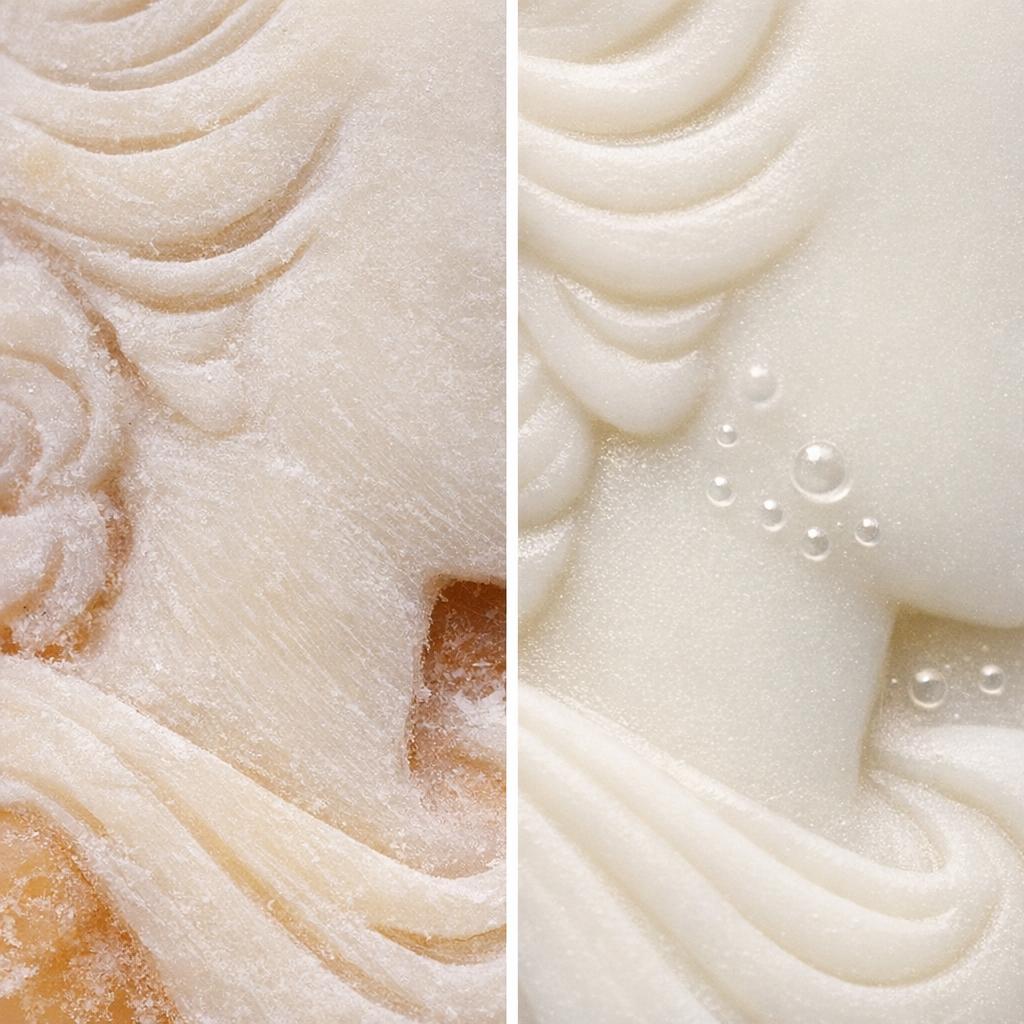
Sign 5: Color Layering and Natural Stratification
Queen conch shell — the primary material for quality shell cameos — has a naturally stratified color structure: a darker brownish-orange outer layer and a creamy white interior. Skilled carvers exploit this by leaving the dark layer as the background portrait silhouette and carving through to the white layer for the raised figure. In a genuine shell cameo, the color boundary between background and figure is organic and slightly irregular, following the natural layer boundary in the shell.
Resin cameos achieve the same two-tone effect by painting or coating the surface. Under close inspection, the "dark" layer sits on top rather than being integral to the material. You may see brush marks, overspray into recessed areas, or a color edge that is too perfectly straight. Hardstone cameos use naturally banded agate or layered onyx — the color bands are parallel and consistent across the stone, unlike the curved stratification of shell.
Sign 6: Carving Depth and Crispness
Run your fingernail lightly across the surface of the raised figure. Quality shell cameos have real relief depth — the carved portrait stands 1–3 mm above the background plane, with undercut edges that create genuine shadows. The carving has a three-dimensional quality that changes as you tilt the piece in raking light.
Resin cameos are often shallow relief or no relief at all — the "carving" is a surface impression pressed into the material during molding, rarely more than 0.5 mm deep. The edges of the figure are rounded rather than sharp, and the shadows they cast are soft and diffuse. Hardstone cameos can achieve the greatest detail of all three materials because the stone holds a crisp edge without the brittleness concerns of shell, but they are also the most expensive to produce.
Sign 7: Metal Quality of the Setting
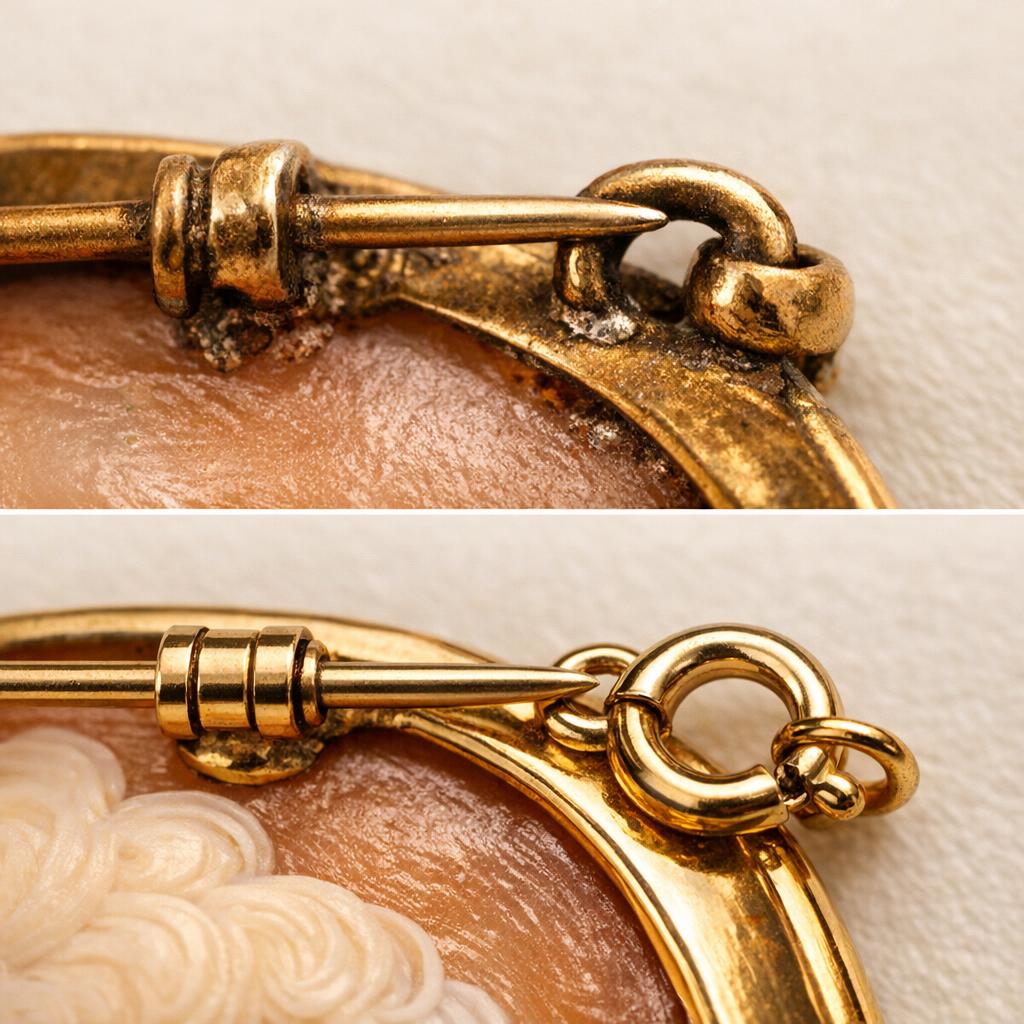
The mounting is one of the most reliable quick proxies for cameo authenticity and value. Cameos set in 14k or 18k gold, or in sterling silver (marked 925), are far more likely to be genuine shell or hardstone — jewelers don't mount cheap resin reproductions in precious metal. Look for hallmarks stamped inside the pin stem, on the clasp, or on the reverse of a pendant bail.
Base-metal settings — brass-tone, copper-tone, or mystery-metal alloys with no stamp — almost always indicate a mass-produced resin cameo. If you see visible glue residue around the cameo edge, or if the cameo appears to be simply glued into a bezel rather than mechanically set, it's almost certainly a low-value piece. A cameo in 10k gold sits at the boundary: it could be a genuine lower-grade shell cameo or a decent resin copy, so additional signs are needed.
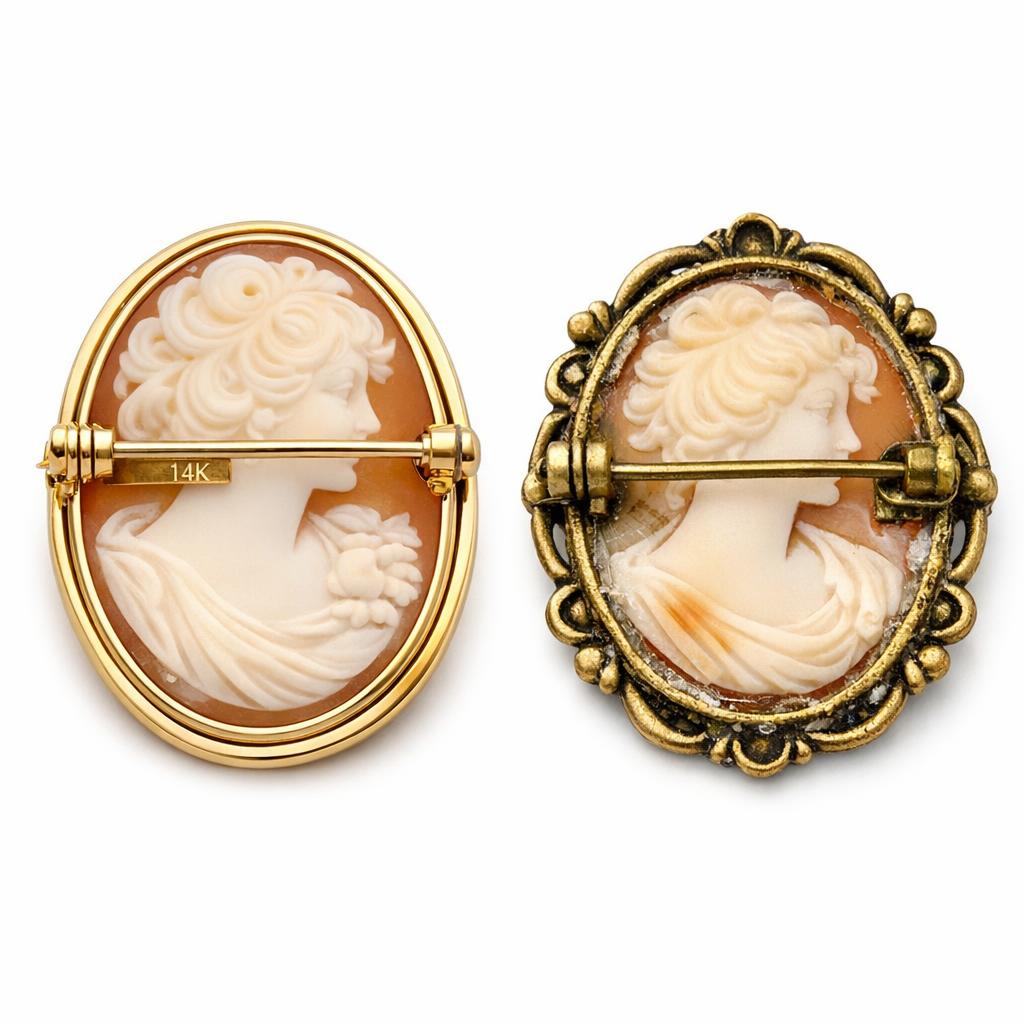
Sign 8: Translucency Under Bright Light
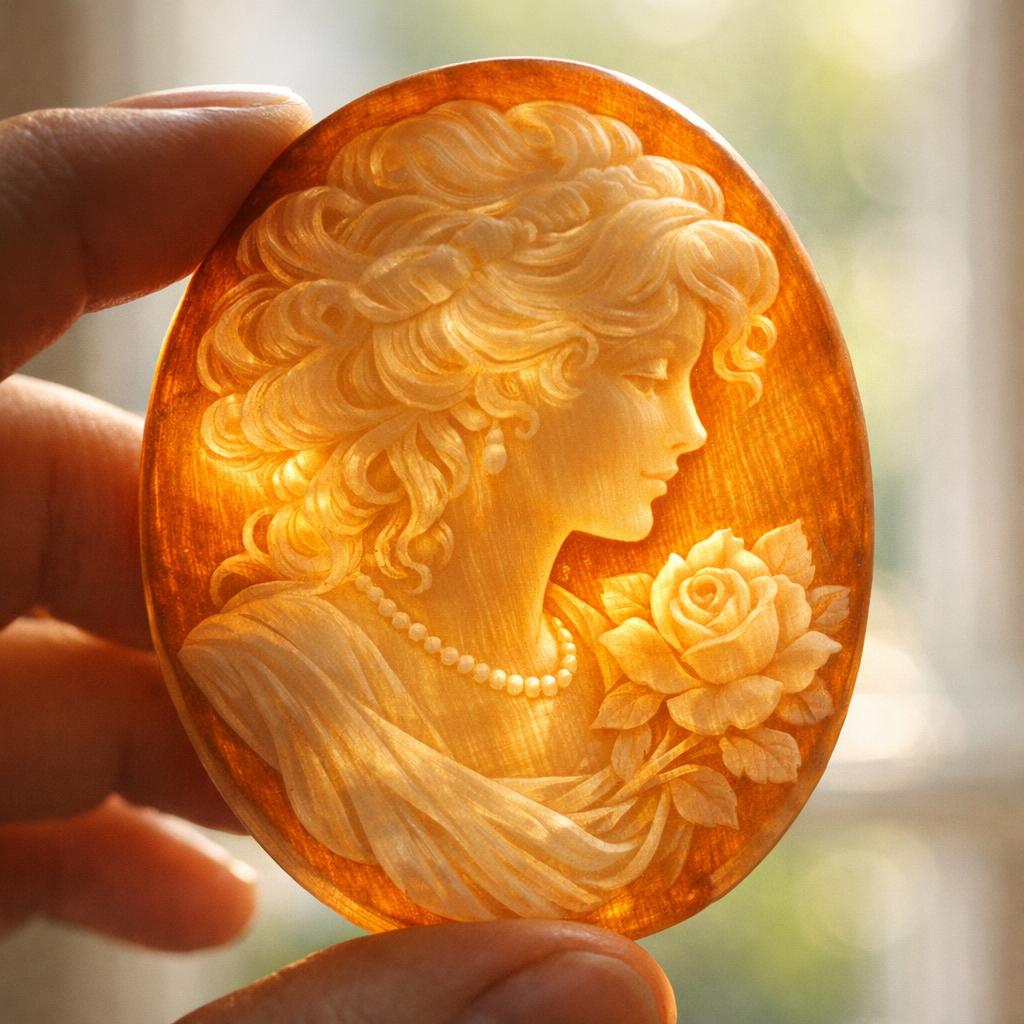
Hold the cameo up to a bright light source — a window, a strong lamp, or your phone's flashlight pressed against the back. Shell cameos show a warm, amber translucency; light passes through the thin carved areas, revealing the shell's natural fibrous structure. The effect is similar to holding a fingernail up to light — a soft glow, not full transparency.
Hardstone cameos are completely opaque — no light passes through regardless of how thin the carving. Resin cameos are either fully opaque or uniformly translucent without the warm amber tint or fibrous texture of genuine shell. If the light passes through evenly like frosted plastic, you're likely looking at resin.
Sign 9: Smell and the Hot-Pin Test
This is a destructive test, so use it only on a piece you're prepared to mark slightly — or skip it if the cameo appears valuable. Heat the tip of a straight pin or needle until it's hot (a lighter flame works). Touch the heated pin to an inconspicuous area on the back or edge of the cameo.
Shell cameos produce a faint organic smell — similar to burning hair or fingernail — because shell is made of calcium carbonate and conchiolin, the same protein family as human keratin. The pin may leave a small white mark but won't melt the surface. Hardstone cameos produce no smell and no mark — stone doesn't react to a pin heated by a lighter. Resin cameos melt and produce a sharp plastic or chemical odor; the pin tip will sink into the surface and leave a visible depression with a darkened rim.
Sign 10: UV/Blacklight Response
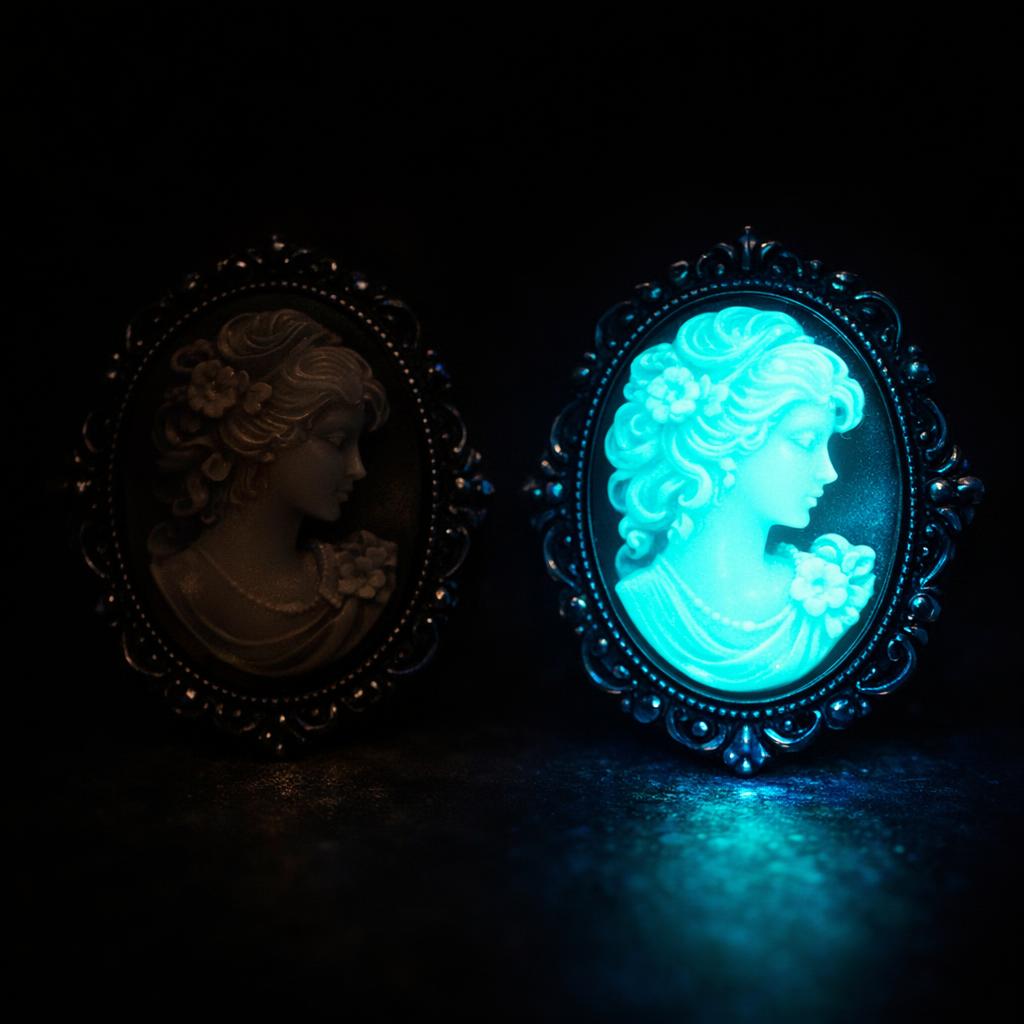
Shine a UV flashlight (365 nm wavelength works best) on the cameo in a darkened room. Many resin cameos fluoresce a blue-green or bright white under UV light because of optical brighteners and additives in the resin compound. The fluorescence is often uniform across the entire piece. Shell cameos remain largely inert under UV — they may show a very faint warm glow but nothing dramatic. Hardstone cameos are also inert, though some agate varieties can show subtle band-reactive fluorescence if the stone was treated with dye.
This test is non-destructive, quick, and has become increasingly useful as 3D-printed resin fakes flood online marketplaces. If your cameo glows under UV, treat it as resin until other signs prove otherwise.
Sign 11: Provenance Markers — Signatures, Hallmarks, and Period-Consistent Findings
Examine the cameo and its setting for any maker's marks, signatures, or clues about age. Italian cameo workshops — particularly those from Torre del Greco, the historic center of cameo carving since the 18th century — often stamp their pieces with workshop marks or carver initials. Names like "Incisa," "Mottola," or "A. M." appear on documented pieces and can significantly increase value.
The clasp and pin mechanism also date the piece. A C-clasp or Trombone clasp suggests 19th- or early 20th-century manufacture, consistent with a genuinely antique shell or stone cameo. A modern spring-ring clasp or a stamped "China" mark on the reverse indicates recent mass production — almost certainly resin. Findings (the pin stem, hinge, and catch) that are hand-soldered rather than machine-stamped also point to a higher-quality, older piece worth closer examination.
What Your Cameo Could Be Worth
Once you've identified the material, the value range narrows considerably. Here's what the current market looks like based on recent auction results and dealer pricing:
| Material | Setting | Typical Value Range | Notes |
|---|---|---|---|
| Resin (mass-produced) | Base metal, no stamp | $5 – $40 | Costume jewelry; no appraisal needed |
| Resin (higher quality) | Gold-plated or 10k gold | $20 – $80 | Better mold work; still not collectible |
| Shell (unsigned, average carving) | Sterling silver or 10k gold | $50 – $300 | Common vintage market; appraisal optional |
| Shell (fine carving, signed) | 14k or 18k gold | $300 – $2,000+ | Appraisal recommended for insurance |
| Hardstone (agate, onyx, lava) | Any precious metal | $200 – $5,000+ | Documented workshop attribution can double or triple value |
These ranges reflect realized auction prices and dealer asking prices as of early 2026. A shell cameo attributed to a documented Torre del Greco workshop recently sold for $1,800 at a regional auction house — nearly four times the price of an unsigned shell cameo with comparable carving quality in the same sale. Documented maker attribution consistently lifts realized prices by 30% to several hundred percent.
The broader cameo market showed steady activity through 2025 and early 2026, with shell cameo and gold pieces appearing regularly on Invaluable, LiveAuctioneers, and at regional estate auction houses. A shell cameo set in a 10k gold ring sold at auction in early 2026, confirming sustained demand for even mid-tier pieces. At the same time, the influx of 3D-printed resin reproductions on Etsy, eBay, and Temu has created a two-tier market: authenticated, documented cameos command real prices, while unverified resin copies compete at the bottom.
Free first read
Check whether your cameo is worth appraising
Share the material clues, setting marks, and photos to get a free instant estimate before choosing a written report.
Private review. Free estimate first. Checkout only if you decide to proceed.
Recent Cameo Market Activity and Why Authentication Matters Now
The cameo market in 2025–2026 presents a tale of two segments. On the authenticated side, fine shell and hardstone cameos continue to achieve solid prices at auction. Regional auction houses regularly feature Victorian and Edwardian shell cameos in 14k gold settings, with realized prices of $400–$1,500 being common for pieces in good condition with documented provenance. A particularly fine Italian hardstone cameo attributed to a known workshop sold for over $4,000 in a 2025 sale, underscoring the premium that attribution commands.
On the unverified side, the proliferation of 3D-printed and injection-molded resin cameos has accelerated. Sellers on major online marketplaces increasingly list resin reproductions with vague descriptions like "vintage-style cameo" or "antique-look cameo" that can mislead buyers unfamiliar with the identification tests described above. The resin pieces often carry convincing color stratification in product photos — but under magnification, the absence of tool marks and the presence of mold seams are unmistakable.
This is why material identification isn't just academic. It directly affects what you should pay, what you should accept if selling, and whether an insurance appraisal is justified.
When to Get a Professional Cameo Appraisal
If your cameo passed the majority of the tests above as genuine shell or stone, and especially if it's set in 14k gold or sterling silver with hallmarks, a documented appraisal is warranted in these situations:
- Insurance coverage: Replacement value for a fine shell cameo in gold can exceed $2,000. Homeowner's insurance schedules require documented appraisals for individual items above the blanket jewelry limit (typically $1,000–$2,500).
- Estate division: When dividing personal property among heirs, an appraisal establishes fair market value and prevents disputes. A cameo that looks like "just Grandma's brooch" may carry significant value.
- Charitable donation: The IRS requires a qualified appraisal for donated property valued above $5,000. Even below that threshold, documentation supports your claimed deduction.
- Consignment or private sale: If you plan to sell through an auction house or dealer, an appraisal gives you a defensible reserve price and protects you from undervaluation.
For resin cameos or unsigned shell pieces in base-metal settings with a probable value under $100, the cost of a formal appraisal ($150–$400) typically exceeds the item's worth. In those cases, the identification tests above are sufficient for your own knowledge.
What similar items actually sold for
To help ground this guide in real market activity, here are recent example auction comps from Appraisily’s internal database. These matched sales are market context only, not an object estimate or identification, and they do not guarantee a price for your specific shell cameo.
Shown EUR range: EUR 100-EUR 460. Median of these 4 EUR examples: EUR 300.
| Comparable | What sold | Auction house | Date | Lot | Source-reported amount |
|---|---|---|---|---|---|
 |
Oval shell cameo ‘Goddess Flora’ in gold-plated setting with steel pin, 13.4g, 4.6 x 3.8 cm, signs of wearSource blocked; provenance matched | Kendzia | 2026-06-11 | 310 | EUR 100 (buyer’s-premium treatment unknown) |
 |
A gold shell cameo bar brooch,Source blocked; provenance matched | Sworders | 2020-09-29 | 376 | GBP 40 (buyer’s-premium treatment unknown) |
 |
Shell cameo braceletSource blocked; provenance matched | Henry's Auktionshaus | 2024-10-24 | 780 | EUR 460 (buyer’s-premium treatment unknown) |
 |
Pendant brooch with shell cameo «Erato»Source blocked; provenance matched | Auktionshaus Kaupp GmbH | 2022-11-25 | 1260 | EUR 250 (buyer’s-premium treatment unknown) |
 |
A 14CT GOLD SHELL CAMEO BROOCHSource blocked; provenance matched | Lawsons | 2025-11-20 | 336 | AUD 500 (buyer’s-premium treatment unknown) |
 |
ANTIQUE 14K GOLD CARVED SHELL CAMEO RINGSource blocked; provenance matched | Westport Auction | 2023-05-11 | 241 | USD 180 (buyer’s-premium treatment unknown) |
 |
14K Yellow Gold, Shell Cameo, EarringsSource blocked; provenance matched | Alderfer Auction | 2015-06-11 | 3018 | USD 80 (buyer’s-premium treatment unknown) |
 |
9 kt gold brooch with shell cameoSource blocked; provenance matched | Henry's Auktionshaus | 2020-08-27 | 604 | EUR 350 (buyer’s-premium treatment unknown) |
How these auction records were verified
Each row retains its exact source URL, lot identity, retrieval time, access result, and immutable record hash. Live source access was blocked; the exact record matched Appraisily's immutable pipeline provenance. Inspect the public comparable provenance record.
Disclosure: prices are shown as reported by auction houses and are provided for appraisal context. Learn more in our editorial policy.
Screen your cameo before paying for a report
Share closeups of the carving, reverse, clasp, hallmark, and setting to get a free first read on whether a written appraisal makes sense.
Search variations collectors ask
Readers often Google these questions — each one is addressed in the identification guide above:
- How can you tell if a cameo is real shell or plastic?
- What is the difference between shell and stone cameos?
- How to identify a valuable antique cameo brooch?
- Are resin cameos worth anything?
- How to tell if a cameo is hand-carved or molded?
- What makes a cameo worth appraising for insurance?
- How much is a Victorian shell cameo worth today?
- Can you test cameo material at home without damage?
Each question above is answered in detail in the 11-sign guide above.
References and sourcing
This article draws on identification methods documented by the Spruce Crafts, antique jewelry reference sources, and recent auction results from Invaluable and regional auction houses. Material properties (density, thermal conductivity, UV response) are consistent with published gemological and jewelry-science references. For our full editorial standards and corrections policy, see our editorial policy page.