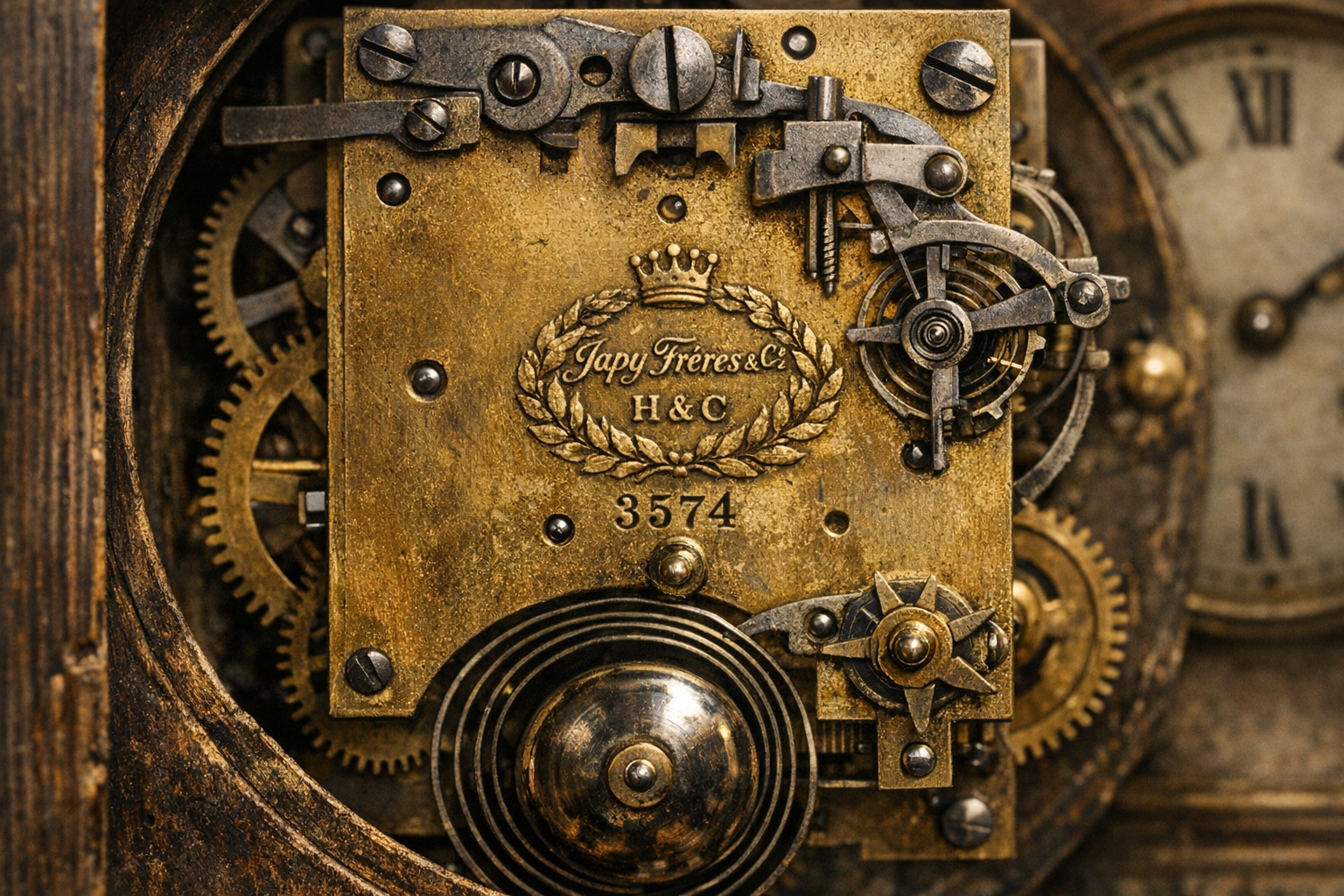
Antique Clock Makers Marks: Movement Plates, Dial Names, Labels, Serial Numbers and Cases

Identify antique clock makers marks by documenting movement plates, dial names, paper labels, serial numbers, case marks, repairs, and provenance.

Antique clock makers marks reference with movement plates, dial names, paper labels, serial numbers, case marks, repairs, and provenance
Antique clock makers marks reference with movement plates, dial names, paper labels, serial numbers, case marks, repairs, and provenance. Reference image; item-specific appraisal depends on submitted photos and documentation.

Antique clock makers marks quick checks

Start with the movement plate, dial signature, paper label, case interior, pendulum, weights, bells, serial numbers, patent marks, retailer names, repair labels, and any mismatch between movement and case. Compare related guides for clock makers mark identification, antique clock identification, and old clocks value before assigning a maker or value.

Antique clock makers marks can identify a workshop, retailer, movement maker, case maker, or later repair. A careful appraisal separates those clues before using the name on the dial as proof of origin.

Look beyond the dial

Dial signatures often name a retailer, not the maker. Check the movement back plate, paper labels, case interior, pendulum, weights, bells, and serial numbers for better attribution evidence.

Match marks to construction

A mark is strongest when the movement style, case construction, escapement, strike train, country marks, and hardware all fit the same period. Conflicting clues can suggest a married case or replacement movement.

Protect the evidence

Avoid polishing plates, sanding labels, or forcing access to the movement. Overcleaning can erase shallow stamps and lower both identification confidence and market value.

Quick appraisal checklist

  • Photograph dial, movement plate, case labels, pendulum, and weights
  • Record serial numbers and assembly marks exactly
  • Note country of origin and patent marks
  • Describe repairs, replaced parts, and missing labels
  • Compare only to clocks with matching movement and case type

What similar items actually sold for

To help ground this guide in real market activity, here are recent example auction comps from Appraisily’s internal database. These are educational comparables (not a guarantee of price for your specific item).

Shown GBP range: GBP 550-GBP 6,000. Median of these 3 GBP examples: GBP 1,900.

Image Description Auction house Date Lot Reported price realized
Auction comp thumbnail for A FINE EARLY 19TH CENTURY MAHOGANY DROP DIAL WALL TIMEPIECE BY THE ROYAL CLOCK MAKER, VULLIAMY, LONDON, NO. 1605 the signed 12 inch painted dial with Roman numerals and outer minute track with blued steel hands, within a brass bezel locking on the right hand side, and a moulded frame, secured to the slim trunk with four wooden pegs, the trunk with a hinged door to either side secured via catches, over a chiselled base with fall front, lockable door, the single gut fusee movement with substantial plates and four pillars, also numbered 1605 to the underside of each plate, with deadbeat type escapement, signed and numbered on the backplate 'VULLIAMY LONDON No. 1605', the original steel and heavy brass bob also numbered '1605', the movement also secured to the case with a brass headed screw attached to the bottom of each plate, with associated winder, 61cm high Provenance: This clock has been in the same family for generations and was probably acquired by the family shortly after it was first made. The clock came to the present owner through descent from either the Lyon family of Appleton, Cheshire or from Sir Arthur Havelock, late Governor of Ceylon. The present owners' great-grandfather Charles Lyon married Rachel Havelock daughter of Sir Arthur Havelock and great-niece of Henry Havelock. A number of items belonging to Sir Arthur were passed down to the family.  Benjamin Lewis Vulliamy came from a line of exceptional clock makers that enjoyed royal patronage for three generations. His father, also Benjamin Vulliamy, earned a Royal Appointment in 1773 as King George III's Clockmaker. He was also commissioned to build the Regulator Clock, which was responsible for the official London time until 1884, when the Greenwich Royal Observatory took over this role with the Shepherd Master clock and later in 1893 by Dent no. 2012. Born in 1780, B. L. Vulliamy received the Freedom of the Clockmakers' Company in December 1809 and became a liveryman in January 1810 at the age of 30. The present timepiece is typical of his output, unlike his father who produced very decorative clocks, he was known for producing accurate clocks of exceptional quality and workmanship, and these practical and dependable clocks were supplied to the Royal Household as well as to government offices and other important institutions.  Similar drop dial wall timepieces by Vulliamy have been sold at Bonhams, London, 28 June 2011, lot 109 and Bonhams, London, 13 December 2011, lot 78, numbered 1685 and 1297. A striking drop dial wall clock by Vulliamy, number 1204 was also sold at Bonhams, 15 December 2009, lot 131 (£26,400). (Chiswick Auctions, Lot 436) A FINE EARLY 19TH CENTURY MAHOGANY DROP DIAL WALL TIMEPIECE BY THE ROYAL CLOCK MAKER, VULLIAMY, LONDON, NO. 1605 the signed 12 inch painted dial with Roman numerals and outer minute track with blued steel hands, within a brass bezel locking on the right hand side, and a moulded frame, secured to the slim trunk with four wooden pegs, the trunk with a hinged door to either side secured via catches, over a chiselled base with fall front, lockable door, the single gut fusee movement with substantial plates and four pillars, also numbered 1605 to the underside of each plate, with deadbeat type escapement, signed and numbered on the backplate 'VULLIAMY LONDON No. 1605', the original steel and heavy brass bob also numbered '1605', the movement also secured to the case with a brass headed screw attached to the bottom of each plate, with associated winder, 61cm high Provenance: This clock has been in the same family for generations and was probably acquired by the family shortly after it was first made. The clock came to the present owner through descent from either the Lyon family of Appleton, Cheshire or from Sir Arthur Havelock, late Governor of Ceylon. The present owners' great-grandfather Charles Lyon married Rachel Havelock daughter of Sir Arthur Havelock and great-niece of Henry Havelock. A number of items belonging to Sir Arthur were passed down to the family.  Benjamin Lewis Vulliamy came from a line of exceptional clock makers that enjoyed royal patronage for three generations. His father, also Benjamin Vulliamy, earned a Royal Appointment in 1773 as King George III's Clockmaker. He was also commissioned to build the Regulator Clock, which was responsible for the official London time until 1884, when the Greenwich Royal Observatory took over this role with the Shepherd Master clock and later in 1893 by Dent no. 2012. Born in 1780, B. L. Vulliamy received the Freedom of the Clockmakers' Company in December 1809 and became a liveryman in January 1810 at the age of 30. The present timepiece is typical of his output, unlike his father who produced very decorative clocks, he was known for producing accurate clocks of exceptional quality and workmanship, and these practical and dependable clocks were supplied to the Royal Household as well as to government offices and other important institutions.  Similar drop dial wall timepieces by Vulliamy have been sold at Bonhams, London, 28 June 2011, lot 109 and Bonhams, London, 13 December 2011, lot 78, numbered 1685 and 1297. A striking drop dial wall clock by Vulliamy, number 1204 was also sold at Bonhams, 15 December 2009, lot 131 (£26,400). Chiswick Auctions 2016-09-13 436 GBP 6,000
Auction comp thumbnail for LONG CASE WALL CLOCK - Antique walnut Biedermeier with two weight configuration and time and strike movement, white enamel dial with... (Pacific Galleries, Lot 89) LONG CASE WALL CLOCK - Antique walnut Biedermeier with two weight configuration and time and strike movement, white enamel dial with... Pacific Galleries 2014-09-09 89 USD 250
Auction comp thumbnail for Antique Art Nouveau Gilded Mantel Clock Art Nouveau, aesthetic Movement Antique clock in Gilded Metal, long sinuous organic lines typical of style, decorative arts, intertwined curvaceous leaves tendrils and berries, top crown of Rooster on a branch fron (The Benefit Shop Foundation Inc., Lot 528) Antique Art Nouveau Gilded Mantel Clock Art Nouveau, aesthetic Movement Antique clock in Gilded Metal, long sinuous organic lines typical of style, decorative arts, intertwined curvaceous leaves tendrils and berries, top crown of Rooster on a branch fron The Benefit Shop Foundation Inc. 2017-02-08 528 USD 250
Auction comp thumbnail for STATION CLOCK, antique English single train fusee movement in mahogany case with brass plaque "548", purported to have come from BALACLAVA station in Melbourne, late 19th century, 40cm diameter (Leski Auctions Pty Ltd, Lot 1033) STATION CLOCK, antique English single train fusee movement in mahogany case with brass plaque "548", purported to have come from BALACLAVA station in Melbourne, late 19th century, 40cm diameter Leski Auctions Pty Ltd 2023-05-28 1033 AUD 1,300
Auction comp thumbnail for A rare weight driven small 'diamond' dial wall timepiece movement with alarm (Dreweatts 1759 Fine Sales, Lot 52) A rare weight driven small 'diamond' dial wall timepiece movement with alarm Dreweatts 1759 Fine Sales 2021-04-21 52 GBP 1,900
Auction comp thumbnail for A rare Charles II eight-day longcase timepiece movement with nine-inch dial... (Dreweatts 1759, Lot 228) A rare Charles II eight-day longcase timepiece movement with nine-inch dial... Dreweatts 1759 2017-09-20 228 GBP 550

Disclosure: prices are shown as reported by auction houses and are provided for appraisal context. Learn more in our editorial policy.

Free instant estimate

Not sure if your clock is worth appraising? Let us take a look.

Upload a photo, tell us what you know, and get a free first read. If a full appraisal makes sense, we will say so.

Step 1 of 2

Free. No card needed. Takes about two minutes.

Choose your next step

Use the path that matches the decision you need to make about the item.

Not sure it is worth appraising?

Start with a lower-friction screen to understand the likely category, evidence, and next step.

Upload photos for a free first look

Want proof before paying?

See how a signed report documents photos, comparable evidence, condition notes, and value conclusions.

View signed report sample

Need a signed report?

Use this for insurance, estate, donation, resale, or documented value decisions.

Need documentation now? Start signed appraisal

Need local or specialist help?

Compare directory options when the work needs in-person review or a specialist near you.

Find local specialists

See what the report looks like

Sample reports show how photos, comparable evidence, condition notes, and a value conclusion are documented.

Need a documented value?

Upload clear photos, marks, measurements, condition notes, and any provenance so Appraisily can review the item against relevant market evidence.

Start clock appraisal