Wassily Kandinsky Auction Prices and Value Guide
Wassily Kandinsky auction prices are tracked in Appraisily's artist market index, with source-directory coverage of 5,953 records. Use this page to review sold-lot activity, market context, and valuation factors before requesting a formal appraisal.
Wassily Kandinsky auction prices: quick answer
Wassily Kandinsky auction prices depend on medium, size, date, condition, provenance, edition details, attribution confidence, and recent comparable auction sales.
- Artist
- Wassily Kandinsky
- Source records
- 5,953
- Market update
- 2026-02-06
Wassily Kandinsky market snapshot
Wassily Kandinsky shows very deep auction liquidity with 1,720 tracked lots. Median realized sale is around $3,750. Category concentration is still broad or sparse. Last 12 months recorded 147 sales. Latest recorded sale: 2026-01-26.
Realized price distribution
- Under $1,000 (41.7% · 367 sales)
- $1,000 to $10,000 (17.3% · 152 sales)
- $10,000+ (41.1% · 362 sales)
- Median sale (last 12 months)
- $1,500
- Sales recorded (last 12 months)
- 147
- Median shift vs prior year
- +100.0%
- Latest recorded sale
- 2026-01-26
Artist context
About Wassily Kandinsky
Born
1866
Died
1944
Nationality
Russian, German, French
Also known as
Vasily Kandinsky, Vasilij Kandinsky, Wassily Wassilyevich Kandinsky, Василий Васильевич Кандинский
Wassily Kandinsky (1866–1944) was a Russian-born painter and art theorist widely recognized as a pioneer of abstract art. Born in Moscow, he studied law and economics before enrolling in art school in Munich at age 30. There he co-founded the Expressionist group Der Blaue Reiter with Franz Marc in 1911 and published his influential treatise Concerning the Spiritual in Art, arguing that color and form could express inner feeling without reference to the visible world. After returning to Russia following the outbreak of World War I, he taught at the Bauhaus in Weimar and Dessau from 1922 to 1933, developing a precise geometric visual language. When the Nazis closed the Bauhaus, Kandinsky settled near Paris, where his late work introduced biomorphic forms and softer palettes. His output spans oils, watercolors, gouaches, prints, and stage designs, organized into titled series — Impressions, Improvisations, and Compositions — that collectors and museums hold in high regard.
Abstract ArtExpressionismDer Blaue ReiterBauhausOil on canvasWatercolorPrintmaking (woodcuts, lithographs, etchings)GouacheNon-representational / pure abstractionGeometric forms (circles, lines, triangles)
Common works and media
Collectors and appraisers most frequently encounter Kandinsky's oil paintings on canvas, watercolors and gouaches on paper or board, woodcut prints (especially those published in Der Blaue Reiter Almanac and Bauhaus portfolios), lithographs, and etchings. Early figurative landscapes with Russian folk themes give way to the fully abstract canvases of the Munich years. Bauhaus-period works emphasize intersecting geometric shapes — circles, lines, triangles — often in bold palettes. Late Paris works introduce softer, organic forms in tempera and gouache on board. Reproductions and poster editions of major compositions are widespread and should be distinguished from original prints by examining paper, ink, and edition markings.
Market and appraisal context
Kandinsky commands one of the deepest and widest auction footprints among 20th-century artists, with 1,735 recorded lots spanning 1998 to April 2026 and 895 lots carrying documented prices. The price distribution is exceptionally broad: the entry level starts at approximately $10 (typically poster reproductions or minor prints), the 25th percentile sits at $300, the median at $3,600, the 75th percentile at $56,250, and the recorded maximum reaches $23.3 million. This extreme dispersion reflects the vast difference between Kandinsky's original oil paintings — which attract seven- and eight-figure bids at Christie's and Sotheby's — and his prolific output of prints, lithographs, and posthumous reproductions that trade at accessible levels. The Impressionist and Modern Art category dominates the high end, while Prints and Multiples and Works on Paper account for the bulk of transaction volume. Auction-house diversity is strong: Christie's and Sotheby's anchor the blue-chip tier, while Bonhams, RoGallery, and numerous regional houses provide liquidity across price segments. Recent comparable lots are heavily weighted toward lithographs and reprints priced between $150 and $500, underscoring that the most frequently traded Kandinsky material is at the print-reproduction level rather than original oils.
Auction categories and appraisal factors
Common auction categories
- Impressionist and Modern Art
- Prints and Multiples
- Works on Paper
- Oil on canvas
- Watercolor
Value drivers
- Period: Bauhaus-era oils and early Munich abstractions (pre-1914) command the strongest prices at auction
- Medium: oil paintings significantly outvalue works on paper and prints; watercolors and gouaches occupy a middle tier
- Provenance: works with documented exhibition history or estate provenance carry premium value
- Series: works from the titled Composition, Improvisation, or Impression series are especially sought after
- Authenticity: catalogue raisonné inclusion is a key factor; unsigned or unattributed works require expert verification
- Condition: fragile media (watercolor, gouache, tempera on board) are condition-sensitive; damage materially affects value
Appraisal caveats
- Kandinsky produced a large body of prints (woodcuts, lithographs, etchings) that trade at accessible price points; not every work attributed to him is a major oil.
- Late Paris-period works on board use unconventional media mixes that can complicate condition assessment.
- The artist's print editions vary in size and are not always fully documented; edition numbering should be verified against catalogue references.
- Attribution disputes are uncommon but can arise with unsigned works on paper from the transitional Munich period.
Evidence
Sources for artist context
This source-grounded artist context passed Appraisily's promotion threshold: high confidence, strong sources.
- Library of Congress library authority
- The Museum of Modern Art museum or university
- RKD — Netherlands Institute for Art History library authority
- VIAF (OCLC) library authority
- Wikidata library authority
- Tate museum or university
Recent sale records
Selected public auction records currently in the Appraisily lot index. Use them as market context, then request a formal appraisal before you sell, insure, or donate.

wassily kandinsky 1866 1944 rigide et courb · Christie's · 2016-11-16 wassily kandinsky 1866 1944 rigide et courb Christie's · 2016-11-16
wassily kandinsky 1866 1944 tiefes braun oil on canvas 32 3 4 x 28 5 8 in · Christie's · 2022-11-09 wassily kandinsky 1866 1944 tiefes braun oil on canvas 32 3 4 x 28 5 8 in Christie's · 2022-11-09

wassily kandinsky 1866 1944 strandszene oil on board 20 x 26 3 8 in 52 · Christie's · 2014-05-06 wassily kandinsky 1866 1944 strandszene oil on board 20 x 26 3 8 in 52 Christie's · 2014-05-06
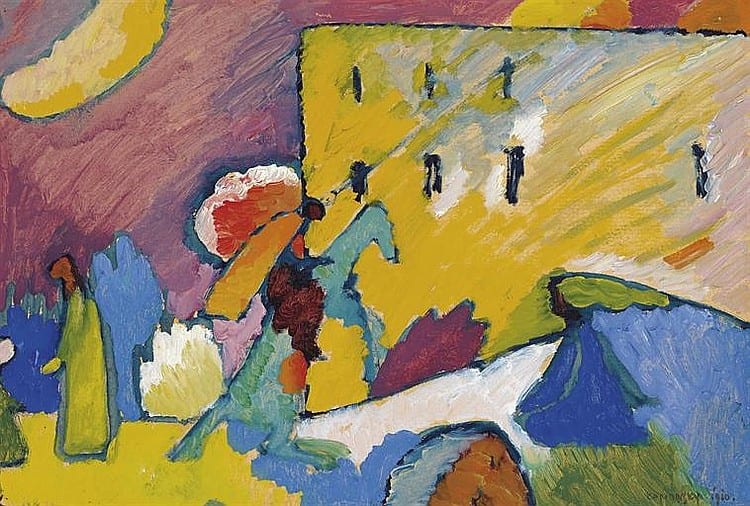
wassily kandinsky 1866 1944 · Christie's · 2008-11-06 wassily kandinsky 1866 1944 Christie's · 2008-11-06

wassily kandinsky 1866 1944 improvisation mit pferden studie f r improvisation 20 · Christie's · 2017-11-13 wassily kandinsky 1866 1944 improvisation mit pferden studie f r improvisation 20 Christie's · 2017-11-13
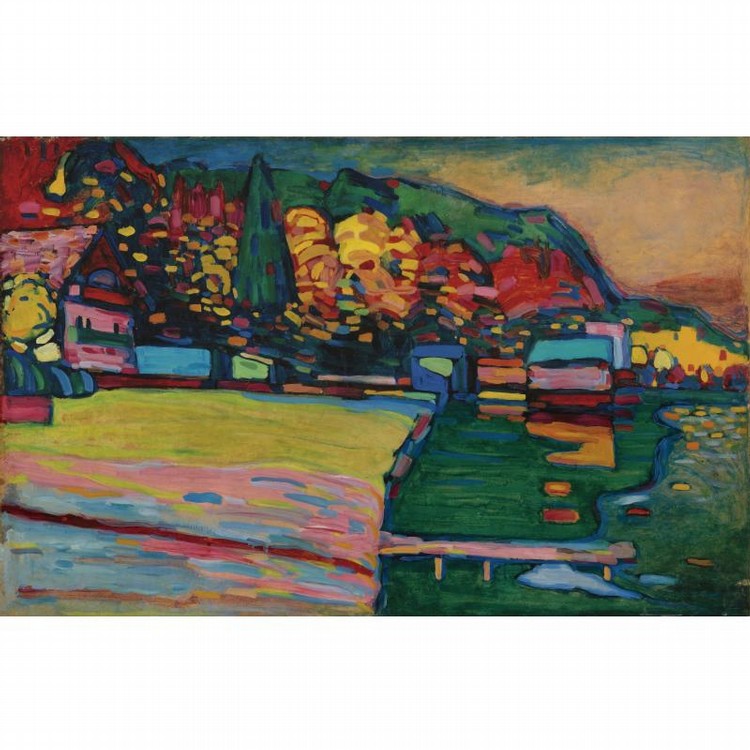
wassily kandinsky · Sotheby's · 2006-11-07 wassily kandinsky Sotheby's · 2006-11-07
Data basis
This page is built from Appraisily's public auction market index. Private transactions, incomplete sale feeds, and attribution changes may not be fully represented.
Artist value FAQ
How much is Wassily Kandinsky worth?
Comparable public auction sales are the best starting point, but final value depends on the specific artwork, condition, size, medium, provenance, and attribution confidence.
Can Appraisily value my Wassily Kandinsky artwork?
Yes. Appraisily can review photos, dimensions, signatures, condition, provenance, and comparable market data to prepare a current valuation.