Dorothea Tanning Auction Prices and Value Guide
Dorothea Tanning auction prices are tracked in Appraisily's artist market index, with source-directory coverage of 401 records. Use this page to review sold-lot activity, market context, and valuation factors before requesting a formal appraisal.
Dorothea Tanning auction prices: quick answer
Dorothea Tanning auction prices depend on medium, size, date, condition, provenance, edition details, attribution confidence, and recent comparable auction sales.
- Artist
- Dorothea Tanning
- Source records
- 401
- Market update
- 2026-02-16
Dorothea Tanning market snapshot
Dorothea Tanning shows deep auction liquidity with 229 tracked lots. Median realized sale is around $3,000. Category concentration is still broad or sparse. Last 12 months recorded 15 sales. Latest recorded sale: 2026-02-05.
Realized price distribution
- Under $1,000 (37.9% · 55 sales)
- $1,000 to $10,000 (33.8% · 49 sales)
- $10,000+ (28.3% · 41 sales)
- Median sale (last 12 months)
- $800
- Sales recorded (last 12 months)
- 15
- Median shift vs prior year
- 0.0%
- Latest recorded sale
- 2026-02-05
Artist context
About Dorothea Tanning
Born
1910
Died
2012
Nationality
American, French
Also known as
Dorothea Ernst, Dorothea Ernst-Tanning
Dorothea Tanning (1910–2012) was an American painter, sculptor, printmaker, and poet who became one of the most distinctive voices of the Surrealist movement. Born to Swedish immigrant parents in Galesburg, Illinois, she was largely self-taught as an artist, pursuing her own vision after brief formal training in Chicago. A transformative visit to MoMA's 1936 exhibition Fantastic Art, Dada, Surrealism redirected her life toward the avant-garde. By the early 1940s she had joined the circle of exiled Surrealists in New York and married the German artist Max Ernst. Over a career spanning seven decades, Tanning moved from meticulously rendered dreamlike figurative paintings to pioneering soft-sculpture installations and later to luminous abstract canvases. She also published poetry and two memoirs. Her work is held by major museums worldwide, including the Museum of Modern Art in New York, Tate in London, and the Centre Pompidou in Paris.
Surrealismoil paintinglithographysculpture (soft sculpture)drawing and works on paperdreamlike interior scenes with female figuresself-portraiture and metamorphosisdomestic and psychological spaces
Common works and media
Tanning's body of work includes finely detailed Surrealist oil paintings of dreamlike interior scenes with intertwined female figures, such as Birthday (1942) and Eine Kleine Nachtmusik (1943). She produced lithographs and works on paper throughout her career. In the 1960s and 1970s she created innovative soft sculptures made from stuffed fabric. Her later period yielded prismatic abstract paintings. Collectors may also encounter costume and set designs from her ballet collaborations, as well as illustrated books and poetry publications.
Market and appraisal context
Dorothea Tanning's works appear at auction in the Post-War and Contemporary Art and Prints and Multiples categories. Her early Surrealist oil paintings from the 1940s, characterized by intricate figurative dreamscapes, are the rarest and most sought-after lots. Prints and lithographs are more frequently available. Appraisal value depends on medium, period, size, provenance, condition, and exhibition history. Recognition of women Surrealists has grown substantially, which has influenced collector interest in recent years. Collectors should verify authenticity and provenance carefully, especially for unsigned prints.
Auction categories and appraisal factors
Appraisal caveats
- Market data in this profile is based on artist identity research and general auction context; specific realized prices should be confirmed against current auction records.
- Tanning's auction market has strengthened in recent years alongside broader recognition of women Surrealists, but remains less established than that of contemporaries such as Leonora Carrington or Remedios Varo.
Evidence
Sources for artist context
This source-grounded artist context passed Appraisily's promotion threshold: high confidence, strong sources.
- The Museum of Modern Art museum or university
- Tate museum or university
- Dorothea Tanning Estate artist estate or foundation
- RKD — Netherlands Institute for Art History library authority
- Wikidata library authority
- VIAF library authority
Recent sale records
Selected public auction records currently in the Appraisily lot index. Use them as market context, then request a formal appraisal before you sell, insure, or donate.
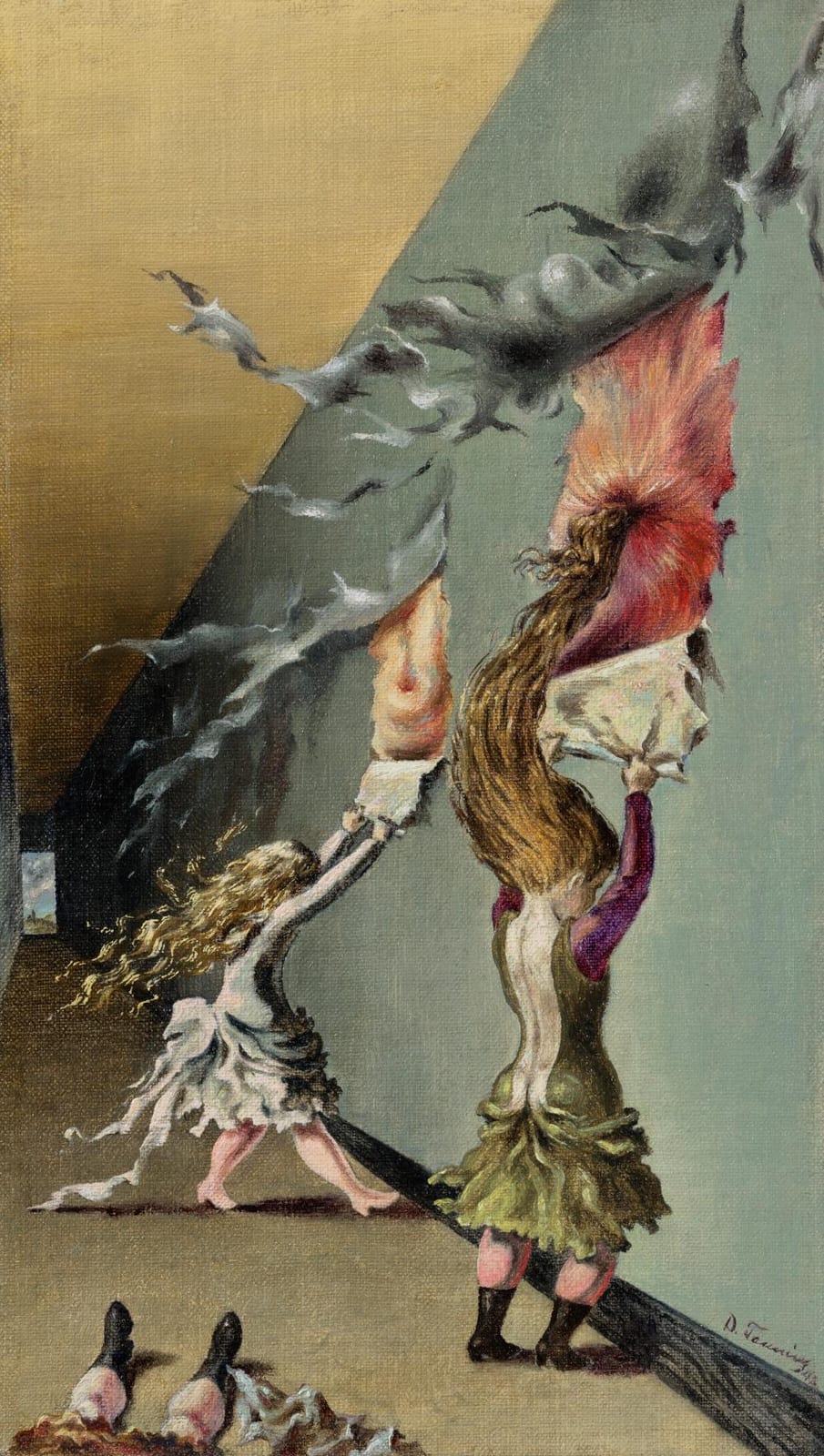
dorothea tanning 1910 2012 children s games oil on canvas9 x 5 5 8 2 · Christie's · 2026-03-05 dorothea tanning 1910 2012 children s games oil on canvas9 x 5 5 8 2 Christie's · 2026-03-05
Data basis
This page is built from Appraisily's public auction market index. Private transactions, incomplete sale feeds, and attribution changes may not be fully represented.
Artist value FAQ
How much is Dorothea Tanning worth?
Comparable public auction sales are the best starting point, but final value depends on the specific artwork, condition, size, medium, provenance, and attribution confidence.
Can Appraisily value my Dorothea Tanning artwork?
Yes. Appraisily can review photos, dimensions, signatures, condition, provenance, and comparable market data to prepare a current valuation.