
When Sterling Silver Needs a Qualified Appraisal for Donation Estate or Insurance: appraisal and value basics
When Sterling Silver Needs a Qualified Appraisal for Donation Estate or Insurance research should start with identification, condition, provenance, and item-specific market evidence. Use this guide to compare the signals that matter before paying for a formal appraisal or deciding whether to sell.
Quick Answer: When Is a Qualified Appraisal Required?
The short answer depends on what you are doing with the silver and what you need it documented for. Three situations commonly drive the need for a qualified, formal appraisal of sterling silver:
- Charitable donation valued at a value that must be established from current, topic-matched sales or more: The IRS requires a written qualified appraisal from a credentialed appraiser to substantiate your deduction (Form 8283, Section B). Donations over a value that must be established from current, topic-matched sales must still be reported on Form 8283, Section A.
- Estate settlement: Executors must establish fair market value (FMV) as of the date of death for all valuable personal property, including sterling silver. A qualified appraisal provides defensible documentation if the IRS questions the estate tax return.
- Insurance scheduling: Most carriers require a recent professional appraisal to add individual sterling silver items to a homeowner's or renter's policy as scheduled personal property. Without one, you risk being underinsured or denied coverage on a claim.
Below, we break down each scenario, explain the IRS thresholds that trigger appraisal requirements, and show you how to identify whether your sterling silver is worth far more than its scrap melt value.
What Makes Sterling Silver Worth More Than Scrap?
Sterling silver is an alloy containing a category-dependent amount pure silver and a category-dependent amount other metals (usually copper for strength). Every piece should carry a hallmark—"STERLING," "925," or a maker's mark—stamped into the base or handle. But the intrinsic silver content is only the starting point.
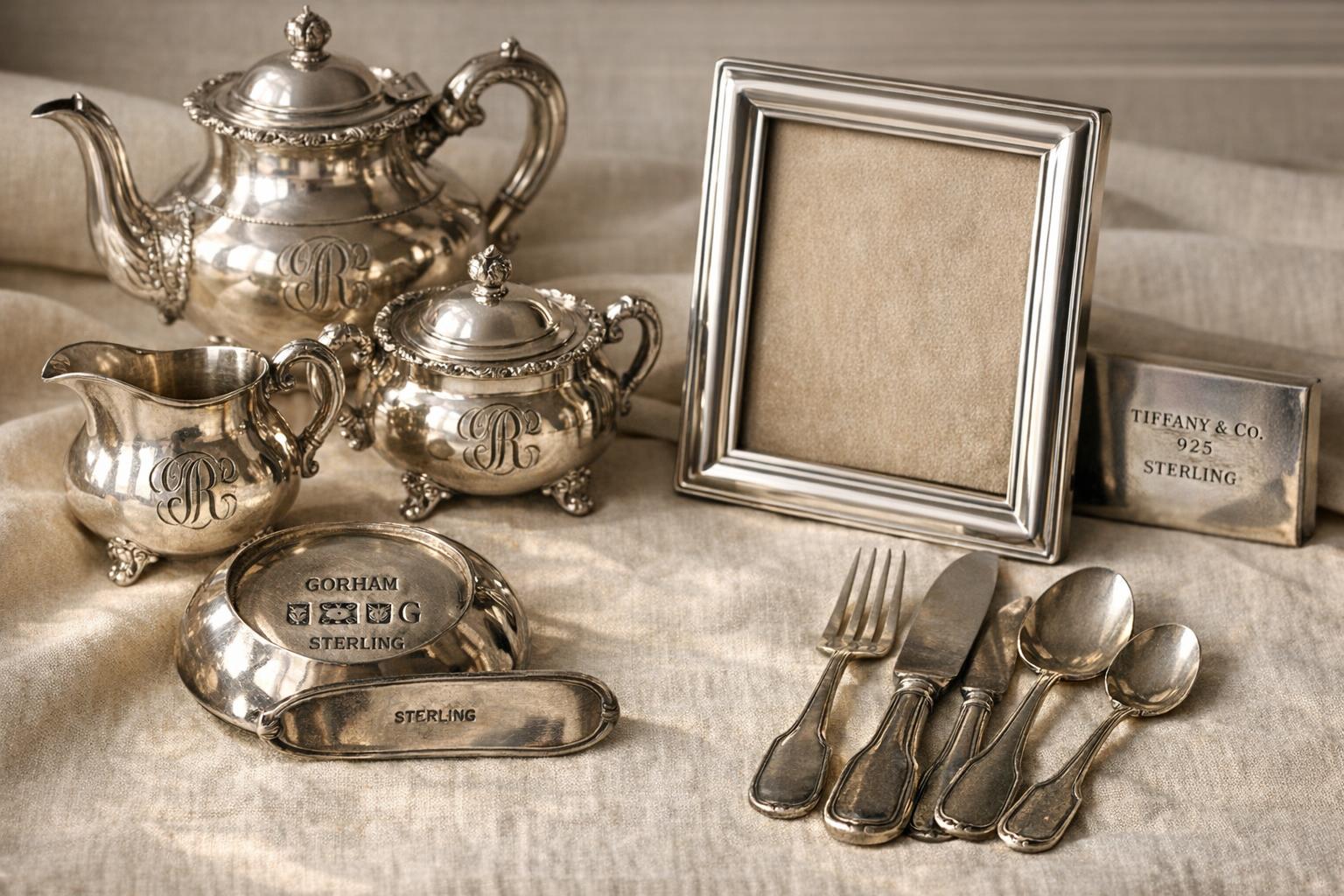
What drives value higher—sometimes dramatically—are maker attribution, pattern rarity, age, condition, and form. A Gorham "Martelé" tea service from the early 1900s can sell for several thousand dollars at auction, while an unmarked scrap spoon fetches only its weight in silver (roughly a value that must be established from current, topic-matched sales at 2025–2026 spot prices). The difference between the two is exactly why the IRS and insurance carriers demand qualified appraisals for significant sterling silver holdings.
Key value drivers include:
- Maker/manufacturer: Gorham, Tiffany & Co., Reed & Barton, Wallace, Christofle, International Silver, and Buckeye are among the most collectible American and European makers.
- Pattern name: Discontinued or limited-run patterns (Gorham "Chantilly," Tiffany "Faneuil," Reed & Barton "Francis I") carry premiums over common stock patterns.
- Form and function: Complete tea and coffee services, centerpieces, candelabra, and hollowware command more than individual flatware pieces.
- Condition and completeness: A full 12-place-setting service in its original chest is worth significantly more than a partial set. Monogramming or removal of decoration can reduce value.
- Historical provenance: Pieces with documented ownership history, exhibition records, or original receipts can achieve auction prices well above catalog estimates.
Sterling Silver Donations: IRS Rules and Appraisal Thresholds
Donating sterling silver to a qualified 501(c)(3) charity—whether a museum, historical society, church, or nonprofit—can generate a meaningful tax deduction. But the IRS has specific documentation requirements that many donors miss.
The Three IRS Donation Thresholds
Under current IRS-style guidance, the requirements generally break down as follows:
| Donation Value | Requirement | Form 8283 Section |
|---|---|---|
| Under a value that must be established from current, topic-matched sales | No appraisal needed; keep receipt and photos | Not required |
| a value that must be established from current, topic-matched sales | Report on Form 8283; appraisal recommended but not legally required to be "qualified" | Section A |
| Over a value that must be established from current, topic-matched sales | Qualified appraisal required from a qualified appraiser; appraiser signs Form 8283, Section B | Section B |
For context, a single complete Gorham sterling silver tea service (teapot, coffee pot, creamer, sugar bowl, and waste bowl) in a sought-after pattern can easily exceed a value that must be established from current, topic-matched sales in fair market value—putting it squarely in the qualified-appraisal zone. Even a large flatware service of 80–120 pieces in a premium pattern can cross the a value that must be established from current, topic-matched sales mark.
Fair Market Value vs. Melt Value for Donations
The IRS defines fair market value (FMV) as "the price at which property would change hands between a willing buyer and a willing seller, neither being under any compulsion to buy or sell and both having reasonable knowledge of relevant facts." For sterling silver, this means what a collector or dealer would pay at auction or retail—not what a scrap buyer would offer for the silver content.
As an example, a marked hollowware piece might yield a value that must be established from current, topic-matched sales as scrap based on weight and spot pricing. In strong collector-grade condition, similar pieces can command much higher amounts depending on hallmarks, maker, and condition. A qualified appraisal helps you document a defensible market value.
What the Receiving Organization Needs
For donations above the higher-value reporting band, the charity must acknowledge receipt on Form 8283, Part IV (Donee Acknowledgment). The organization does not need to agree with your appraised value, but it must confirm it received the items described. Keep the following in your donation file:
- The qualified appraisal report (signed and dated by a qualified appraiser)
- Completed Form 8283, Sections A and B as applicable
- Donee acknowledgment signed by an authorized representative of the charity
- Photographs of the donated items showing condition, hallmarks, and any damage
- A written description of the items (maker, pattern, approximate date, condition)
Two-step intake
Get an expert appraisal for your sterling silver
Share the basics and we’ll route you to the right specialist with a written quote and next steps.
Secure intake. Routed to the right specialist. Checkout only if you decide to proceed.
Estate Settlements: Valuing Sterling Silver After Death
When someone dies, the executor of their estate must determine the fair market value of all assets as of the date of death. This includes every piece of sterling silver—from a single monogrammed cup to a full dining service. The stakes are high: undervaluing assets can trigger IRS penalties; overvaluing them inflates the estate tax burden unnecessarily.
Why Date-of-Value Matters
Unlike a donation appraisal (which values items as of the donation date) or an insurance appraisal (which reflects current replacement cost), an estate appraisal must establish value as of the decedent's date of death. This retrospective valuation requires the appraiser to research market evidence and market conditions from that specific point in time—a skill that generic online calculators cannot replicate.
Publication 561 and estate filing practice generally require a defensible FMV for valuable personal property. While there is no single hard threshold, the practical standard is whether the value would affect the estate's tax profile or the equitable distribution among beneficiaries. Sterling silver collections with services, hollowware, or named-pattern pieces often meet that bar.
Step-Up in Basis and Capital Gains
Heirs receive a step-up in cost basis to the FMV at the date of death. If the estate values a sterling silver collection at a value that must be established from current, topic-matched sales and the heir later sells it for a value that must be established from current, topic-matched sales the taxable gain is only a value that must be established from current, topic-matched sales. Without a qualified appraisal documenting the a value that must be established from current, topic-matched sales figure, the heir may have no defensible basis and could owe capital gains on the full sale amount. This alone makes the cost of an appraisal a worthwhile investment for any nontrivial sterling silver holding.
Practical Steps for Executors
- Inventory everything: Photograph each piece, noting hallmarks, maker marks, pattern names, and condition issues.
- Do not clean or polish: Cleaning can remove original patina and reduce value. Appraisers prefer to assess items in their current state.
- Hire a qualified personal-property appraiser: Look for ASA (Accredited Senior Appraiser), ISA (Certified Member), or AAA credentials with specific experience in silver and hollowware.
- Request a formal written report: The appraisal should state the purpose (estate settlement), the valuation standard (FMV), the effective date (date of death), and the methodology used.
- Retain the report with estate records: The IRS has three years from the filing date to audit an estate tax return; keep the appraisal for at least that period.
Insurance Scheduling: Protecting Your Sterling Silver
Standard homeowner's and renter's insurance policies include limited sub-limits for certain categories of personal property—"jewelry, watches, furs, precious or semi-precious stones" and often "silverware, goldware, and pewterware" are capped at a market-dependent range total, regardless of your overall policy limit. If you own a sterling silver service worth a value that must be established from current, topic-matched sales a standard policy will not cover the full loss.
Scheduled Personal Property Endorsement
To fully cover valuable sterling silver, you add a scheduled personal property endorsement (also called a "rider" or "floater") to your homeowner's or renter's policy. This endorsement:
- Covers individual items at their appraised value with no deductible
- Protects against "all risks" (not just the named perils in the base policy)
- Requires a current qualified appraisal (typically within the last 3–5 years) for each scheduled item
Replacement Value vs. Fair Market Value
Insurance appraisals typically use replacement value—what it would cost to purchase a comparable item at retail today—rather than FMV (what you could sell it for). For sterling silver, replacement value is often a category-dependent amount to a category-dependent amount higher than FMV because retail markups, dealer availability, and pattern discontinuation all drive up the cost of finding an equivalent piece.
For example, a 12-place-setting flatware service might have a lower FMV than its replacement cost if you need to source every piece today. Insurance carriers often use replacement framing so the scheduled coverage can respond to a real replacement need.
How to Identify Real Sterling Silver at Home
Before you commission an appraisal, it helps to know what you actually have. Not every silver-colored item is sterling—and not every sterling piece is valuable. Here is a practical identification workflow:
Step 1: Check for Hallmarks
Turn the piece over and look for stamps on the underside, back, or handle base:
- "STERLING" — the most common American hallmark, used from the mid-1860s onward
- "925" — international standard for a category-dependent amount silver content
- Lion passant — British hallmark indicating sterling standard (used since 1300)
- Maker's mark — Gorham (anchor), Tiffany & Co., Reed & Barton (crossed anchors), Wallace, International Silver, Christofle
- Pattern name — some pieces include the pattern name stamped on the back
Step 2: The Magnet Test
Silver is not magnetic. If a magnet sticks strongly to the piece, it is either silver-plated base metal or stainless steel (which some flatware makers use). Note that some sterling pieces have stainless steel knife blades—this is normal and does not disqualify the piece.
Step 3: Weight and Sound
Sterling silver is denser than most base metals used in plating. A genuine sterling piece feels noticeably heavy for its size. When gently tapped with a fingernail or coin, sterling produces a clear, bell-like ring that lasts 1–2 seconds; plated metal sounds duller and shorter.
What Is Not Sterling
Common lookalikes that are not sterling silver:
- Silver plate (EPNS, EP, A1, AA): Electroplated nickel silver—only a thin silver coating over base metal
- "German silver" or "nickel silver": A copper-nickel-zinc alloy with no actual silver content
- "Coin silver": An American standard of a category-dependent amount silver (used before the 1860s); valuable but technically below the sterling threshold
- Britannia silver: A British standard of a category-dependent amount silver (marked with Britannia figure); higher purity than sterling
Decision Tree: Do You Need a Qualified Appraisal?
Use the flowchart below to quickly determine whether your sterling silver collection warrants a qualified professional appraisal based on your specific situation.
Choosing a Qualified Appraiser for Sterling Silver
Not every appraiser is qualified to value sterling silver. In higher-value donation contexts, qualified-appraiser standards are stricter, and even for non-IRS purposes you want someone with proven silver expertise and documented methodology.
IRS Requirements for a Qualified Appraiser
When a high-value, tax-relevant appraisal is needed, the appraiser should:
- Hold an appraisal designation from a recognized professional organization (ASA, ISA, AAA) for the specific property type (personal property → metals/silver)
- Demonstrate verifiable education and experience in valuing personal property of the same type
- Be regularly engaged in the business of providing appraisal services
- Not be the donor, the donee (charity), a party to the transaction, or related to any of these parties
- Comply with the Uniform Standards of Professional Appraisal Practice (USPAP)
What Does an Appraisal Cost?
Sterling silver appraisal fees typically range from a market-dependent range depending on the size of the collection, the level of detail required, and the appraiser's credentials. Most appraisers charge by the hour (a market-dependent hourly rate) or a flat fee per item or group. Reputable appraisers never charge a share of the appraised value—that creates a conflict of interest and is prohibited by USPAP and IRS regulations.
What to Expect During the Appraisal
A competent sterling silver appraisal includes:
- Physical examination of each piece, including hallmark verification, weight, dimensions, condition assessment, and photographic documentation
- Maker and pattern identification using reference works such as the Gorham pattern guides, Tiffany & Co. archives, and the International Silver Company records
- Market research comparing recent auction results, dealer listings, and retail prices for comparable items
- A written report stating the purpose of the appraisal, the type of value (FMV or replacement), the effective date, methodology, and the appraiser's qualifications and signature
Recent Market Activity: Why Timing Matters
The sterling silver market is active and prices shift. At the Richard Winterton Auctioneers' 42nd Annual Auction in March 2026, sterling silver lots drew strong bidder participation across tea services, flatware, and decorative hollowware. Foss Appraisal Service's February 2026 estate auction featured Christofle sterling silver pieces that closed above pre-sale estimates, underscoring sustained collector demand for European silver makers.
With current silver pricing, even scrap sterling has meaningful baseline value. But the gap between melt and collectible value remains wide: a marked and complete sterling piece can trade far above raw silver value when maker attribution and condition support demand. This is why appraisal context matters for donation, estate, and insurance scenarios.
Market examples from Appraisily market evidence
Recent internal valuation samples for this topic include:
- Bargain Hunt Auctions: an Antique Swiss sterling 935 watch lot closed at AUD 1,000.
- Leonard Joel and Leski Auctions lot sales (AUD 260 and AUD 360) highlighted how size, completeness, and condition reduce or lift outcomes.
- Additional sterling entries (for example, Tiffany bracelets and flatware groups) reinforced that similar metals can vary widely by maker, pattern, and lot composition.
In public reporting, we also reviewed a 1749 London sterling silver lidded tankard case from our platform, where hallmarks, provenance cues, and condition were key to positioning value.
Common Mistakes to Avoid
- Donating without appropriate support: Inadequate paperwork can lead to challenged deductions and potential delay in the charitable deduction process.
- Cleaning sterling before appraisal: Polishing removes patina and can erase soft hallmark details. Leave pieces in their current state for the appraiser to assess.
- Using an online price guide as the sole valuation: Published price guides are starting points, not appraisals. They do not account for condition, provenance, or local market conditions.
- Assuming all silver-colored items are sterling: Silver plate, nickel silver, and stainless steel flatware are common. Always verify hallmarks before claiming value.
- Letting insurance appraisals expire: Most carriers require appraisals to be no more than 3–5 years old. Replacement costs change with inflation, pattern availability, and dealer pricing.
- Mixing scrap weight with collectible value: Scrap buyers pay for silver content only. A qualified appraisal also reflects maker, pattern, condition, completeness, and market demand.
Search Variations Collectors Ask
Readers often Google these questions. Each one is addressed in the guide above:
- When does the IRS require a qualified appraisal for donated silver?
- How much is my sterling silver flatware set worth?
- Do I need an appraisal to insure antique silver on my homeowner's policy?
- How to value sterling silver for estate tax purposes?
- What is the difference between FMV and replacement value for silver?
- How to identify real sterling silver from silver plate?
- What does a qualified silver appraisal cost?
- Form 8283 sterling silver donation requirements 2026
Each question is answered in the valuation guide above. If your situation is more complex, our intake form can connect you with a specialist.