What is Value in Art?
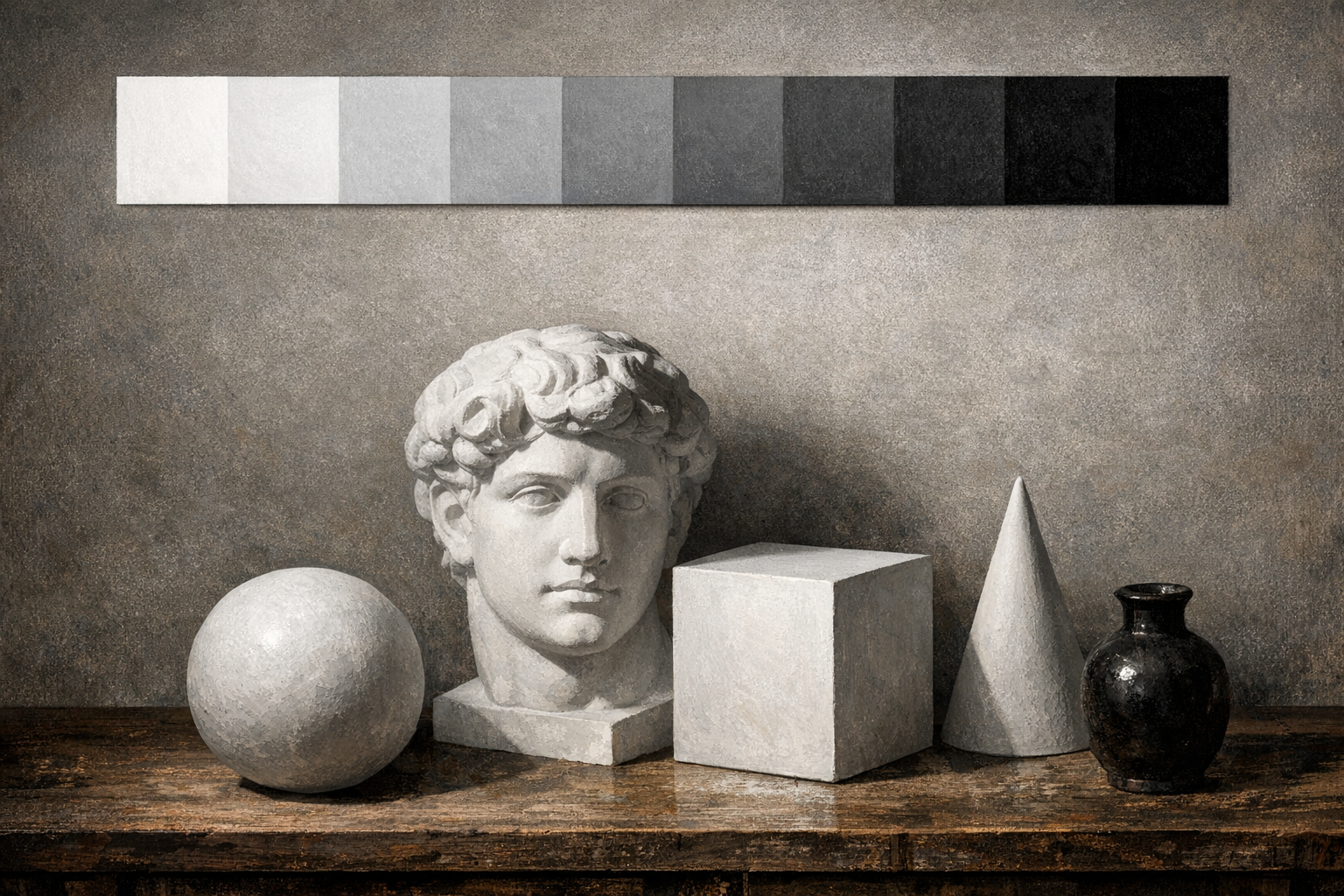
When artists talk about value, they’re referring to how light or dark a particular area appears. Value exists independently of color—even colorful paintings have underlying value structures that can be seen when converted to black and white. Value is one of the seven essential elements of art, alongside line, shape, form, space, texture, and color.
Value creates the illusion of three-dimensionality on a flat surface and guides the viewer’s eye through a composition. It’s also responsible for creating mood, atmosphere, and dramatic effects in artwork.
Key Value Concepts
According to the Cascadia Art Museum, “Value is the lightness or darkness of a color, and it adds dimension in a piece.” This simple but powerful concept is the foundation upon which artists create visual depth and realism in their work.
The Value Scale in Art
Most value scales include anywhere from 9 to 11 distinct values, though some more detailed scales may include more. The middle value on the scale is referred to as “middle gray” or “mid-tone.” Values lighter than middle gray are considered “high values,” while those darker are “low values.”
Understanding the value scale is crucial for artists because it allows them to:
- Analyze how light interacts with objects
- Create proper shading and highlights
- Establish focal points through value contrast
- Maintain consistency throughout a composition
As noted by The Virtual Instructor, “Since we see objects and understand objects because of how light interacts with them, we use value in art to create the illusion of light.”
Historical Use of Value in Art
- 15th Century
Renaissance Chiaroscuro
Artists like Leonardo da Vinci pioneered the use of strong value contrasts (chiaroscuro) to create dramatic three-dimensional effects in their paintings.
- 17th Century
Baroque Tenebrism
Caravaggio and followers developed tenebrism, an extreme form of chiaroscuro with intense dark and light values to create theatrical lighting effects.
- 19th Century
Impressionist Light Studies
Impressionists became masters of observing and capturing subtle value shifts to represent changing light conditions in outdoor settings.
- 20th Century
Abstract Value Exploration
Abstract artists used value relationships to create visual impact, emotional response, and compositional structure independent of representational subjects.
How to See and Understand Value
According to Shelby Dillon Studio, “Our eyes see first in light and dark, and see color second. The secret to creating dynamic, wow-worthy artwork is to focus on the value.”
Here are several techniques to help you better observe and understand value:
Value Perception Exercises
Try these activities to improve your ability to see value
- Squint at an image to reduce color information and see value patterns
- Convert color photos to black and white to study value structures
- Create a simple value scale from white to black for reference
- Practice identifying values numerically (on a scale of 1-9)
- Look for value patterns in masterworks of art
The University of Delaware’s Art Foundation program explains that “Values allow us to perceive the three-dimensionality of objects because values correspond to planes of form.” This connection between value and form is what enables artists to create realistic renderings of three-dimensional objects on two-dimensional surfaces.
Value Techniques in Artistic Practice
Value in Drawing
In drawing, artists create value through various mark-making techniques:
- Hatching: Parallel lines placed close together, with denser lines creating darker values
- Cross-hatching: Layered hatching in different directions for more intense values
- Stippling: Using dots of varying density to create value gradations
- Scumbling: Circular scribbling motions that create textured value areas
- Blending: Smoothing transitions between values using tools like blending stumps
As explained in the materials from Hilldale K-12 Schools, “Artists commonly create value scales to help them practice making a full range of values,” which helps them develop technical control over their mark-making.
Value in Painting
In painting, value is manipulated through:
- Tinting: Adding white to lighten a color’s value
- Shading: Adding black or complementary colors to darken a value
- Glazing: Applying transparent layers to modify underlying values
- Scumbling: Applying thin, broken layers of lighter paint over darker areas
- Chiaroscuro: Using strong contrasts between light and dark values
Value-Based Techniques and Their Effects
How different value approaches impact artwork
According to Artists Network, “In painting, value changes can be achieved by adding either black or white to the chosen color.” However, many painters prefer to create value changes by working with the inherent values of different pigments rather than simply adding black or white.
Value vs. Other Art Elements
Value vs. Color
Value and color are closely related but distinct elements. As explained by MasterClass, “Value is one of the elements of art that dictates how light or dark a color appears.” Every color has an inherent value—yellow is naturally lighter than purple, for instance—but artists can manipulate a color’s value by adding white or black.
Understanding the relationship between value and color allows artists to:
- Create harmonious color schemes based on similar values
- Ensure proper contrast even when working with complex color palettes
- Maintain the readability of a composition despite varied hues
- Create atmospheric effects through value manipulation
Value vs. Form and Space
Value is instrumental in creating the illusion of form and space in artwork. Through strategic value placement, artists can:
- Define three-dimensional forms on two-dimensional surfaces
- Create the illusion of depth and distance
- Establish spatial relationships between objects
- Guide the viewer’s eye through compositional space
The New York Times Learning Network notes that “Values are best understood when visualized as a scale or gradient, from dark to light,” which helps artists systematically approach the creation of form through value.
The Cultural and Philosophical Value of Art
The Internet Encyclopedia of Philosophy defines artistic value as “something had by all and only artworks as a measure of how good (or bad) they are.” This broader concept of value encompasses aesthetic, cultural, personal, and financial dimensions.
According to the Peninsula Arts Society, “Art can uplift, provoke, soothe, entertain and educate us and is an important part of our lives. At its most profound level, it takes us from the everyday to a place of introspection and contemplation, to see the bigger picture of the human condition.”
Artland Magazine highlights the social dimension of art’s value: “Art indeed is a means of communication, as it passes ideas, values, feelings from one person to another.” This communicative function gives art its enduring cultural significance.
External Resources on Value in Art
The Elements of Art - 'Value'
Comprehensive explanation of value as an art element with examples and exercises from The Virtual Instructor.
Value in Art Explained
MasterClass guide exploring value techniques across different media and its importance in composition.
Understanding Value and Tone for Better Painting
Artists Network's practical guide to implementing value in painting with techniques for improvement.
Analyzing the Elements of Art: Four Ways to Think About Value
New York Times Learning Network's educational resource with four approaches to analyzing value in artwork.
Value in Art Examples
Artsper's exploration of value in contemporary art with numerous visual examples.
What Is Value in Art and Why Is It So Important?
Draw Paint Academy's comprehensive analysis of value's critical role in effective artwork.
Common Questions About Value in Art
What is value or tone in art?
How do we see value in artwork?
What is the purpose and value of art in society?
How do artists manipulate value in their work?
What is a value scale in art?
How does value create depth in an artwork?
What is the difference between high-key and low-key value schemes?
How does value relate to color in artwork?
Understanding value in art provides a foundation for creating and appreciating visual work across all mediums. Whether you’re an artist looking to improve your technical skills or an art enthusiast wanting to deepen your appreciation, recognizing how value functions is essential to comprehending the visual language of art. Value not only helps create the illusion of three-dimensional form and space but also contributes significantly to the mood, atmosphere, and emotional impact of artistic works.
By mastering the principles of value—from technical application to conceptual understanding—artists can create more compelling visual experiences that effectively communicate their vision to viewers. For art appreciators, recognizing value relationships enhances the ability to analyze and interpret artwork on a deeper level, beyond surface-level subject matter.
Value truly stands as a fundamental building block of visual expression, bridging the gap between what we see in the world and how we represent it through art.
Choose your next step
Use the path that matches the decision you need to make about the item.
Need a signed report?
Use this for insurance, estate, donation, resale, or documented value decisions.
Start a signed reportNot sure it is worth appraising?
Start with a lower-friction screen to understand the likely category, evidence, and next step.
Use the free screenerNeed local or specialist help?
Compare directory options when the work needs in-person review or a specialist near you.
Find art appraisersSee what the report looks like
Sample reports show how photos, comparable evidence, condition notes, and a value conclusion are documented.
Get artwork reviewed
Upload photos of the artwork, close-ups, signature, back, medium, dimensions, and condition issues.
- Expert report with photos and market context
- Fast turnaround
- Fixed, upfront pricing
No obligation. Secure upload.
Continue your valuation journey
Choose the next best step after reading this guide
Our directories connect thousands of readers with the right appraiser every month. Pick the experience that fits your item.
Antique specialists
Browse the Antique Appraiser Directory
Search 300+ vetted experts by location, specialty, and response time. Perfect for heirlooms, Americana, and estate items.
Modern & fine art
Browse the Art Appraisers Directory
Compare fine art, contemporary, and design appraisers by city and specialty in our public directory.
Machine-readable summaries
Use these machine-friendly references for AI and crawler discovery of Appraisily content.
Ready for pricing guidance?
Start a secure online appraisal
Upload images and details. Certified specialists respond within 24 hours.
Start art appraisal