Value of old Disney VHS: appraisal guide and resale reality
Learn what makes old Disney VHS valuable, how to document condition, and what next step to take for realistic pricing.
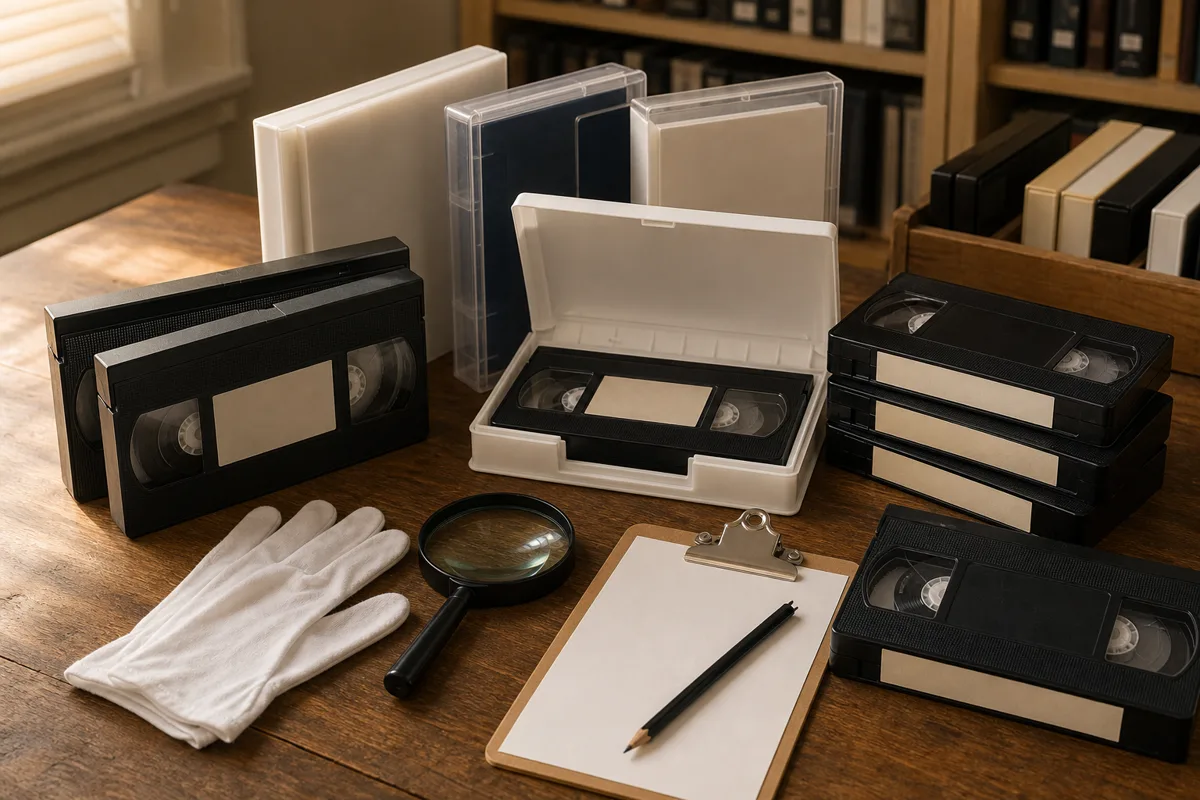
Generated editorial illustration of generic vintage VHS media; it does not depict a Disney edition and is not evidence of authenticity or value.
By Appraisily TeamReviewed by Appraisily Valuation TeamEditorial policy
This guide does not publish a numeric price range because the current evidence does not include enough clean, directly matched sales for this broad topic. A free first look can help identify the title, edition, packaging, and condition details needed for a narrower comparison; it is not a signed appraisal. For our sourcing and update standards, see Editorial policy.
Short answer: why there is no honest single price here
A broad Disney VHS label is not enough to support a defensible number; title, edition, packaging, completeness, and condition must match the sale evidence.
Quick view: this page intentionally does not give a numeric range. The current evidence is too broad to treat as like-for-like sales, and repeating asking prices or anecdotes would create false precision.
Use the guide to document the exact tape, edition, packaging, inserts, seals, and condition. That evidence is what a free first look can organize before you decide whether a written appraisal or a narrower completed-sale search is warranted.
Move in three evidence steps: identify the exact edition, document condition and completeness, then compare only directly matched completed sales.
Base lot: used, incomplete, or low-visibility pieces usually trade lowest because uncertainty increases buyer discounting.
Collector-leaning lot: complete packaging, intact inserts, and recognized edition cues can raise confidence and interest quickly.
High-confidence lot: sealed or very well documented examples may attract stronger buyer interest when title, provenance, and condition are all strong.
Start with a free estimate when you are unsure; it is the least risky way to test how your data holds up.
3 fast steps before you talk price
Identify the exact item profile: title, tape count, packaging type, and edition markers.
Document the asset: front/back box, spine, barcode/lot text, inserts, and tape body wear.
Match like-for-like comps: compare only records that share title family and condition band.
If any step is weak, stay conservative until proof is added.
How this guide uses evidence
This article uses two evidence layers:
Layer 1: title-family, edition, condition, and completeness checks.
Layer 2: public market signals for context, treated as broad background only.
When signals disagree, defer to object-specific evidence and avoid expanding price language beyond what the available records support.
How we research valuation data
We ground the identification and valuation guidance in documented object traits, broad market context, and expert review workflows. The page can be revised as more verified comps and case outcomes become available. Appraisily provides both the free first look and the optional paid written appraisal described in this guide.
The value drivers you can verify before pricing
Use this checklist to separate useful signals from noise.
Signal
What it proves
Typical value effect
Factory seal or original shrink
Lower handling risk and usually faster buyer confidence.
Often lifts early interest and narrows valuation uncertainty.
Edition marker (for example Black Diamond)
Shows rarity pattern and search behavior.
Can improve buyer positioning when the lot is otherwise complete.
Complete clamshell + insert set
Improves comparability between lots.
Supports stronger comparisons and cleaner offer language.
Condition markers (wear, split seams, repairs)
Shows likely handling history and replacement risk.
Directly impacts what buyers discount before asking.
Photo set quality
Lets readers validate title family and condition claims.
Improves reliability of any free estimate or paid appraisal outcome.
Auction proof context
We avoid single-lot hype and compare like-for-like examples.
Comps are the proof step in this guide, but the current search does not contain enough directly matched auction records to publish a defensible price range. Narrow the title family, edition, condition, and completeness before treating any broader market result as comparable.
Note: We couldn’t find enough auction records that directly match old Disney VHS tapes to publish a defensible price table. If you are valuing a specific item, include its title, edition, packaging, photos, and condition so the search can be narrowed.
Current comparable-sale evidence
The current auction search does not contain at least three clean, directly matched sales for Disney VHS tapes yet. If you’re valuing a specific tape, use the free estimate flow so the search can be narrowed by title, edition, packaging, photos, and condition.
No relevant auction comps found for this topic right now.
When directly matched auction records are available, their sources and reported prices will be disclosed here. Learn more in our editorial policy.
How buyers compare old Disney VHS in 2026
Start with lot quality, then compare by channel and documentation strength.
A helpful mental model is to think in three lanes:
General lane: incomplete or unclear item description with mixed market signal.
Collector lane: intact packaging, clear title/edition data, and strong photos.
Specialty lane: very complete sets or high-identity variants that hold buyer attention for longer.
Practical rule: when broad public discussions conflict with directly matched completed sales, rely on the matched sales and verify that title, edition, completeness, and condition align.
How to identify what you actually own
A lot is easier to value when the lot identity is explicit in one place.
Capture these four fields first. Missing fields usually lower confidence more than the item title itself:
Exact title and release lineage: include title spelling, release era, and if part of a bundle.
Label language: region, distributor, and any edition cue on the sleeve or tray.
Condition chronology: visible wear, repair marks, and any storage indication.
If your notes and photos do not tell a single, consistent story, keep your first ask conservative until that story is built.
For multiple pressings, compare typography, package structure, and whether the lot is sold as a standalone title or a branded collection.
Use this pricing roadmap before public listing
Go from fact to valuation in four layers, then choose your route.
Layer 1 - lot definition: write title, count, and provenance in one sentence.
Layer 2 - evidence: share at least 4 photos: case front, case back, inserts, and tape body.
Layer 3 - benchmark: find 3 to 4 directly matched completed sales, then discard records that differ on title, edition, completeness, or condition.
Layer 4 - route: choose channel and confidence band; only then set a final listing framework.
If any layer is incomplete, you usually gain more by adding one proof item than by raising your ask.
In practice, this means a partial lot in poor condition should start in a lower confidence band, while complete documented sets can be tested in a collector-focused lane first.
Run a practical valuation check before escalation
Use this model to avoid anchoring on a single headline claim.
Most overpricing errors start with the number, then search for proof to defend it. Flip the order instead: establish the item facts, find directly matched completed sales, then set an item-specific range only when the evidence supports one.
Three valuation scenarios
Scenario one: partial, open, mixed-condition lot. Prioritize a clear what is included note and avoid a numeric range until matched evidence exists.
Scenario two: mostly complete set with readable inserts. An item-specific range may be possible when metadata, images, and directly matched sales are complete.
Scenario three: sealed or near-sealed set. Still validate variant and handling details before lifting your ask.
Common owner errors
Frequent mistakes come from treating forum stories as direct precedent, using incomplete metadata, and pricing before completion photos are ready. Each mistake is usually fixed by adding evidence first and testing again.
Correction loop:
Record missing metadata.
Collect 3 to 4 closest comps from the same condition band.
Run a conservative free estimate route.
Lift only when documented details improve materially.
Authentication and context before price talk
Separate identity, completeness, and handling history before a final value decision.
For old Disney VHS, documentation quality commonly matters more than enthusiasm. Buyers convert slower on vague claims and faster on a complete evidence chain.
What "what it is" should include
Edition and production signal: exact title spelling, label era, and any set name.
Packaging archetype: clamshell generation, tray layout, and retained insert cards.
Lot structure: single tape, partial sequence, or full set. This is often the first sorting filter for comparability.
What "how complete" changes
Case integrity: intact shell and readable spine text usually reduce skepticism.
Insert set: catalogs and cards usually carry the strongest historical clues.
Photo sequence: multiple angles reduce the claim-to-asset gap.
A lot with a clear provenance statement and strong imagery usually moves faster than one with only title recognition.
What "what happened to it" reveals
Storage history: stable indoor handling generally supports higher confidence.
Handling signs: seam wear or clip repairs are useful indicators of use history, not automatic rejection.
Image cadence: condition photos from both sides and close details materially improve assessment quality.
If your supporting evidence is thin, start with a lower estimate band and upgrade only once your proof profile is complete.
Where to sell old Disney VHS and when
Match your channel to the level of proof you can currently support.
Not every channel rewards the same signals equally. A listing route that fits your proof level will reduce discount pressure and decision fatigue.
Collector-facing channels
These reward strong packaging, complete metadata, and clean storytelling. They usually work better once proof is strong enough to prove rarity and condition.
Best fit: complete lots with clear edition details.
General marketplace channels
Higher volume and faster turnover, but usually larger risk adjustments. Use conservative wording, and define exactly what is not included.
Best fit: mixed-condition lots where speed matters.
Specialist-led review path
Use when documentation is incomplete, or when your outcome depends on precision for insurance, estate, or estate-like use cases.
Best fit: collections, high-complexity provenance, or disputed claims.
Low-friction sequence before committing to a list
Draft a neutral lot note in one line.
Upload 4 to 8 photos covering shell, inserts, front, and back.
Review the free first look, then use its identification details to search for directly matched completed sales.
Pick a channel and set one conservative starting band.
Refine only when your evidence expands and your responses stay positive.
When in doubt, begin with the free estimate path. Move to a signed review when your evidence supports a precise written valuation decision.
Most practical next steps
Choose the right action path based on what you know today.
1) Start with free estimate
If you are unsure, start with the free first look to organize the title, edition, packaging, and condition details needed for a narrower completed-sale search.
2) Upgrade to full appraisal when needed
Use the full appraisal path for signed reports, insurance needs, estate planning, or larger lots.
3) Sell when evidence is complete
Only list once photos, details, and condition notes are complete and you have directly matched completed-sale evidence for similar copies.
Common questions, answered clearly
Are most old Disney VHS tapes worth anything?
Some interest collectors, but value depends on the exact title, edition, completeness, and condition. Common used copies often draw limited buyer interest, so keep expectations grounded until directly matched completed sales support a number.
Which Disney VHS editions tend to move better?
Collectors generally focus on known limited variants, complete sealed examples, and items with strong package integrity. The historical “Black Diamond” family is still one of the highest-signal editions, but it is not a blanket premium on every copy.
What role does condition play?
Condition is usually the biggest multiplier. Seal status, shell cracks, cover wear, tape body condition, and insert completeness are among the first filters buyers apply before even checking brand.
Can I sell old VHS without paying to appraise first?
You can. For many small lots this is reasonable, but free first reads reduce costly mistakes by helping you avoid overpricing, underpricing, or misrepresenting item condition.
Is a factory-sealed copy always better?
Factory-sealed copies generally offer a stronger proof position because they are assumed less handled, but buyers still check exact title, variant, and evidence of storage health. Seal is one filter, not the only one.
Should I pay for a paid signed report?
Use paid reports for high-intent cases: larger collections, insurance/estate context, or uncertain authenticity and provenance. For simple, low-value lots, a free estimate often provides enough confidence for initial listing decisions.
Conclusion: value is real when evidence is complete
For old Disney VHS, most owners should expect realistic outcomes first and exceptional outcomes second. The market does reward rarity and preservation, but it discounts poor documentation and poor condition quickly. The safest path is to build a complete evidence packet—title, edition clues, condition photos, and provenance notes—before deciding whether to keep, sell, or request a signed appraisal.
When you are ready, use the free estimate path first, then decide whether a full signed report makes sense for your exact stack and goals.
Choose your next step
Use the path that matches the decision you need to make about the item.
Need a paid appraiser review?
Best for insurance, donation, formal documentation, or when sale strategy needs stronger certainty.