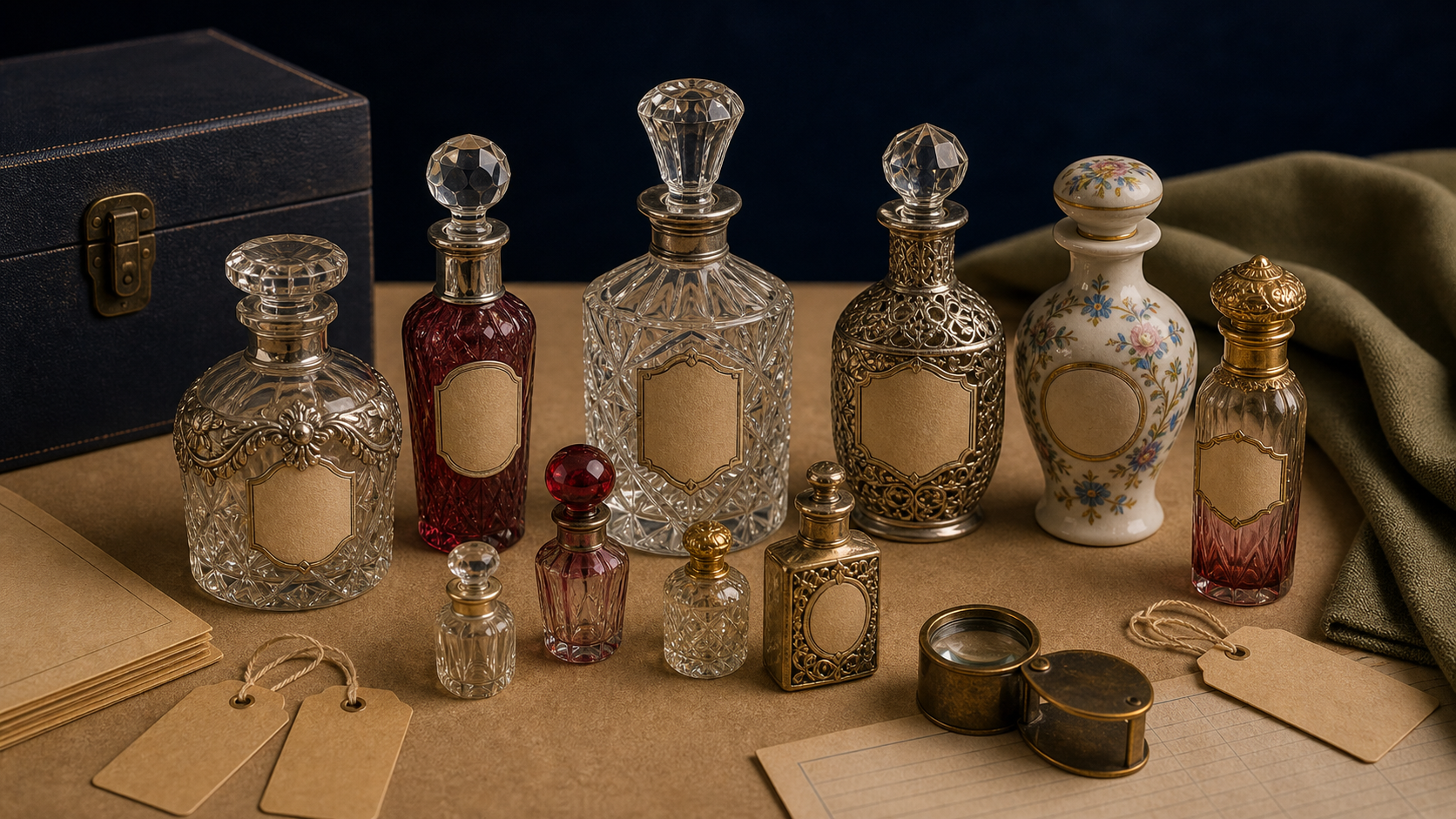
Unlocking the Secrets to the Value of Antique Perfume Bottles a Collectors Guide: appraisal and value basics
Unlocking the Secrets to the Value of Antique Perfume Bottles a Collectors Guide research should start with identification, condition, provenance, and item-specific market evidence. Use this guide to compare the signals that matter before paying for a formal appraisal or deciding whether to sell.
Antique perfume bottles value checklist
Antique perfume bottles compress jewelry, sculpture, and industrial design into an object that fits in the hand. For appraisers and collectors, their value hinges on maker, material, period style, authenticity, and condition—plus the ever-shifting market for decorative arts. This guide distills what matters, how to identify quality quickly, and where common pitfalls lie.
What Makes An Antique Perfume Bottle Valuable
Several factors consistently drive value:
- Maker and attribution: Bottles by R. Lalique, Baccarat, Tiffany & Co., Steuben, Daum, Saint-Louis, and high-style Bohemian/Czech designers (e.g., Karl Palda, Heinrich Hoffmann, Curt Schlevogt’s “Ingrid”) command premiums. For mounted pieces, look for high-grade silversmiths (Alvin, Gorham), or goldsmiths.
- Design and artistry: Strong Art Nouveau reliefs, crisp Art Deco geometry, cameo glass, intaglio figural stoppers, guilloché enamel, and fine wheel-cut rock crystal elevate desirability.
- Period and style: Georgian/Regency and Victorian lay-down or double-ended scent bottles, Art Nouveau (c. 1895–1914), and Art Deco (c. 1920s–30s) are sweet spots. Mid-century designer collaborations can also be valuable, but more selective.
- Materials and technique: Rock crystal (clear quartz), heavy lead crystal, cameo glass, rich enameling, silver/gold overlays or mounts, and pate-de-verre show cost and skill. Pressed glass can be collectible when paired with exceptional design (e.g., Hoffmann/Schlevogt), but generally trails blown and cut work.
- Completeness and originality: A correct, matching ground-glass stopper with intact dauber, original atomizer hardware and bulb, paper labels, presentation boxes, stands, and ribbons all add value. Mismatched or replaced parts reduce it.
- Condition: Chips at the lip, bruises to facets, internal “sickness” (blooming/cloudiness), or worn enamels can halve value. Atomizer metal loss and perished bulbs are common; sympathetic replacements are acceptable but should be disclosed.
- Rarity and scale: Uncommon models, early commercial collaborations, prototypes, and large exhibition or luxury dresser bottles bring premiums. Oversized store-display “factices” are exceptions—impressive but usually lower in value.
- Provenance and documentation: Catalog references, old price tags from noteworthy retailers, or provenance to a named collection can solidify value and ease authentication.
Periods, Makers, and Materials To Know
A quick chronology with names to anchor your attributions:
Georgian to Victorian (c. 1780–1900)
- Forms: Lay-down scent bottles, chatelaine flasks, double-ended bottles (two scents), often with gold or silver mounts.
- Materials: Cut crystal, agate and hardstone, rock crystal, enamel, micromosaic panels.
- Makers: English houses like Thomas Webb; Continental gold- and silversmiths (hallmarks matter).
- Market: Quality gold-mounted or finely cut examples are strongest.
Art Nouveau (c. 1895–1914)
- Forms: Organic forms, nymphs, flora, sinuous lines.
- Makers: R. Lalique (the benchmark), Daum, Gallé, Loetz (mounted), Moser; French perfumers (Coty, Guerlain) commissioning bottles.
- Techniques: Molded and wheel-finished glass, acid etch, relief decoration, pâte-de-verre.
Art Deco (c. 1920s–30s)
- Forms: Geometric silhouettes, dramatic stoppers, black enamel accents.
- Makers: R. Lalique, Baccarat, Saint-Louis; Bohemian/Czech designers Karl Palda (bold enamel), Heinrich Hoffmann (butterfly mark; intaglio stoppers), Schlevogt’s “Ingrid” line (colored pressed glass); American DeVilbiss atomizers (often on Czech or U.S. glass).
- Techniques: Heavy crystal, intaglio cutting, polished edges, enamel banding, chrome or gilded atomizer fittings.
Mid-century (c. 1940s–60s)
- Forms: Clean-lined crystal, branded commercial flacons.
- Makers: Postwar Lalique (without “R.”), Baccarat and Saint-Louis for perfume houses (Guerlain, Caron, Worth, Lanvin), Steuben and Tiffany for luxury scent bottles.
- Notes: Many commercial bottles are common; limited editions and luxury collaborations perform best.
Key materials and what they imply:
- Rock crystal (quartz): Dense, cold to the touch, exceptional clarity. Top-tier when wheel cut or mounted in precious metals.
- Lead crystal: Bright ring, heft, precise facets. Expect high craftsmanship from Baccarat, Saint-Louis.
- Cameo glass: Contrasting layers carved in relief; rare and valuable.
- Guilloché enamel on silver or gold: Engine-turned metal with translucent enamel; fine workmanship can rival jewelry.
- Silver overlay: Look for “Sterling” or “999/1000 Fine” and maker marks (e.g., Alvin). Crisp overlay edges and original patina indicate quality.
Identification: Marks, Stoppers, and Tells
Marks and signatures
- R. Lalique: Typically “R. Lalique” (molded, etched, or engraved) for pre-1945 pieces. Post-1945 production drops the “R” and reads “Lalique” or “Lalique France.” Be aware that placement and form vary; study known examples.
- Baccarat: Acid-etched circular mark “BACCARAT FRANCE” with carafe/goblets generally appears from the mid-20th century; earlier pieces may have paper labels or etched numerals. Shape numbers sometimes scratched to base or stopper.
- DeVilbiss: Name or patent dates on atomizer hardware; glass bodies may be by U.S. firms or imported Czech/Bohemian.
- Czech/Bohemian: Acid stamps “Czechoslovakia,” molded “Hoffmann” with butterfly emblem, “Ingrid” for Schlevogt. Karl Palda often unmarked; attribution rests on characteristic black geometric enamel and forms.
- Tiffany & Co.: “L.C.T.” or “Favrile” for earlier art glass; “Tiffany & Co.” on metal mounts; quality and color iridescence are strong clues.
- Steuben: “Steuben” engraved, often with polished pontil; Aurene finishes.
- Silver/gold mounts: National hallmarks (lion passant for sterling UK, Minerva head in France, etc.), maker’s marks, and purity marks (Sterling, 925, 950, 999). Match mount dates to stylistic cues.
Stoppers and fit
- Ground joints: Both neck and stopper should be ground and seat smoothly with a precise fit. Many bottles carry matching assembly numbers (tiny etched digits on stopper and neck). Mismatches reduce value.
- Daubers: Slender internal applicator at the end of the stopper—often broken. Complete, intact daubers are a plus.
- Atomizers: Original bulb/cords harden with age. Replacements are acceptable for usability but note them in descriptions.
Construction and wear
- Pressed vs blown: Pressed glass shows mold seams and softer detail at edges; blown/cut pieces display sharper facets, polished pontils, and hand finishing.
- Base wear: Honest, fine wear to the resting ring is a good sign. Freshly polished bases may indicate restoration or attempts to disguise wear or chips.
- Surface treatment: Frosted vs polished interplay is typical for Art Deco; look for crisp transitions. Excessive rounding suggests overpolishing.
Red flags for reproductions
- Overly crisp but shallow detail with uniform, matte frosting and no base wear.
- Modern adhesive residues where mounts meet glass; misfitting stoppers with no numbering.
- Signatures that look laser-etched or in incorrect fonts; “Lalique France” on patterns known only prewar; fantasy colors.
- Hardware with bright modern plating, Phillips screws, or plastic fittings on purported 1920s pieces.
Condition and Completeness: Where Value Is Won or Lost
Common issues and their impact:
- Chips and flakes: Especially at the lip or stopper edge; visible losses materially lower price.
- Bruises and internal fractures: Look for crescents at facet junctions; serious structural issues deter buyers.
- Cloudiness (“sickness”): Perfume acids etch interiors; light haze can sometimes be reduced, but deep bloom is often permanent.
- Enamel loss and gilt wear: Even, honest wear is expected; patchy loss on design motifs is more problematic.
- Atomizer degradation: Perished bulbs/hoses and plating loss are common. A sympathetic, period-appropriate replacement bulb is acceptable but should be disclosed; originality still brings a premium.
- Repairs: Reglued stoppers, ground-down rims, and repolished facets reduce value and should be stated.
- Stuck stoppers: Forcing risks damage. Document the issue; specialists can often release them safely.
Completeness that adds value:
- Original labeled box, fitted case, stand, or outer carton for branded perfumes (Guerlain, Coty, Worth).
- Paper labels on bottle and base; intact ribbons/seals.
- Matching pairs or full vanity/dresser sets.
Note on contents
- Original perfume contents can interest brand collectors, but liquid often stains or clouds glass. Many buyers prefer empty, clean bottles; shipping regulations may also apply. Value is mostly in the bottle, not the juice.
Market Benchmarks: What Real-World Prices Look Like
Prices fluctuate by region and sale venue, but the following ranges provide orientation for intact, authentic examples in good condition:
R. Lalique (pre-1945)
- Common commercial models with desirable stoppers: roughly a value that must be established from current, topic-matched sales
- Scarcer figural or large stoppers (“Bouchon Mûres,” “Deux Figurines,” “Serpents,” etc.): a value that must be established from current, topic-matched sales+
- Original box/labels can add markedly; rare colors or opalescent glass command premiums.
Lalique (post-1945)
- Mid-century and later production: a value that must be established from current, topic-matched sales generally; limited editions higher.
Baccarat and Saint-Louis
- Cut crystal dresser bottles: a value that must be established from current, topic-matched sales
- Perfume-house collaborations or luxury editions: a value that must be established from current, topic-matched sales
- 19th-century rock crystal or ornately gilded examples: a value that must be established from current, topic-matched sales+
Tiffany & Co. and Steuben
- Favrile/Aurene scent bottles and luxury forms: typically a value that must be established from current, topic-matched sales with standout designs higher.
Bohemian/Czech Art Deco
- Karl Palda geometric enamel bottles: a value that must be established from current, topic-matched sales
- Heinrich Hoffmann or Schlevogt “Ingrid” figural stoppers: a value that must be established from current, topic-matched sales+ depending on color and condition
- Elaborate vanity sets bring multiples.
American atomizers (DeVilbiss, 1920s–30s)
- Decorated examples with original hardware and strong decoration: a value that must be established from current, topic-matched sales
- Exceptional, jeweled, or cameo-decorated pieces can exceed a value that must be established from current, topic-matched sales.
Victorian scent bottles
- Silver-mounted cut crystal or agate lay-downs: a value that must be established from current, topic-matched sales
- Double-ended with gold mounts or rock crystal: a value that must be established from current, topic-matched sales+
Branded commercial bottles (mid-20th century onward)
- Common production (Chanel, Dior, etc.): a value that must be established from current, topic-matched sales
- Early editions, rare presentations, prototypes: a value that must be established from current, topic-matched sales+
Remember: provenance, exceptional condition, and complete packaging can double or triple expectations; damage or mismatched stoppers can halve them.
Practical Appraisal Checklist
Use this quick sequence to triage and value a bottle efficiently:
- Identify the form: dresser bottle, atomizer, commercial flacon, lay-down, double-ended, or vanity-set component.
- Weigh the glass: substantial heft and clarity usually indicate higher quality.
- Inspect the base: honest wear; polished pontil for blown pieces; avoid freshly buffed bases masking damage.
- Check marks and numbers: maker’s signature, acid stamps, hallmarks; matching assembly numbers on stopper and neck.
- Test stopper fit: smooth, snug ground-glass join; confirm original dauber presence.
- Examine decoration: crisp wheel cutting, sharp intaglio, intact enamel/gilt; avoid soft or smeared detailing.
- Evaluate condition: lip and stopper edges, internal haze, scratches, atomizer hardware integrity, and plating.
- Verify originality: labels, box, stand, ribbons; hardware era-correct; beware of modern replacement bulbs claimed as original.
- Contextualize period and maker: does style match the signature and purported date?
- Benchmark value: compare to known models and recent sales; adjust for condition, completeness, and market demand.
FAQ
Q: How can I quickly tell if a “Lalique” bottle is prewar or later? A: Look at the signature and model. Pre-1945 pieces typically bear “R. Lalique” (incised, molded, or etched). Postwar production generally reads “Lalique” or “Lalique France.” Cross-check that the model existed in the prewar catalog if “R.” appears.
Q: Do contents increase value? A: Usually no. Original perfume is interesting but can stain or etch glass. Collectors prioritize the bottle’s design, maker, and condition. Sealed early commercial presentations with box and labels can be exceptions.
Q: My atomizer’s bulb is crumbling—should I replace it? A: Yes, for stability and presentation, but keep and document the original parts. A period-appropriate replacement is acceptable; originality still brings a premium.
Q: What’s the safest way to clean an antique perfume bottle? A: Start with a mild, lukewarm soap solution and a soft rinse. Avoid harsh chemicals, prolonged soaking, or abrasives—especially on enamel, gilt, or silver overlay. Never force a stuck stopper; consult a conservator.
Q: Are large display bottles valuable? A: Store-display “factices” can be decorative but usually sell for far less than true production bottles. They lack stoppers/daubers and were not intended for retail sale of perfume.
Care, Storage, and Appraisal Best Practices
- Handling and display: Lift by the body, not the stopper. Keep away from direct sun (UV can fade enamels and labels) and heat sources that may warp or split stoppers and mount adhesives.
- Cleaning: Empty and rinse promptly after purchase; minimize contact time with water on mounted or enameled pieces. Dry completely before reassembly.
- Conservation: For internal haze or stuck stoppers, seek a specialist. Amateur attempts often cause chipping or stress fractures.
- Documentation: Photograph marks, stopper numbers, and any packaging. Keep notes on dimensions, weight, and condition. For high-value pieces, cite standard references and known model names.
- Insurance and valuation: Insure at replacement value, which can be higher than typical auction hammer prices. Revisit valuations every few years as trends shift (Art Deco remains robust; top-tier names lead).
Final thought: The best results come from pairing connoisseurship—recognizing maker, model, and workmanship—with disciplined condition assessment. When in doubt, step back, document, and compare. In the small world of antique perfume bottles, details are everything.


