Antique Gun Appraisal Tips: Marks, Model, Provenance and Condition
Use antique gun appraisal tips to document maker marks, proof marks, model, serial numbers, action, barrel, stock, finish, provenance, legal limits, and condition.
Get answers fast
Get a price-ready appraisal for your antique firearm
Answer a few quick questions and we route your photos to the specialist who knows your era. Certified valuation packets land in 24 hours on average.
- 15k+collectors served
- 24havg delivery
- A+BBB rating
Secure Stripe checkout · Full refund if we can’t help
Start gun appraisalAntique firearms can carry real history (and real value), but that value depends on details most owners never think to document: the exact maker’s marks, proof stamps, configuration, matching numbers, and whether condition has been preserved or “improved.”
This guide walks you through a safe, practical appraisal workflow: how to research marks, grade condition, understand rarity and demand, navigate common legal considerations, and benchmark pricing with concrete auction results.
Two-step intake
Get the right appraisal for your situation
Share the basics and we’ll route you to the right specialist with a written quote and next steps.
Secure intake. Routed to the right specialist. Checkout only if you decide to proceed.
Safety-first triage (before you appraise)
Start with safety and preservation. Even if a firearm is “old,” treat it as a functioning weapon until a qualified professional confirms otherwise. The goal is to keep people safe and to protect finish, markings, and matching parts that collectors pay for.
- Assume it is loaded. Keep the muzzle in a safe direction and keep fingers off the trigger.
- Do not test-fire. Old metallurgy, unknown ammunition history, and brittle components can create serious risk.
- Photograph before you disassemble. Incorrect disassembly can mar screws, chip wood, and destroy originality.
- Avoid aggressive cleaning. Heavy polishing, rebluing, and sanding stocks can permanently reduce value.
Once it’s safe, focus on three questions: what it is, what condition it’s in, and what comparable examples sell for. Everything else is supporting evidence.
Deciphering marks and maker history
Most antique gun appraisals start the same way: identifying markings. Even a partial maker mark or proof stamp can narrow the country of origin, time period, and sometimes a specific model variant.
- Maker marks: Check barrel flats, lock plate, receiver ring, top strap, tang, and buttplate.
- Proof marks: National proof systems (British, German, Belgian, etc.) can be decisive and may show reproof dates.
- Serial numbers: Matching numbers across barrel/frame/cylinder can boost value; mismatches usually mean replaced parts.
- Military/inspector marks: Acceptance stamps can turn a family heirloom into a documented contract piece.
Photograph marks in raking light (flashlight held at a low angle) so shallow stamps “pop.” Avoid rubbing with abrasives; softening stamp edges can reduce confidence and value.
Condition and originality: what appraisers grade
Collectors pay for originality. Honest wear is often preferable to a “restored” surface that removes evidence of age. When professionals describe condition, they’re translating details into buyer behavior: what will collectors pay more for, and what will they avoid?
- Metal finish: Remaining bluing/browning/patina, pitting, and signs of polishing or refinish.
- Bore & chamber: Corrosion, bulges, and mechanical defects can reduce both value and desirability.
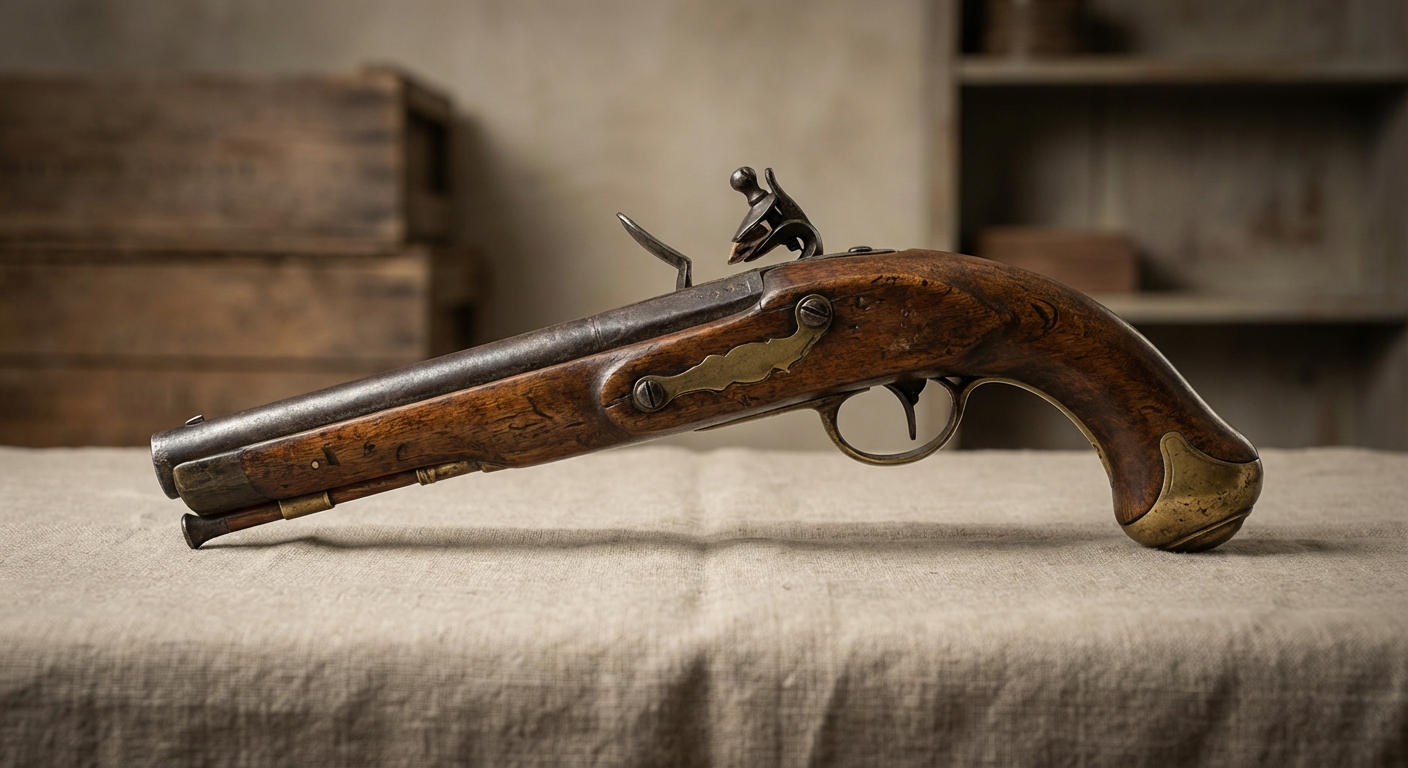
- Wood: Cracks at the wrist, repairs at the tang, replaced stocks, and sanded checkering matter.
- Mechanical integrity: Timing/lockup on revolvers, lock function on flint/percussion arms, and safety mechanisms.
- Parts correctness: Period-correct sights, ramrods, screws, and small components vs. modern replacements.
If you’re unsure whether a part is original, photograph it and disclose uncertainty rather than “cleaning it up.” Appraisers can often spot modern replacements from tooling marks, screw slots, and surface texture.
Rarity and demand: what actually moves the needle
Two guns can look similar and still belong to completely different markets. Value is driven by the intersection of (1) what survived, (2) what collectors want, and (3) what documentation supports.
- Variant and configuration: Caliber, barrel length, sights, engraving, and finish create sub-variants with different demand.
- Completeness: Cased sets, original tools, molds, and paperwork can add meaningful premiums.
- Provenance: Named ownership, military issue/bring-back stories (when documented), and collection pedigrees matter.
- Market cycles: Western-era arms, Civil War material, and European flintlocks rise and fall with collector trends.
If you can’t prove a story, treat it as “possible” rather than “certain.” Strong provenance is evidence-based, and the market prices it that way.
Provenance and legal considerations (general guidance)
This guide is not legal advice, but legal status can affect transferability and therefore market value. Even when a firearm qualifies as an “antique” in one place, state or country rules may still restrict sale, shipment, or export.
- Write down the story. Who owned it, where it lived, and any known dates/units. Photograph tags, letters, receipts, or old cases.
- Separate fact from family lore. A “bring-back” claim becomes valuable when it’s supported by paperwork, markings, or contemporaneous photos.
- Know the definition in your jurisdiction. In the U.S., federal antique firearm definitions often hinge on manufacture date (commonly 1898 or earlier) and ignition type; local rules may differ.
- Plan for shipping/export friction. Compliance complexity can reduce your buyer pool even when the item is historically important.
Comparable Research for Antique Firearms
Comparable sales are useful only when they match the firearm closely by maker, model, configuration, caliber, barrel length, finish, proof marks, condition, provenance, accessories, and legal transfer context. A rare documented example and a common altered example can sit in completely different markets even when the broad model name sounds similar.
Use multiple recent, verifiable sales to bracket a value opinion, then adjust for condition, originality, completeness, documentation, and venue. Avoid quoting isolated prices without source review and buyer-premium context.
Preservation tips that protect appraisal value
When it comes to antique guns, preservation usually beats restoration. Many changes that make a firearm look “better” (rebluing, polishing, sanding) remove originality that the market values and that appraisers use to confirm age.
- Stabilize, don’t scour. If there is active rust, use gentle, appropriate methods and stop once the surface is stable.
- Control humidity. Store around 40–55% relative humidity; avoid foam-lined cases that trap moisture against metal.
- Keep sets together. Original cases, tools, molds, and paperwork can materially affect value—store them as a unit.
- Don’t force stuck parts. Forcing a frozen screw or wedge can shear hardware and leave visible damage.
What to send an appraiser (photo + notes checklist)
Strong documentation is the fastest route to a confident identification and a defensible value range. Capture:
- Full-length left/right side photos in even light.
- Close-ups of all marks (barrel, lock plate, receiver ring/top strap, tang, cylinder, buttplate).
- Serial numbers and any matching-number locations.
- Condition shots: pitting, cracks/repairs, missing parts, and any evidence of refinish.
- Accessories: holster, case, tools, powder accessories, letters/receipts.
Add a short written note: where it came from, how long it’s been in the family, and any known repairs. Even partial provenance helps an expert place your piece in the right market tier.
References
- Bureau of Alcohol, Tobacco, Firearms and Explosives (ATF). "Definitions: Antique Firearm."
- Wikipedia. "Proof mark" (overview of proof systems and terminology).
- NRA Museums. Firearms history and collection resources.
- Rock Island Auction Company. Firearms auction archives and collecting primers.
- Wikipedia. "Flintlock" (mechanical overview for identification context).
Collector search variations we cover
These long-tail questions surface in appraisal requests and are addressed in the guide above.
- how to tell if a gun is pre-1899 (antique firearm) in the US
- where to find proof marks on old shotguns and rifles
- antique revolver appraisal: what matching numbers mean
- does refinishing an antique gun reduce collector value
- how to value a flintlock pistol with no maker mark
- Winchester 1866 value factors and provenance checks
- Colt percussion revolver appraisal checklist
- safe storage tips for antique firearms to prevent rust
- what photos an appraiser needs for antique gun valuation
Each phrase links back to identification steps, authentication workflows, and valuation benchmarks outlined above.
How We Research Valuation Data
Our appraisal guides are based on auction results, dealer pricing data, and professional appraiser insights. We may earn a commission when you use our free professional appraisal service. Learn about our editorial standards.