
Sterling Silver Value Guide Price Drivers Appraisal Clues and What Collectors Notice: appraisal and value basics
Sterling Silver Value Guide Price Drivers Appraisal Clues and What Collectors Notice research should start with identification, condition, provenance, and recent comparable sales. Use this guide to compare the signals that matter before paying for a formal appraisal or deciding whether to sell.
Collectors often say sterling silver is both simple and confusing to value. It looks straightforward if you only see the luster and the hallmarks, then suddenly difficult once maker name, restoration history, and completeness are layered into the picture. The practical method is to value by four lanes: legal sterling content, attribution quality, coherence of the set, and condition quality.
This guide keeps those lanes in focus. We start with what collectors evaluate first, then map what those signals usually mean for pricing, and finish with a practical valuation workflow for a tea service, flatware lot, tankard, or mixed silver group. If your item is unusual, the same method still works—you value the evidence, not the story alone.
Before you begin, treat auction context as your baseline. A recent comparable lot gives you confidence that your range is realistic, while a single online guess often leads to range errors of 2x to 10x.
What similar items actually sold for
To help ground this guide in real market activity, here are recent example auction comps from Appraisily’s internal database. These are educational comparables (not a guarantee of price for your specific item).
Shown USD range: USD 250-USD 350. Median of these 5 USD examples: USD 300.
| Image | Description | Auction house | Date | Lot | Reported price realized |
|---|---|---|---|---|---|
|
STERLING SILVER SPOONS & UTENSILS 330G | DejaVu Estate Sales & Auctions | 2026-02-23 | 589 | USD 300 |
|
ASSORTED STERLING SILVER UTENSILS 410G | DejaVu Estate Sales & Auctions | 2026-02-23 | 479A | USD 275 |
|
STERLING SILVER TEA STRAINERS & SPOONS 250g | DejaVu Estate Sales & Auctions | 2026-02-23 | 289 | USD 350 |
|
Six Serving Pieces in 800 Silver, 5 Utensils with 800/925 Handles and 5 Individual Tea Strainers in 925 Sterling | Goldberg Coins & Collectibles | 2025-10-21 | 1141 | USD 250 |
|
STERLING SILVER PIERCED PEDESTAL COMPOTE 310G | DejaVu Estate Sales & Auctions | 2026-02-23 | 410A | USD 325 |
Disclosure: prices are shown as reported by auction houses and are provided for appraisal context. Learn more in our editorial policy.
What collectors notice first in sterling silver
- Attribution certainty. A credible maker or pattern attribution usually carries the largest premium over anonymous yet similar-weight silver.
- Service coherence. Matching proportions, unified engraving style, and complete functional pieces indicate stronger desirability.
- Finish behavior. Buyers value honest age and reject uncertain repairs that change how the object will age in use.
- Material consistency. Mixed 800 and sterling pieces in one lot reduce comparability unless clearly documented as a period set.
- Documentation quality. Provenance, maker notes, and photos of marks usually improve trust and reduce appraisal drag.
If one line of the lot is uncertain, price that uncertainty explicitly. Overstated certainty is a frequent source of failed listing decisions.
Authentication and appraisal clues that change range quality
Hallmarks and legal indicators
- Identify mark families: record every mark, where possible, not just the one strongest mark.
- Check sequence and context: compare placement with period patterns; single isolated marks without context often deserve caution.
- Cross-check material claims: mark claims and visual behavior should agree; conflicting signals usually lower confidence.
- Document in clean, neutral photos: angled and edge lighting captures edge wear that straight shots miss.
Condition clues that alter value fast
When you price a silver set, avoid emotional adjectives and describe condition with appraisal language.
- Rim and foot wear: minor wear may be acceptable; severe edge loss generally reduces sale range.
- Repairs: solder seams and replacement pieces are normal in collectible objects, but value adjustments depend on visibility and reversibility.
- Disharmony in finishing: uneven gilding, repainting, or mismatched patina can lower confidence even when the item is attractive.
- Missing links: missing lids, replacements, or nonmatching components reduce premium potential quickly.
How to turn clues into a pricing framework
Use a three-band model to keep your final call realistic:
This method avoids anchoring on a single number. It also helps you decide quickly whether your piece is a “sell now,” “document,” or “repair first” case.
A practical rule: if two strong positive traits are missing, the likely value often sits in the lower band unless there is a compelling offset.
Step-by-step valuation workflow for your item
- Photograph everything. Include overall set photos, close-up marks, and underside details in side lighting.
- Document exact piece counts. A service that loses function or pattern continuity should be priced as such.
- Mark every issue by severity. Note chips, replacements, polishing evidence, and missing matching components.
- Group by maker and weight type. Separate true sterling portions from mixed or uncertain silver groups.
- Find matching comps. Use recent verified sales for each subgroup before building final guidance.
- Produce a defensible range. Give a lower, expected, and upside figure and label the confidence attached to each.
How one public case helps calibrate expectations
A recent public appraisal case describes a 1749 London-style sterling silver lidded tankard with a hinged lid and attributed maker context. The published notes point to generally good condition, light age-related wear, and maker-related context for market education.
This is a useful reminder: even with a strong style reference point, the final range is still driven by photographic evidence, wear pattern, and how directly comparable the current lot is.
Use public cases as educational context, not as a direct substitute for your own valuation.
Free instant estimate
Not sure if your item is worth appraising? Let us take a look.
Upload a photo, tell us what you know, and get a free first read. If a full appraisal makes sense, we will say so.
Free. No card needed. Takes about two minutes.
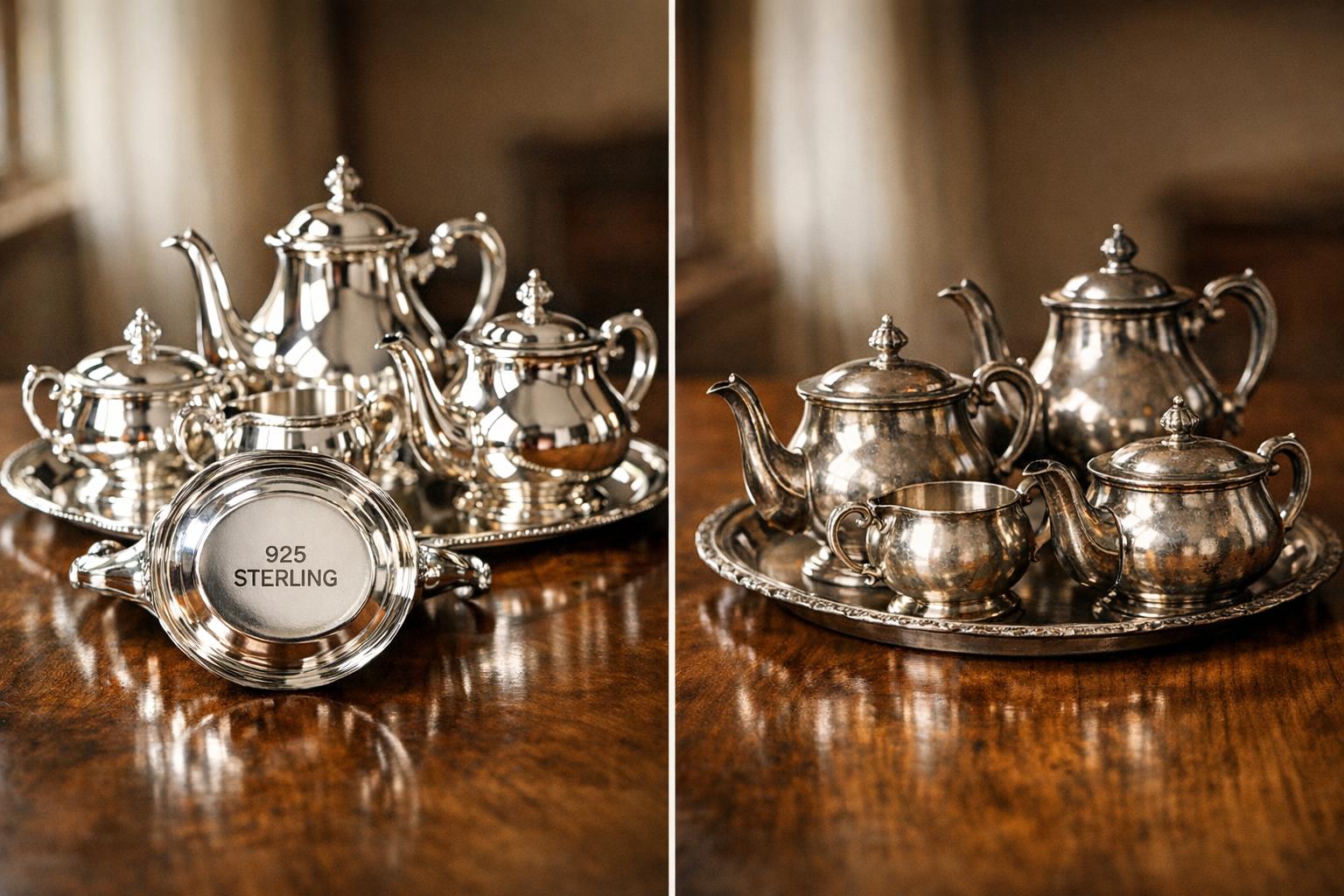
Feature gallery: what collectors inspect
Use this checklist when you photograph your silver for valuation.
Quick condition checklist before you finalize a number
- Confirm every piece matches pattern, maker, and period indicators.
- Photograph marks, rims, and underside in soft side light.
- Separate genuine wear from visible repairs and overcleaning.
- Separate true sterling portions from mixed-metal pieces.
- Only after this pass, compare to sale data and note where your evidence is weaker.
That sequence is often enough to avoid the most common overpricing mistakes.
Long-tail search variations
- How is sterling silver value calculated by piece count?
- What does a sterling hallmark mean for resale value?
- Do mixed silver and plated items reduce total value?
- How much does a repaired sterling tankard usually lose?
- What should I photograph before listing silverware for sale?
- How do buyers read authenticity in incomplete silver services?
- How wide can a realistic silver appraisal range be?
The core answer is the same: attribution, completeness, and condition quality determine where each lot lands, with auction comparables helping anchor the range.
References
- Appraisily internal auction-results comparison process for sterling silver lot examples gathered for this guide.
- Editorial methodology, including disclosure and valuation standards: /editorial-policy/.
- Recent market signals from auction listings and observed valuation behavior across silverware categories.