
Original Oil Painting vs Print How to Tell the Difference and Which Is Worth More: appraisal and value basics
Original Oil Painting vs Print How to Tell the Difference and Which Is Worth More research should start with identification, condition, provenance, and recent comparable sales. Use this guide to compare the signals that matter before paying for a formal appraisal or deciding whether to sell.
Quick Answer: The Core Difference
An original oil painting is a one-of-a-kind work created by applying oil paint directly to a support (canvas, panel, or board). Every brushstroke is unique, the surface has physical texture you can see and feel, and the piece carries the highest potential market value.
A print is a reproduction — the image of an original artwork is captured digitally or mechanically and reprinted onto canvas, paper, or another substrate. Even high-quality giclée prints lack the three-dimensional brushwork of the original and trade at a fraction of the price, typically 10× to 100× less for the same image.
The confusion is growing because modern pigment printers can produce reproductions so vivid and sharp that even experienced collectors need a flashlight and a 10× loupe to tell them apart. Below is the exact 5-step workflow professional appraisers use to make the call.
Original Oil Painting vs Print — At a Glance
Before diving into the identification steps, this table summarizes the key differences that affect both identification and value:
| Feature | Original Oil Painting | Print / Reproduction |
|---|---|---|
| Surface texture | Raised impasto; visible brushstroke ridges | Flat; smooth to the touch |
| Creation method | Hand-applied oil pigments on canvas or panel | Digitally or mechanically reproduced image |
| Uniqueness | One-of-a-kind | Multiple copies (open or limited edition) |
| Signature | Wet paint; raised; often on front or verso | Printed flat ink or pencil-signed on margin |
| Canvas edge | Paint wraps around stretcher bars | Clean white edge or printed border |
| Under magnification | Random pigment particles; no pattern | CMYK halftone dot grid or screen pattern |
| Value range | Hundreds to millions (artist-dependent) | $20–$500 for open editions; $200–$5,000+ for signed limited editions |
| Longevity | Centuries with proper care | 10–100 years depending on ink and paper quality |
5-Step Test: How to Tell an Original Oil Painting from a Print
Professional appraisers run through a quick sensory checklist. You can do the same at home with a desk lamp, a magnifying glass (10× or higher), and five minutes.
Step 1: Tilt & Observe Under Raking Light
Hold a lamp or flashlight at a shallow angle (10°–20°) across the painting's surface. This is called raking light, and it's the single fastest way to spot an original.
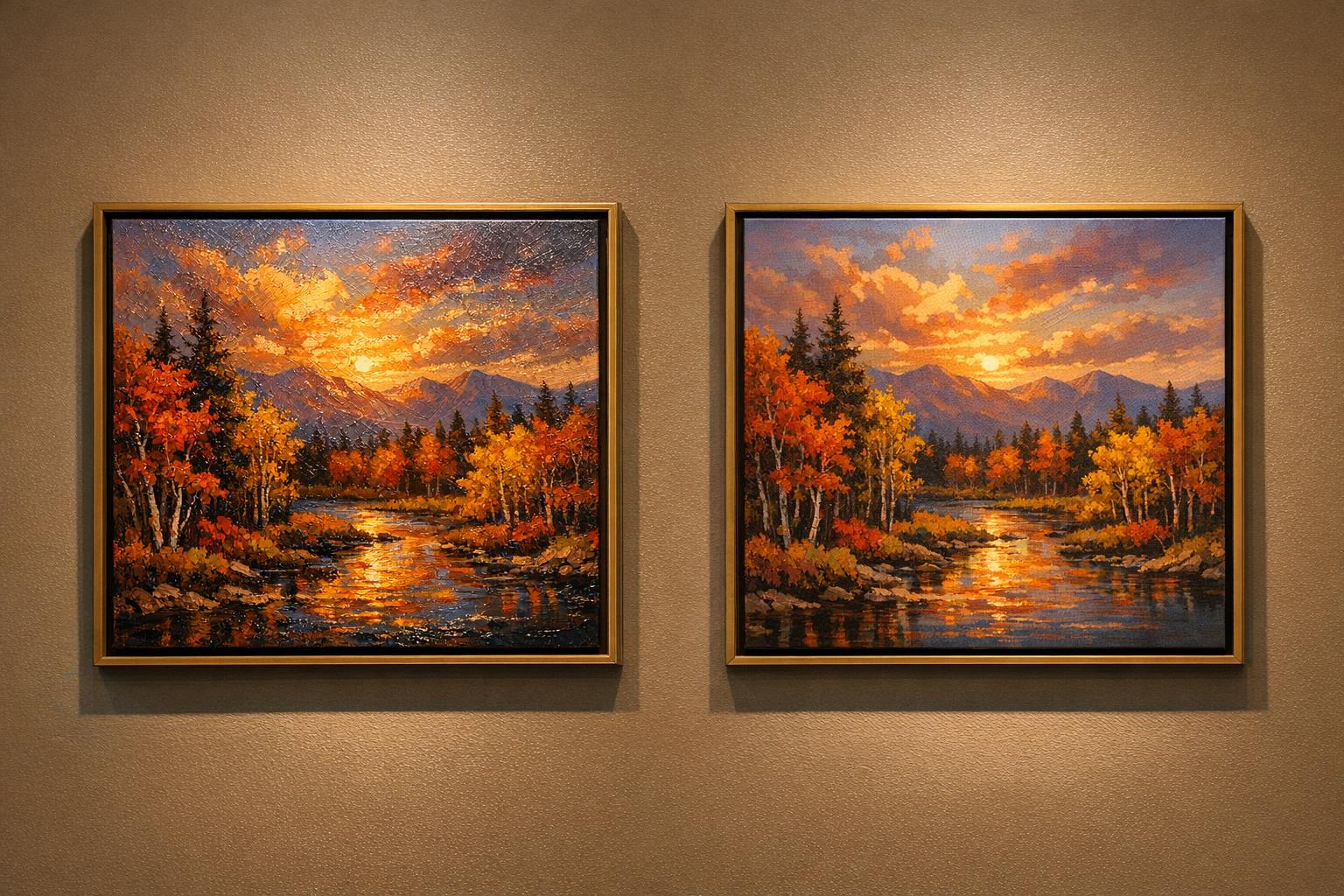
Original: You'll see tiny shadows cast by raised paint ridges. Impasto (thick paint applied with a brush or palette knife) creates a topography that catches light from certain angles and casts micro-shadows from others. Tilt the canvas and watch the highlights shift — that movement is impossible to reproduce on a flat print.
Print: The surface stays uniformly flat. Even the best giclée reproductions on textured canvas stock simulate brushwork with ink — the "texture" is a visual trick, not a physical one. Under raking light, nothing casts a shadow.
Step 2: Examine the Edges and Canvas Back
Remove the frame if possible and look at the canvas sides and back.
Original: Oil paint wraps over the front edge and onto the sides of the stretcher bars. The back shows raw canvas, wooden or aluminum stretcher bars, and often gallery labels, exhibition stickers, or handwritten notes from the artist. You may see paint drips or splatter on the reverse.
Print: Canvas prints typically have a clean white margin that wraps the edge, or the printed image continues uniformly. The back may show a printed barcode, manufacturer label, or a completely smooth, machine-finished surface. Many stretched canvas prints are mounted on thinner, lighter bars.
Step 3: Magnify the Surface
Use a jeweler's loupe (10× or higher) or a strong magnifying glass to examine a small area of the image — preferably a mid-tone section, not the darkest or lightest parts.
Original: You'll see random pigment particles, canvas weave, and possibly tiny air bubbles or brush hairs trapped in the paint. There is no repeating pattern — every square millimeter is organically unique.
Print: A grid of tiny colored dots appears. This is the CMYK halftone pattern — cyan, magenta, yellow, and black dots arranged in a rosette or line screen pattern. It's the smoking gun of digital reproduction. Even the best pigment printers cannot eliminate this pattern entirely; they can only make it small enough to escape casual notice.
Step 4: Check the Signature
Where and how the artist signed the work tells you a great deal.
Original: The signature is made with wet oil paint, so it sits slightly raised above the surrounding surface. It may be on the front lower corner, on the verso (back), or both. Under magnification, you can see the brush marks that formed each letter.
Print: If the signature is part of the printed image, it lies flat and will show the same halftone dots as the rest of the picture. A hand-signed print in pencil on the margin is a legitimate limited edition fine art print — valuable in its own right, but not an original oil painting. Look for edition notation like "23/250" (meaning print number 23 of a run of 250).
Step 5: Look for Edition Numbers or Publisher Marks
Fine art prints are often numbered and sometimes carry a publisher's chopmark, printer's proof designation, or bon à tirer (BAT) notation. If you see any edition notation — even "AP" for artist's proof — the work is a print, not an original.
Open-edition reproductions (posters, mass-market canvas prints) carry no numbering at all. These are the lowest-value tier and are sold as decorative art, not collectible fine art.
Visual Decision Tree
Save this flowchart for quick reference when evaluating a piece:
The Brushstroke Test — Why Texture Matters Most
Of all the identification methods, surface texture is the most reliable single indicator. Here's why:
Oil paint is a viscous mixture of pigment suspended in drying oil (usually linseed). When an artist applies it with a brush, knife, or rag, the material builds up in layers that remain physically raised after curing. This is called impasto. The thickness varies with the artist's technique — some apply paint thinly (a glaze), while others build it up millimeters thick.
No commercial printer — not even the most advanced giclée system with white-ink texture passes — can reproduce the organic, unpredictable topography of hand-applied oil paint. The closest technology (3D varnish overlays on flat prints) produces a regular, repeating pattern rather than the chaotic, varied surface of a genuine painting.
The Grey Area: Hand-Embellished Prints
One of the most common sources of confusion is the hand-embellished print — a printed reproduction that the artist (or studio assistant) has partially painted over by hand. These pieces blur the line between original and print:
- The base is a print — the underlying image is mechanically reproduced.
- The embellishments are real paint — acrylic or oil applied by hand on top of the print to add texture and highlight details.
- Value sits in between — more than a bare print, far less than a full original. Prices range from $100 to $2,000+ depending on the extent of handwork, the artist's reputation, and the edition size.
How to spot one: Under raking light, you'll see some raised texture — but it's localized (only on highlighted areas like flower petals, jewelry, or signature details) while the rest of the surface is flat. Under magnification, the un-embellished areas show the CMYK dot grid. The artist may sign the piece in paint over the embellished area, but the signature won't match the original's placement or style.
If you own or are considering a hand-embellished piece, the safest approach is to disclose both the printed base and the hand-applied paint when seeking an appraisal, insurance valuation, or resale listing.
How Much More Is an Original Oil Painting Worth?
The value gap between originals and prints is the single largest spread in the art market. Here's how it breaks down in practice.
Original Oil Paintings: Highest Value Tier
Originals command the highest prices because they are unique, irreplaceable, and carry the artist's direct hand. Auction results consistently show originals selling for 10× to 100× (or more) than prints of the same image by the same artist. Key value drivers include:
- Artist reputation: A confirmed original by a listed artist can range from hundreds to millions. Unattributed works still carry intrinsic material and craftsmanship value.
- Provenance: Documented ownership history, exhibition records, and gallery representation multiply value.
- Condition: Craquelure (age cracking), yellowed varnish, and restoration history all affect price. A well-preserved original with original varnish commands significantly more than one with heavy overpainting.
- Size and medium: Large-scale oils on canvas generally outvalue small studies on board, but an extraordinary miniature can outperform a mediocre large work.
Limited Edition Prints: Mid-Tier Value
Signed, numbered limited edition prints — especially giclées on archival paper or canvas — hold real value, but it's categorically different from an original:
- Edition size matters: A print numbered 5/25 is worth more than 200/500 from the same edition. Lower numbers don't intrinsically carry more value, but scarcity does.
- Artist signature: A genuine hand-signed print (not a printed facsimile signature) carries a 20–50% premium over unsigned copies.
- Printer quality: Archival pigment prints on Hahnemühle or similar papers hold value better than open-edition posters on coated stock.
- Price range: Typically $200–$5,000 for recognized artists; unknown artists' prints may sell for $20–$200 at auction.
Open-Edition Reproductions: Lowest Value Tier
Posters, mass-market canvas prints, and decorative reproductions are produced without edition limits and carry minimal collectible value. They are priced as home décor, not fine art — typically $10–$150 new, and often less on the secondary market.
Market context: In recent Appraisily-auctioned lots, confirmed original oil paintings by listed regional artists have realized prices 30× to 80× higher than printed reproductions of comparable subject matter. The distinction isn't academic — it's the difference between a $30 thrift-store purchase and a $2,400 find.
Note: We couldn’t find enough auction records that directly match Original Oil Painting vs Print: Surface, Back and Value to publish a defensible price table. If you are valuing a specific item, include its maker, model, material, photos, and condition so the search can be narrowed.
What similar items actually sold for
The current auction search does not contain at least three clean, directly matched sales for Original Oil Painting vs Print: Surface, Back and Value yet. If you’re valuing a specific item, use the free estimate flow so the search can be narrowed by maker, material, photos, and condition.
| Image | Description | Auction house | Date | Lot | Reported price realized |
|---|---|---|---|---|---|
| No relevant auction comps found for this topic right now. | |||||
Disclosure: prices are shown as reported by auction houses and are provided for appraisal context. Learn more in our editorial policy.
What Actually Changes Value — Beyond Original vs. Print
Once you've confirmed whether you have an original or a print, these factors determine the actual dollar value:
| Value Driver | Impact on Originals | Impact on Prints |
|---|---|---|
| Artist attribution | Massive — listed artists command 5–100× unattributed works | Moderate — signed prints carry 20–50% premium |
| Condition | Major — restoration, craquelure, and varnish state directly affect price | Moderate — fading, foxing, and edge damage matter |
| Provenance | Critical — documented history can double or triple value | Minor — edition certificate helps marginally |
| Size | Significant — large oils generally command more | Minor — print size has limited effect on value |
| Market demand | High — subject matter trends (landscapes, portraits, abstract) shift prices | Low — decorative prints follow interior design trends |
When to Find out if it is a painting or print
Not every piece needs a formal appraisal. Here's when it's worth the investment:
- Insurance coverage: You need a documented replacement value (not auction fair market value) for your homeowner's or renter's policy. Only an original oil painting justifies a high scheduled-art endorsement.
- Charitable donation: The IRS requires a qualified appraisal for non-cash contributions exceeding $5,000. An original painting and a print of the same image will appraise for dramatically different amounts.
- Estate settlement: Executors need accurate fair market valuations for estate tax purposes. Misidentifying an original as a print (or vice versa) can lead to significant tax errors.
- Potential sale: If you believe you may have an original by a listed artist, a pre-sale appraisal tells you whether to approach an auction house, gallery, or private dealer — and what reserve to expect.
- You simply don't know: If the identification steps above leave you uncertain (e.g., the piece has some texture but also a dot pattern under magnification), a professional appraisal with UV fluorescence and microscopy analysis resolves the question definitively.
Start your appraisal to share photos and details with a vetted specialist. Expect a written assessment and quote within 24 hours.
Caring for Originals vs. Prints
The maintenance requirements differ significantly between the two types:
- Original oil paintings should be kept away from direct sunlight and high humidity. Varnish should be inspected every 5–10 years and professionally cleaned or re-applied when yellowed. Store and hang with adequate spacing from walls to allow air circulation.
- Archival prints on pigment-based inks last 50–100+ years under proper conditions but are more susceptible to UV fading than oil pigments. Frame behind UV-filtering acrylic or glass. Avoid laminating fine art prints — it permanently reduces value.
- Open-edition posters are generally not worth professional conservation. Store flat in acid-free sleeves if you wish to preserve them.