Old Watches Value: appraisal and value basics
Old Watches Value research should start with identification, condition, provenance, and recent comparable sales. Use this guide to compare the signals that matter before paying for a formal appraisal or deciding whether to sell.
The world of vintage watches offers both horological fascination and significant investment potential. Whether you’ve inherited an old timepiece, discovered one at an estate sale, or are considering starting a collection, understanding the value of vintage watches is essential. Not all old timepieces are created equal, and determining their worth involves examining numerous factors that can dramatically affect their market value.
In this comprehensive guide, we’ll explore what makes vintage watches valuable, how to identify potential treasures, and the steps to determine an accurate valuation for your timepieces. From luxury brands like Rolex and Patek Philippe to more accessible collectibles, we’ll cover the spectrum of the vintage watch market.
What Makes a Vintage Watch Valuable?
Key Value Factors for Old Timepieces
Brand Prestige and Heritage
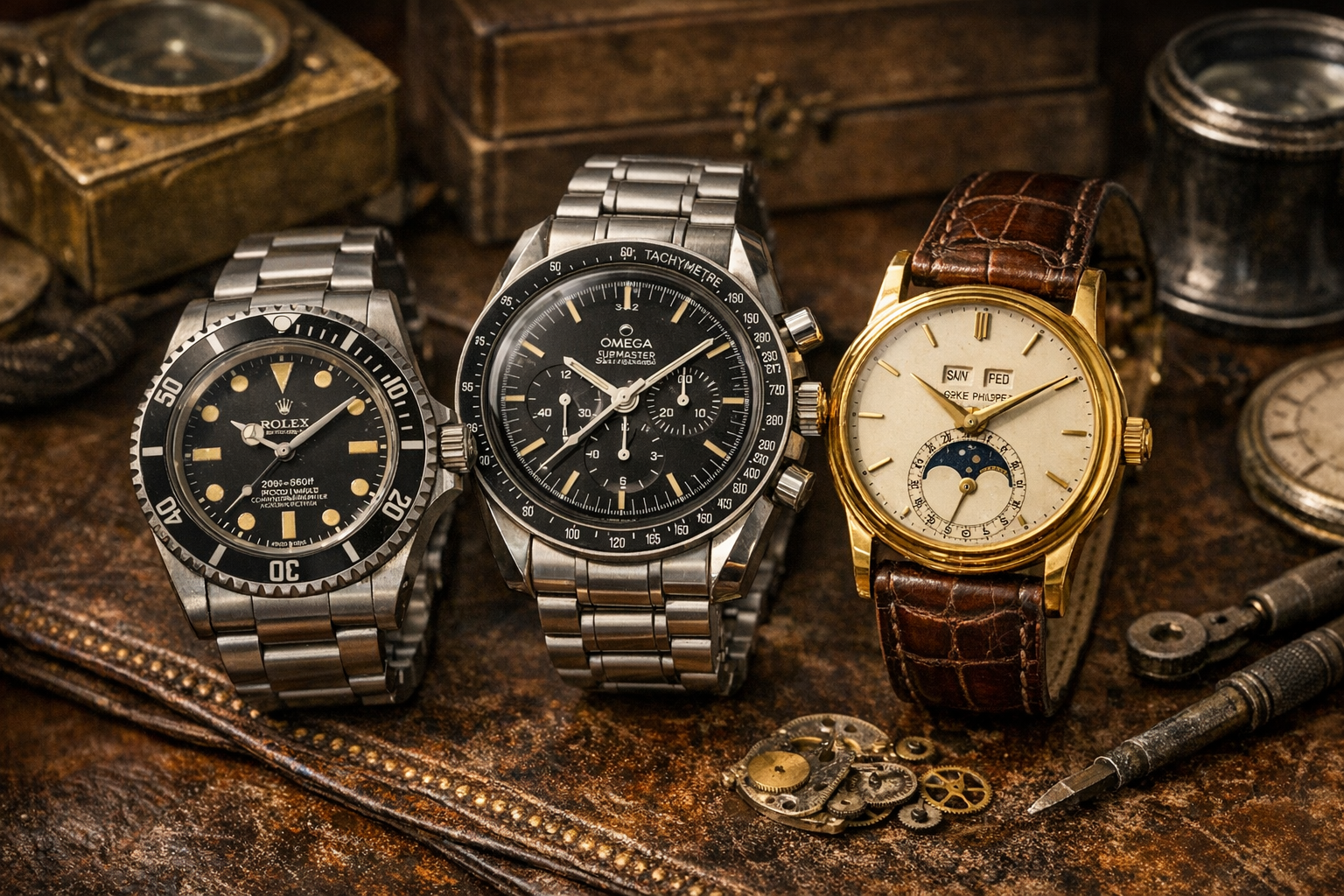
The manufacturer’s reputation plays a crucial role in determining a vintage watch’s value. Prestigious Swiss brands like Patek Philippe, Rolex, Audemars Piguet, and Vacheron Constantin consistently command the highest prices due to their long-standing heritage of exceptional craftsmanship and innovation.
Be particularly cautious about:
- Refinished dials (can decrease value by 50% or more)
- Replacement hands that don’t match the period
- Excessive case polishing that removes original lines and details
- Non-original crowns, crystals, or bracelets
- Service replacement parts instead of period-correct components
Factor in Documentation and Accessories
The “full set” premium is substantial in vintage watch valuation:
- Original box: Adds 10-15% to value
- Original papers/guarantee: Adds 15-20% to value
- Complete set with box, papers, tags, etc.: Adds 25-30% to value
- Service history documentation: Adds 5-10% to value
- Original receipts or historical provenance: Can add 10-50%+ depending on significance
Recent Auction Results for Vintage Watches
| Category | Price | Notes |
|---|---|---|
| Luxury Tier | $5,000 - $500,000+ | Highest investment potential |
| Premium Tier | $2,000 - $50,000 | Strong collector interest |
| Value Tier | $500 - $10,000 | Excellent entry points |
| Mass Market | $100 - $1,000 | Mostly sentimental value |
| Mint Condition | 100% of Market Value | Like new with all original parts |
| Excellent Condition | 80-90% of Market Value | Minor wear consistent with age |
| Good Condition | 60-70% of Market Value | Noticeable wear but fully functional |
| Fair Condition | 30-50% of Market Value | Significant wear or non-original parts |
| Poor Condition | 10-25% of Market Value | Major issues or not functioning |
</tbody> </table>
Maintaining and Increasing Your Watch’s Value
Care and Investment Strategies
Proper Storage and Care
Proper storage is essential for maintaining condition:
Watch boxes or cases: Store watches in dedicated boxes that protect from dust and damage.
Watch winders: For automatic watches, consider using watch winders to keep them running properly.
Climate control: Avoid extreme temperatures and humidity, which can damage movements and dials.
Regular winding: Even when not worn, mechanical watches should be wound periodically to keep the oils distributed.
Avoid magnets: Keep vintage watches away from strong magnetic fields, which can affect accuracy.
Professional Servicing
Regular maintenance by qualified professionals is crucial:
Service intervals: Most vintage watches should be serviced every 5-7 years, even if they appear to be running correctly.
Specialist selection: Use watchmakers experienced with your specific brand and model, preferably with vintage expertise.
Service records: Maintain documentation of all services performed, which adds value when selling.
Original parts: Request that original parts be returned to you when replaced during servicing.
Conservative approach: Request minimal cosmetic intervention—avoid dial refinishing, case polishing, or non-essential parts replacement.
A common mistake is sending vintage watches to the original manufacturer for service, as they often replace parts with modern equivalents, potentially decreasing collector value. Instead, seek independent specialists known for preservation-minded approaches.
Documentation and Provenance
Enhance your watch’s provenance whenever possible:
Collect documentation: Original purchase receipts, service records, warranty cards, and instruction manuals all add value.
Archive extracts: Some manufacturers like Patek Philippe and Omega offer heritage certificates confirming production details.
Previous ownership: If your watch has an interesting history or previous notable owner, document this information.
Original photography: If available, collect period photos or advertisements featuring your watch model.
Keep the box: Original packaging is highly valued by collectors.
Market Awareness and Timing
Understanding market trends can help maximize value:
Follow auction results: Major watch auctions provide insight into market direction and collector preferences.
Join collector communities: Forums and social media groups offer valuable market intelligence.
Watch brand anniversaries: Values often increase around significant brand or model anniversaries.
Limited editions: Limited production watches generally appreciate faster than standard models.
Condition premiums: The gap between average and exceptional examples continues to widen, making preservation increasingly important.
Where to Sell Vintage Watches for Maximum Value
Selling Options and Considerations
Auction Houses
Advantages:
- Access to serious collectors and investors
- Professional authentication and documentation
- Marketing to targeted audiences
- Potential for bidding wars on desirable pieces
Considerations:
- Commission fees typically range from 10-25%
- May not accept lower-value watches
- Sales occur on the auction house’s timeline
- No guaranteed sale price
Major watch auction specialists include Phillips, Christie’s, Sotheby’s, Antiquorum, and Bonhams.
Specialty Watch Retailers
Advantages:
- Expert knowledge of the product
- Established customer base of watch collectors
- Ability to display watches in person
- May offer consignment options
Considerations:
- Typically offer 60-70% of expected retail price when buying outright
- Consignment fees can range from 15-30%
- May be selective about brands and models they accept
Notable specialist retailers include Hodinkee Shop, Bob’s Watches, Crown & Caliber, and Analog Shift.
Online Marketplaces
Advantages:
- Direct access to global buyers
- Lower commission fees than traditional channels
- Immediate listing and potentially faster sales
- Control over pricing and sale terms
Considerations:
- Requires self-marketing and photography skills
- Potential for fraudulent buyers
- Responsibility for shipping and insurance logistics
- Competitive marketplace with many listings
Popular platforms include Chrono24, eBay, WatchBox, and dedicated watch forums with sales sections.
Private Sales
Advantages:
- No commission fees
- Direct negotiation with buyers
- Potential for building collector relationships
- Maximum control over the transaction
Considerations:
- Requires network of contacts or marketing effort
- Responsibility for authentication and valuation
- Managing payment security and shipping logistics
- Potentially longer timeframe to find the right buyer
Private sales can be facilitated through watch collector groups, social media, or word-of-mouth.
Vintage Watch Valuation Resources
Chrono24 Watch Valuation Tool
Free online valuation tool that uses current market data to estimate your watch's value based on model, condition, and accessories.
WatchCharts Market Price Database
Comprehensive database tracking 27,530+ watches on the secondary market with price histories and trends.
myGemma Vintage Watch Value Guide
Detailed guide to understanding factors affecting vintage watch values and market trends.
Vintage Gold Watches Collector's Guide
Expert analysis of which vintage watch brands have the best collection and investment potential.
The 1916 Company Watch Valuation Guide
Comprehensive guide to determining watch values including serial number lookup methods.
Dawsons Auctioneers Vintage Watch Article
Professional auctioneer's perspective on vintage watch valuation and market trends.
Common Pitfalls to Avoid
Watch Valuation Mistakes
Overvaluing Based on Emotional Attachment
Many inherited or gifted watches carry significant sentimental value that doesn’t translate to market value. While a watch may be priceless to you personally, its market value depends on objective factors like brand, model, condition, and demand.
Misidentifying the Model or Period
Minor variations in dial text, case size, or movement caliber can mean substantial differences in value. For example, a Rolex Submariner with a “meters first” dial might be worth twice as much as an otherwise identical model with a “feet first” dial. Research your specific reference number and variation thoroughly.
Overestimating Condition
Be honest about your watch’s condition. What appears “excellent” to an untrained eye might only be “good” or even “fair” to a collector who notices refinished dials, replacement hands, or excessive case polishing. When in doubt, get a professional assessment.
Neglecting Authentication
The vintage watch market is unfortunately plagued with counterfeits, “Franken-watches” (pieces assembled from various watches), and watches with unauthorized replacement parts. Without proper authentication, you risk both overvaluing a problematic watch and potential legal issues if selling it.
Undervaluing Rare Variations
Sometimes small details can dramatically increase value. Special dials (like “tropical” dials that have changed color over time), military provenance, retailer signatures (like Tiffany & Co.), or unusual features can significantly enhance worth to collectors.
Inappropriate Restoration
Well-intentioned servicing or restoration can dramatically decrease value if not done appropriately for vintage pieces. Common value-diminishing mistakes include:
- Dial refinishing
- Case polishing that removes original edges and details
- Replacement of original parts with modern equivalents
- Using non-period-correct replacement parts
Ignoring Market Timing
Watch values fluctuate based on market trends, collector interests, and broader economic conditions. Values for certain styles or brands can increase or decrease significantly over time. For maximum value, stay aware of current market conditions before selling.
Vintage Watch Investment Outlook
Future Value Considerations
Current Market Trends
The vintage watch market has seen significant growth over the past decade, with several notable trends:
Condition premium: The gap between average examples and exceptional examples continues to widen, with pristine, original condition watches commanding increasingly substantial premiums.
Sports models dominance: Vintage sports watches—particularly from Rolex, Omega, and Heuer—have seen the strongest appreciation, outpacing dress watches from the same periods.
Size preferences: After a period of favoring larger modern watches, the market has embraced more modest vintage sizes, with 36-39mm watches seeing renewed interest.
Documentation value: “Full set” watches with original boxes, papers, and accessories command increasingly substantial premiums over naked watches.
Brand diversification: While Rolex and Patek Philippe continue to lead the market, collectors are expanding into previously overlooked quality brands like Universal Genève, Longines, and Zenith.
Investment Considerations
For those approaching vintage watches as investments:
Liquidity: Vintage watches can be relatively illiquid compared to other investments, with sales potentially taking weeks or months in non-auction settings.
Carrying costs: Consider the cost of proper storage, insurance, and periodic servicing when calculating investment returns.
Authentication concerns: As values rise, so does the sophistication of counterfeits, making expert authentication increasingly important.
Condition stability: Vintage watches require careful handling and appropriate storage to maintain their condition and value.
Market knowledge: Successful watch investing requires substantial knowledge or trusted expert guidance.
Collector vs. Investor Approach
Many of the most financially successful watch collectors focus first on purchasing pieces they genuinely appreciate rather than solely on investment potential. This approach often leads to:
- Better understanding of subtle quality differences
- More patience in finding exemplary examples
- Greater willingness to hold through market fluctuations
- More enjoyment of the collection regardless of financial outcomes
- Better connections within collector communities, leading to access to rare pieces
Common Questions About Vintage Watch Values
How do I find the value of an old watch?
- Identify the maker, model, and if possible, the reference/serial numbers
- Research recent sale prices for similar watches on platforms like Chrono24, WatchCharts, or auction results
- Assess the condition honestly, noting any damage, wear, or non-original parts
- Check if you have original packaging, papers, or receipts, which can add 20-30% to value
- For valuable pieces, consider a professional appraisal from a vintage watch specialist
Are older watches worth anything?
- Brand (premium makers like Rolex, Patek Philippe, and Omega command higher prices)
- Model (certain models like the Rolex Daytona or Omega Speedmaster are particularly collectible)
- Condition (original, unrestored watches in good working order are most valuable)
- Rarity (limited production models or those with unusual features)
- Provenance (documented history, especially if associated with notable people or events)
What old watch brands are worth money?
Top Tier:
- Patek Philippe
- Rolex
- Audemars Piguet
- Vacheron Constantin
High Value:
- Omega
- Cartier
- Jaeger-LeCoultre
- Heuer (pre-TAG)
- Breitling
- IWC
Growing Interest:
- Tudor
- Longines
- Universal Genève
- Zenith
- Movado (vintage chronographs)
What should I do with old watches?
-
Have them appraised: Before making any decisions, determine if they have value by consulting a watch specialist.
-
Restore and wear them: Many vintage watches can be serviced and returned to working condition for personal enjoyment.
-
Sell them: If valuable, you can sell through auction houses, specialty retailers, online platforms, or directly to collectors.
-
Keep as heirlooms: Watches make meaningful family heirlooms that can be passed down through generations.
-
Donate them: Some organizations accept watch donations for charity auctions or to provide timepieces to those in need.
-
Repurpose components: Non-valuable watches can have their components repurposed for craft projects or jewelry making.
How much does it cost to repair a vintage watch?
- Complexity of the movement (more complications = higher cost)
- Availability of parts (rare or discontinued parts can be expensive)
- Extent of damage or wear
- Brand (luxury brands typically cost more to service)
Typical cost ranges:
- Basic service for simple vintage movement: $200-400
- Complete overhaul of chronograph or complicated movement: $500-1,500
- Repair requiring custom or hard-to-find parts: $600-2,500+
- Case restoration or refinishing: $150-500
- Crystal replacement: $50-300 depending on material and shape
Does polishing a vintage watch decrease its value?
- Polishing removes a thin layer of metal, altering the original case lines and proportions
- It eliminates the patina that collectors prize as evidence of authenticity and history
- Sharp edges and facets become rounded, changing the original design aesthetic
- Repeated polishing can eventually alter case dimensions and remove hallmarks
For highly collectible watches, aggressive polishing can reduce value by 20-40%. Collectors generally prefer watches with original finish showing appropriate age-related wear over those that have been polished to look "like new."
If servicing is necessary, explicitly instruct watchmakers not to polish the case, or to do only the lightest possible cleaning if absolutely necessary.Are vintage gold watches worth more than the gold value?
However, for damaged, non-functional, or non-collectible gold watches, the gold value may indeed be their primary worth. Solid gold cases from the early to mid-20th century are typically 14k or 18k gold and can contain significant precious metal value.
Before considering scrapping any gold watch:
- Have it examined by a watch specialist, not just a jeweler
- Research the specific model to check collector interest
- Consider that even if the movement is damaged, the case alone might have value to restorers
How can I tell if my old watch is valuable?
Brand Indicators:
- Prestigious manufacturer name on the dial (Rolex, Omega, Patek Philippe, etc.)
- Quality of dial printing and overall finishing
- Solid gold, platinum or high-quality stainless steel case
Technical Indicators:
- Mechanical movement rather than quartz (generally)
- Presence of complications (chronograph, calendar, moon phase)
- High jewel count in the movement (17 jewels or higher)
Condition Factors:
- All original parts (not a mix from different watches)
- Working condition or easily repairable
- Original dial without refinishing
Documentation:
- Original box and papers
- Service records or purchase receipts
- Any connection to historical events or notable previous owners
Conclusion
The world of vintage watches offers a fascinating intersection of craftsmanship, history, and investment potential. While determining the value of old timepieces involves numerous factors—from brand prestige and model rarity to condition and provenance—understanding these elements can help you make informed decisions whether you’re buying, selling, or preserving watches.
Remember that the most successful collectors typically focus first on quality and personal appreciation rather than solely on investment potential. By developing knowledge and working with reputable specialists, you can navigate the vintage watch market with confidence.
Whether you’ve inherited a timepiece with family history, discovered a potential treasure at an estate sale, or are deliberately building a collection, taking the time to properly authenticate, maintain, and document your watches will maximize both their enjoyment value and their market worth.
The vintage watch market continues to evolve, with collector preferences shifting over time. However, exceptional examples of historically significant watches from prestigious manufacturers have shown remarkable staying power as both objects of desire and stores of value, suggesting that quality timepieces will continue to be treasured for generations to come.
Choose your next step
Use the path that matches the decision you need to make about the item.
Need a signed report?
Use this for insurance, estate, donation, resale, or documented value decisions.
Start a signed reportNot sure it is worth appraising?
Start with a lower-friction screen to understand the likely category, evidence, and next step.
Use the free screenerNeed local or specialist help?
Compare directory options when the work needs in-person review or a specialist near you.
Find local specialistsSee what the report looks like
Sample reports show how photos, comparable evidence, condition notes, and a value conclusion are documented.
Get these old watches appraised
Upload photos of the dial, caseback, crown, lugs, bracelet, movement if safely visible, serial or reference numbers, box, papers, service records, wear, and condition.
- Expert report with photos and comps
- Fast turnaround
- Fixed, upfront pricing
No obligation. Secure upload.
Continue your valuation journey
Choose the next best step after reading this guide
Our directories connect thousands of readers with the right appraiser every month. Pick the experience that fits your item.
Antique specialists
Browse the Antique Appraiser Directory
Search 300+ vetted experts by location, specialty, and response time. Perfect for heirlooms, Americana, and estate items.
Modern & fine art
Browse the Art Appraisers Directory
Compare fine art, contemporary, and design appraisers by city and specialty in our public directory.
Machine-readable summaries
Use these machine-friendly references for AI and crawler discovery of Appraisily content.
Ready for pricing guidance?
Start a secure online appraisal
Upload images and details. Certified specialists respond within 24 hours.
Start watch appraisal